THE SHORT ANSWER
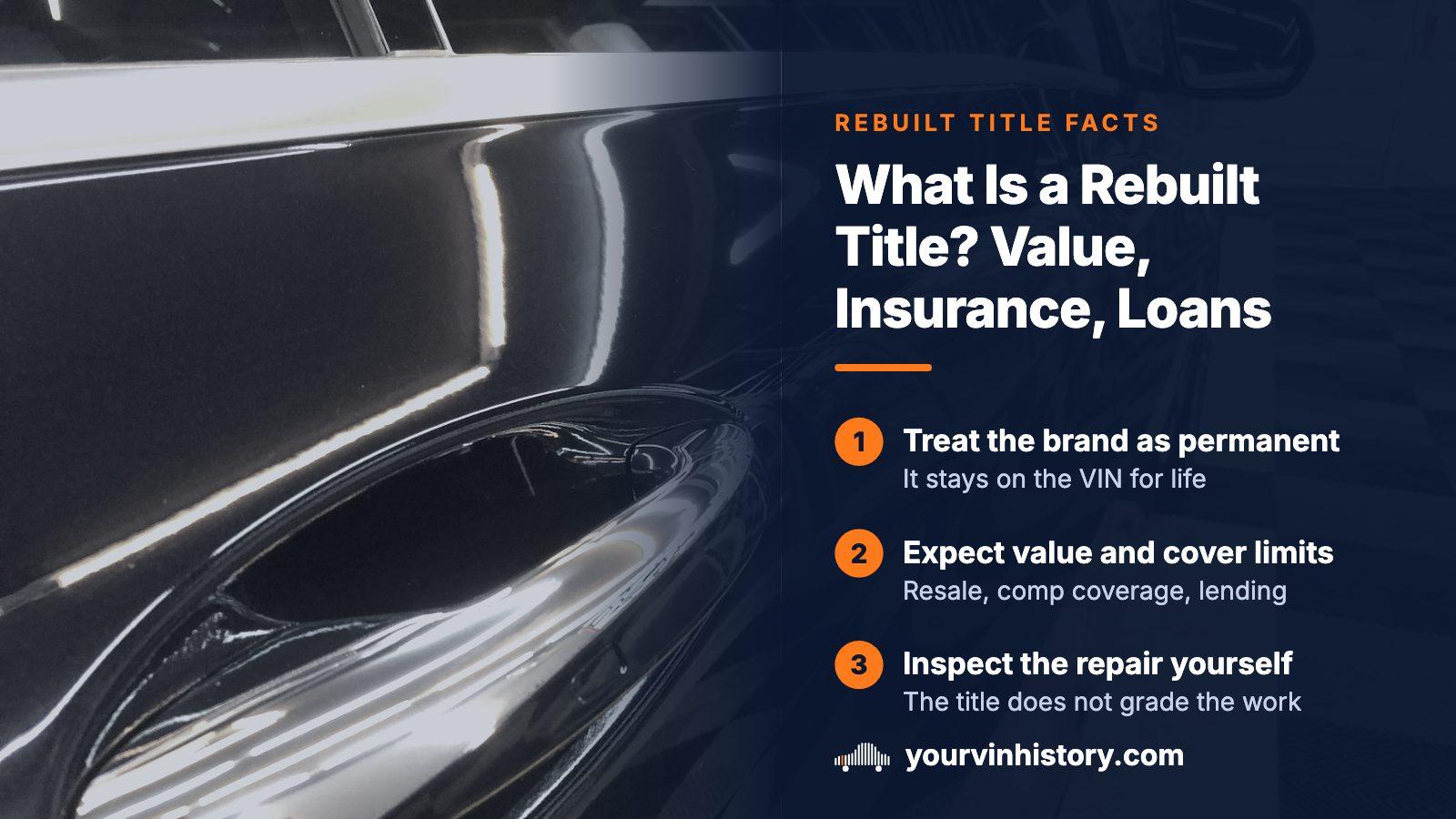
A rebuilt title says a car was declared a total loss, repaired, and then passed a state inspection so it can be registered again. It is legal to drive and sell, but the brand is permanent. Expect a lower resale value, trouble getting collision and comp coverage, and few lenders willing to finance it. The title does not grade the repair, so an independent inspection is the only way to judge the work.
- Brand lifespan
- Stays on the VIN for the life of the car
- Federal reporting
- States send titling data to NMVTIS every 24 hours, brands included
- Usual value gap
- Often quoted at 20 to 40 percent below a clean-title twin
- Easy part of insurance
- Liability; the hard part is cover for your own car
From wreck to road: how a car earns the brand
Every rebuilt title starts as a salvage record. Federal rules call a vehicle salvage when its salvage value plus the cost of making it roadworthy would top its worth just before the damage. A car also qualifies when its insurer declares it a total loss, even if the owner keeps it.
- A crash, fire, flood or theft leaves damage that costs more to fix than the car is worth.
- The insurer or state declares a total loss and brands the title salvage. Such a car generally cannot be registered or driven on public roads.
- A buyer, often an auction bidder, repairs the wreck.
- The state inspects the finished car and, if it passes, issues a rebuilt title.
Each state sets its own trigger for step two, using a share of pre-loss value or a formula. A modest crash can total an older car while identical damage on a newer one is repaired and keeps a clean title.
What the label says, and what it leaves out
Think of the brand as a bookmark in the paperwork. It shows the car was written off, repaired by someone and released by an inspector. It is silent on who did the repair, what parts went in, and whether the structure was restored to factory dimensions.
The inspection itself is mostly an identity check. In many states the examiner confirms the VIN plates are original, asks for receipts showing where major parts came from, and tests basic safety equipment. It began as a way to stop thieves pairing a stolen car with a wreck's papers. Frame measurement and weld judging usually fall outside it.
| Label | Usual signal |
|---|---|
| Salvage | Written off, not yet cleared for registration |
| Rebuilt, reconstructed, revived salvage, prior salvage | Written off, repaired and cleared; each state picks its wording |
| Junk or nonrepairable | Parts or scrap only |
| Flood | Water damage, often the reason behind a salvage brand |
Treat reconstructed as the same caution as rebuilt. Federal definitions center on salvage and junk automobiles, and the wording for a repaired car comes from state law, so the label mostly reveals who issued the title.
Why moving to another state does not clear it
The brand is designed to travel. Under the Justice Department's NMVTIS regulation, every state must transmit its titling information to the national system once every 24 hours, with every brand on the certificate of title. A brand added in one state therefore sits in a record the next state can consult before issuing a title.
Insurers, salvage yards and junk yards report into the same system, and a total loss counts whether or not the owner surrenders the car. A loss can be on record before any new title exists.
Timing is the gap. A very new brand may not have reached the national record, so check again just before you pay. Typical signs of title washing: hops between states within weeks with no change of owner, a title issued far from where the car is sold, and a seller who shows a report screenshot rather than the VIN.
Value: the discount you get is the discount you pass on
Expect a rebuilt car to sell for roughly 20 to 40 percent under a similar clean-title one. That range is a market rule of thumb, not an official number, and it widens on popular models where clean examples are easy to find.
The saving is borrowed. Whoever buys from you will haggle for the same cut you got, so you pocket the discount on the way in and surrender it on the way out. The math works if you keep the car for years, or never sell it.
Trade-ins expose the problem fastest. Branded stock is slow to sell, so dealers bid low, and some franchise stores pass such cars to a wholesale auction. Instead of trusting a seller's percentage, line up current listings of clean cars with the same year, trim and mileage, and subtract a discount you can defend.
Insurance: liability is easy, covering your own car is the question
A policy has two halves, and the brand treats them differently.
| Coverage | Effect of the brand |
|---|---|
| Liability, which covers harm you cause to other people | Normally available, since drivers must carry it and insurers sell it |
| Collision and comp, which cover your own car | Where insurers balk, because they must put a number on a car whose worth is disputed |
The sticking point is valuation, not crash risk. A physical damage payout follows what the car was worth just before the loss, and a rebuilt car was worth less than its clean twin that morning. Total it a second time and the check reflects branded value, which still beats nothing.
Terms differ by carrier and state and shift over time, so no guide can quote a premium. Phone your insurer with the VIN before buying and ask:
- Do you offer liability on this VIN, and collision and comp as well?
- How is the car valued when a claim is paid, and does the brand lower the settlement?
- Do deductibles or limits differ from an unbranded car?
- Is an agreed-value policy available, and what does it require?
- Can you confirm this in writing, with a date and a name?
Financing: the car is the lender's collateral
The car is the lender's only security, and a branded one is worth less and is harder to sell if the borrower defaults. Big mainstream lenders therefore mostly decline. Some credit unions bend more readily for members with good credit, and specialty lenders will lend at steeper rates.
Many buyers end up paying cash, so build that into your plan, and be skeptical of a seller advertising easy financing on a branded car. Ask your own bank or credit union for a written answer before you shop. Lender and insurer each hold a veto, so settle both before leaving a deposit.
Find out what actually damaged it
A hailstorm and a side-impact crash can leave the same title, and the risks are nothing alike. The cause is not printed on the title, so dig for it in the car's insurance and auction records and in the seller's repair file.
| Original cause | What to check |
|---|---|
| Hail | Mostly cosmetic dents; confirm glass and seals were done right |
| Theft recovery | Depends on what was taken; lost wheels are minor, a hacked wiring harness is not |
| Front or rear impact | Frame or unibody pulls, airbag replacement, radiator support alignment |
| Side impact | More worrying; side structures are built for one hit and are hard to restore |
| Fresh-water flood | Serious; connectors and control modules can corrode years later |
| Salt-water flood | The hardest to repair reliably, since corrosion keeps advancing |
The history report on this site includes salvage and auction records with photos, which can show the car as it looked before repair.
Inspecting a rebuilt car before money changes hands
A test drive proves little on a branded car. Take these steps in order, and walk away if the seller resists any of them.
- Run the VIN before traveling. Confirm the brand, states and dates, then use NHTSA's free recall lookup and NICB's free VINCheck, which draws on participating member insurers.
- Ask for the rebuild file: the salvage title, repair invoices, parts receipts and the state inspection certificate. A rebuilder who did honest work kept them.
- Hire an independent shop, never the seller's mechanic. Request a lift, a structural and frame check, and a read of any stored trouble codes.
- Test the airbag system. The dashboard warning lamp should light briefly at start-up and then go out. Bags that deployed and were never replaced properly are among the riskiest shortcuts.
- Hunt for flood signs: silt or rust beneath the carpets, in the spare tire well, on the seat tracks and inside wiring connectors.
- Secure a firm insurance quote and financing answer before signing.
If a dealer is selling it: what the federal rule covers
Dealers are bound by the FTC Used Car Rule, 16 CFR Part 455. Section 455.2 requires a Buyers Guide displayed on the vehicle. Under 455.3 the final window form becomes part of the sales contract and prevails over any conflicting term. Section 455.1 makes misrepresenting a used car's mechanical condition a deceptive practice.
A dealer who calls a branded car cosmetic only is making a claim about the car. The As Is box speaks to warranty coverage, while the ban on misstating condition sits in the rule's general duties. Ask what the car was branded for and get it in writing.
Private sellers are outside the rule, which counts someone as a dealer only after five or more used vehicles sold or offered in the previous twelve months. With an occasional seller, your inspection and the paperwork are all you have.
When the discount is worth taking
Buying rebuilt can be the smart move. It works for someone who keeps cars a decade, pays cash, would carry only liability on an older car anyway, and holds both the rebuild file and an independent report on the repair. For that buyer the discount stays in the pocket.
It stops working when one of those pieces is missing. A buyer who needs a loan, wants full coverage, may trade within a few years, or cannot find out what was damaged and who repaired it is taking on unpriced risk, not saving money.
Where this information comes from
- eCFR: 28 CFR Part 25, subpart B (NMVTIS) — Defines salvage and junk automobiles and total loss, and requires states to send titling data with all brands every 24 hours.
- eCFR: 16 CFR Part 455 (FTC Used Car Rule) — Sets the Buyers Guide duty, the contract effect of the window form, the ban on misrepresenting condition and who counts as a dealer.
- NMVTIS: National Motor Vehicle Title Information System — The Justice Department page for the federal title record, which carries brands from state to state.
- NHTSA: Recalls lookup — Free open-recall search by VIN, useful on a rebuilt car whatever the title says.
- NICB: VINCheck — Free theft and salvage lookup drawn from participating member insurers.
Sources and photos: Facts checked against the sources above in October 2026. Photo by Clarence Tioh on Unsplash; diagrams by YourVINHistory.
Keep reading
- Rebuilt title inspectionWhat the state exam actually checks before it issues the brand, and what it leaves unjudged.
- Buying a rebuilt title carA buyer's walk through deciding whether a particular discount is real value.
- Title washingHow a brand can seem to vanish across a state line, and how to catch it.
- Total loss threshold by stateWhy identical damage totals a car under one state's law and not under the next.
Frequently asked questions
Is it safe to drive a car with a rebuilt title?
Possibly, but the title alone cannot say. State checks generally look at roadworthiness and parts sources rather than workmanship, and a hail repair carries very different risks from a rebuild after a side impact. Judge the specific car by a mechanic's findings with it raised, and by its repair paperwork.
Can a rebuilt title go back to a clean title?
Not legitimately. The brand is meant to follow the VIN for good, including across state lines. A clean title showing up on a car that was branded earlier suggests washing or fraud. Check the VIN against the national record yourself rather than trusting the paper in the seller's hand.
Was a car with a rebuilt title in a crash?
Not always. Insurers also write off cars for floods, fires, hail, vandalism and recovered thefts, and the title does not state which. Since the cause shapes the risk so much, request the repair file and look for auction or insurance records describing the original loss.
How much is a rebuilt-title car worth?
Often 20 to 40 percent below a similar clean-title car, but the gap moves with model, age and how obvious the damage was. Treat that as a starting range: price clean listings of the same year and mileage, then subtract what you can justify. Your own buyer will expect the same cut.
Will a rebuilt title lower my insurance payout?
It can. Settlements for damage to your own car usually track the car's worth just before the loss, and a rebuilt car was worth less than a clean twin at that moment. Ask the carrier, before buying, how it would value the car in a claim and whether an agreed value is offered.
Now check the car itself
The guide explains what to look for. The report shows what this VIN has on record.