THE SHORT ANSWER
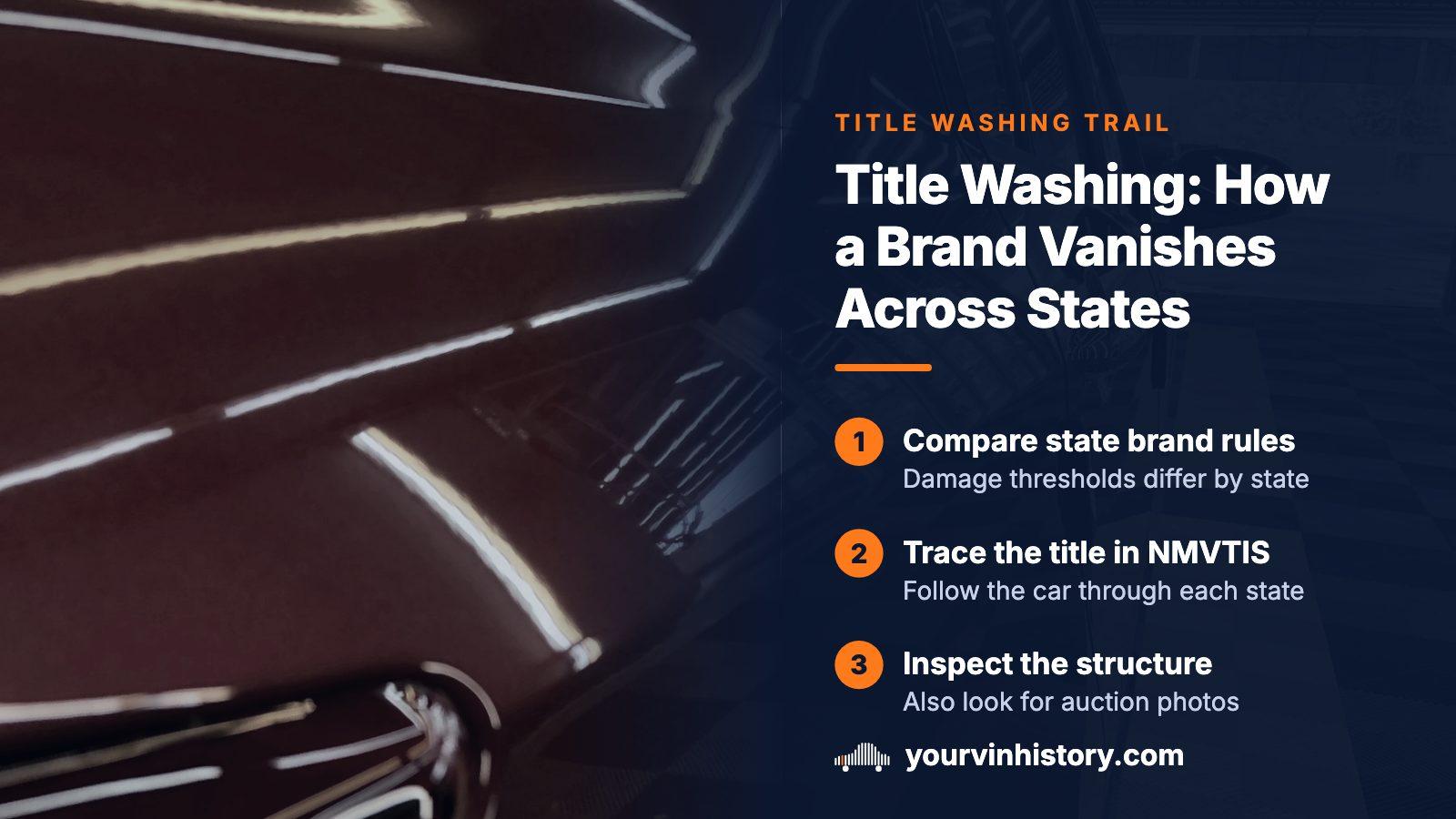
Title washing is when a salvage, flood, hail or similar brand does not appear on a title issued by a second state. Fraud explains some cases. Others come from honest differences between states: damage thresholds, vehicle age limits and brand categories that exist in only one place. Trace the title history through NMVTIS, look for auction photos, and have the structure inspected.
- Deliberate version
- Fraud, and the case federal title reporting was built to catch
- Wisconsin salvage line
- Repair cost over 70 percent of market value, vehicle under seven years old
- Texas salvage line
- Repairs costing more than the car was worth before the damage, any model year
- Insurer reporting window
- Current model year plus the four before it
One phrase covering two very different events
People use the term for anything that leaves a damaged car holding a clean title in a new state. Under that umbrella sit two events that look identical on paper and share nothing else.
The first is fraud. Someone holding a branded title registers the car elsewhere, hoping a state with thinner records will print a document without the mark. The second involves no wrongdoing. A car is branded under one state's law, moves, and the next state applies its own law, which does not call for a brand. The clerk issues a clean title, and by that state's standard the clerk is right.
For a buyer the result is the same: paper that leaves out part of the car's past. What changes is how you look for the gap. Hunting for a liar gets you nowhere in the second case. Comparing rules does.
The same wreck, judged by two states
Wisconsin and Texas make a useful pair because their published rules differ on almost every point that matters. Neither state is unusual; their paperwork is just easy to compare.
| Question | Wisconsin | Texas |
|---|---|---|
| What triggers salvage | Repair cost, estimated or actual, whichever is higher, above 70 percent of fair market value | Repair cost above the vehicle's actual value just before the damage |
| Does vehicle age matter | Yes, salvage applies only to vehicles under seven years old | No, the definition applies regardless of model year |
| Hail damage | Has its own Hail Damage brand | Left out of the salvage definition when an insurer paid a hail claim |
| What counts as repair cost | The larger of the estimate and the real bill | Repainting materials and labor, and sales tax, are excluded |
Picture a wreck whose repairs would run to roughly 75 percent of the car's value. If it is under seven years old, Wisconsin calls that salvage. Texas does not, because it waits until repairs exceed the full pre-damage value. Strictly speaking that is not washing, because the verdict comes from where the loss occurred rather than from any later move. The buyer still holds a title that cannot reveal which rulebook applied.
A brand with nothing to translate into
Wisconsin's Insurance Claim Paid brand covers a vehicle under seven years old that passed to its insurer after a payout for damage between 30 and 70 percent of market value. That is a car hurt badly but not totaled, and most states keep no such tier. Retitle it elsewhere and the new state has no matching box to fill in. The label is not hidden. It has nowhere to go.
Hail shows the same problem from another angle. Wisconsin brands hail damage once repairs pass 70 percent of value. Texas writes hail out of its salvage definition, so a car with a paid hail claim is not salvage there. A Wisconsin hail brand therefore describes an event that Texas never treats as a branding event.
Receiving states can also read a prior brand differently. Texas treats a damaged car arriving on an out-of-state salvage document as salvage when its face says something like accident damage or flood damage, yet its definition excludes arrivals marked rebuilt or prior salvage. The words an earlier state chose can decide the outcome.
Age limits that stop a brand from ever forming
Wisconsin's salvage and hail brands both stop at the seven-year mark. An eight-year-old car damaged far past the 70 percent line never qualifies, so its title stays clean for good and there is nothing to wash. The state's flood brand carries no age condition, which shows that a state can gate some brands and leave others open.
Texas once had a similar gate. In the years before September 2003, its loss ranges applied only to vehicles under seven years old. Since the 2003 amendments the definitions cover every model year, so an older wreck that Texas would brand can go unbranded in a state that keeps an age cutoff.
Reading a clean title on an older car
Where an age gate applies, a missing brand may say nothing more than how old the car was when it was hurt. Treat the same clean title as weaker evidence on a ten-year-old vehicle than on a three-year-old one.
How the deliberate version works and the trail it leaves
The scheme needs a branded title and a state that reissues paperwork without asking questions. The owner surrenders the marked document, applies in the new state and leaves with a clean one. Timing gives it away. A total-loss payout in one state, followed within weeks by a fresh title from a distant state the car has no other tie to, calls for a blunt question to the seller.
Federal reporting exists largely to blunt this. NMVTIS gathers records from participating state agencies, insurers and salvage operators into a single database keyed on the VIN. A brand logged in one state stays visible when the car surfaces in another, no matter which document the seller is holding.
Honest rule gaps produce ordinary dates. A car can sit under one state's title for years, sell normally and move on, with no odd timing anywhere, and still carry damage that no title ever recorded. The date check is necessary but not sufficient.
Where the federal reporting rules run out
Justice Department regulations spell out who reports to NMVTIS and what they must send. They also leave gaps that a clean federal result cannot cover.
| Reporter | What the rule requires | Where it falls short |
|---|---|---|
| Insurance carriers | A monthly list of the junk and salvage automobiles the insurer took over | Covers the current model year and the four before it, so older cars fall outside this duty |
| Junk, salvage and recycling yards | A monthly inventory of vehicles obtained, with a later update when the final disposition was unknown | Operators handling fewer than five such vehicles a year are exempt |
| Carriers, on the cause of loss | Sharing why the vehicle was taken is strongly encouraged | A filing may note a total loss yet say nothing about whether water, fire, a crash or a thief caused it |
Nothing here touches the honest rule gaps. When a state's law attaches no brand, there is nothing to report, and the federal system records brands rather than questioning them. It defends well against the fraudulent route and not at all against differing rules.
Tracing a car through its states, step by step
- Get the list of states and title dates from a federal title record, not from the paper the seller hands you. One current title shows no sequence at all.
- For each move, ask what explains it. A new job, a military posting or a plain sale all make sense. A short stop in a state with no other tie to the car is the one to raise.
- Find the rules of the state where any damage happened. A high threshold or an age gate can make a clean title genuine and uninformative at once.
- Search salvage auction records by VIN, since a lot listing does not depend on which state issued which document.
- Finish with a physical inspection. Every case above ends with paperwork that cannot settle the question and a car that can.
Records that sit outside the titling system
Salvage auction listings hold evidence that retitling cannot touch. A lot page usually shows photos taken when the car arrived, before anyone repaired it, plus damage notes, the odometer reading as cataloged and the final price. Which state issued which title makes no difference to any of it.
The National Insurance Crime Bureau offers VINCheck, which screens a VIN at no cost against theft and total-loss claims that participating insurers have sent in. Use it first, then buy the NMVTIS record from a provider on the Justice Department's approved list.
A yourvinhistory report puts title brands, accidents with a damage map, and salvage and auction records with photos in one place. Its NMVTIS title records come from ClearVin LLC, an approved NMVTIS data provider. The preview comes first and costs nothing; the full report is a one-time purchase.
What a clean title proves and what it does not
A clean title records one fact: the issuing state's rules attached no brand. That is a statement about paperwork, not about the car. Damage below the state's line, damage to a car past its age cutoff, and damage of a kind it ignores each yield a spotless title on a damaged vehicle.
None of this makes an out-of-state title suspect on its own. Cars cross state lines constantly for dull reasons. The weight a title deserves depends on which state issued it, when, and how old the car was at the time of any loss.
Moves that protect you before you pay
- Pull the federal title record on any vehicle worth real money, and do it before you drive out to see the car.
- Search auction archives by VIN before the visit, so you know which panels and seams deserve a close look.
- Ask the seller which states have issued a title for the car, then compare that answer with the record.
- Discount a clean title on an older car, because age gates mean fewer brands could attach.
- Have a shop check the structure and scan the restraint system if anything hints at a serious impact.
Where this information comes from
- Wisconsin DOT: Form MV2849, title branding notification — Source for Wisconsin's 70 percent salvage line, the seven-year limit, the separate hail and flood brands, and the Insurance Claim Paid tier.
- TxDMV: Salvage/Nonrepairable Motor Vehicle Manual — Source for the Texas salvage definition, its hail and repainting exclusions, the 2003 change, and how out-of-state salvage documents are treated.
- 28 CFR 25.55: responsibilities of insurance carriers — Sets the monthly insurer inventory, the five-model-year window and the optional status of the cause of loss.
- 28 CFR 25.56: junk yards, salvage yards and auto recyclers — Sets the monthly yard inventory, the later disposition update and the exemption for very small operators.
- BJA: NMVTIS vehicle history record — Where the Justice Department lists the approved data providers who sell the federal title record.
- NICB: VINCheck — A no-cost screen for theft and total-loss records reported by participating insurers.
Sources and photos: Facts checked against the sources above in October 2026. Photo by Clarence Tioh on Unsplash; diagrams by YourVINHistory.
Keep reading
- Salvage title VIN checkA three-step order of checks that catches a washed title.
- Total loss threshold by stateShows how far apart state damage percentages really sit.
- NMVTIS reportExplains the federal record that reveals the state-by-state sequence.
- Auction history by VINCovers the photos and damage codes that no retitling can remove.
Frequently asked questions
Is title washing illegal?
Shedding a brand on purpose, or telling a buyer a branded car is clean, is fraud. A state issuing a clean title under its own rules is not illegal, since nothing was concealed. Federal title reporting makes the first kind easier to catch and can do nothing about the second, so buyers still need records from outside the title.
Can a flooded car have a clean title?
Yes. Wisconsin, for example, brands flood damage only when repairs would exceed 70 percent of market value, and other states set other lines or word the brand differently. A flooded car below the line, or retitled where flood is not branded the same way, can carry a plain title. Check auction listings and total-loss records for it.
Which states are worst for title washing?
No official source ranks them, and a ranking would mislead. What matters is the gap between the state where the damage happened and the state that issued the current title: thresholds, age windows and brand categories. Look up the branding rules for both states, then compare them with what the federal record shows for the VIN.
Will a VIN check always catch a washed title?
No. A federal record shows what was reported to it. A small salvage operator, an older car outside the insurer window, or a car that never received a brand in the first place can leave nothing to find. A clean result lowers the risk without removing it, which is why photos and a hands-on inspection come next.
What should I do if I find a brand after buying?
Keep the purchase papers, the ad, your messages with the seller and the report showing the brand. Then contact your state motor vehicle agency and a local attorney, since remedies depend on state law and on what the seller said. Move quickly, because dispute deadlines can be short.
Now check the car itself
The guide explains what to look for. The report shows what this VIN has on record.