THE SHORT ANSWER
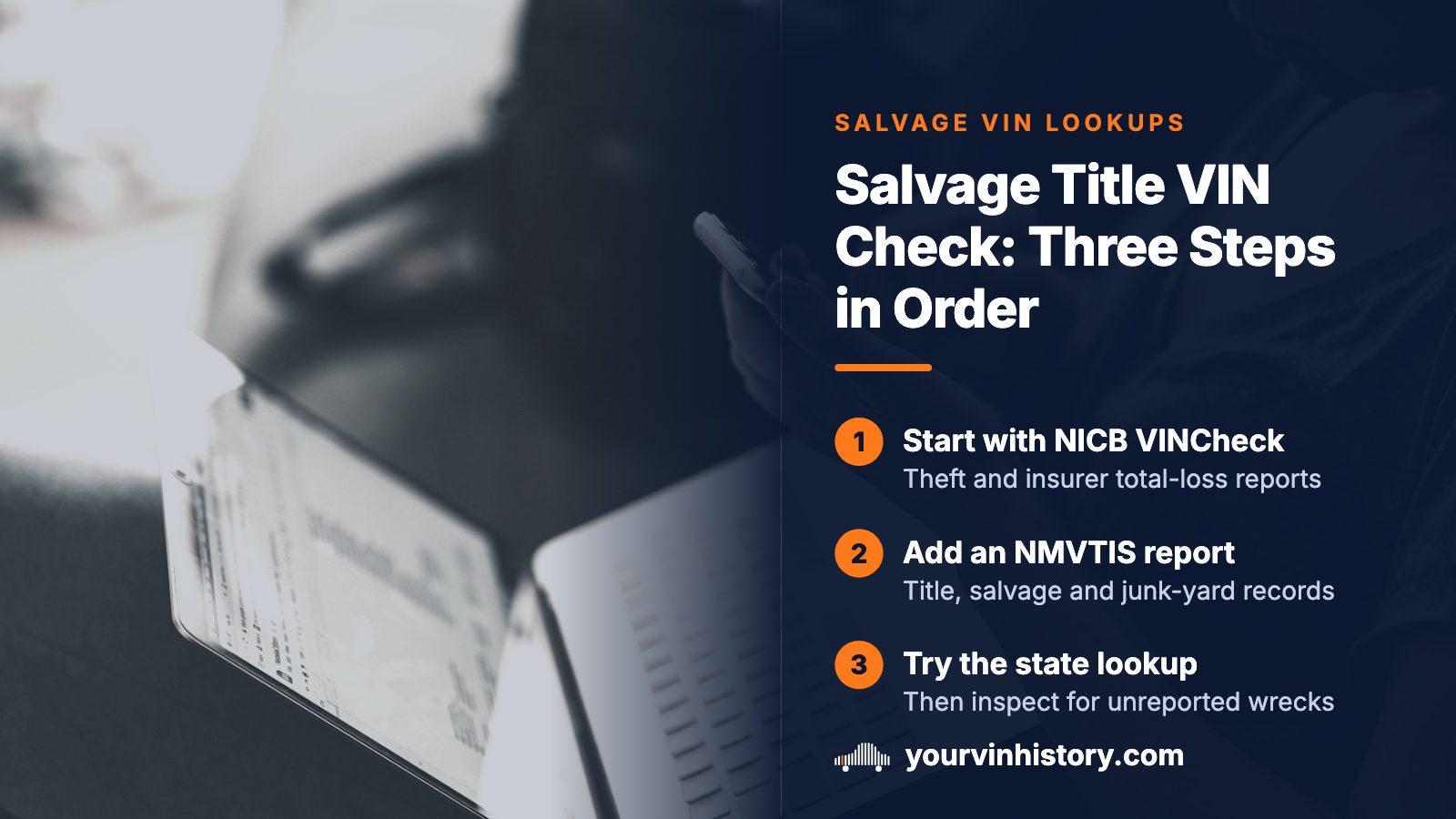
To check a VIN for a salvage title, run three lookups in order. NICB's VINCheck is a free screen for theft and insurer total-loss reports. An NMVTIS report from an approved provider shows federal title, salvage and junk-yard records, and it is the check built to expose a washed title. Then try the state's own lookup if one exists. A car wrecked without an insurance claim can pass all three, so inspect it.
- Free screen
- NICB VINCheck, for theft and insurer total-loss reports
- Federal record
- NMVTIS, sold to the public only through approved providers
- Insurer window
- Current model year plus the four before it
- Main blind spot
- Wrecks repaired privately with no insurance claim
What a salvage brand actually records
Under federal rules, a salvage automobile is one damaged by collision, fire, flood or a similar event badly enough that its scrap value plus the cost of making it street legal would top its worth just before the damage. A junk automobile sits below that: it cannot run on public roads and is good only for parts or metal.
The federal definition also sweeps in any car that a state declares a total loss, or that an insurer writes off under its own policy terms. That holds even when the owner keeps the car and the insurer never takes title. A brand, then, records a money decision. It says little about how hard the car was hit, which is why an inspection closes out the sequence.
Three lookups that each see something different
Each system below is fed by different reporters, so a clean answer from one tells you little about the others. Run them cheapest first and stop the moment one returns a brand. A plain VIN decode is not on the list: it reads how the car was built, not what its title says.
| Lookup | Fed by | Cost | Blind spot |
|---|---|---|---|
| NICB VINCheck | Participating insurers | Free | Insurers that do not take part; it holds no title data |
| NMVTIS report | State titling agencies, insurers, salvage and junk yards | A fee set by the approved provider | Cars that no state, insurer or yard ever reported |
| State lookup | That state's own title file | Varies, often free | Other states, and states with no public tool |
Step one: the NICB screen
The National Insurance Crime Bureau runs VINCheck for the public at no charge. It tells you whether a participating insurer has reported the VIN as stolen and not recovered, or as a total loss. There is a daily cap on searches, and insurers that do not participate are invisible to it. It shows no title brands at all.
Treat a hit as a reason to stop and ask questions. Treat a miss as thin evidence: it means no participating insurer filed a report, not that the title is clean. Its value is speed: a minute of typing can end a bad lead early.
Step two: the federal record that follows the car
NMVTIS, the National Motor Vehicle Title Information System, works because reporting into it is required. States send their titling data, brands included, on a daily schedule. Insurers and salvage or junk yards send inventories monthly. Salvage pools and auctions count as yards here.
The rule also directs each state to run a VIN check against the system before titling a car that came from another state. That checkpoint is what makes washing hard: the old brand is waiting in the federal file when the new state looks. The operator may not let anyone delete an earlier salvage or junk report, so a past entry cannot be quietly removed.
Consumers buy the record through providers the Justice Department approves and lists on a public page. Check that any report seller appears there. A yourvinhistory report takes its NMVTIS title records from ClearVin LLC, an approved NMVTIS data provider.
The five questions the federal record must answer
The rule lists what the system has to let a user establish, and the list is wider than salvage or not.
- Whether a title document in your hands is genuine, and what its status is
- Whether the VIN appears on a title issued by a given state
- Whether a car titled there is, or ever was, rated junk or salvage
- The odometer disclosure made at title issue, and any later reading the state recorded
- Whether any federal junk or salvage report has been filed against the VIN
The first item is the most overlooked. It lets you test the paper title in a private sale, which is the check that exposes a forged or altered document. The third item covers history, not just current status. One limit: individual buyers do not get the owner's name or address.
Step three: the state tool, where one exists
A few states publish a VIN lookup of their own. Florida's Motor Vehicle Information Check, run by FLHSMV, returns title status and brand flags for a VIN at no charge. Wisconsin, Georgia, Ohio and Connecticut offer status checks of varying depth, and many other states offer nothing public at all. Coverage is uneven, so note what the tool actually returns.
Use a state tool when the car has spent time in that state, since it reads that state's file directly. Where no tool exists, the title and registration in the seller's hand are your record. Compare its brand wording and issue date with the earlier checks.
Why a lightly damaged car can carry a brand
The federal total-loss test is arithmetic. On one side it adds the repair bill, the extra damage a shop expects to find once panels come off, the resale value the car loses simply for having been repaired, and the rental the insurer pays while the car waits. On the other it sets the car's pre-accident value minus what the wreck would fetch at salvage.
| Factor | Why it tips the decision |
|---|---|
| Slow parts supply | Rental costs pile up for each week the car sits idle |
| High-value car | Lost resale value scales with the price of the car |
| Suspected hidden damage | Expected extra repairs are counted before anyone finds them |
| Strong parts market | Higher salvage proceeds shrink the figure the repair bill must beat |
Only the first term concerns the metal. An expensive car waiting on parts can be written off after a modest hit while a cheaper one with worse damage gets repaired.
Clean title, bad wreck: when the test never applied
Branding rules carry age windows and value floors, so a car outside them can be wrecked beyond repair and still hold a clean title. Nobody washed anything; the test simply never ran. Virginia applies its salvage rule to late model vehicles, meaning the current model year plus the five before it, or any car whose value before the damage was $10,000 or more. Missouri's damage test reaches a vehicle only within six years of its model year.
The federal insurer stream has a window of its own: carriers report cars from the current model year and the four before it. An older write-off can leave no insurer entry. Some repair costs are excluded from the arithmetic too: hail and tires in Missouri, engine, transmission and drive axle work in one of Virginia's tests.
Weigh a clean title by the car's age
A clean title tells you a lot on a late-model, high-value car, since the branding test almost surely applied there. On an older or cheaper car it tells you much less, because the test may never have engaged. Many buyers ease up as the price drops, which is backwards.
Cars no database ever saw
The hardest case is not a washed title but a car that was never branded. An owner with no collision coverage who wrecks a car and repairs it privately creates no claim, no total-loss decision and no record. It passes every lookup above, and only an inspection catches it.
- Panel gaps that change along a seam, or a door that needs a shove to latch
- Paint texture or depth of color that shifts between neighboring panels in low, angled light
- Overspray on rubber seals, wiring or the inside of the fuel filler door
- Welds or seam sealer unlike the factory beads elsewhere on the car
- Glass, headlight or radiator support date codes that disagree with the build date
- Airbag warning light behavior at startup, or a scan that shows replaced modules
A pre-purchase inspection on a lift, at a shop the seller did not pick, is the practical answer.
What a yard entry tells you, and what its absence does not
Salvage yards, junk yards, recyclers and the auctions that handle written-off cars file a monthly inventory. Each entry carries the yard's details, the VIN, the date the car was obtained, who it came from, whether it was crushed or otherwise disposed of, who received it and whether it is headed for export.
An entry saying a car was crushed, set against a VIN now advertised as a running car, is not a puzzle for the seller to explain away. Stop there. Absence proves less. A yard that already reports through a state feed need not file separately, and a business that handles fewer than five such vehicles a year is exempt.
Reading the results together
- All three clear: encouraging, not conclusive. No record exists, so go to the inspection with normal care.
- Insurer total loss, no brand on the title: the washed-title pattern. Price the car as branded or walk away.
- Brand in an earlier state, clean title now: the earlier brand is the history that follows the car. Treat it as branded.
- Yard or junk entry: parts-car territory. If it is advertised as drivable, the records and the car tell different stories.
A salvage or rebuilt result is a repricing, not an automatic no. The price should reflect which parts were damaged, who repaired them, what paperwork backs the work, and whether your insurer will cover the car. Open recalls survive a rebuild, so also run the VIN through NHTSA's recall lookup.
Where this information comes from
- eCFR: 28 CFR Part 25, subpart B (NMVTIS) — The federal rule that defines salvage and total loss and sets what states, insurers and yards must report.
- Department of Justice: NMVTIS consumer information — The public list of approved providers that may sell the federal title record.
- NICB: VINCheck — The insurer-fed screen for stolen and total-loss reports, with its search limits.
- Code of Virginia: section 46.2-1600, definitions — Shows how one state limits salvage branding by model-year window, pre-damage value and repair-cost exclusions.
- FLHSMV: Motor Vehicle Information Check — Florida's no-charge title status lookup by VIN.
- NHTSA: Recalls — Federal VIN search for open recalls, which a rebuild does not clear.
Sources and photos: Facts checked against the sources above in October 2026. Photo by Michal Biernat on Unsplash; diagrams by YourVINHistory.
Keep reading
Frequently asked questions
Which lookups reveal a salvage title on a VIN?
Start with NICB's VINCheck, then order an NMVTIS report from a provider on the Justice Department's approved list, then try the state's lookup. Afterward, compare the results with the paper title in the seller's hand. Brand wording and issue date should fit the history; a mismatch is a reason to pause.
Is there a free way to find a salvage brand?
Partly. NICB's VINCheck costs nothing, and a few states, Florida among them, publish no-charge title lookups. The complete NMVTIS record is sold by approved providers for a fee, so a site offering it for nothing deserves a look at who supplies its data.
Could a salvage car still come back clean on every check?
Yes. A car repaired privately with no insurance claim leaves nothing to find, and older cars can fall outside both state branding windows and the insurer reporting window. Timing matters too: insurers and yards report monthly, so a very recent write-off may not appear yet. Rerun the check shortly before you pay.
Why does a salvage record not say what happened to the car?
The required insurer and yard reports list the VIN, dates and parties involved, but not the cause of the damage. Insurers are only encouraged to add a reason, such as flood, fire or collision. A record can prove a car is salvage while saying nothing about whether water, flames or a crash did it.
How does a rebuilt title differ from a salvage title?
Salvage means the car was written off and is not cleared for the road as it stands. Rebuilt means someone repaired it and the state allowed it back onto the road after an inspection. Wording varies by state, but a rebuilt car was salvage first, and that history is what to price in.
Now check the car itself
The guide explains what to look for. The report shows what this VIN has on record.