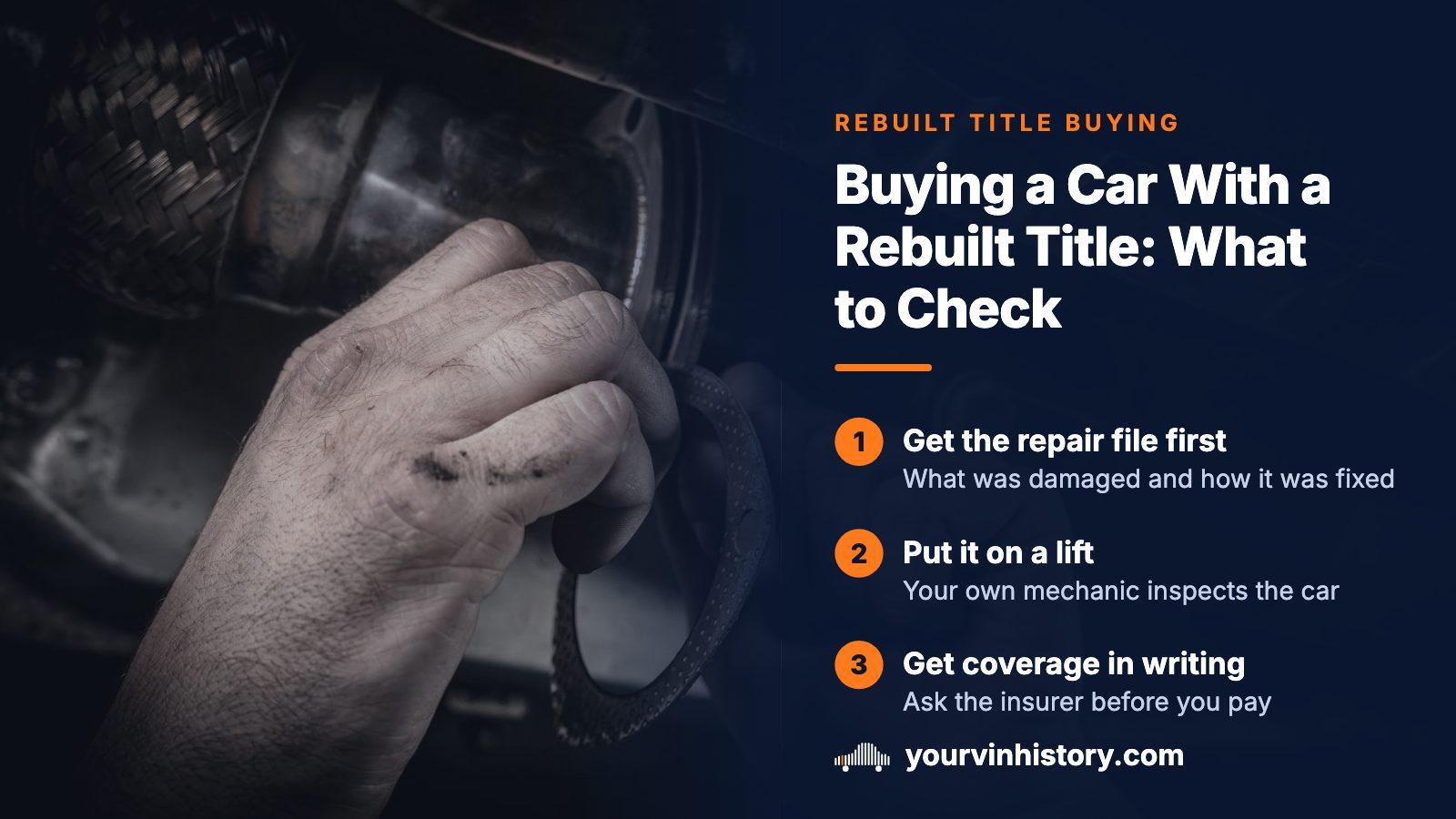
THE SHORT ANSWER
A rebuilt title car is worth buying only when three things line up: paperwork showing what was originally damaged and how it was repaired, an inspection by your own mechanic with the car on a lift, and a written answer from your insurer about coverage. Expect it to be priced roughly 20% to 40% under a clean-title match. Flood history or a bent unibody should end the conversation.
- Typical discount
- Roughly 20% to 40% below a matching clean-title car
- How long the brand lasts
- Permanent, for every later owner
- Usual way to pay
- Cash, since most mainstream lenders decline
- State rebuild inspection
- Looks at parts and ownership, not repair quality
What the rebuilt brand says, and what it leaves blank
A rebuilt title records three events in a row. An insurer decided the repair bill outran the car's value, someone repaired it anyway, and a state agency later cleared it to be registered again. Nothing in that sequence tells you which parts were wrecked. A sedan that sat under hail and a sedan that sat in salt water wear the same word on the title, and they are not the same purchase.
So treat the brand as a question, not a verdict. Your job is to answer it with paper and steel before any money moves. Sellers who did the work properly tend to have the evidence on hand, and sellers who cannot produce any are usually describing a car they do not fully know themselves.
Ask for the repair file before the test drive
Open with a request for paperwork, because the reply sorts sellers quickly. A well-documented rebuild leaves a trail, and you want to see most of it:
- The insurer's total-loss valuation and the original repair estimate
- Invoices for the parts used, with special attention to airbags and anything structural
- Photographs taken while the car was stripped down or sitting on the frame machine
- Printed before-and-after measurements, if the structure was straightened
- The name of the shop that did the work, one you can actually phone
Photographs matter more than most buyers expect. Someone who documented the car with its panels off is showing you exactly what had to be fixed, which is evidence a car with a hidden problem will never have. If the seller waves the question away, take that as an answer.
Sorting the damage stories: hail, theft, collision, flood
With the file in hand, match the original loss to what it tends to mean for a buyer. This table is a rough sort, and the car itself still gets the final word.
| Original loss | What to confirm | Where it usually lands |
|---|---|---|
| Hail | Dents and glass were the whole problem, with no structural or electrical work | Often acceptable, if documented |
| Theft recovery | Missing panels and parts were replaced and nothing structural was touched | Often acceptable, if documented |
| Low-speed collision | A bumper and a fender took the hit and the frame was never involved | Possible, after a lift inspection |
| Impact that bent the unibody | Whether the structure was straightened, and how it was measured | Walk away |
| Flood | Corrosion in wiring and connectors, which can surface years later | Walk away |
Flood earns the hardest line. Corrosion creeps through wiring and connectors over time, no inspection reliably catches it, and no repair reverses it. A straightened unibody is nearly as bad: crash structure is engineered to crumple once, so a repaired one can behave unpredictably in the next impact.
Turning the discount into a real number
Listings for rebuilt cars commonly sit roughly 20% to 40% under a matching clean-title car. That gap is the market's charge for three burdens you take on: narrower insurance, narrower financing and a slow resale. Subtract them before you call the gap savings. A car advertised 30% under book that you must pay for in cash, insure for liability only and eventually sell to another cash buyer is a smaller win than the sticker suggests.
A thin discount is a warning
If the asking price lands within 10% of the clean-title figure, the seller is hoping you have not priced the brand. Negotiate toward the market range or leave. The brand follows the car for good, whatever you pay today.
Insurance and financing are decided by other people
Make your insurer the first phone call. Liability cover on a rebuilt car is generally easy to find. Theft, weather and collision cover is where options thin out: some carriers refuse branded titles, some want their own photo inspection before they bind the policy, and some write it but would settle a future claim at a lowered value. Give your company the VIN before you agree on money and ask for the answer in writing. A seller who says insurance is no problem is describing their own carrier, state and claims history.
Lenders want a car they can value and sell without a loss if you stop paying, and a brand makes both harder. Most banks and manufacturer finance arms say no. Credit unions are the usual exception, and they tend to lend less against the car's value or charge a higher rate. Plan on cash, then ask whether tying up that cash is worth the discount compared with financing a clean-title car.
What the state inspection did and did not check
Buyers sometimes read the state's rebuilt inspection as a stamp of quality. It is narrower than that. The inspection looks at parts and ownership paperwork, not at how well the repair was done. A car can pass with crooked welds or a dead airbag circuit, because those were never the question being asked.
Rules differ by state, and Utah shows how odd the results can get. Most vehicles there no longer need a safety inspection, but salvage ones still do, so a rebuilt car may have been inspected while the clean-title car parked beside it was not. Treat a pass as a baseline: the car is legal to register, and that is all it proves.
Your own inspection, in order
- Pull the records first. Decode the VIN, check recalls, run the NICB search and pull the NMVTIS title record to learn which state applied the brand and when.
- Book an hour at a shop you chose, not the seller's, with the car on a lift. Ask them to check the frame rails and floor pans, the suspension mounting points and the quality of any welds.
- Have every module scanned. Stored fault codes and the airbag system's status reveal what the dashboard has been told to hide.
- Hold the seller's explanation up against the car. A claim of hail damage collapses when the shop finds repaired structure at the front, and the price should collapse with it.
Look over the outside as well. Uneven panel gaps, inconsistent paint depth, overspray on trim, glass with mismatched date codes and welded quarter panels all suggest more damage than anyone admitted. An airbag warning light that stays lit, or a fault masked with a resistor, is a frequent shortcut on bargain rebuilds, and the one most likely to injure someone. The FTC advises asking for a written report with repair cost estimates, which also gives you bargaining power on price.
Records to pull, and the paperwork that comes with the sale
Three outside checks cost little and answer different questions. NMVTIS, the national title system, shows which state branded the car and what came before. The NICB's VINCheck is a free search for theft and total-loss records from participating insurers. NHTSA's recall lookup lists open recalls, and a rebuild does not clear them, so run the VIN and ask a dealer for that make who pays for the fix on this particular car.
A yourvinhistory report can add accident records with a damage map, plus salvage and auction entries with photos. Pre-repair photos are handy here, since you can compare the original damage with what the seller described.
Dealers bring the Buyers Guide, the form posted on the car that says whether it is sold as is or with a warranty. An as-is sale leaves repairs after the sale with you, so any spoken promise belongs in writing on that form. A history report can show accidents and flood damage but typically not mechanical faults, so it supports the lift inspection and does not replace it.
Plan the exit before you pay
The brand never comes off, so each future buyer will run the arithmetic you are running now, and many will decline. Dealers seldom offer a sensible trade-in on a rebuilt car. The realistic route is a private sale to someone at ease with the brand, which takes longer and brings less money. That makes a rebuilt car a poor flip and a decent keeper, because the discount pays off over years of ownership, not months.
Keep the repair file, your inspection report and the insurer's letter together in one folder. Handing the next buyer that bundle is the one thing that wins back some of the value the brand took.
The purchase that does make sense
There is a sound case, though a narrower one than the ads suggest. Picture a hail-damaged car with a full file, bought for cash at about 35% under the clean-title price, cleared by your own mechanic, insurable the way you need and kept for ten years. The damage never reached anything that matters, and the lower price is a lasting gain. A theft-recovery car that got replacement panels and nothing structural fits the same pattern.
The bad version is the reverse: a loan from a credit union, no paperwork, a seller's word for what happened and a plan to sell in three years. In that setup the brand charges you at every stage and the discount never covers the bill.
Where this information comes from
- NMVTIS: National Motor Vehicle Title Information System — The federal title-record system meant to protect consumers from fraud and unsafe vehicles, and the place to learn which state branded a car.
- FTC: Buying a used car from a dealer — Covers the Buyers Guide, what an as-is sale means, and why an independent mechanic's inspection is worth paying for.
- NHTSA: Recalls — Lookup for open recalls on a specific car, which a rebuild does not erase.
- NICB: VINCheck — A no-cost search of theft and total-loss records reported by participating insurers.
Sources and photos: Facts checked against the sources above in October 2026. Photo by Mustafa Sheikhmouss on Unsplash; diagrams by YourVINHistory.
Keep reading
- What is a rebuilt title?What the brand means and how a state grants it.
- Rebuilt title inspectionWhat the state exam actually covers before you add your own.
- Flood-damaged carsThe damage type that should end the deal, and how it hides.
- Pre-purchase inspectionWhat a shop looks at when you hand over the keys for an hour.
Frequently asked questions
Is it a good idea to buy a rebuilt title car?
Sometimes. It works when the original damage was cosmetic or peripheral, the repair is documented, your own mechanic approves it and your insurer agrees in writing to cover it. If you cannot get all of those, pass. Plenty of clean-title cars exist, and nothing obliges you to take on a permanent brand because the price tag looks low.
What discount makes a rebuilt title car a fair deal?
Plan on roughly 20% to 40% below a similar clean-title car, with wider gaps on newer and pricier models. Check what comparable clean cars actually sell for near you, then subtract what limited insurance and cash-only buying cost. An offer near 10% off is a reason to look elsewhere.
Can you insure a rebuilt title car?
Usually, at least for liability. Full coverage is less certain: some insurers decline, some inspect first, and some pay claims at a reduced value. Because practice varies by company and state, give your insurer the VIN, say the car is rebuilt, and ask them to confirm in writing what they will write and how a claim would be valued.
Can I get a loan for a rebuilt title car?
Mainstream banks and manufacturer lenders mostly refuse, since a branded title makes the collateral hard to value and hard to sell. Credit unions are the common exception, sometimes lending less against the car's value or charging more. Ask before you start shopping, and if the answer is no, price the car as a cash purchase.
Is driving a rebuilt title car safe?
That depends on the original damage and the shop that fixed it. A hail or theft-recovery rebuild can leave the structure untouched. A flood car, or one with a bent unibody, can hide corroded electronics or weakened crash protection, and the state inspection tests for neither. Your own lift inspection and module scan are what tell you.
Now check the car itself
The guide explains what to look for. The report shows what this VIN has on record.