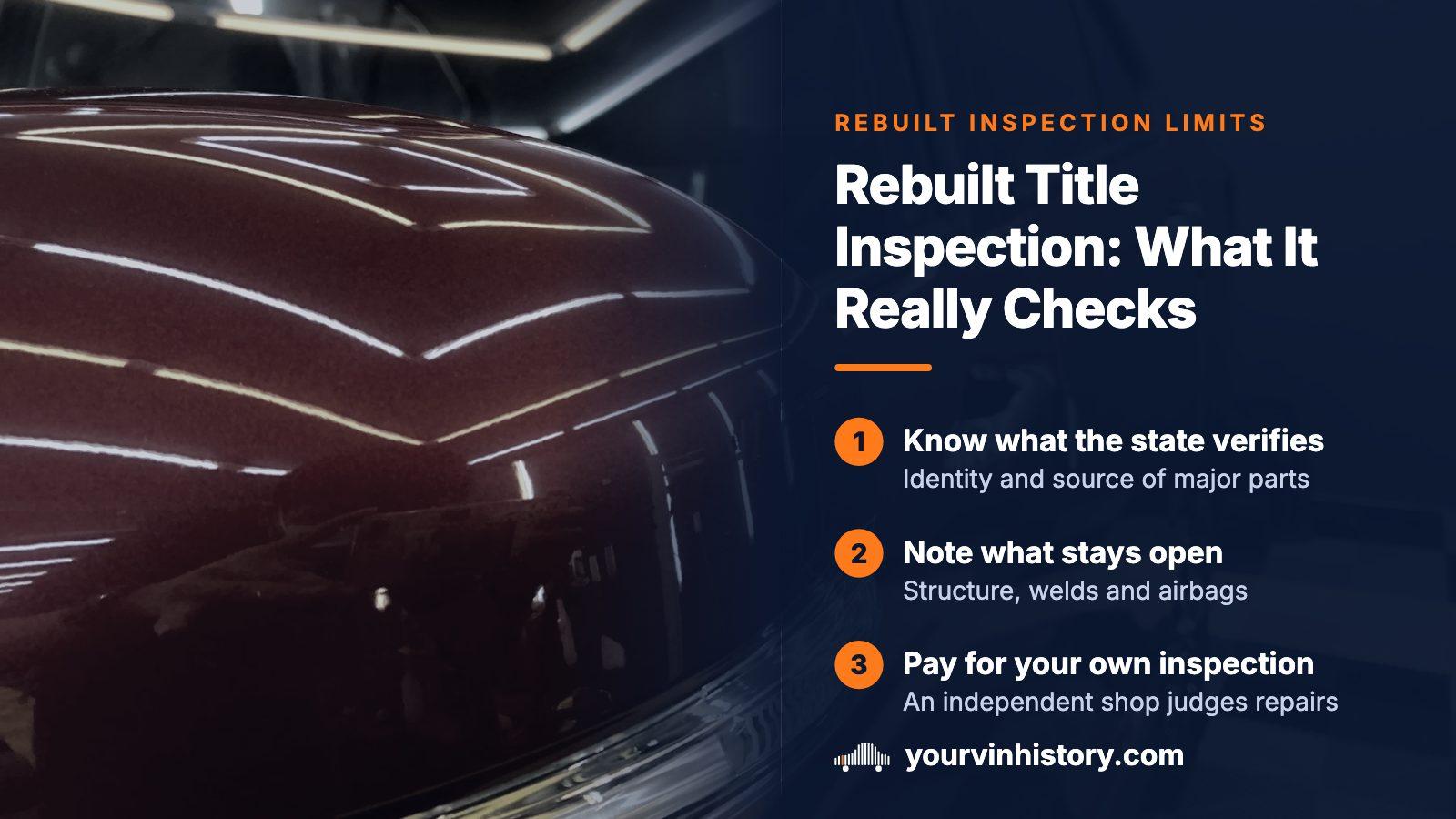
THE SHORT ANSWER
State rebuilt procedures exist to stop stolen-parts fraud. Texas issues the rebuilt title from a signed statement describing the car, the repairs and the source of major parts, and it accepts 'Repairs unknown' from a buyer who never touched the repairs. Wisconsin sends the car to a certified inspector by appointment, who checks identity, parts ownership and required safety equipment. In both states, an independent shop still has to judge the repair.
- What gets verified
- Vehicle identity and where major parts came from
- What stays open
- Structure, welds and the airbag system
- Texas route
- Statement Form VTR-61, 'Repairs unknown' allowed
- Wisconsin route
- Appointment-only inspection by authorized inspectors
What a pass actually tells you
The popular story runs like this: a wreck gets fixed, an official checks the work, and the car earns its rebuilt brand. The states' own documents describe something narrower. They are built to establish that the car is the one named on the title and that the major components in it were acquired lawfully, with equipment rules added on top in some places.
Those are sound questions and they are enforced. They are just not the ones a buyer worries about most: whether the structure sits true, whether the restraint system works as a system, and whether anything is hiding under fresh paint.
Texas: a signed statement rather than a repair review
Texas issues a rebuilt salvage title on a Rebuilt Vehicle Statement, Form VTR-61. Page one describes the car (year, make, model, VIN, body style) and asks for a written explanation of the repairs or alterations. Page two lists component parts, from the engine, frame and body to fenders, hood, doors, bumpers and the roof or floor pan, and asks where each replacement came from.
Ownership evidence, meaning a bill of sale or a title, is required when an engine, frame or body was swapped in. The rebuilder also certifies the work was theirs and that every part was lawfully obtained. Now look at what the form never requests: a measurement, a standard the repair had to meet, or a signature from anyone qualified to say the structure is back to factory specification.
Paperwork assurance, not workmanship assurance
As the TxDMV manual lays it out, the rebuilt title follows from a complete and consistent file. The assurance is only as good as the statements behind it.
'Repairs unknown' is a permitted answer
One provision surprises people more than any other. Suppose someone buys a car that was already repaired and has no idea what was done to it. The Texas procedure lets that buyer write 'Repairs unknown' in the work-performed section and skip the second page.
The reasoning is fair. An innocent purchaser should not be stuck with an untitled car because a previous owner threw out the receipts. The side effect lands on whoever buys next, because a rebuilt brand can rest on a file that says, in effect, nobody knows. If a rebuilt car comes with no repair records, do not assume the title fills that gap. It may be the very thing that shows the gap.
Where applications stall: parts records and VIN proof
Missing repair notes are tolerated; missing parts records are not. A Texas applicant who cannot give the part number or donor-vehicle VIN for a replaced engine, frame or body cannot file a normal application. The alternatives are a hearing before the county tax assessor-collector or a bonded title, and both are slower and more demanding.
Even identity can come down to a signature. A car last titled and registered in another state needs VIN certification in Texas. That happens through an inspection the car already falls under, such as an emissions or commercial inspection. Where no inspection applies, the applicant can self-certify on the form, and a record found in the inspection database means no physical proof is needed at all.
None of this is sinister; administrative systems have to stay workable. Still, the image of an official standing beside your car may not apply even to the identity step.
Wisconsin: an appointment with a certified inspector
Wisconsin differs in kind, not just in strictness. A repaired salvage vehicle gets a physical inspection, only by authorized inspectors, and only by scheduled appointment. The state's agency list opens with State Patrol posts, grouped by county. Nobody takes the car to a DMV counter or a garage.
State Patrol policy gives the program two aims: keep stolen parts out of repaired salvage vehicles, and confirm that required safety equipment is present and working before highway use. The inspector finds the VIN in several places on the car, runs the numbers through crime databases and the NICB, and goes over the body, frame or unibody, steering, brakes and drivetrain, working over a pit or hoist.
A car fails for an altered or obliterated VIN, major parts whose ownership cannot be verified, or equipment that breaks the rules. After an equipment failure, re-inspection can be scheduled within 15 days with no second fee. That is a real look, well beyond a form. Its stated purpose is still anti-theft and equipment compliance, a narrower job than certifying a repair.
Side by side: what the state settles and what stays yours
| Question | State process | Who settles it for you |
|---|---|---|
| Is this the vehicle its VIN names? | Yes, by inspection or certification | The state |
| Which donor car supplied a body, frame or engine? | Yes, by disclosure and bills of sale | The state |
| Is required safety equipment in place? | Wisconsin checks it; the Texas statement does not ask | The state, in some places |
| Was the structure returned to factory dimensions? | Not shown in the filings | An independent shop |
| Were the welds sound and done by someone qualified? | Not shown in the filings | An independent shop |
| Was the restraint system replaced, or only reset? | Not shown in the filings | A shop with a scan tool |
The bottom three rows are what you are really paying for, and no state paperwork supplies them.
Why the design points at theft
Thieves have long valued a wrecked car that still has valid paperwork. Pair that title with a stolen vehicle of the same model and the stolen car can be passed off as the damaged one. Donor VIN disclosure, certified lawful acquisition, a police officer as inspector and a hard stop on undocumented major components all trace back to that scheme.
Workmanship is handled by the open market and by the equipment rules that cover any car on the road. That is a defensible design. It simply means the discount on a rebuilt car pays you for a risk that remains open, not for a problem the state has closed.
How much a pass should move your offer
- It supports the claim that the car is what it says and that the major parts were accounted for.
- It does not show who did the repair or whether anyone qualified looked at the result.
- It does not show what was repaired, because a Texas file can say the repairs are unknown.
- It does not vouch for the structure, the alignment or the restraint system.
- Treat the discount as pay for the risk you are taking, and let your own inspection shrink that risk before you agree to a price.
None of this makes a rebuilt car a bad purchase. Plenty are repaired well and priced sensibly. The pass simply carries less weight than the word suggests, so the proof has to come from somewhere else.
Buying the inspection the state does not
- Pull the pre-repair photos. Salvage and auction records by VIN often show where the car was hit, which tells the inspector where to concentrate.
- Pay a shop with no stake. A body shop that neither did the work nor profits from the sale has no reason to shade the answer.
- Ask for structural measurement. Frame or unibody dimensions checked against factory specification catch what eyes cannot.
- Have the airbag control module read. Stored crash data and active faults tell you more than a warning lamp that goes dark.
- Get the findings in writing with a date. A written report backs up your price talk and your records later.
Cheap screens to run before paying a shop
Decode the VIN and confirm the factory build matches the car in front of you. Run the NICB VINCheck for theft and salvage flags from member insurers, and search NHTSA's recall lookup by VIN; both are free tools from others. Whether a maker fixes an open recall at no charge depends on the recall and the vehicle's age, since very old vehicles fall outside the federal free-repair rule, so ask a dealer before counting on it.
For the brand and the state-to-state title sequence, use a record from an approved NMVTIS data provider. A vehicle history report for the VIN can add auction and salvage records with photos and a damage map; its title records come from ClearVin LLC, an approved provider. The preview on this site costs nothing; the full report is a one-time purchase.
When you did the rebuild yourself
Keep every receipt, and write down the identification numbers on major components as you fit them, especially the body, frame and engine, along with the VIN of each donor vehicle. That disclosure is what the Texas form is built around, and it is where applications fail.
Wisconsin adds a photo requirement: the inspector wants a picture of each side of the car taken before any repair starts, plus a bill of sale for every major part replaced. Texas dealers face their own rule. A licensed salvage vehicle dealer or independent dealer who rebuilds a salvage vehicle must title it in the dealership's name before resale, and selling a rebuilt salvage vehicle takes the right dealer license. Read your own state's form before buying the wreck.
Where this information comes from
- TxDMV: Salvage/Nonrepairable Motor Vehicle Manual — Source for the Texas rebuilt procedure, the 'Repairs unknown' option, donor-VIN disclosure, VIN certification and the dealer titling rule.
- TxDMV: Rebuilt Vehicle Statement (Form VTR-61) — The form itself, including the component part list and the ownership evidence needed for an engine, frame or body.
- Wisconsin DOT: Salvage Vehicle Inspecting Agency List — Shows that repaired salvage vehicles are inspected only by authorized inspectors, by appointment, at State Patrol posts.
- Wisconsin State Patrol: Salvaged Titled Vehicle Inspections policy — Sets out the anti-theft and equipment aims, what the inspector examines, and the reasons a car fails.
- NMVTIS: Vehicle history record — The Justice Department page for the federal title record and the list of approved data providers.
- NHTSA: Recalls lookup — Government search for open safety recalls by VIN.
Sources and photos: Facts checked against the sources above in October 2026. Photo by Clarence Tioh on Unsplash; diagrams by YourVINHistory.
Keep reading
- What is a rebuilt title?What the brand means for value, coverage and loans once you know what produced it.
- Buying a rebuilt title carThe purchase decision itself, and what the discount ought to reflect.
- Frame damage checkHow to test the structure when the records say nothing about it.
- Airbag deployed checkThe restraint system that no rebuilt process certifies.
Frequently asked questions
Does a rebuilt title mean the car passed a safety inspection?
Not in the sense most sellers imply. Wisconsin's inspector confirms that required safety equipment is present and working, while the Texas statement form does not ask for that. Neither filing includes a structural measurement report or any test of how the car would protect you in a second crash. When an ad says the car passed, it usually means the paperwork cleared.
What documents do I need for a rebuilt title inspection?
It varies by state. In Wisconsin, expect to bring the salvage title, a major parts affidavit, a bill of sale for each major part replaced, and photos of every side taken before repairs. In Texas, the filing is Form VTR-61, with bills of sale for any engine, frame or body used. Check your own agency's list first.
How much does a rebuilt title inspection cost?
State fees differ and change, so confirm with the agency that will inspect. In Wisconsin, the applicant also arranges and pays for the pit or hoist the inspector needs. Your own independent inspection is billed separately by the shop, and it is the one that tells you about repair quality, so budget for both.
What happens if a car fails the rebuilt inspection?
It depends on why. In Wisconsin, an equipment defect can be fixed and the car brought back for re-inspection within 15 days without another fee. An altered VIN or a part nobody can document is far more serious, and an inspector who identifies a stolen part or tampered VIN files an offense report. In Texas, undocumented major parts send the applicant to a hearing or a bonded title.
Should I still get my own inspection if the car already passed?
Yes, and bring the pre-repair photos so the shop knows where the impact was. Choose an independent body shop, ask for structural measurement and a scan of the airbag module, and have the findings written down. If a seller will not allow an outside inspection, that refusal is information about the car.
Now check the car itself
The guide explains what to look for. The report shows what this VIN has on record.