THE SHORT ANSWER
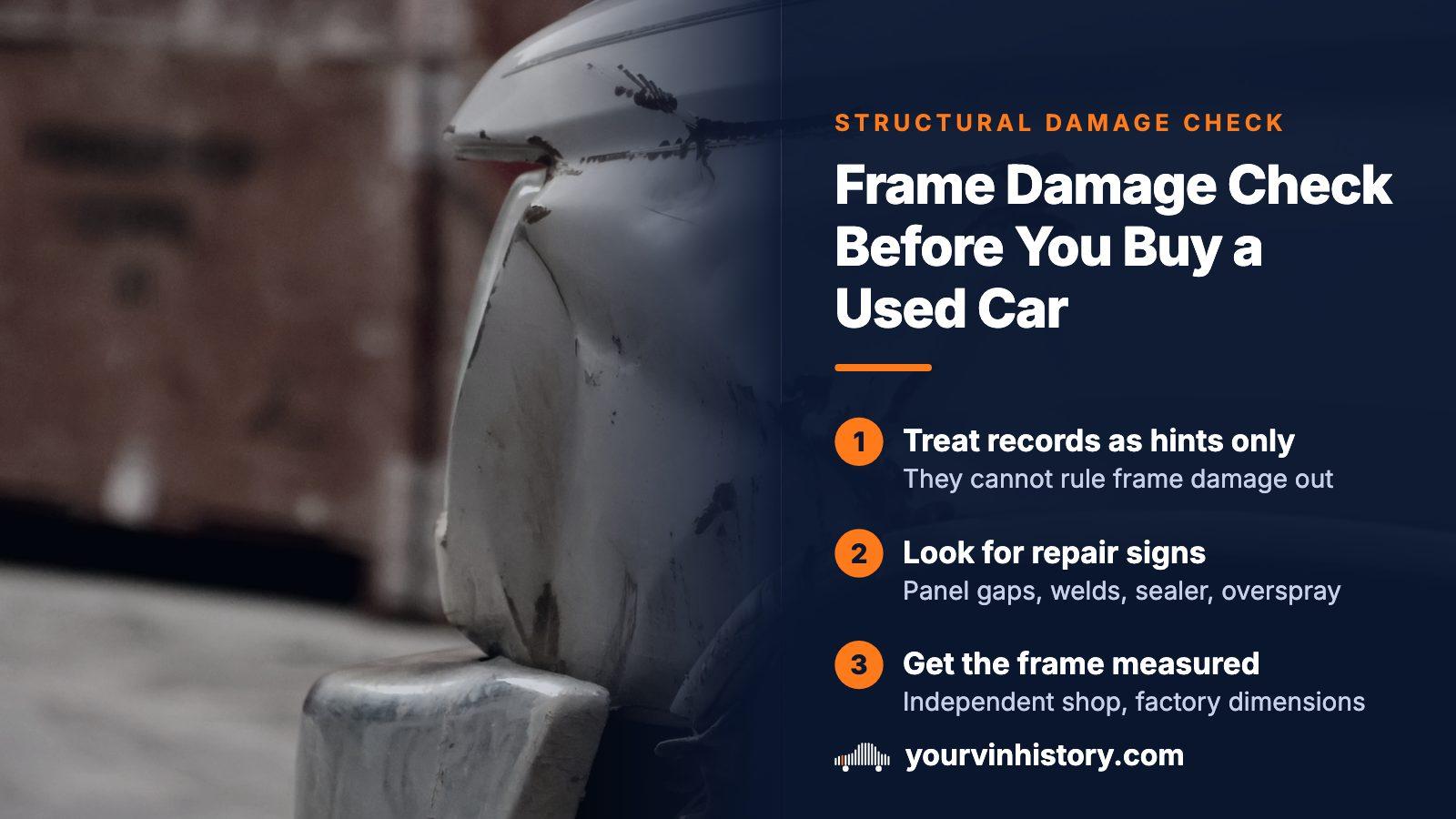
A record can hint at frame damage but cannot rule it out. Federal total-loss reports need not state the cause of a loss, and state brands turn on repair cost against value, not on how the structure fared. The only conclusive test is an independent shop's measurement against the manufacturer's dimensions. Panel gaps, welds, sealer and overspray show that shop where to look.
- What triggers a brand
- Repair cost against the car's value, not the damage type
- Federal insurer report
- Five required items; the cause of loss is only encouraged
- Conclusive test
- Independent shop measures the car against factory dimensions
- Certification label
- Tied to the build date; the rule describes no renewal after repair
Unibody or body-on-frame: what the seller means
The phrase covers two builds. Most modern cars and crossovers are unibody: the shell itself carries the loads, so there is no separate frame to bend, and crushed rails or pillars are damage to the structure you sit inside. Pickups and some large SUVs are body-on-frame, with a ladder-style frame under a body that bolts on. Their panels can be wrecked while the frame survives, and a frame can sometimes be straightened or swapped.
Neither layout is safer by default; the difference is how much margin a repair has. A unibody must be pulled back to exact dimensions because structure and cabin are one piece. When a seller says frame damage, first work out which kind of vehicle they mean.
What the federal insurer report must contain
Under 28 CFR 25.55, an insurer that takes in a junk or salvage vehicle files a report, and the required contents concern identity and timing:
- The carrier's name, address and contact details
- The VIN
- The date the carrier obtained the car or designated it junk or salvage
- Who the car came from, and who held it when it was designated
- The owner at the time the report is filed
The reason the carrier ended up with the car (flood, fire, collision, theft and recovery) sits in a separate paragraph that only says carriers are strongly encouraged to supply it. A compliant report can show a write-off without saying the car was in a crash, and collision is the cause that bends structure.
Why an insurer's write-off says little about structure
Whether to write a car off comes down to the repair bill against the car's value, which says nothing about the structure. A valuable car with structural damage can stay under the line and keep a clean title, while a cheap old car can be totaled by a bill for cosmetic damage.
| State | What triggers a salvage brand | Age condition |
|---|---|---|
| Texas | Repair cost above the car's value immediately before the damage | Any model year |
| Wisconsin | Repair cost above a set share of fair market value, using the higher of estimate or actual bill | Car must be under seven years old |
Picture a repair bill that reaches 75 percent of a car's value. On a young Wisconsin car, that is salvage. In Texas the same wreck falls short of the salvage definition, because the bill never passed the car's full value. A clean title tells you only that the arithmetic stayed under a line.
What a rebuilt title does and does not check
A rebuilt brand sounds like proof that someone checked the repair. The paperwork says otherwise. In Texas the owner files a Rebuilt Vehicle Statement that identifies the car, explains the repairs and, if used parts went in, names the part number or donor VIN for the body, frame or engine. A buyer of an already-rebuilt car may write that the repairs are unknown. Nothing there is a measurement.
Wisconsin sends a repaired salvage car to an authorized inspector, at a State Patrol post or another listed agency, by appointment. The state says the purpose is to confirm the car and its parts are not stolen, and that it has required equipment and is safe to operate. That has real value, but it is not a comparison of the shell with factory dimensions.
Why the factory certification does not cover a repair
Every new passenger car sold in the United States carries a label beside the driver's seat, on a door edge or pillar, showing its month and year of manufacture. Under 49 CFR 567.4, that label states that the car met every federal safety, bumper and theft prevention standard in force on that date.
The date is the point. The label describes the car as built, and the section says nothing about a replacement label after a collision repair. Once sections have been cut out, pulled straight or welded in, nothing in this rule certifies the result.
A repair is a claim, not a certificate
A good repair can restore how the structure absorbs a crash. You are still trusting one shop's workmanship and records, which is why measurements outweigh an invoice.
Signs of structural repair you can spot yourself
None of this replaces a measurement, but it costs nothing and tells you whether one is worth ordering. Work in daylight on level ground and compare each side of the car with the other.
| Where to look | What a repair leaves behind |
|---|---|
| Gaps around doors, hood and trunk | Gaps that narrow or widen along their length, or differ left to right. A door that must be lifted to latch points the same way. |
| Paint in daylight | Texture or shade shifting between panels. Sight along the surface, not straight at it. |
| Seals, trim, glass edges and underbody | Paint where it was never meant to go. It reveals the true edge of the repair. |
| Seam sealer | Factory sealer runs in a consistent machine pattern. Replaced seams are sealed by hand and look different. |
| Welds near pillars, rails and the front support | Factory spot welds look like tidy, evenly spaced dimples. Welds ground flat or irregularly spaced suggest a replaced section. |
| Bolts on fenders, hinges and bumper mounts | Tool marks cracking the paint around bolts that should never have been turned. |
A single oddity is a question for the seller; a cluster in one area justifies a measurement.
Photos taken before the repair
The nearest thing to direct evidence is the set of photos shot when a damaged car was listed at a salvage auction. They predate any work, so crushed radiator supports, wheels at odd angles or a car loaded on a flatbed are visible. A yourvinhistory report includes salvage and auction records with photos where they exist.
Two cautions. A blank result is normal, since most cars never see an auction, and it proves nothing. The photos also show the damage, not the quality of the fix, so treat them as a list of points for the measuring shop.
Five questions to put to the seller
Ask plainly, ideally before the test drive.
- Has anyone repaired structural or frame damage on this car, as far as you know?
- Do you have invoices, and do any mention structural work or frame sublets?
- Was the car measured after the repair, and do you have the printout?
- Which shop did the work, and will you let me call them?
- Will you allow an independent shop to measure the structure before I pay, at my cost?
A seller holding a post-repair printout will hand it over at once, since it is the best proof they own. A refusal on the last question has answered it. No accusation is needed.
What a dealer can be held to, and what a private seller escapes
The FTC Used Car Rule gives you something to hold a dealer to. The as-is box on the window form limits warranty coverage after the sale; it is not permission to misdescribe the car. Three provisions in 16 CFR Part 455 matter:
- 455.1 lists misrepresenting a used vehicle's mechanical condition as a deceptive dealer practice
- 455.3 makes the window form override any contrary term in the sales contract
- 455.4 bars oral or written statements that alter or contradict the required disclosures
How far mechanical condition reaches into body structure is a legal question, so treat this as a reason to get answers in writing, not a guarantee. Put any claim about structural history into the signed sale paperwork. The rule applies once a seller has sold five used vehicles in the previous twelve months, so a one-off private seller sits outside it, though state misrepresentation law still applies.
Ordering a structural measurement
Do the cheap steps first: the VIN through NHTSA's recall lookup and NICB's VINCheck, both free tools from other organizations, then a history report and the auction photo search. Then pay for the measurement. A shop puts the car on a bench or jig, or uses an electronic measuring system, and compares structural reference points with the manufacturer's published dimensions, returning deviations in millimeters point by point.
- Pick a shop with nothing riding on the sale: not the seller's, and not one the seller recommends.
- Request a structural measurement by name. A standard pre-purchase inspection often amounts to a drive, a look underneath and a code scan.
- Hand over any pre-repair photos so the shop knows where the impact landed.
- Ask for the printout, not only a verdict.
- Have the airbag control module scanned on the same visit.
Reading the printout and pricing the car
Three habits carry most of the meaning.
- Look for clusters. Small, scattered variation is ordinary manufacturing tolerance, while a group of larger deviations in one area marks an impact zone.
- Check which points deviate, not only by how much. One corner off tells a different story from a whole rail off.
- Compare left with right. Structures are largely symmetrical, so a mismatch between sides can say more than either side against the specification.
Read the numbers before the technician's summary, so the summary is something you weigh rather than inherit. A repaired car is not automatically a bad buy, since structural repair is routine. A documented repair with a clean printout is worth less than an undamaged twin and more than an unmeasured one. If the owner cannot say whether it was measured, treat the price as a gamble or walk away.
Where this information comes from
- eCFR: 49 CFR 567.4, certification label — Where the label goes, what a passenger car's statement says, and why it is tied to the build date.
- eCFR: 16 CFR Part 455, FTC Used Car Rule — Source for the misrepresentation ban, the window form overriding the contract, the contradiction ban and the definition of a dealer.
- 28 CFR 25.55: responsibilities of insurance carriers — Lists the items a carrier must report on a junk or salvage vehicle, and shows the reason for the loss is only encouraged.
- TxDMV: Salvage/Nonrepairable Motor Vehicle Manual — Texas salvage definition measured against pre-damage value, plus what the Rebuilt Vehicle Statement asks the owner to disclose.
- Wisconsin DOT: Salvage Vehicle Inspecting Agency List — Shows repaired salvage cars go to authorized inspectors by appointment, at State Patrol posts and other listed agencies.
Sources and photos: Facts checked against the sources above in October 2026. Photo by Everett Pachmann on Unsplash; diagrams by YourVINHistory.
Keep reading
- VIN accident checkWhat accident records can and cannot show, and where the gaps are.
- Auction history by VINHow to find the pre-repair photos that show where an impact landed.
- Rebuilt title inspectionWhat a state inspection after a rebuild actually examines.
- Pre-purchase inspectionWhat an independent inspection covers and how to add a measurement to it.
Frequently asked questions
Will a vehicle history report show frame damage?
Sometimes it carries a clue, such as an accident entry, a total-loss record or auction photos taken before repair. A yourvinhistory report lists accident records with a damage map. None of those entries has to describe the structure, so an empty report does not prove the frame is straight.
Does a clean title mean the frame is straight?
No. A clean title shows that no brand was triggered, and brands follow repair cost against value, with age cutoffs in some states. An expensive car can take serious structural damage and stay under the line. Damage below a state's cutoff leaves nothing to brand, so ask for repair invoices and any measurement printout.
Was the frame inspected if the car has a rebuilt title?
A rebuilt title means the state accepted the paperwork. Texas accepts a repair statement that can say repairs are unknown when the owner bought the car already rebuilt, and Wisconsin adds an inspection aimed at stolen parts and safe operation. Neither is a dimensional check, so measure a rebuilt car before paying.
Can a dealer hide frame damage by selling the car as is?
An as-is sale limits warranty coverage after you drive away. It does not let a dealer misstate a car's mechanical condition, which the FTC rule treats as deceptive. Whether a dealer must volunteer past structural repairs depends on state law, so ask directly and get the answer into the signed paperwork.
Can a car with frame damage be repaired properly?
Yes. A car pulled back to specification on a measuring system and documented is a different purchase from one eyeballed straight. What matters is evidence: a printout, invoices and ideally the pre-repair photos. Without them you rely on the seller's account, and the price should reflect that.
Now check the car itself
The guide explains what to look for. The report shows what this VIN has on record.