THE SHORT ANSWER
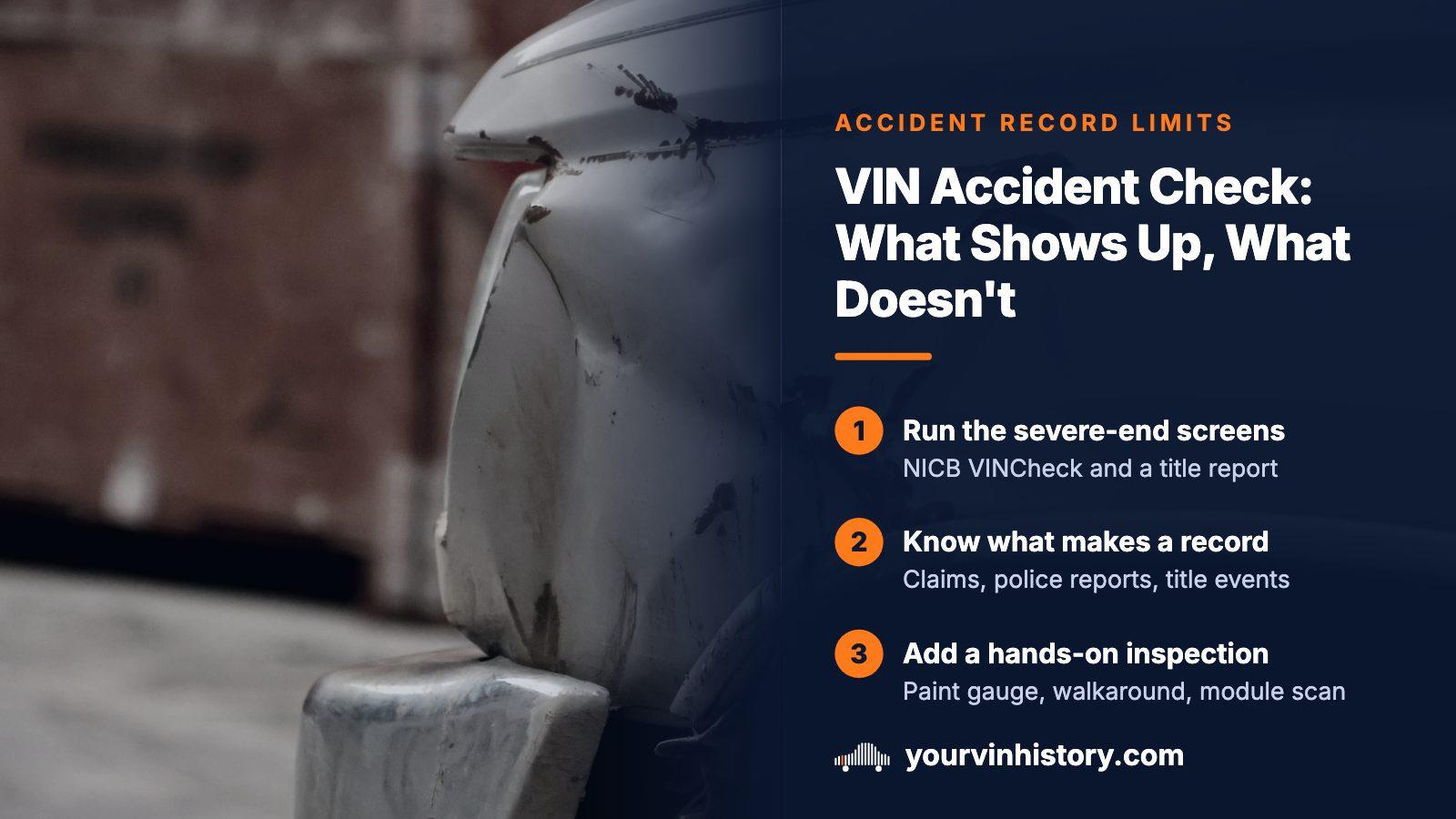
Only partly. A VIN check finds accidents that produced a record: an insurer total loss, a title brand, a paid claim or a repair at a shop that reports. NICB VINCheck and a federal title report cover the severe end. Cash repairs and smaller collisions often appear nowhere, so pair any report with a paint-thickness reading, a body walkaround and a scan of every module.
- Free screen
- NICB VINCheck flags theft and insurer-reported total losses
- Federal title record
- Brands, total loss, salvage and odometer, but no repair history
- What makes a record
- A claim, a police report, a title event or a reporting shop
- Leaves no trace
- A cash repair at an independent shop
A VIN opens filing cabinets, it does not hold a crash log
The seventeen characters stamped on a car describe how it was built: manufacturer, model, engine, plant, year. Nothing about its later life is encoded in them. When a lookup returns accident information, that information came from a separate database that logged an event under the car's number.
Insurers keep claim files. States keep title files. Salvage buyers keep sale files. Repair shops keep job files, and only some share them with anyone. A search can only find what reached one of those cabinets, and a crash that never generated a page is invisible at any price.
Who has a reason to write a crash down
Records exist because somebody had a duty or a business reason to create one. Follow the paperwork and you can predict what a search finds.
| What happened | Record it can leave |
|---|---|
| Insurer paid out and wrote the car off | A title brand and a total-loss entry that NICB and the federal title system can reach |
| Insurer paid a smaller claim | A claim entry that commercial report networks may carry |
| Police attended the scene | A crash report that some commercial networks see, depending on the jurisdiction |
| A reporting shop repaired the car | A service line inside that shop's network only |
| A dealer fixed an airbag deployment | Occasionally the manufacturer's service history |
| An independent shop repaired it for cash | Nothing |
The pattern is blunt. The more an insurer or a government office touched the crash, the better the odds that a trace exists.
Severe damage gets reported by duty, moderate damage by choice
A write-off is the one kind of crash that is hard to bury. The federal title system draws on state and local titling authorities, salvage yards and insurance companies, so a car that an insurer totals tends to surface as a brand or a total-loss entry.
A body-shop repair well short of a write-off sits on the other side of the line. Reporting it is up to the shop, and a commercial network learns of the work only if that shop sends data.
Two clean results, two different meanings
A clean federal title record is solid evidence that nobody ever wrote the car off. A clean commercial report is thin evidence that it never had a moderate collision, because silence may only mean that no one filed. Treat them as separate answers to separate questions.
Free checks that earn a few minutes
Several no-cost lookups exist, and each takes only a minute.
- NICB VINCheck screens a VIN for theft and for total losses reported by participating insurers.
- The NHTSA recall lookup shows open safety recalls, a separate matter from crash history that still affects what you are buying.
- A VIN decode checks the listing's claimed trim and build against the factory record, which exposes mismatched ads but says nothing about damage.
- State title tools, where a state offers one, can show the current brand status.
- The seller's own paper trail, such as repair invoices or an insurer's settlement letter, often gets handed over casually.
Be skeptical of any page that promises a full crash history at no charge. No source holds one, so the offer is usually a sign-up form dressed up as a report. And a quiet NICB result means only that no participating insurer reported a total loss.
What the federal title record covers, and what it leaves out
NMVTIS, the Justice Department's national title database, is the cheapest way to see the most consequential outcome of a crash. A report built from it lists the current title state and last title date, brands applied by any state, the odometer reading, total-loss history and salvage history. Consumers buy these from approved data providers for a few dollars.
It is deliberately narrow. The government's own explanation says the report leaves out private provider data such as repair histories, recall information and maintenance records, and it advises an independent inspection before you buy. The Federal Trade Commission likewise says a history report may list accidents and flood damage but is no replacement for a mechanic's look.
A yourvinhistory report starts from NMVTIS title records supplied by ClearVin LLC, an approved provider, then adds accident and salvage detail, including a damage map and auction photos where they exist.
Estimate, spend, payout: three numbers behind a brand
Sellers like to say a repair came in under the limit. Whether that settles anything depends on the state, because each runs its brand test on a different number.
| State | What triggers the brand |
|---|---|
| Wisconsin | On a car under seven years old, repair cost above 70% of market value, counting the larger of the estimate and the actual bill. A separate Insurance Claim Paid brand covers an insurer taking a car of that age on a claim of 30% through 70%. |
| North Carolina | Either repair cost plus making the car safe to drive above 75% of fair retail value, or an insurer paying a claim above 75%. |
| New Jersey | Within eight model years, a licensed shop or insurer estimate that equals or exceeds market value. For older cars of enough value, the same estimate test or an insurer settling a total loss. |
Read the rows side by side and the trap shows. An estimate, a final bill and an insurer's payout are three different figures, and a seller can truthfully quote the one that stayed under the line while another crossed it. In New Jersey the highest estimate counts when several exist, and one prepared by the owner does not.
Put narrower questions to the seller
Asking whether a car was ever in an accident invites a one-word answer. These prompts ask for specifics you can check.
- Ask whether any insurance claim was paid on the car, and roughly how large it was.
- Ask how many repair estimates exist and what the highest one said.
- Ask what was actually spent, and request the invoice or the shop's name.
- Ask whether an insurer ever took ownership of the car, even briefly.
- Ask whether an earlier owner received a claim payment.
None of these settles the brand question alone. They point you toward the record to look for and show whether the story matches it. A seller who truly cannot say whether a claim was paid has told you the conversation will not settle it.
Some states also put the seller's knowledge on paper. North Carolina's form MVR-181 is a damage disclosure statement covering collision damage, salvage history, flood exposure, recovered theft and reconstruction, so ask whether your state has an equivalent.
The crash that never made it onto paper
Picture two drivers who clip each other in a parking lot. One has a high deductible and a clean record worth protecting, so they agree on a number, shake hands, and the damaged car goes to an independent body shop. No claim, no police report, no title event, no data feed. Two years later the car is for sale and every search returns a spotless result. The searches are not wrong. Nothing was ever filed.
Multiply that scene by every owner who decides a claim would cost more in premiums than the repair, and a clean report and a hands-on inspection plainly answer different questions. The first tells you what got logged. Only the second tells you what happened.
Finding repairs the records missed
Physical evidence needs no one to have filed a report. Start with the body, then have a shop read the electronics.
- Panel gaps: run a fingertip along each seam, because factory gaps stay even and repaired ones drift.
- Paint thickness: an inexpensive gauge reads refinished panels as thicker than original paint.
- Low light: crouch at a corner and sight along the side for shifts in texture or color.
- Overspray: look for stray paint on rubber seals, in wheel arches, around the fuel filler and along the hood's underside.
- Fastener paint: cracked paint or rounded corners on a fender bolt mean the panel has been off.
- Date codes: stamped dates on glass, headlights and the radiator support should land close to the build date.
Then have a shop scan every module, not only the engine computer. Earlier fault codes, the airbag system's status, and part numbers or programming dates that look wrong for the car's age can all point to work nobody reported. If the airbag control unit was swapped and no crash was ever reported, ask why before money changes hands.
A sensible order for the whole check
- Decode the VIN and confirm the car matches the listing.
- Run NICB VINCheck and the NHTSA recall lookup.
- Pull the federal title record from an approved provider.
- Add a paid commercial report if the price justifies it, because its accident networks collect data the federal system lacks.
- Inspect the body, measure the paint and scan every module before you agree on a price.
The first three steps cost little and can end a negotiation early. Save the last two for cars that survived the cheap screen. A yourvinhistory VIN search begins with a free preview before you decide on a full report.
Where this information comes from
- NMVTIS: consumer information — Names the approved data providers consumers can buy a federal title record from.
- FTC: buying a used car from a dealer — Explains that a history report may list accidents but cannot replace an independent inspection.
- WisDOT: form MV2849, title application and branding notification — Source for Wisconsin's repair-cost test and its separate Insurance Claim Paid brand.
- NCDMV: form MVR-181, damage disclosure statement — North Carolina's salvage definition with its two routes, plus the written disclosure a seller signs.
- NJ MVC: salvage certificates of title regulations — New Jersey's economically-impractical-to-repair test, including the highest-estimate rule.
- NICB: VINCheck — The no-cost theft and total-loss screen built on participating insurers' reports.
Sources and photos: Facts checked against the sources above in October 2026. Photo by Everett Pachmann on Unsplash; diagrams by YourVINHistory.
Keep reading
- Salvage title VIN checkThe next step when a search turns up a salvage or total-loss entry.
- Frame damage checkHow to measure for structural damage that records tend to stay silent about.
- NICB VINCheck explainedA closer look at what the free NICB search covers and where it stops.
- Total loss threshold by stateWhy published threshold tables disagree with each other from state to state.
Frequently asked questions
Can I check a VIN for accidents for free?
Only in part. NICB VINCheck is free and flags theft plus total losses that participating insurers reported, and the NHTSA recall lookup is free for open recalls. A clean result from either says little about fender-benders, because neither reads claim files for ordinary repairs. A complete crash narrative is not free from any legitimate source.
Does a clean title mean the car was never in an accident?
No. A clean title means no state applied a brand, and brands attach only when damage crosses a legal line, such as a share of market value or an insurer total loss. Plenty of crashes fall below it. The federal system records brands from any state, so crossing a border does not erase one, but it cannot show damage that never reached the line.
What is the best way to check a used car for accident damage?
Combine the records with a professional look. The FTC recommends an independent mechanic's inspection even for certified cars and suggests getting a written report with a cost estimate to use in price talks. Ask for a paint-thickness reading and a scan of every module as part of it, since those two find repairs that no database lists.
Will a free VIN decoder list past accidents?
It will not. Decoding the seventeen characters yields build facts: make, model, engine, assembly plant and model year. Accident data lives in insurer, police, title and repair records, which are separate systems. Use the decode to confirm the listing matches the car, and be wary of any decoder that claims to show crashes without naming where the data comes from.
Why doesn't an NHTSA complaint about a crash count as this car's accident history?
Owners file those complaints about a failure on a model year, and the record notes whether a crash was involved. It describes how a design tends to fail, not an event attached to your VIN. Use it to decide how closely to inspect a given year, particularly one with steering or braking complaints, never as a finding about one car.
Now check the car itself
The guide explains what to look for. The report shows what this VIN has on record.