THE SHORT ANSWER
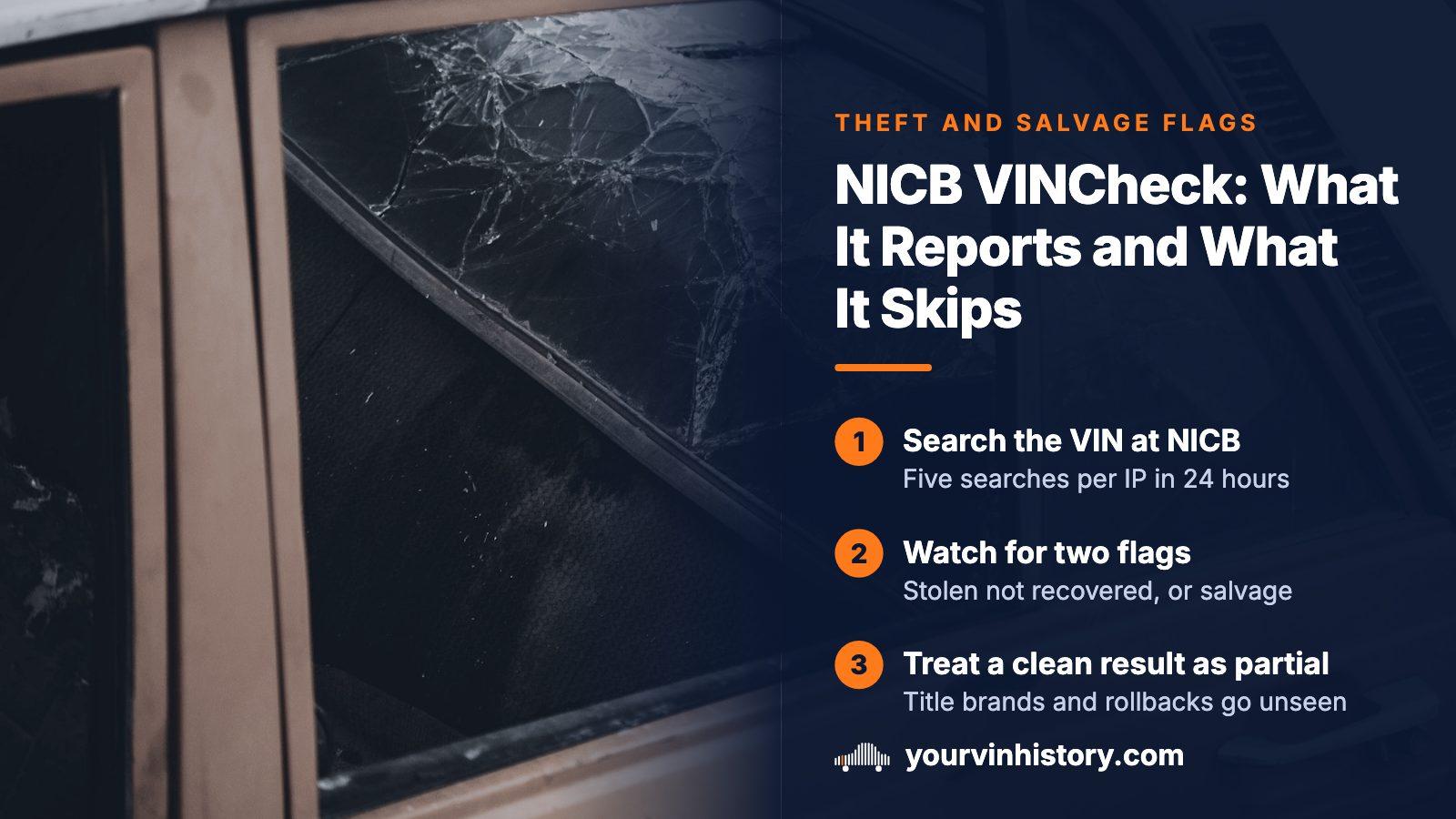
NICB VINCheck is a no-cost VIN search that shows whether a participating insurer has reported a vehicle as stolen and not recovered, or as salvage. No account is needed, and each IP address gets five searches in 24 hours. It covers insurer reports only, so a clean result does not rule out title brands, rolled-back mileage, accidents that never became a total loss, or a car written off without any insurance claim.
- Cost
- No charge and no account at NICB
- Daily limit
- Five searches per IP address in 24 hours
- What it flags
- Theft not recovered, and salvage, as reported by participating insurers
- What it skips
- Title brands, odometer readings, owner counts, accidents short of a total loss
Who runs VINCheck, and who supplies its records
NICB stands for the National Insurance Crime Bureau, a nonprofit that property and casualty insurers fund to fight fraud and vehicle theft. VINCheck is the public window onto theft and salvage records those insurers share with it. There is no sign-up, no fee and no premium tier, so a site that bills you for an NICB lookup is reselling something that costs nothing at the source.
That insurer-funded design cuts two ways. A flag from a company with every reason to report accurately deserves attention. But the database holds only what participating companies chose to send. Think of it as a smoke detector for two specific problems, not a home inspection.
Running a search, step by step
- Read the VIN off the car itself: the tag visible through the windshield on the driver's side of the dashboard, or the label on the driver's door frame. A number copied from an ad has not been checked against anything.
- Open the VINCheck page on nicb.org.
- Type all 17 characters. Partial VINs are rejected, and since a VIN never uses the letters I, O or Q, a character that resembles one is almost certainly a 1 or a 0.
- Accept the terms and submit. The answer appears right away.
- Note the date attached to any record.
Expect a cap. NICB allows five searches from one IP address in a 24-hour window, which is plenty for a single purchase. If you are comparing several cars, decode each VIN first, drop the ones that do not match their ads, and spend your five searches on cars you would actually drive to see.
The two flags VINCheck can raise
| Result | What it means | Sensible next move |
|---|---|---|
| Stolen, not recovered | An insurer in the program says the car was stolen and has not reported it recovered. | Stop. Do not pay or take the car. |
| Salvage | A participating insurer reported the vehicle as salvage, usually after a total loss. It may have been repaired and retitled since. | Ask for repair records and price the car with that past in mind. |
| No record | No participating insurer filed theft or salvage data on that VIN. The next section covers what that does and does not prove. | Keep going: title record, recalls, inspection. |
Records carry a report date, and a salvage entry may name the type of loss when the insurer supplied one. Read the date and the type together. A salvage entry from 2019 on a car for sale today means it was written off, then fixed and retitled at some point since. Alone, that does not rule the car out, yet it changes the price, the insurance options and the questions you should ask. Neither flag tells you how bad the damage was or who owns the car now.
What a clean result does and does not prove
An empty result is the usual outcome, and VINCheck cannot tell you which of three situations produced it. The car may truly have no theft or salvage history. The insurer that handled a loss may not take part in the program. Or the loss may never have reached an insurer at all: the owner carried no coverage, the car was sold for cash right after a flood, or a friend repaired it off the books.
Because of that, all of the following sit outside what the search can see:
- Accident claims that stopped short of a total loss
- Title brands from a state, such as flood, lemon, junk or rebuilt
- Odometer readings logged when ownership changed
- How many owners the car has had
- Damage fixed privately with no claim filed
- Open safety recalls
- Liens held by a lender
- Salvage auction records
Read an empty result narrowly
It means only that no participating insurer filed theft or salvage data on that VIN. It is not evidence that no record exists anywhere.
Where federal rules send the same kind of data
VINCheck rests on voluntary participation. A separate system, the National Motor Vehicle Title Information System, runs on reporting that federal regulation compels. Under 28 CFR 25.55, an insurance carrier must report monthly on vehicles it took possession of and judged to be junk, salvage or a total loss. Under 28 CFR 25.54, each state must send its titling data on every automobile, with all brands noted on the title, once every 24 hours. Junk and salvage yards owe the system a monthly inventory of what they acquired.
| Reporter | Schedule | Destination |
|---|---|---|
| Insurance carriers | Monthly | NMVTIS: write-offs and salvage takeovers |
| Junk and salvage yards | Monthly | NMVTIS: vehicles acquired last month |
| States | Every 24 hours | NMVTIS: titling data, brands included |
| Insurers in the NICB program | Set by NICB membership, not by federal rule | VINCheck |
That split explains why a free search can come back empty on a car whose federal record carries a brand. The brand traveled through the state feed, and the industry lookup never received it. Both systems did their jobs; they simply answer different questions.
Why age changes how much an empty result tells you
The monthly insurer duty in 28 CFR 25.55 applies to vehicles from this model year plus the previous four. A total-loss decision on anything older is not swept in by that particular rule. State titling and yard reporting still apply, and a brand added by a state remains the most durable record a car can carry, but the quickest channel for write-offs thins out as a vehicle ages.
There is no need for alarm, only for proportion. On a newer car, a blank VINCheck plus a clean federal title record is a fairly strong sign. On a car well past that model-year window, put more weight on a hands-on inspection and on the title paper itself.
Lookups to run beside it
VINCheck is one gauge on a panel. Match each question to the tool that actually holds the answer.
| Question | Where to look |
|---|---|
| Reported stolen and not recovered? | NICB VINCheck |
| Called salvage by a participating insurer? | NICB VINCheck |
| Does the title carry a brand? What did the odometer read at each transfer? | NMVTIS data, which consumers can buy through approved providers |
| Any open safety recalls? | The NHTSA recall lookup by VIN, a government tool that costs nothing to run |
| Does the VIN match the build described in the ad? | A VIN decoder |
| Title or registration status? | A state motor vehicle agency tool, where the state offers one |
Recalls deserve a note. A franchised dealer for the brand typically performs a recall repair without charge, but the federal free-repair rule has an age cutoff, so confirm the terms with a dealer before assuming an older car is covered.
Where a paid history report fits
Free tools leave gaps in title brands, mileage readings and accidents that did not total the car. If a vehicle passes your free checks and you still want it, a vehicle history report fills those gaps. At this site the preview of a VIN is free and the full report is a one-time purchase rather than a subscription. It brings together title brands, accident entries with a damage map, odometer readings, salvage and auction records with photos, liens, theft and open recalls, and its NMVTIS title records come from ClearVin LLC, an approved NMVTIS data provider.
Run the no-cost searches first, cross off the cars that fail, and pay only for the one you are close to buying.
If the search flags the car
A stolen-and-not-recovered record is a different kind of finding from everything else here. On the insurer's books the vehicle is still stolen property, and someone who buys stolen goods generally does not end up with good title, however convincing the paperwork looks. A salvage record is serious but not automatically a dealbreaker.
- Stolen: hand over no deposit, accept no keys, and keep the discovery to yourself while you are still standing in the seller's driveway. Give local police the VIN, the address and the listing details. A stale entry, where nobody filed the recovery, is something the seller can fix through the insurer and the state; revisit the deal once they have.
- Salvage: the burden of proof moves to the seller. Ask for repair invoices, the shop's name and the state inspection paperwork behind any rebuilt title, and ask what caused the loss, because hail and a front-end structural hit are both salvage records but very different cars. Then call your own insurer before you commit, since cover for a rebuilt car is often limited and a lender may be harder to find.
Confirm the VIN before you trust the answer
Every lookup is only as good as the number you typed. Compare the windshield plate, the door-frame sticker and the VIN printed on the title. All three should agree character for character. If one looks tampered with, or the stamping varies in style or depth, regard the whole vehicle with suspicion.
Swapped or cloned VINs are how a stolen or written-off car gets dressed up as a clean one, and a database query cannot catch that, because a query trusts the number it receives. Seller screenshots deserve the same suspicion, since an image can show a different car's result. Run the search yourself, on the VIN you read from the car.
Where this information comes from
- NICB: VINCheck — The public lookup itself, with its terms and the daily search limit.
- 28 CFR 25.55: Reporting by insurance carriers — Sets the monthly junk, salvage and total-loss reporting duty and its model-year window.
- 28 CFR 25.54: What states must report — Requires states to send titling information, brands included, every 24 hours.
- U.S. Department of Justice: NMVTIS consumer portal — Explains the federal title system and how consumers reach its data.
- NHTSA: Recalls lookup by VIN — Government search for open safety recalls on a specific vehicle.
Sources and photos: Facts checked against the sources above in October 2026. Photo by Abolfazl Ranjbar on Unsplash; diagrams by YourVINHistory.
Keep reading
- NMVTIS reportThe federal title record that fills most of the gaps a theft-and-salvage search leaves.
- Salvage title VIN checkA three-step order of checks for catching a washed salvage brand.
- Report a stolen carWhat to do first if a stolen flag turns up, or if your own car goes missing.
- VIN cloningHow a copied VIN passes every database lookup, and how to spot one.
Frequently asked questions
Is NICB VINCheck really free, and is there a limit?
Yes. NICB offers it to the public with no fee and no account, and no paid tier exists. The one restriction is five searches per IP address in a 24-hour window. If a site asks for a card number in exchange for what it calls an NICB check, it is charging for something the source gives away.
Will VINCheck tell me about accidents or odometer history?
No. It reports a theft-not-recovered flag and a salvage flag from participating insurers, nothing more. Fender benders, owner counts and odometer history live in other records, such as insurance and auction filings and NMVTIS title data. For those questions you need a different tool.
Why does VINCheck show nothing for a car that was in a wreck?
Most likely the loss never reached a participating insurer as a salvage determination. The car may have been repaired without a claim, handled by a company outside the program, or damaged short of a total loss. Any of those leaves a clean result on a car with a real collision history.
How does NICB VINCheck differ from an NMVTIS report?
They are separate tools. NMVTIS is the federal title system that states, insurers and salvage yards report into, and its data includes brands and odometer readings tied to title events. VINCheck is a separate insurer-industry lookup limited to theft and salvage. They overlap on salvage, but each can hold a record the other lacks.
Could a seller pass off a faked VINCheck result?
A seller can show a screenshot of another vehicle's result, or type a VIN that is not the one on the car. Protect yourself by reading the VIN from the windshield plate and door sticker, then running the search on your own phone or computer. A result you pulled yourself, on the right VIN, cannot be edited by the seller.
Now check the car itself
The guide explains what to look for. The report shows what this VIN has on record.