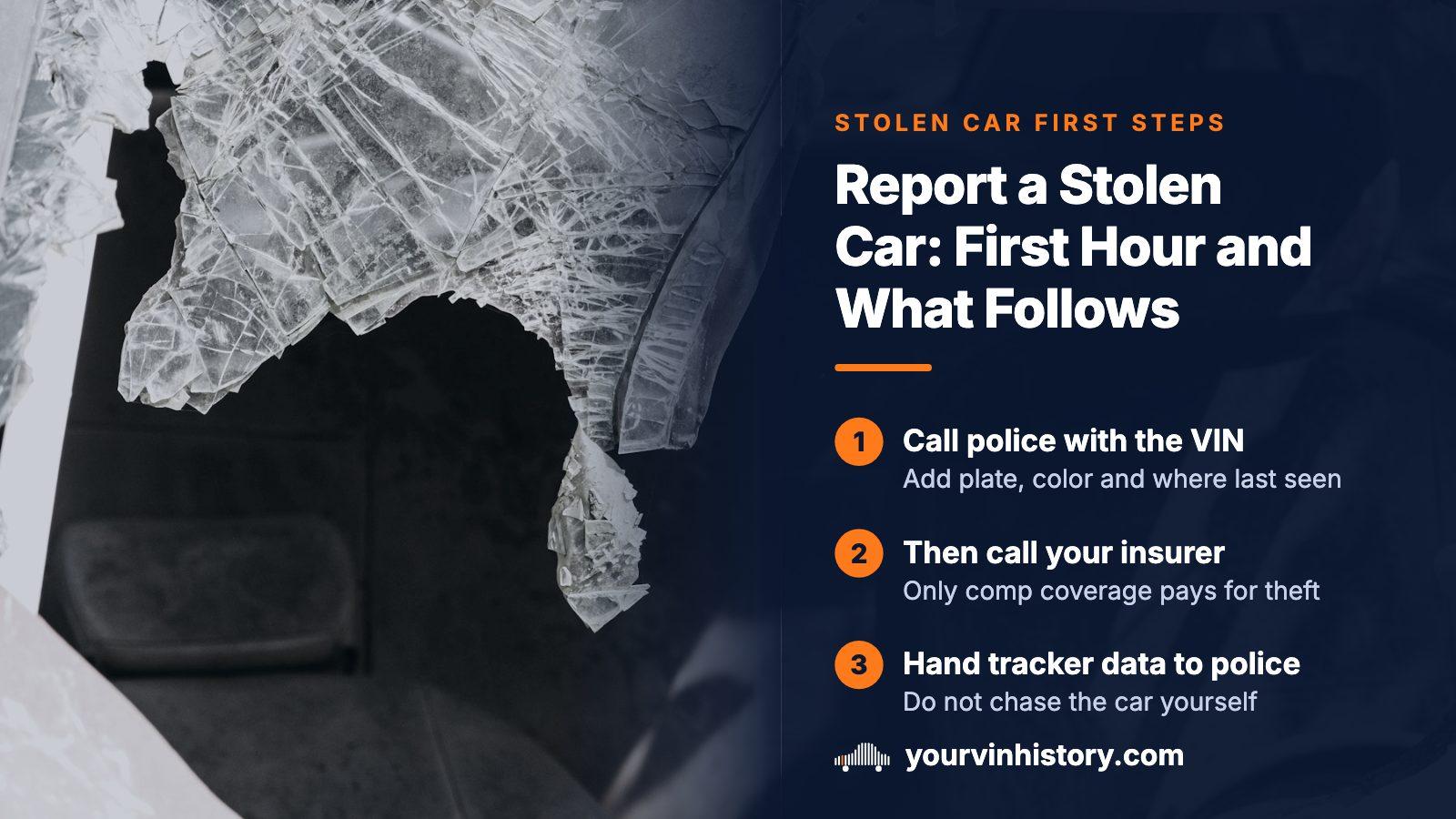
THE SHORT ANSWER
Make sure the car was not towed or repossessed, then call the police and file a theft report with the VIN, plate, make, model, year, color and the time and place you last saw it. Write down the report number. Next, call your insurer, since only comp coverage pays for theft, and your lender if there is a loan. Give any tracker location to police instead of chasing the car yourself.
- Who to call first
- Police, on the non-emergency number, unless someone is in danger
- Identifier that matters
- The 17-character VIN, not the plate
- Typical settlement wait
- Around 30 days, set by policy and state rules
- Liability-only policy
- No payment for theft
Rule out a tow or repossession before you call
Spend two minutes on the dull explanations before telling police a car was stolen. A tow looks exactly like a theft when you face an empty space, and a false alarm wastes everyone's time, yours included.
- Look for tow-away signs on the block, then ask the local towing authority or the police non-emergency number whether a tow was logged.
- If you are behind on payments, ask the lender whether a repossession agent took the car.
- Text the partner, relative or teenager who might have borrowed it.
- Recall any valet stand or repair shop loaner still open.
- Walk the neighboring streets. People misremember where they parked.
What to tell the police, and what to have in hand
Call the non-emergency line unless a theft is under way or someone is at risk. Many departments take reports by phone or online, while others want you in person, so ask before you drive anywhere. Be exact about the last time you knew the car was there; a firm time beats a guess.
| Detail | Where it comes from |
|---|---|
| VIN | Registration, insurance card, title, or a phone photo of the dashboard plate |
| Plate number | Registration, insurance card, or an old photo of the car |
| Make, model, year, color | Registration or the purchase paperwork |
| Features that set it apart | Dents, stickers, aftermarket wheels, a roof rack |
| Last seen: place and time | Your memory, backed by a receipt or a text |
| Keys | Whether any key or fob was inside the car or hidden on it |
| Insurance policy number | The insurance card or the insurer's app |
Ask for the report number before you hang up. The insurer, the lender and the motor vehicle agency will each want it.
Report first, search later
Looking around the block before you call feels productive, but the search delays the moment the car shows up as stolen everywhere else. Make the report, then go and look.
The VIN, not the plate, identifies the car
A plate can be swapped in seconds. The 17-character VIN is stamped and printed in several places on the car and is far harder to alter, which is why a theft record rests on it as well as on the tag number.
Filing the report is what lists the car in the nationwide stolen vehicle database that officers query. From then on, a plate or VIN run anywhere in the country returns a stolen flag. Before that, the same query comes back ordinary, so each hour of delay gives the thief more room.
Most recoveries come from routine events rather than detective work: a traffic stop for something unrelated, an impound lot sweep, an automated plate reader, or someone trying to title or register the car so the record surfaces. Each depends on the VIN being in the system.
Your registration may leave with the car. Photograph the VIN plate and the door-frame label now, and keep the pictures in cloud storage.
The insurer call: coverage, details and honesty
Phone the insurer once you have the report number. Theft is paid under the comp portion of an auto policy. A liability-only policy pays nothing for a stolen car, and the claim ends there. Have these ready:
- The report number and the department that took it
- When and where the car was last seen
- Mileage, as close as you can get it
- Whether keys were inside, answered truthfully
- Aftermarket equipment permanently fitted, such as a stereo or wheels
- Whether the policy pays for a rental while the claim is open
Payment is based on actual cash value: what the car was worth just before it disappeared, minus your deductible. That is a market figure, not the price you paid.
If the car is financed or leased
A stolen car does not cancel a loan. You still owe the lender, and the insurance payment goes toward the balance before anything reaches you. On a recent purchase the balance can exceed the car's market worth, and the difference lands on you unless you bought gap coverage.
Tell the lender early, give them the report number, and ask what they expect you to do about monthly payments until the claim resolves. Request the payoff figure in writing so you can compare it with the settlement later. A lease runs along similar lines, since the owner of the car expects a call.
How a theft claim moves from report to payout
Timing differs by insurer, but the stages arrive in a steady order.
- Opening: you hand over the report number and the details of the loss.
- Waiting period: many insurers hold off for a set stretch, commonly around 30 days, in case the car is found. Policy terms and state rules fix the exact length, so ask the adjuster for the date.
- Review: the insurer confirms coverage and looks at the circumstances. Questions about keys are routine.
- Valuation: actual cash value is set from comparable sales, mileage and condition.
- Payment: with a loan, the lender receives the settlement first; otherwise you do, less the deductible.
- Ownership: the insurer typically takes title to the car. If it turns up later, it is theirs.
Trackers and connected apps: use them, then hand off the result
Many owners have location tools they never think of as such. Open the manufacturer's connected-car app and look for a last known position. Check any aftermarket tracker you fitted. A phone, tablet or tracking tag left in a seat pocket can report the car's position, too. Some manufacturers run a stolen-vehicle assistance line, which you can call alongside the police report.
Pass it on, do not go yourself
People who steal cars can be dangerous, and a confrontation gains you nothing. Give any location you find to the department handling your case, with the report number, and let officers act on it.
Belongings and papers that went with the car
Auto insurance pays for the vehicle, not usually for what was inside it. Laptops, tools, child seats and sports gear are normally a homeowners or renters matter, under that policy's own deductible. List everything while your memory is fresh, add it to the police report, and weigh the total against the deductible before you file again.
Papers matter too. A registration, an insurance card or a garage remote hands someone your home address and possibly a way in. Reset whatever the stolen papers point to, such as a garage keypad, and watch your accounts for signs of identity theft.
When the police call to say they found it
Condition on recovery swings widely, from undamaged and abandoned nearby to stripped bare. Timing decides the next step. Found before the insurer pays, the car is assessed and then repaired or written off as a total loss. Found afterward, it generally belongs to the insurer, though some insurers let you buy it back.
- Leave it where it is until police and the insurer say it can be moved.
- Photograph the car's condition before any tow or repair.
- Look over the VIN plates for tampering, because a recovered car can carry a swapped identity.
- Have a mechanic look at more than the paint.
- Expect impound and towing charges, and ask whether the insurer covers them.
- Run the VIN through the NHTSA recall lookup, a free tool, as part of the inspection.
A theft-recovery brand may land on the title, and it does not wear off. It follows the car through every later sale and lowers its value for good.
For buyers: how to tell if a car was ever reported stolen
Anyone shopping used is on the other side of this story, and two checks speak to theft. NICB VINCheck is a free lookup of vehicles that member insurers reported stolen and that have not been recovered. Since it covers unrecovered cars, one found years ago will not appear, so a clean result is only part of the picture.
The second is a title-record report built on NMVTIS, a federal title information system hosted by the Justice Department and sold through approved data providers. Those reports show title data, brand history, the latest odometer reading, total loss and salvage history, and theft history where one exists. A vehicle history report from this site takes its title records from ClearVin LLC, an approved NMVTIS provider.
An empty NMVTIS result can mean no state reported anything for that car, so pair the paperwork with a hands-on look. Read the VIN on the dashboard plate and the door-frame label. If they disagree, or either looks altered, walk away.
Mistakes to skip now, and habits for the next car
- Delaying the report while you search alone
- Confronting anyone you believe has the car
- Meeting a stranger who says they found it, instead of passing the contact to police
- Overstating what was inside or bending the story on the claim
- Cancelling the policy while the claim is open
- Going quiet on the department handling the case
Nothing makes a car theft-proof; the goal is to be harder to steal than the one parked beside you. Never leave the engine running while you step away. Put a keyless fob in a signal-blocking pouch, kept away from outside walls and doors. Add a visible wheel lock, choose lit and busy parking or a garage, fit a tracker if your model is a frequent target, and confirm today that your policy includes comp coverage.
Where this information comes from
- NICB: VINCheck — A no-cost lookup of vehicles that member insurers reported stolen and not recovered, used here as the buyer's first theft check.
- U.S. Department of Justice: NMVTIS vehicle history — The federal title information system, whose consumer pages describe the brand, odometer, total loss, salvage and theft data an approved provider's report can contain.
- NHTSA: Recalls lookup — A VIN-based recall check that is handy when inspecting a recovered or newly bought car.
Sources and photos: Facts checked against the sources above in October 2026. Photo by Macro.jr on Unsplash; diagrams by YourVINHistory.
Keep reading
- NICB VINCheck explainedHow the theft lookup works and where its coverage stops.
- Where is the VIN number?Find and photograph every copy of your VIN before you need it.
- Theft recovery vehicleWhat a recovered theft does to a title and to resale value.
- Most stolen carsWhich models thieves favor, and what a buyer can check.
Frequently asked questions
Can I report a stolen car online?
Often, yes. Many departments accept theft reports by phone or through an online form, but some insist on an in-person visit, so ask what yours requires. Whichever route you use, finish with a report number in hand, because the insurer will not start the claim without one.
How long should I wait before reporting a car stolen?
There is no reason to wait once you have ruled out a tow or repossession. The car cannot be flagged nationally until a report exists, and a long gap between the last sighting and the report works against recovery. Insurers also expect prompt notice, though your policy may spell out its own terms.
Do I still owe my loan if the car is stolen?
Yes. The theft does not end your obligation to the lender, and the insurer pays the lender first. If the payout falls short of the balance, you owe the difference unless you carry gap coverage. Call the lender early and ask how it wants payments handled meanwhile.
Will my insurance pay for a rental car after a theft?
Only if your policy includes it; it is not automatic. Ask the adjuster on the first call, get the daily limit and the time cap in writing, and keep every receipt. That avoids paying for a rental out of pocket during the wait of around 30 days before settlement.
What happens if the car is found after the insurer has paid?
Once the insurer settles, it typically owns the car, so a later recovery is its business first. Some insurers offer the former owner a chance to buy it back. If you do, inspect it closely and expect the title history to carry the theft, since a theft-recovery brand can stay on the record permanently.
Now check the car itself
The guide explains what to look for. The report shows what this VIN has on record.