THE SHORT ANSWER
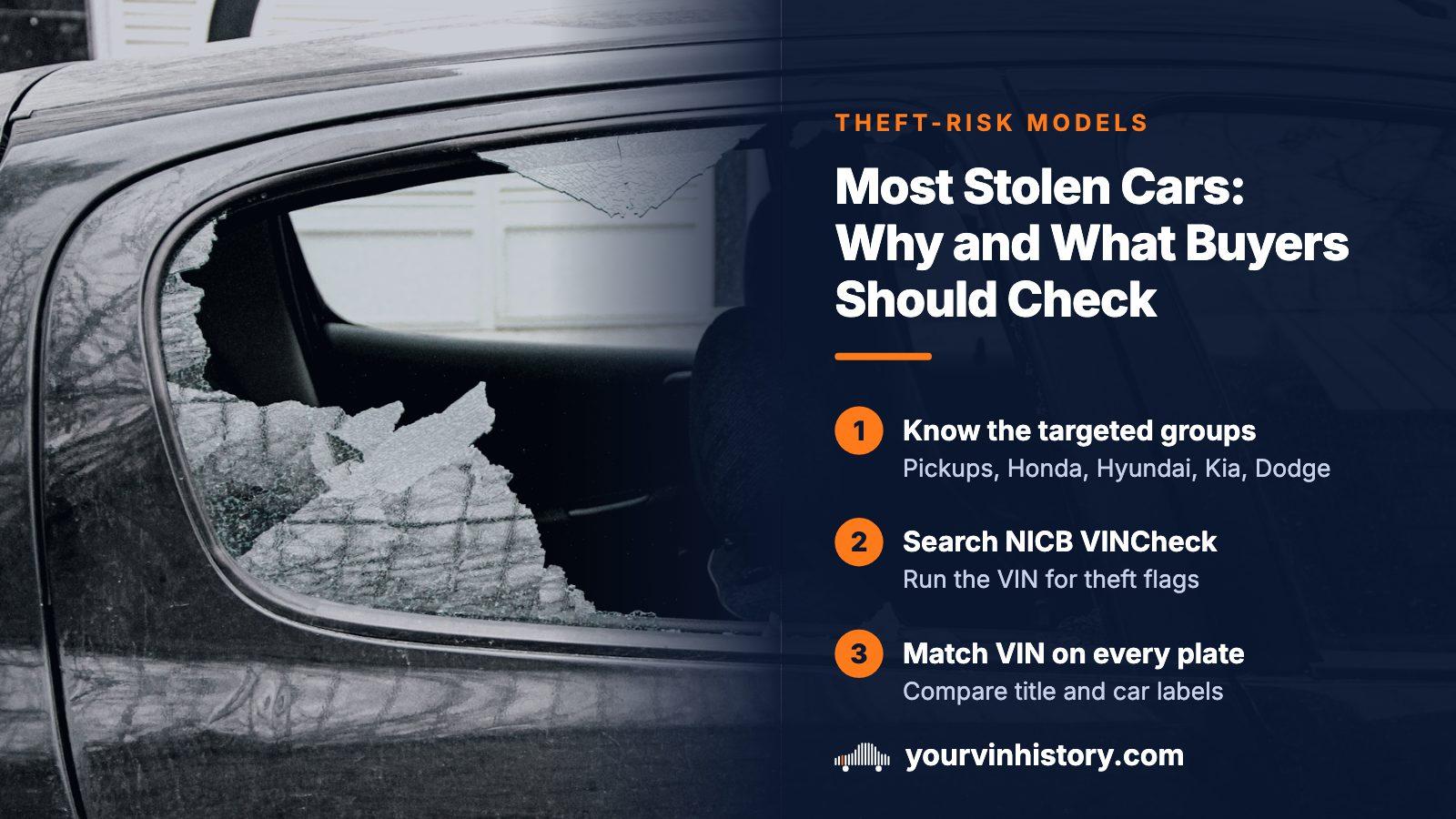
Thieves favor cars that are easy to take and sell: full-size pickups, Honda Civics and Accords, many Hyundai and Kia models from 2011 through 2021 that lack engine immobilizers, and high-horsepower Dodges. NICB publishes the yearly ranking from police theft reports. If you are buying one used, run the VIN through NICB's VINCheck, confirm it matches on every plate and the title, and pull a title record.
- Scoreboard
- NICB Hot Wheels, built from police theft reports
- Weak-lock models
- Many 2011 to 2021 Hyundai and Kia cars with turn-key ignitions
- Marking rule limit
- Trucks and MPVs rated above 6,000 pounds fall outside it
- Screening tool
- NICB VINCheck, searched by VIN
Four groups that keep turning up on theft lists
Full-size pickups from Ford and Chevrolet sit near the top of count-based rankings nearly every year, mostly because there are so many of them. The Honda Civic and Accord are long-time regulars for the same reason, helped by a deep market for their parts.
Two other groups got there through a specific weakness. Many Hyundai and Kia models from 2011 through 2021 have a turn-key ignition and no engine immobilizer. And the high-output Dodge Charger and Challenger trims, the Hellcat family among them, draw thieves with power, resale value and electronics that key-cloning tools can defeat.
Each group is listed for a different reason, and the reason decides what a buyer does about it. A pickup calls for a look at replaced tailgates and wheels, a Hyundai for a question about software, a Dodge for a hard look at the VIN plates.
What a theft ranking counts, and what it skips
The National Insurance Crime Bureau builds its Hot Wheels report from police data. Each vehicle theft report that an agency enters into the FBI-run National Crime Information Center counts as one theft, insured or not, and the totals ignore how many cars of each model are registered.
Lists drawn from insurance claims measure something else. A claim can be filed for a stolen mirror, so a part theft registers where a whole-car theft would not, while thefts of older uninsured cars never reach a claims database.
| Type of list | What it counts | Blind spot |
|---|---|---|
| Police-report tally (NICB) | Whole vehicles reported stolen | Raw counts favor common models |
| Insurance claim rate | Theft claims against insured vehicles | Part-only claims count, uninsured thefts vanish |
Use a tally to see what thieves take. Use a rate, thefts measured against how many of that model exist, to judge the odds for one.
Four reasons a particular car becomes a target
- A weak lock. Without an immobilizer, the engine starts without the key's electronic handshake, which turns a special skill into a routine.
- Street value of power. Performance trims resell well, and the same trims are the ones most often seen cloned under another car's VIN.
- A hungry parts market. A model sold in huge numbers has panels, wheels and tailgates that fit thousands of others, so stolen pieces move with little scrutiny.
- Precious metals. Catalytic converters hold platinum, palladium and rhodium, and a handheld saw removes one in minutes. Hybrids are favored because their converters are barely worn.
Popularity lifts a model in a ranking by count. A flaw lifts it in a ranking by rate.
A fair question for the seller
When a hood, tailgate, ignition cylinder or converter is clearly newer than the car around it, ask what happened to the original, when the work was done and who did it. A dated invoice that fits the story is reassuring. A vague answer is a reason to slow down and pull the records.
The Hyundai and Kia gap, seen from the buyer's side
From 2011 through 2021, many Hyundai and Kia models with a physical key were built without an engine immobilizer, the chip handshake that most rivals had made standard years earlier. A way to exploit the gap spread on social media and bent national theft numbers. The aftermath included insurer surcharges, refusals to cover some models, class settlements, and a manufacturer software update that blocks the engine unless the fob is present.
Not every car from those years is affected. Model, year and ignition type all matter, and a VIN decode confirms the build. Before buying one, settle three things.
- Confirm the anti-theft software update was installed, with a dealer work order as proof.
- Look for repairs to the steering column or ignition. The attack damages both, so a repair suggests the car was targeted.
- Price the insurance. Get a quote on the exact VIN before agreeing to a figure.
The federal rule that puts VINs on stripped-car parts
NHTSA's Theft Prevention Standard states its purpose plainly: cut vehicle theft by making parts from stolen cars easier to trace and recover. Where it applies, the vehicle's identifying number, normally the VIN, goes on each of eighteen named parts the vehicle has, including the engine, transmission, hood, fenders, doors, bumpers, quarter panels and tailgate or hatchback.
| Vehicle | Covered by the standard |
|---|---|
| Passenger cars | Yes |
| Multipurpose passenger vehicles rated 6,000 pounds GVWR or less | Yes |
| Light-duty trucks of 6,000 pounds or less | Only lines NHTSA found high-theft, or tied to a covered car line by shared parts |
| Trucks and MPVs rated above 6,000 pounds | No |
| Makers selling fewer than 5,000 vehicles per year in the U.S. | No |
GVWR means gross vehicle weight rating, printed on the certification label near the driver's door. Read it first, because it tells you whether the rule ever applied to that vehicle.
How a pickup line ends up under the rule
Cars are covered across the board, but light-duty trucks are decided line by line, and the first assessment comes from the maker.
- The manufacturer of a new truck line judges whether its theft rate will land above or below the median for 1990 and 1991, then sends the evaluation to NHTSA at least 15 months before sales begin.
- NHTSA reviews the submission and issues a preliminary determination.
- The manufacturer has 30 days after the agency's letter to ask for reconsideration.
- With no request, the determination becomes final 45 days after the letter.
A second route covers a low-theft truck line that shares most major interchangeable parts with a covered car line. Thieves take parts, not badges, so marking one and not the other would leave a hole. With a 1990 and 1991 median as the yardstick, the rule is a parts-tracing tool, not a current risk ranking.
What a factory label does when someone tampers with it
The standard also says how the number goes on. A label must be printed indelibly and permanently attached, and where practicable sit on an interior surface, one not directly exposed to sun and precipitation. The spot should survive installation tools, collisions and dealer rustproofing, and the number must stay readable once the part is off the car.
The tamper behavior is what helps a buyer. Peeling the label must make it tear or smear the number, and must leave label or adhesive residue as evidence that something was there. Altering the printed number has to leave some of the original showing, or visibly mar the label material.
Replacement parts follow a different pattern: they carry the replacement maker's trademark and the letter R instead of the VIN. A door with an R mark is probably a legitimate repair part. A door with scraped residue and no readable number, on a car whose line was marked, earns a question for the seller, not an accusation.
Why unmarked panels prove less than they seem to
A door or fender with no number on it tells you very little. Several ordinary explanations come before tampering.
- The vehicle sits outside the rule: a truck line never designated, or a truck or MPV rated above 6,000 pounds.
- The maker is a small one, selling under 5,000 vehicles annually in the U.S. market.
- The line was released from marking because the maker fitted a qualifying antitheft device.
- The car predates the requirement for its class.
- The panel is a replacement part, which carries a maker's mark and an R in place of a VIN.
So a bare panel has several innocent stories and one bad one. Treat markings as supporting evidence, useful mainly on a car whose line was covered. The VIN checks come first.
A short routine for checking one car's theft history
- Run the VIN through NICB's VINCheck. It searches records from participating insurers for vehicles reported stolen and not recovered, and for salvage. It does not search police files, so a clear result narrows the odds without closing the question.
- Compare the VIN on the dashboard plate, the door-jamb label and the title, plus any etching on the glass. All must agree. A mismatch is the signature of a cloned or altered car.
- Pull a title record from an approved NMVTIS provider. The federal system can show title, odometer, brand history and, in some cases, historical theft data.
- If the seller admits a past theft, ask for the police and insurer paperwork.
- Get an insurance quote on the exact VIN before you sign anything.
A yourvinhistory report gathers title brands, theft, salvage and auction records, and insurance records for a VIN. Start with the preview, then decide whether the full report is worth buying.
Cloned cars and recovered thefts are different problems
A cloned car is a stolen vehicle wearing the VIN of a legitimate one of the same make, model and year, so its paperwork looks real. The federal NMVTIS site describes a multistate case built on exactly this trick. Catching one is a physical job: match the plates, the title and the car itself.
A recovered theft is the honest version of the problem. If an insurer paid out and wrote the car off, that decision should surface in the title record, and such a car can be a fair purchase when it is inspected carefully and priced as what it is. The real risk is a seller who stays quiet about it.
Where this information comes from
- NHTSA via GovInfo: 49 CFR Part 541, Theft Prevention Standard — Backs the list of eighteen marked parts, which vehicles are covered, the 6,000 pound cutoff, the small-maker exclusion, label tamper behavior and the R mark on replacement parts.
- NHTSA via GovInfo: 49 CFR Part 542, light truck line selection — Backs the step-by-step process for new truck lines, including the 15 month filing, the 30 day reconsideration window and the 45 day finality rule.
- NICB: Hot Wheels vs. theft claim rate reports — Explains why a tally of police reports and a rate built from insurance claims produce different rankings.
- NICB: VINCheck — The no-cost search that screens a VIN against participating insurers' theft and salvage records.
- Bureau of Justice Assistance: NMVTIS consumer information — Describes what the national title system can show a buyer and how stolen and cloned vehicles figure in it.
Sources and photos: Facts checked against the sources above in October 2026. Photo by Ali Aliakbari on Unsplash; diagrams by YourVINHistory.
Keep reading
- NICB VINCheck explainedThe theft screen in step-by-step form, with the gaps a clear result can hide.
- Theft recovery vehicleWhat a recovered stolen car carries on its title and how to price it.
- NMVTIS reportThe federal title record that can show theft write-offs and brands.
- Report a stolen carIf you own a targeted model, the first steps to take after a theft.
Frequently asked questions
Which cars are stolen most often in the United States?
NICB's Hot Wheels report is the reference, and it shifts from year to year. Full-size Ford and Chevrolet pickups, the Civic and the Accord appear most often, while Hyundai, Kia and some Dodge muscle cars climb in the years when thieves found a way in. Check the newest edition.
Why were so many Kias and Hyundais stolen?
Many models from 2011 through 2021 had a turn-key ignition and no immobilizer, so the engine could be started without the key's chip. Owners can ask a dealer about the anti-theft software update, and a steering wheel lock adds a visible hurdle. Buyers should ask for proof of the update and inspect the steering column.
How do I check whether a used car was reported stolen?
Start with NICB's VINCheck, which searches participating insurers' records for vehicles reported stolen and not recovered, plus salvage. It does not search police files, so also compare the VIN on the dashboard plate, door label and title, and pull a title record. A theft recovered without a write-off may leave little to see, so ask the seller directly.
Why are catalytic converters stolen?
The converter holds platinum, palladium and rhodium, which are worth real money as scrap, and it sits under the car where a saw reaches it. Hybrids and high-clearance vehicles are favorite targets. If the exhaust is loud or the seller mentions a recent replacement, ask for the receipt and look underneath.
Should I avoid a used car from a frequently stolen model?
No. A popular target is not a flawed car, and most examples were never touched. What changes is how much checking it deserves: a VIN screen, matching VIN plates, a look for a repaired column or fresh parts, and an insurance quote on the exact VIN before you agree to a price.
Now check the car itself
The guide explains what to look for. The report shows what this VIN has on record.