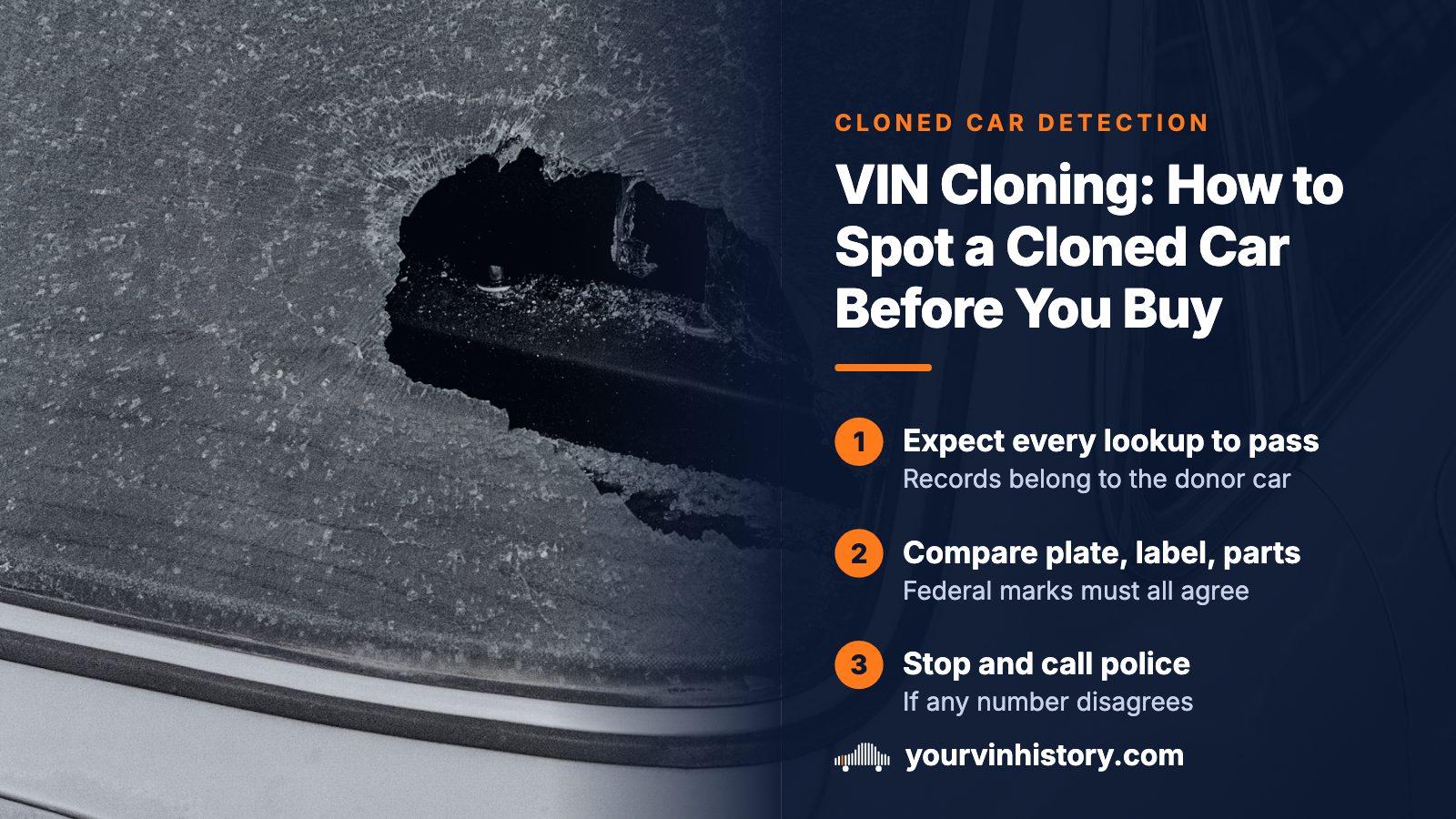
THE SHORT ANSWER
No lookup can reliably expose a cloned vehicle, because the VIN on the stolen car was copied from a real one and the records that return belong to that real car. What exposes a clone is physical: the dash plate, the door label and the numbers federal rules place on engine, transmission and body parts either agree or they do not. If they disagree, stop and call law enforcement.
- What a lookup returns
- True records for the donor car, not the one you are buying
- Uniqueness rule
- No repeated VINs across 60 years, counted from the 1980 model year
- Marked parts
- Up to eighteen on covered vehicles, never all on one
- Federal penalty
- Up to five years for altering an identification number
One VIN, two cars: how a clone is built
Picture a silver sedan in a driveway in one state, titled, insured and ordinary. A thief steals a sedan of the same year, make and model, puts that first car's VIN on it, and sells it in another state. Florida's motor vehicle agency calls the scheme elaborate, resting on stolen numbers, counterfeit VIN tags and forged paperwork, and says the donor is chosen because it is legitimate and still on the road.
Federal rules treat this as impossible. Under 49 CFR 565, no two vehicles built to the federal safety standards within a 60-year window that opens with the 1980 model year should carry the same VIN. A clone breaks that rule by existing, yet the paper shows nothing, because the paper describes the donor.
Why every lookup passes, and what a report can still do
Everything a buyer can query is keyed on the VIN: title records, theft screens, recall lookups, decoders, paid history reports. Each is asked about a real number that belongs to the donor car, and each answers truthfully. The year, make and engine fit, the position-nine check digit is valid because the characters were copied from a real vehicle, and the title history is exactly as clean as the donor's.
A national title database, NMVTIS, is meant to flag a number already titled in one state when someone applies elsewhere. That safeguard works at the motor vehicle office, after you have paid.
A history report still works as a yardstick. It lists the factory specifications recorded for the VIN, so you can hold them against the car you are standing beside. A gap between the two is a thread worth pulling.
Cloning, swapping and re-vinning are not the same thing
The three terms get used interchangeably, yet the physical work differs. Federal law uses none of them.
| Term | What happens to the car | What a lookup shows |
|---|---|---|
| Cloning | A real car's VIN is copied onto a stolen car of the same type | The donor's genuine, clean history |
| VIN swapping | Identity tags are moved between vehicles, or newly made ones are fitted | Records for whatever number is on the car now |
| Re-vinning | A wrecked car's identity is moved onto a different vehicle | A real title history, wrong shell |
Only cloning leaves the donor car untouched. The other two require physical work on the car being sold, and physical work leaves marks.
The dash plate and door label: the easy numbers to fake
Part 565 requires the VIN on cars, multipurpose vehicles and lighter trucks to sit inside the passenger compartment, legible through the glass in daylight from outside, beside the left windshield pillar. Characters must be at least 4 mm tall. That visibility helps inspectors and buyers, and it is also why this plate is the first one a cloner replaces.
The door-jamb label is barely harder to fake. Treat both as evidence of tampering, not proof of identity. Look for scratches around the plate, an adhesive line that does not suit the car's age, a label that sits crooked or has a different finish from its surroundings, and lettering that differs from the rest of the car. Copy the number by hand so you have something to compare against later.
Marked parts: the numbers that are costly to fake
The federal theft prevention standard, 49 CFR 541, exists to help trace and recover parts from stolen vehicles. On covered vehicles it requires an identifying number, normally the full VIN, on a defined set of major parts, applied by label or inscription. A plate swap is quick. Making every marked part agree is slow, and a cloner who skips it leaves a mismatch behind.
- Drivetrain: engine and transmission
- Front end: both front fenders, the hood and the front bumper
- Doors: front and rear on both sides, plus any sliding or cargo door
- Rear end: the rear bumper, plus the decklid, tailgate, hatchback or rear doors, whichever applies
- By body type: rear quarter panels on cars, side assemblies on multipurpose vehicles, the pickup or cargo box on light trucks
Only parts a vehicle actually has need a number, and the body-type entries are alternatives, so no vehicle carries all eighteen. Labels are built to give tampering away: removal should tear them and leave adhesive residue, and altering the number should leave traces of the original. Two or three readable markings, compared with the dash plate, are enough.
When a missing marking proves nothing
A blank spot where a number should be does not make a clone. The standard covers passenger cars and certain multipurpose vehicles and light trucks, and it excludes several groups.
| Situation | Parts marking required? |
|---|---|
| Maker building fewer than 5,000 vehicles a year for the U.S. | Excluded |
| Line producing 3,500 vehicles a year or fewer | Excluded |
| Line with a qualifying antitheft device | May be exempted; an appendix lists the lines |
| Light truck NHTSA has not brought under the standard | Not covered |
So an absent marking is ambiguous: it fits a clone and an exempt vehicle alike. A conflicting marking is different, since no exemption explains a fender or engine number that disagrees with the dash plate. One wrinkle: makers already stamping engines or transmissions with a shortened VIN on October 24, 1984 may continue, provided it covers at least the last eight characters. Compare the tail of the number before calling a short one a mismatch.
A walk-around check, in order
Work through the car in this order.
- Start at the windshield and read the dash plate from outside. Copy the full number by hand and photograph it.
- Next, check the label on the driver's door jamb. See that it lies flat and that the finish around it matches.
- Find part markings you can reach, where practical on an interior surface of a door, the hood or a fender, and compare each with the dash number.
- Match the paperwork. Title, registration and service records should show the same number, spelled correctly. Florida treats misspellings as a warning sign by themselves.
- If any two numbers disagree, end the visit and call law enforcement, not the seller. Time to explain is time to make the car vanish.
Price and paperwork signals that fit the scheme
Florida's motor vehicle agency sees the fraudulent titles first-hand, so its buyer tips are worth reading. No single sign proves a clone, and a few have harmless explanations. Several together, on a car whose markings you could not read, deserve a hard look.
- A price well below comparable models, which is how these cars attract buyers
- A late-model car with no lienholder, when most cars that age are financed
- Misspellings on the title or other paperwork
- Scratches, damage or a mismatched adhesive line at the dash VIN plate
- A seller who insists on meeting somewhere other than the address on the paperwork, or whose name differs from the title
- Pressure to close fast, before the number reaches a titling office
Altered numbers and the law
Under 18 U.S.C. § 511, it is a federal crime to knowingly take off, deface, tamper with or change an identification number on a motor vehicle or part. The penalty is a fine, up to five years in prison, or both. The term means numbers placed under the federal vehicle statutes, so it covers the VIN and parts markings, not any digits on a car.
Some people are exempt, unless they know the item is stolen: scrap processors and demolishers following state law, repairers whose work reasonably requires altering the number, and anyone restoring or replacing a number under state law.
The last group is why a replaced plate alone is not proof of fraud. States run formal replacement procedures, typically after repair or rebuild, and a car that went through one should carry paperwork saying so. Ask for it. A swapped plate with nothing behind it goes to law enforcement, not into a debate with the seller.
Confiscation, the loan, and what to do if you already bought one
Florida states the outcome plainly: once a cloned car's true history surfaces, the car is confiscated and the buyer remains responsible for any outstanding loan. The car goes, the debt stays, and your claim runs against a seller who was not who they said they were. If it has already happened, order matters.
- Photograph every number where it sits before anyone repairs or moves the car. A repairer may lawfully alter a number when a repair truly requires it.
- Report suspected title or registration fraud in writing to your state's fraud unit, and call law enforcement instead of the seller.
- Tell your lender and insurer yourself, with photographs and paperwork ready.
- Save the ad, the texts and emails, and the bill of sale, then ask a lawyer in your state about recovering from the seller.
Do not resell it
Passing the car to the next buyer shifts the loss without ending it. The car stays stolen property no matter who holds the keys.
Where this information comes from
- FLHSMV: Vehicle Cloning — Florida's own description of the scheme, its warning about confiscation and loans, the title database safeguard and its buyer tips.
- 18 U.S.C. § 511: Altering or removing motor vehicle identification numbers — The federal offense, its five-year maximum, what counts as an identification number and who may lawfully alter one.
- 49 CFR Part 541: Federal Motor Vehicle Theft Prevention Standard — The parts-marking purpose, the list of marked parts, the exclusions and the shortened VIN allowance for older engine marking.
- 49 CFR Part 565: Vehicle identification number requirements — The no-duplicates rule from the 1980 model year and the requirement that the dash VIN be readable from outside.
- Bureau of Justice Assistance: NMVTIS vehicle history — The federal title database and the roster of approved providers that offer its records to consumers.
Sources and photos: Facts checked against the sources above in October 2026. Photo by Kenan Reed on Unsplash; diagrams by YourVINHistory.
Keep reading
- Where is the VIN number?Every spot a car carries its VIN, which is the comparison list this check depends on.
- VIN verificationWhat a hands-on examination of the car itself involves.
- NICB VINCheck explainedWhat the NICB theft screen can flag, and why it also runs on the number alone.
- Used car red flagsOther warning signs to weigh next to the price and paperwork clues.
Frequently asked questions
Can a VIN check tell me whether a car is cloned?
Not by itself. A lookup returns whatever is attached to the number, and that number belongs to a real car with a real history. A report's factory specifications can help, because you can compare them with the car in front of you. A mismatch is a cue to inspect the plates and part markings.
Does a valid check digit prove the car is legitimate?
No. The ninth character is calculated from the rest of the VIN, so it only confirms the number is internally consistent. A cloner copies a complete number from a real vehicle, so the digit always works out. It says the number is well formed, not which physical car is wearing it.
What happens if I unknowingly buy a cloned car?
Florida's motor vehicle agency says the car is confiscated once its identity comes out, and you stay on the hook for any loan. Discovery can come at the titling office, so a stalled registration may be the first sign. Document the numbers and report it to law enforcement and your state fraud unit.
Is a replaced VIN plate always a sign of fraud?
No. Federal law lets people restore or replace an identification number in line with state law, and repairers may alter one when a repair requires it. States have formal procedures for this, and a car that went through one should come with documents. Ask for them. A replaced plate with nothing behind it is what deserves a report.
What should I do if the numbers on a car do not match?
Stop the purchase and keep your money. Photograph each number and where it sits, then contact law enforcement instead of asking the seller to explain. A seller who senses suspicion can move the car, and the evidence, elsewhere. Do not hand over a deposit while you wait.
Now check the car itself
The guide explains what to look for. The report shows what this VIN has on record.