THE SHORT ANSWER
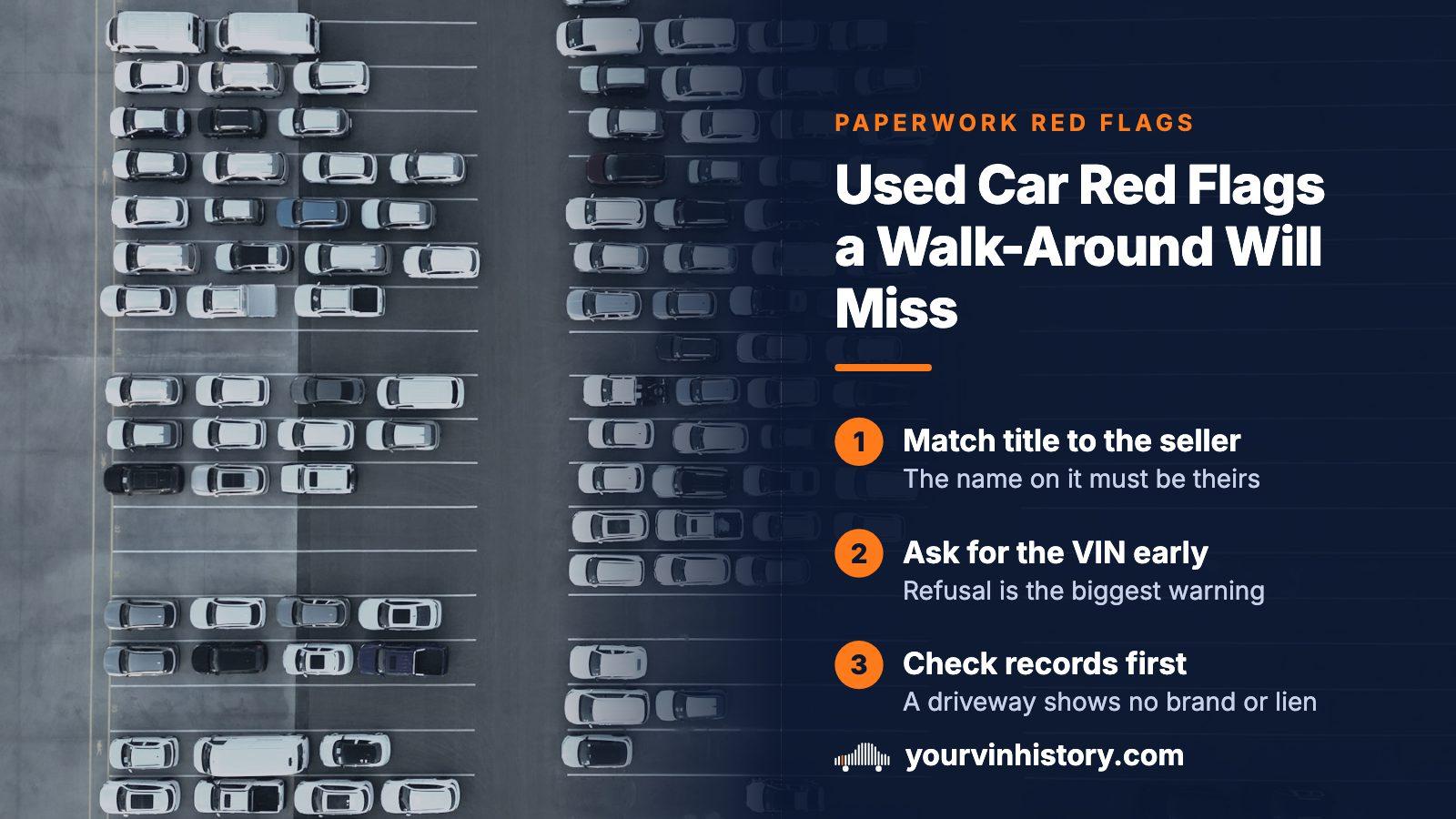
The most telling used car red flags are paperwork problems: a title that is not in the seller's name, a brand recorded in another state, mileage that does not fit the model year, a lien never released, and a recall still open on that VIN. A seller who withholds the VIN or blocks an independent inspection is the other major warning. None of this shows in a driveway, so check records first.
- Biggest single warning
- A seller who will not share the VIN before you visit
- Recall check
- NHTSA's lookup by VIN is a free federal tool
- Theft and total loss
- NICB VINCheck screens participating insurers' records at no charge
- Title record
- NMVTIS data is sold only through approved providers
Sort every red flag by who controls the evidence
A detail, a warmed-up engine and a midday appointment can quiet a lot of what a buyer would notice by eye. A title brand cannot be quieted that way. That split tells you which checks deserve your time first.
For each flag, work out whether the seller could have staged it or whether an agency, a lender or an insurer wrote it down long before the listing went up.
| Red flag | Where the evidence sits | Can a well-prepared seller hide it? |
|---|---|---|
| Fresh undercoating, mismatched paint | On the car itself | Often |
| Warning light, odd noise | On the car, at a time the seller picks | Sometimes |
| Brand from another state | Federal title record | No |
| Odometer that disagrees with the car's history | Past readings in several records | No |
| Unreleased lien | Lender and state title file | No |
| Open recall | NHTSA lookup, by VIN | No |
A title that does not match the person selling
Begin with the document the car is legally sold on. The name printed on the title should belong to the person handing you the keys, and the seller's address should make sense beside it. When you can, meet at the address on the paperwork.
Trouble starts when the title is made out to a stranger, or is signed over by someone you will never meet. Perhaps an in-between buyer never retitled it. Either way, you would be paying for a gap in the ownership chain that you must close later, at your own cost.
A seller who says the title is on its way, or cannot say where it is, wants money before you can confirm ownership. Treat that as a stop sign, not a delay.
Title brands that vanish when a car changes states
Labels such as salvage, rebuilt and flood are applied by the state that issues them. Retitle the car somewhere else, and the new paper can come out looking ordinary. The federal title system, NMVTIS, exists to defeat exactly that move, since it keeps a national record in which a brand stays visible after the car crosses a border.
So the flag is a car whose title history jumps between states shortly before it is listed, especially at a price under similar cars. A branded car can still be a fair buy, but only if you learn of the brand before agreeing to a price.
The record is reached through an approved provider. The program's own site lists those providers and states which ones sell to the public. A yourvinhistory report draws its NMVTIS title records from ClearVin LLC, one of the approved providers.
Mileage that does not fit the car's age or its paper trail
A single odometer reading proves little. It turns suspicious when it sits far below what a car of that model year normally shows, when it is lower than a reading recorded earlier, or when the wear says otherwise: pedals, seat bolsters and a steering wheel polished well past what the display admits.
Service records settle a lot here. Dated invoices spread across the years when the miles piled up are good evidence. A folder that starts only recently, with nothing before it, leaves blank the exact stretch you most need to see.
The real test compares one record against another, so do it from a desk before spending a Saturday on the car.
A lender's claim that outlives the sale
If the seller still owes money on the car, the lender may hold a claim that stays attached to it after you pay. Nothing about the metal hints at that. A record search or proof of payoff answers it, and the time to ask is before money changes hands.
- The seller is vague about whether the car is paid off.
- No one can say where the title is or who is holding it.
- A deposit is requested before any paperwork is shown.
- The seller resists a payoff through the lender at the sale.
Any one of these deserves a direct question. Once a loan is cleared, ask for the lender's release in writing.
A recall still open on this exact VIN
Nearly every model has a recall somewhere in its past, so the existence of recalls says little. The flag is an open one on the specific car you are considering. NHTSA's lookup, a free federal tool, takes the VIN and answers in about a minute.
Open means the repair was never done. It also hints at the owner: someone who ignored a safety notice may have skipped other upkeep.
The duty to remedy follows the vehicle rather than a person, so the next buyer inherits the open item and the right to ask for the fix. That right has limits. The federal rule on no-charge recall repairs has an age cutoff, and a very old vehicle can fall outside it. For an older car, ask the manufacturer or a franchised dealer what applies before you assume anything.
A model year that stands apart from its siblings
Raw complaint totals mislead, because a bestseller draws more of everything. What matters is one model year attracting far more reports than the years on either side, or a cluster of owners describing the same symptom in the same expensive part. That pattern can mark a design change later reversed, and it appears in public records long before it appears on the car in front of you.
NHTSA publishes complaint and recall records as datasets, so they can be broken out by model year. Each complaint notes whether it involved a fire, a crash or an injury. Reports carrying those marks turn an annoyance into a safety question, and a test drive of a car that has not failed yet cannot show you any of it.
Seller behavior that blocks a check
Vague unease about a person is not evidence. A handful of behaviors are, because each one stops you from verifying something specific.
- Declines to send the VIN until you arrive, which shuts off every VIN-based lookup at once.
- Rules out an inspection at a shop you choose. The Buyers Guide itself tells shoppers to ask for an independent mechanic's look.
- Has no title in their own name, or offers one signed by someone else.
- Wants to hand over the car at a roadside or parking lot instead of the home on the paperwork.
- Can document only the recent past, with nothing from the years the mileage built up.
- Answers a records question with a reassurance instead of a document.
A hurried seller can still be offering a sound car. One who stops you checking is a different case, so pause the deal until the check is possible. Good signs run the other way: an unprompted VIN, dated invoices, a welcome for the mechanic.
What a dealer's Buyers Guide should say
The FTC's Used Car Rule makes covered dealers display a Buyers Guide on each used car. The sheet says whether the car is sold as is with no dealer warranty, or with implied warranties only, or with a written warranty. It also warns that spoken promises are hard to enforce, and it sends shoppers to FTC guidance on getting a history report and checking for safety recalls. A private seller is generally outside the rule.
Warning signs here are plain: no Buyers Guide on a dealer's car, an as-is box ticked while the salesperson talks about coverage, or a promise that exists only out loud. Anything the dealer says it will do should be written on the Guide before you sign.
What a clean history report still cannot promise
Clean means unreported
A history report is built from records other people created. A collision repaired privately, or a loss nobody filed a claim on, may leave nothing to find. The FTC notes that a report can reveal accidents and flood damage but usually will not show mechanical problems. Treat a clean report as the end of the paperwork check, not a verdict on the car. It cannot say who drove the car, how hard, or where it was repaired.
That is why the order of work matters. Records can eliminate a car cheaply, but only a mechanic you chose can approve one.
The order that keeps wasted effort low
- Get the VIN by message before planning a visit. A seller who will not send it has already answered your first question.
- Decode it and compare the result to the listing. A trim or engine that differs from the decode ends the conversation.
- Run NHTSA's recall lookup for campaigns still open on that VIN.
- Run NICB VINCheck, a no-charge screen for theft and total-loss records from participating insurers.
- Pull the title history from an approved NMVTIS provider to see brands, odometer readings and salvage records.
- Only then inspect the car, drive it and book a mechanic of your choosing.
A yourvinhistory report gathers title brands, accidents, odometer readings, salvage and auction records, liens, theft and open recalls into one document, covering the record checks in steps three through five for one purchase, with a preview first.
Where this information comes from
- NHTSA: Recalls lookup by VIN — The federal tool for finding out whether a specific vehicle still has an unrepaired recall.
- NHTSA: Datasets and APIs — Where the agency publishes complaint and recall records that can be sorted by model year.
- FTC: Dealer's Guide to the Used Car Rule — Explains what the Buyers Guide must tell shoppers about warranties, spoken promises, history reports, recalls and independent inspections.
- NMVTIS: Consumer information and approved providers — The federal title record's own page, listing which providers are approved to sell it and to whom.
- NICB: VINCheck — A no-charge theft and total-loss screen drawing on participating insurers.
Sources and photos: Facts checked against the sources above in October 2026. Photo by Iain on Unsplash; diagrams by YourVINHistory.
Keep reading
- Title washingHow a brand disappears when a car is retitled in another state, and how to catch it.
- Odometer rollback checkComparing records against each other is how clocked cars get caught.
- Vehicle lien checkA lender's claim can stay on the car after you pay, so see how to look for it.
- Buying a car with an open recallWhat your options are when the recall lookup turns up an unrepaired campaign.
Frequently asked questions
Which used car red flag matters most to a careful buyer?
A seller who holds back the VIN until you arrive. The number opens the recall lookup, the theft and total-loss screen and the title history, so withholding it removes your ability to test any claim in the ad. Sellers with nothing to conceal usually send it as soon as asked, often along with a photo of the title.
Is a recall on a used car a red flag?
Not by itself. Recalls are common, and a car whose campaigns were completed has had its defects found and addressed. Concern starts when the lookup shows one still open, or when the car is old enough that the federal repair rule may no longer apply. In either case, ask the manufacturer which remedy applies before you set a price.
Can a car with a clean history report still be a bad purchase?
Yes. A report reflects what was submitted to agencies, insurers and title offices. A private repair after an unreported collision, or mechanical wear that leaves no paperwork, will not appear. Pair the report with an inspection by a mechanic you choose, and ask for service invoices covering the years when the mileage accumulated.
How can I tell if a used car's odometer was rolled back?
Compare readings from different places: the listing, the title, past inspection or service records and any history report. A later reading lower than an earlier one is the clearest sign. Mileage far below normal for the model year, with no service history to back it up, is the softer warning.
What if the seller will not allow an independent inspection?
Treat it as a reason to step back. A pre-purchase look by a mechanic of your choosing is the step the Buyers Guide tells shoppers to request. If the seller objects to one shop, offer another. If the objection continues, move to a different car, because you lose nothing by looking elsewhere.
Now check the car itself
The guide explains what to look for. The report shows what this VIN has on record.