THE SHORT ANSWER
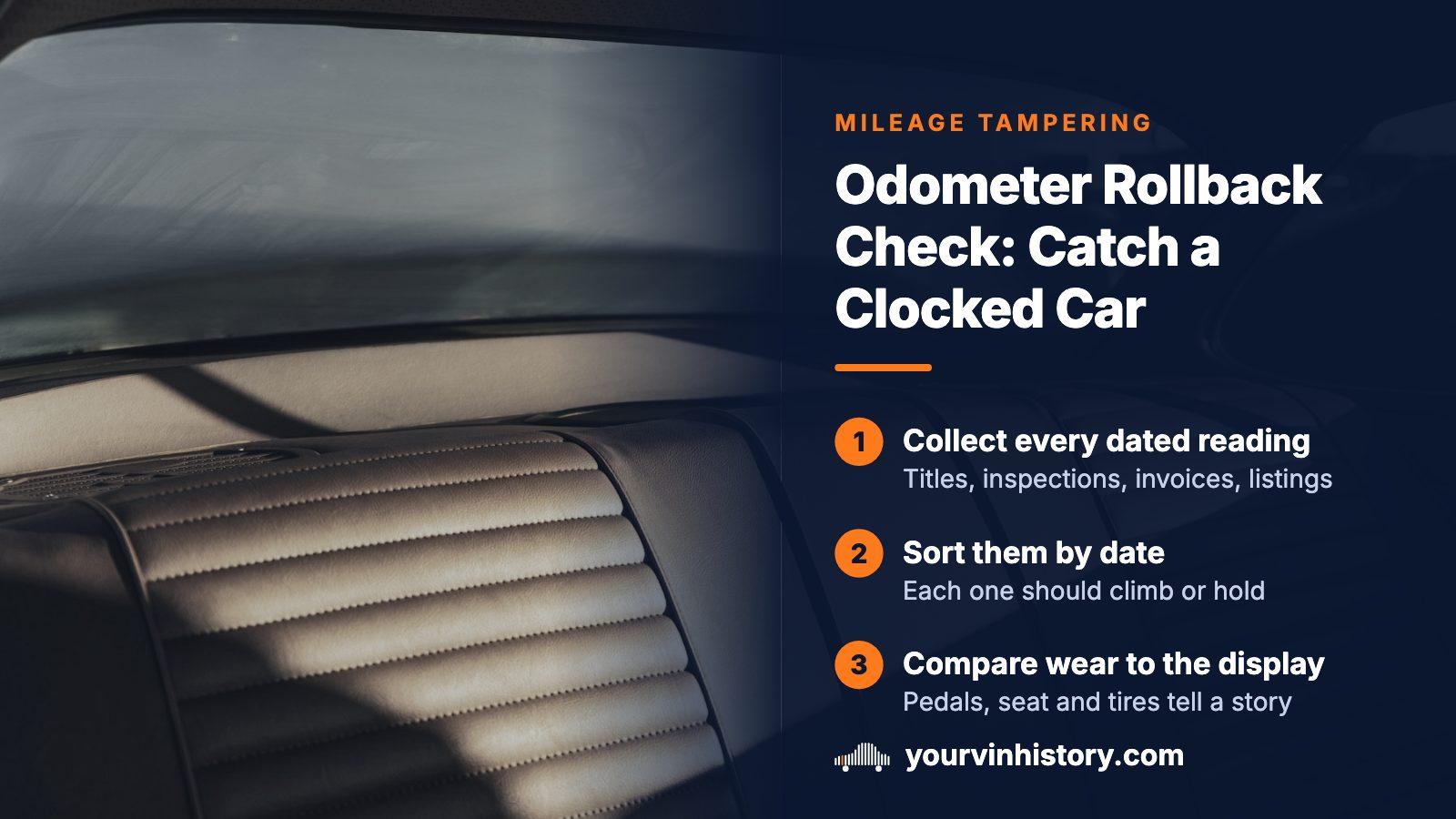
Collect every dated mileage reading you can find for the car: title transfers, state inspections, emissions tests, service invoices and old listings. Sort them by date. Each reading should be equal to or higher than the one before, at a pace the car could plausibly have driven. A step backward is evidence of tampering. Then compare the wear on pedals, seat and tires, and ask a shop to read mileage stored in other modules.
- Best evidence
- Dated readings that stop climbing
- Disclosure exemption
- Model year 2010 and older after 10 years; 2011 and newer after 20
- Civil remedy
- 3 times actual damages or $10,000, whichever is greater
- Time to sue
- 2 years after the claim accrues
Why the dash reading proves so little
Clocking used to mean spinning a mechanical drum backward by hand. On a modern car the mileage is a number held in electronic memory, and tools sold for legitimate instrument cluster repair can overwrite it in a few minutes through the diagnostic port. The same device that lets a shop fix a failed cluster lets a seller shave miles off a car before it is listed.
Treat the display as the seller's claim and nothing more. Two kinds of evidence sit outside the seller's reach: readings that other people wrote down on earlier dates, and the physical wear the car picked up at its true pace. A rollback check is the work of setting those two beside the number on the dash.
Collecting every dated reading the car has left behind
Each time someone records the mileage, the car gains a data point that a later seller cannot edit. Gather as many as you can before you start comparing.
- Title transfers: every sale involves a signed odometer statement, and the federal title record keeps a reading tied to each titling event.
- State safety inspections, where the state runs that kind of program.
- Emissions or smog tests, which usually record the odometer on the day of the test.
- Service invoices, oil-change stickers, tire receipts and dealer recall visits.
- Older online listings and auction listings that include a photo of the dash.
Start with the folder of paperwork the seller keeps, since asking costs nothing. California runs a public lookup of inspection history by VIN or plate through its Bureau of Automotive Repair, a quick cross-reference for any car that spent time in that state.
Putting the readings in date order
Sort the readings by date and run two tests. The first is direction: each reading should match or beat the one before it. The second is pace: take the gap in miles, look at the time between the two readings, and ask whether that car could have lived such a life. A figure near 12,000 miles a year is a common rule of thumb, but commuters, couriers and weekend cars land far on either side, so use it to catch the absurd rather than to judge the ordinary.
| Year | Where it was recorded | Miles | What it tells you |
|---|---|---|---|
| 2019 | Title transfer | 45,000 | Starting point |
| 2021 | Emissions test | 61,000 | Climbs at a believable pace |
| 2026 | Dash reading today | 40,000 | Lower than the 2021 record: stop |
Direction beats pace
An odd pace can have an innocent story, such as a long storage spell or a repair. A reading that goes down cannot. These figures are invented for illustration.
What the national title record promises and what it leaves to the states
The Justice Department rule that governs NMVTIS, 28 CFR 25.53, requires the system to let a user establish the odometer disclosure made under 49 U.S.C. 32705 as of the day a title was issued.
Anything after that depends on the state. The rule adds later mileage only where the state chose to note it, so one car's record may show a single reading per transfer while another shows several. The difference reflects state recording habits, not the car's life. A sparse record does not mean a quiet history, only that the state wrote less down.
In practice, pull the reading attached to each title event and drop it into your timeline. A yourvinhistory report lists odometer readings beside title brands and the other records, and its NMVTIS title records come from ClearVin LLC, an approved NMVTIS data provider.
Older cars may legally have no odometer statement
Federal rules stop requiring an odometer disclosure at sale once a car passes a certain age, and that age limit moved. The old rule dropped every vehicle after 10 years. Since January 1, 2021, vehicles from model year 2011 onward stay covered for 20 years, while model year 2010 and older keep the 10-year cutoff. Plenty of advice online still quotes only the earlier figure.
| Model year | Exempt from disclosure after | A missing statement means |
|---|---|---|
| 2010 and older | 10 years | Lawful, so no warning sign by itself |
| 2011 and newer | 20 years | Worth asking why |
A 2009 car sold without a statement is following the law. A 2015 car sold without one deserves a question. Either way, an exempt car still leaves readings at inspections, service visits and title events, so the timeline works the same.
Wear that argues with the display
Wear builds at the car's true pace, whatever the display says. Check these places in person:
- Pedal pads and steering wheel: glossy, smooth rubber does not fit a low reading.
- Driver's seat bolster and the carpet under the heel, which record every entry and exit.
- Tires: four matching, recent tires on a car showing very low miles suggest the originals wore out. The date code on each sidewall shows when it was made.
- Brake rotors and suspension bushings, parts that wear in step with real driving.
One worn part proves little, since seats get reupholstered and pedals get replaced. Several parts pointing the same way are a different matter. A display of 45,000 miles above pedals, seat and tires that look like 140,000 deserves a hard stop and a call to your mechanic.
Having a shop read mileage stored elsewhere in the car
A modern car spreads its work across many networked control modules, and some of them keep a mileage figure for their own use. A rollback done on the instrument cluster alone can leave those copies untouched, so the dash and a hidden module end up disagreeing. A careful job copies the new number everywhere, which means a matching result clears nothing.
Reading those values takes a diagnostic tool with manufacturer-level access, so this is work for a franchise dealer or an independent specialist in that make. Budget about an hour of diagnostic time, a small sum next to the price of a clocked car. The read earns its fee when:
- the paperwork is thin or inconsistent
- the car went unregistered for a stretch
- the seller's account does not fit the timeline
Treat it as the second step. The record comparison costs nothing and comes first.
True Mileage Unknown and the replaced cluster
Odometers fail for innocent reasons, and the law has a procedure for it. If a repair or replacement cannot preserve the old reading, federal law has the odometer reset to zero and requires the owner or the owner's agent to attach a notice to the left door frame, giving the mileage before the work and the date of the work. Separately, a seller who knows the reading is wrong must say the actual mileage is unknown, and the title or listing then carries the label TMU, short for True Mileage Unknown.
A TMU car is worth less, but it is honest. The dishonest one carries a tidy five-digit reading when the label was what the title owed you. If the seller says the cluster was swapped at some point, request the shop invoice that lists the miles on the day of the swap, and look for the door-frame notice yourself. The legitimate path leaves paper, so missing paper is an answer.
What federal law gives a defrauded buyer
Chapter 327 of Title 49 of the U.S. Code treats odometer tampering as a federal matter. The prohibited conduct includes:
- Installing or selling a device that makes an odometer show something other than the miles driven.
- Disconnecting, resetting or altering an odometer to change the recorded mileage.
- Driving on public roads with intent to defraud while knowing the odometer is disconnected or not working.
- Conspiring to do any of the above, or to break the disclosure and repair rules.
A person who violates the chapter with intent to defraud is liable to the buyer for three times the actual damages or $10,000, whichever is greater. A court must award costs and a reasonable attorney's fee to a buyer who wins, and the suit has to be filed within 2 years after the claim accrues. Knowing and willful violations also carry criminal penalties of up to 3 years in prison. Intent to defraud is the element a lawyer has to prove, which is why dated records count for more than anyone's opinion about the car.
What to do when the timeline breaks
A sequence that runs backward is a reason to act in a set order, and the first move depends on whether any money has changed hands yet.
- Before you pay: walk away and keep your evidence. Screenshot the listing and save the records that show the earlier readings. You owe the seller no explanation.
- After you pay: gather the bill of sale, the title with its odometer statement, the original listing and every record that shows an earlier reading.
- Report it: NHTSA takes odometer fraud complaints through its website and advises contacting your state's enforcement agency as well.
- Talk to a consumer attorney early, because the civil claim has a 2-year filing window and your dated records are the evidence.
Where this information comes from
- NHTSA: changes to odometer disclosure requirements — Backs the move from a 10-year to a 20-year exemption for model year 2011 and newer, effective January 1, 2021.
- NHTSA: odometer fraud — The federal program page and the route for filing an odometer fraud complaint.
- 49 U.S.C. Chapter 327: odometer law — Source for the prohibited acts, the written disclosure duty, the repair notice and the civil and criminal penalties.
- 28 CFR 25.53: responsibilities of the NMVTIS operator — Explains which odometer readings the national title system must let a user establish.
- NMVTIS: national title record — The Justice Department's home for the federal title database that holds title-event mileage.
- California Bureau of Automotive Repair — Home of the state's public inspection history lookup, searchable by VIN or plate.
Sources and photos: Facts checked against the sources above in October 2026. Photo by THLT LCX on Unsplash; diagrams by YourVINHistory.
Keep reading
- Odometer readingHow mileage is read, recorded and confirmed, the groundwork for spotting a bad entry.
- NMVTIS reportWhat the federal title record holds, including the reading at each titling event.
- Smog check historyPublic emissions test logs that can add dated readings to your timeline.
- Pre-purchase inspectionA mechanic's exam can judge wear and read modules before you pay.
Frequently asked questions
Can I check a car for odometer rollback with just the VIN?
The VIN is the key to the records, not the proof. A search by VIN returns whatever readings were recorded against that number, such as title transfers, and you then compare them with the dash. If a car has only one or two recorded readings, the comparison is weak, and the wear check and a shop's module read matter more.
Can a digital odometer really be rolled back?
Yes. Cluster repair tools sold for legitimate use can rewrite the displayed value, and no seal or mechanical part has to be broken, so nothing looks disturbed from the driver's seat. What exposes tampering is disagreement elsewhere: older records with higher numbers, other modules storing a different figure, or wear that does not fit the display.
Which odometer readings should make a buyer suspicious?
No number is suspicious alone. The rule of thumb is about 12,000 miles a year, yet work vehicles run well above it and weekend cars well below. Suspicion comes from contradiction, such as a display lower than an earlier record, or pedals and seats worn far past what the dash claims.
Is a car with a TMU label a bad purchase?
Not automatically. The label means the odometer was disclosed as unreliable, and that disclosure is what the law asks of a seller who knows. Expect a lower price, ask for repair records showing mileage at any cluster swap, and lean harder on the inspection and the wear, since the display gives you nothing to measure.
Who do I report odometer fraud to?
NHTSA takes odometer fraud complaints on its website and advises contacting your state's enforcement agency too, such as the state attorney general. Bring dated records rather than impressions. A report is separate from a lawsuit, so decide on the civil claim with an attorney inside the 2-year window.
Now check the car itself
The guide explains what to look for. The report shows what this VIN has on record.