THE SHORT ANSWER
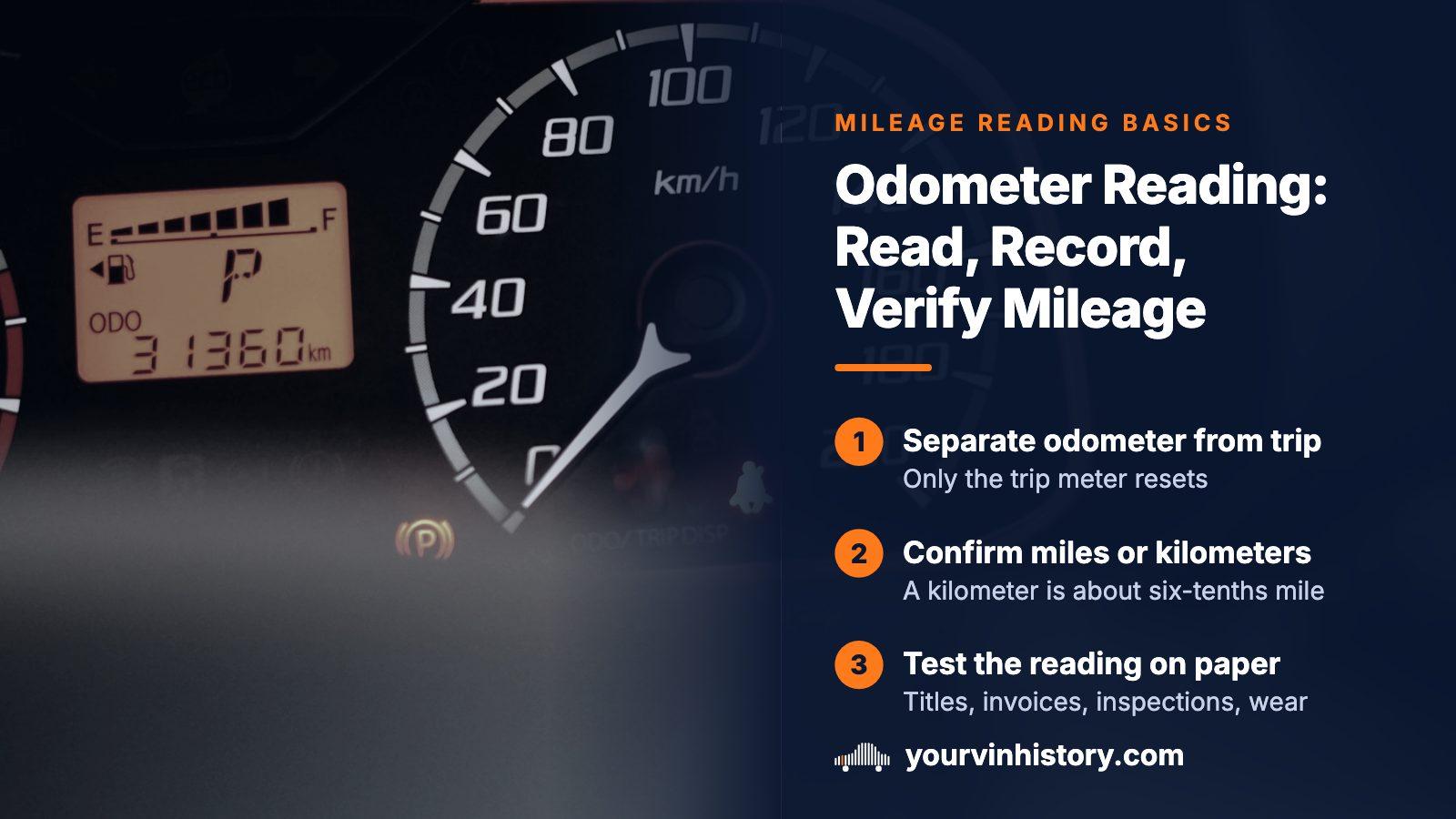
The odometer reading is the lifetime distance total on the instrument cluster, usually the largest figure or one labeled ODO. A trip meter, which does reset, is a separate counter. At a sale, the seller states the reading to the whole mile on the title and certifies what it means. To judge whether it is honest, line it up against title transfers, service invoices, inspection records and physical wear.
- Where mileage is recorded
- On the title at each transfer, to the whole mile
- Seller's certification
- Actual mileage, exceeds mechanical limits, or not actual mileage
- After a replacement
- Door-frame notice with the earlier mileage and the repair date
- Metric clusters
- Each kilometer is roughly six-tenths of a mile
What the number counts and what it leaves out
An odometer adds up distance from the day the vehicle was built. It takes its input from the same signal that drives the speedometer, which is why fitting tires of a different diameter without recalibrating throws off both instruments together.
Mileage stands in for wear, and a rough one. Calendar time ages rubber, seals and paint, while distance ages the engine, transmission, suspension and bearings. Two cars from the same model year can sell for very different amounts because one has covered far less ground. Treat the reading as one input to a price rather than a ruling on condition.
Finding the reading on a cluster that hides it
Analog dials make this easy, because a row of mechanical digits sits in plain view. Screen-based clusters are less consistent.
- Turn the ignition to the on position. Many displays stay dark until then, and the engine does not need to run.
- Look for the largest figure on the screen or a label reading ODO or MILES.
- If nothing matches, cycle through the screens with the button on the end of a wiper or indicator stalk, or with the steering wheel controls.
- Check the vehicle information or settings menu on the center display, and try a different display theme, because some layouts omit the total.
Odometer or trip meter: the quick way to tell
Most dashboards show two numbers that look alike, and only one of them belongs on a legal document.
| Feature | Odometer | Trip meter |
|---|---|---|
| Purpose | Lifetime distance | Distance for one outing or one tank |
| Driver can reset it | No | Yes, usually by holding a button |
| Decimal place | Whole units | Often shows tenths |
| How many | One | Commonly two independent counters |
| Goes on the title | Yes | Never |
A trip meter entry leaves a permanent gap
Copying a trip meter figure onto a title is an honest mistake that still plants a false reading in the paper trail. If a long press on the button zeroes the figure, it was a trip meter. Run that check before anyone signs.
Miles or kilometers: check the unit before you price
Cars first sold in the United States count in miles. A car that began life in Canada, Mexico or overseas may count in kilometers, and imported cars often do. The unit label near the digits settles the question.
The difference is large. A kilometer is roughly six-tenths of a mile, so a cluster showing 200,000 km corresponds to something near 124,000 miles. Mix the units up in either direction and your price is off by a wide margin. The federal rule's wording refers to miles, so on a metric car ask the titling agency how it wants the figure entered.
The mileage statement that goes on the title
When a vehicle changes hands, federal rules oblige the seller to state its mileage in writing, usually on the title itself. A vehicle without a title gets a separate written statement. Either way, these items must appear.
- The reading at the time of transfer, with tenths of a mile left off
- The date of the transfer
- The printed names and current addresses of the seller and the buyer
- The vehicle's make, model, year, body type and VIN
- The seller's signature and printed name
The buyer signs and prints a name too, and hands the seller a copy. A paper form must warn that leaving the statement incomplete, or giving false information, can bring fines, imprisonment or both.
The three statements a seller chooses between
Beyond the figure itself, the seller certifies what it means. Exactly one of three statements applies to any given sale.
| Certification | What it tells the buyer |
|---|---|
| Actual mileage | To the best of the seller's knowledge, the reading matches the distance driven. This is the ordinary case. |
| Exceeds mechanical limits | The counter passed the highest figure it can display and started over, so the true total is higher than shown. |
| Not actual mileage | The reading is unreliable or differs from the real distance by more than normal calibration error, and a warning about the discrepancy goes with it. |
A seller who picks the third statement changes the buyer's whole calculation, and the choice can end up as a notation on the title, so read the title for it before agreeing on a price. Picking the first while knowing better is a false certification, the very thing the federal warning describes.
When the federal statement is not required
The rule exempts some vehicles. Very heavy trucks above a federal weight rating, vehicles that are not self-propelled, and certain vehicles sold by a manufacturer directly to a federal agency fall outside it, as does a brand-new vehicle on a first transfer that is not a resale.
Age is the exemption buyers meet most. Counting from the start of the calendar year that matches the model year, an older model year drops out after ten years and a newer one after twenty. The rule text names the model year where the two cutoffs meet, so read it for any car near that line. Your state title office can tell you how it treats an older car.
Exempt does not mean irrelevant
An exempt car still has a real mileage figure that drives its value and its maintenance. The exemption removes a line from the paperwork, not the reason to ask.
Replaced clusters and the door-frame notice
Clusters fail, and swapping one is legitimate work. The trouble is that a new unit may start counting from its own number instead of the car's real total.
Federal law covers exactly this case. When an odometer is serviced, repaired or replaced and cannot keep showing the same mileage, it has to be adjusted to read zero, and the owner or the owner's agent must attach a written notice to the left door frame giving the earlier mileage and the date of the work. Removing or changing that notice with intent to defraud is prohibited.
- Find out if the cluster was ever swapped, and on what date.
- Request the repair invoice that records the reading that day.
- Look at the left door frame for the notice, then compare it with the service file.
- Treat an undocumented replacement as unknown mileage.
Digital readouts and the law on tampering
People still repeat that mechanical odometers could be rolled back while digital ones cannot. A digital figure is a value held in electronic memory, and tools that rewrite it are sold. The change can also leave no mark: a wound-back mechanical unit may show crooked digits or scarred trim, while a rewritten digital cluster can look factory fresh.
Federal law prohibits disconnecting, resetting or altering an odometer with intent to change the mileage it records. It also bars selling or installing a device meant to make the reading differ from the true distance. A defrauded buyer can sue, and a violator who acted with intent to defraud owes the greater of three times the actual damages or a fixed statutory minimum, plus court costs and reasonable attorney fees.
Testing a reading against the paper trail
The dashboard is only the claim; the records are the evidence.
- Title transfer history. A reading is captured each time a title changes hands, and NMVTIS title records carry those readings. Falling numbers, or years with almost no movement, are the strongest warning.
- Service invoices. Shops write the mileage on each job, so a rising line across years supports the dash, while a gap or a drop does not.
- Inspection or emissions records, in states that test on a schedule.
- Wear points: pedal rubbers, the steering wheel rim, the driver's seat bolster and the door handles.
- Tires and brakes. Factory tires with deep tread on a very high reading, or a fresh set on a very low one, deserve a question.
- The cluster itself: crooked digits, a scratched bezel or turned screws.
A vehicle history report pulls the recorded readings into one list. The yourvinhistory report shows odometer readings next to title brands and accident records, and you see a free preview before deciding whether to buy.
When the numbers disagree
A mismatch is not automatically fraud. Clusters get swapped, clerks mistype, and trip meter figures slip onto paperwork. It still needs an answer first.
- Ask the seller to explain, and ask for paper proof of any cluster replacement.
- Line the discrepancy up against the service file to find where the records split.
- Treat a reading that fell between two dated records as evidence of a problem, not an open question.
- Look for a not-actual-mileage notation on the title.
- Be ready to walk away instead of accepting an explanation the documents do not back.
If the true mileage cannot be established, price the car as unknown mileage, because that is what it is. A notation of that kind tends to stay with the car, and with its price.
Proof a seller can build for the next owner
If you are the one selling, a small habit pays off. Photograph the cluster with the reading visible each time the car goes in for service, and note the date and the unit. Record the figure in whole units exactly as displayed.
Keep the photos with the sale paperwork. A dated series is cheap provenance, and it carries weight with a buyer when the car has an unusual use pattern, such as a long stretch parked. A buyer can match each photo against the invoice from the same day.
Where this information comes from
- eCFR: 49 CFR Part 580, odometer disclosure requirements — The federal rule behind the mileage statement: what it must contain, the three certifications, and which vehicles are exempt.
- U.S. Code: 49 U.S.C. 32704, service, repair, and replacement — The statute that sets out the zero reset and the door-frame notice after an odometer is repaired or replaced.
- NMVTIS: National Motor Vehicle Title Information System — The federal title record system, and the starting point for buying a title history report.
- NICB: VINCheck — A theft and salvage lookup that works as a second angle on a car whose mileage story looks shaky.
Sources and photos: Facts checked against the sources above in October 2026. Photo by muhammad dennisa on Unsplash; diagrams by YourVINHistory.
Keep reading
- Odometer rollback checkHow clocked cars get caught when records are compared against each other.
- How many miles is too many?What government files can and cannot say about how far a car has gone.
- Bill of sale for a carWhy the odometer statement belongs on the title and not on the receipt.
- Vehicle history reportWhat a history report must contain and which extras are optional.
Frequently asked questions
Where is the odometer on a car?
It sits in the instrument cluster behind the steering wheel, either as a row of digits on a dial or as a figure on a screen. On newer cars the display may need the ignition on and a few presses of a stalk or wheel button. The owner's manual explains the menus for your model.
What does exceeds mechanical limits mean on a title?
It means the odometer ran past the highest figure it can display and began counting again, so the number shown is lower than the real total. It mostly comes up on older cars with a mechanical counter. The seller must say so on the form, so the buyer does not read a low figure as true.
Do I have to disclose mileage when I sell a car?
In most sales, yes. The seller states the reading in writing at transfer, to the whole mile, and certifies one of three statements. A car old enough for the age exemption, or heavy enough for the weight one, is the exception. Even then, noting the mileage on the bill of sale helps the buyer.
Can a digital odometer be rolled back?
It can. The reading is stored electronically, and equipment to change it exists. What changes is the evidence to look for: a figure that drops between dated records, a replacement with no door-frame notice, or a worn interior on a low reading.
How can I tell if a used car's mileage is real?
Compare the dash with every dated reading you can collect: prior title transfers, service invoices and inspection or emissions records. The figures should climb at a believable pace. One gap can be innocent, but a reading that goes backward is a reason to stop.
Now check the car itself
The guide explains what to look for. The report shows what this VIN has on record.