THE SHORT ANSWER
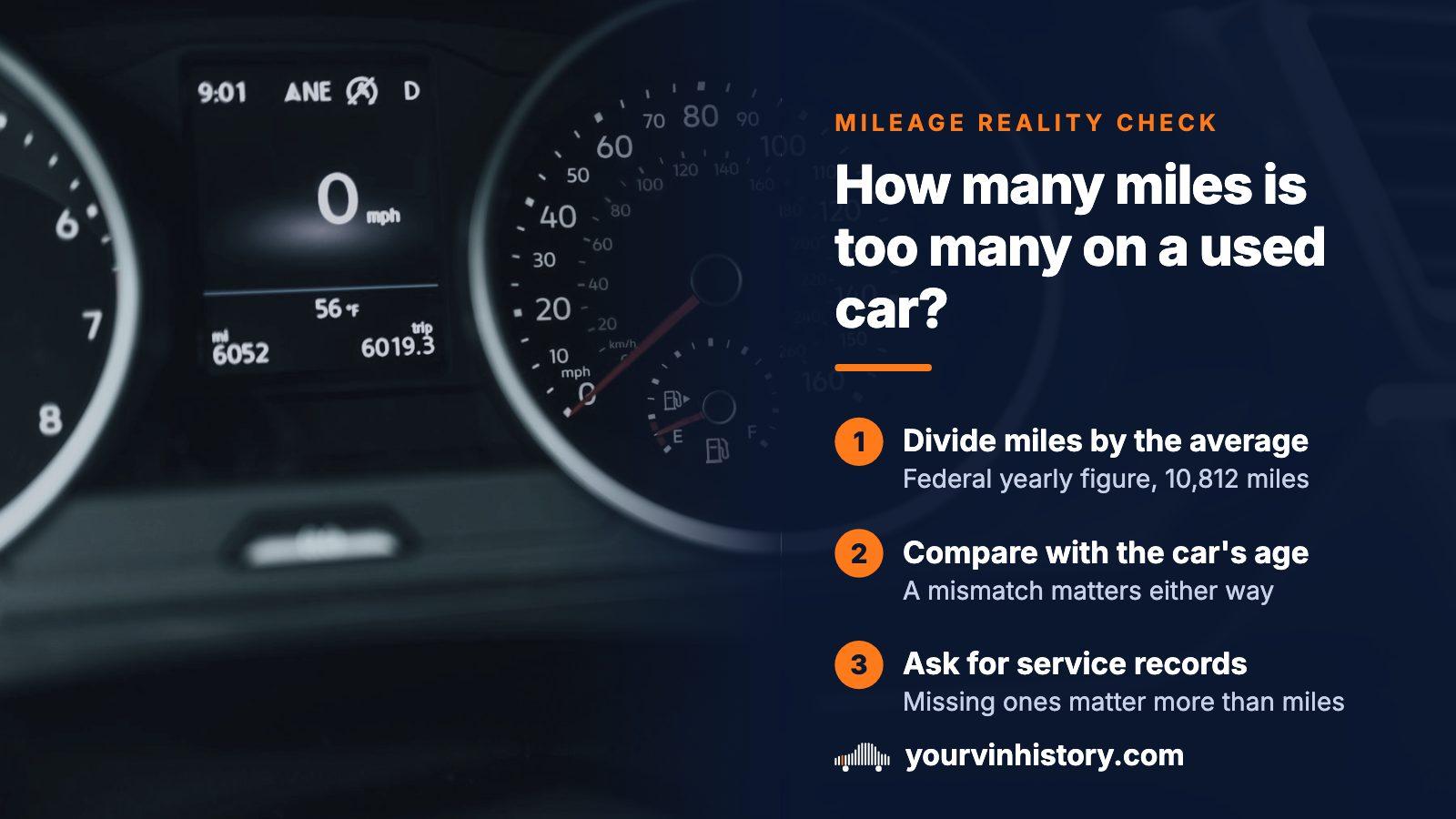
There is no safe or unsafe mileage. Divide the reading by 10,812, the federal yearly average for cars, crossovers and small SUVs, to see how many years of typical driving it represents, then compare that with the car's real age. A 100,000-mile car equals about 9.2 years of average use. A mismatch in either direction, or missing service records, matters more than the raw number.
- Federal yearly average
- 10,812 miles for cars, crossovers and small SUVs (2024)
- 100,000 miles equals
- About 9.2 years of average driving
- Common rule of thumb
- A yearly 12,000 to 15,000 miles
- Complaint lookup
- Incident dates and components, no odometer field
Why a single mileage cutoff keeps failing
Every cutoff you hear, whether 100,000 or 150,000 or 200,000, tries to answer a question about one car with a statistic about all cars. The odometer measures distance. A buyer wants to know about wear, and wear depends on how the miles were added, how the car was maintained and how many calendar years they were spread across.
Mileage also folds two variables into one number: use and age. A long-haul commuter and a weekend car can show the same reading and be completely different purchases. Two cars of the same age can have very different readings and be equally sound, or equally troubled, depending on what was done along the way. The sections below pull those variables apart, using federal figures wherever they exist.
What the federal complaint lookup records, and what it omits
NHTSA lets anyone pull owner complaints for a make, model and model year through a public lookup. Each record carries a complaint number, the manufacturer, flags for crash and fire, injury and death counts, when the incident happened, when the complaint was filed, which components were involved, a VIN and the owner's own account.
There is no odometer field in that layout. Some owners type a mileage into their narrative, but nothing tallies it, so the records cannot be sorted by distance. The biggest public file of owner-reported problems is built around dates and components instead. Keep the scope of that point in mind: it describes the per-vehicle lookup. Other NHTSA downloads may be laid out differently, so read the field list of any file before drawing conclusions from it.
The federal average is lower than the rule of thumb
The familiar rule says a car should cover somewhere between 12,000 and 15,000 miles annually. The Federal Highway Administration publishes the measured figure in Table VM-1 of Highway Statistics, which divides total travel by the number of registered vehicles. In the 2024 edition, light-duty vehicles with a short wheelbase, meaning cars, crossovers and small SUVs, averaged 10,812 miles across 205,550,881 registered vehicles.
The gap matters because the rule of thumb gets used as a test. Hold a used car to 15,000 miles a year and plenty of ordinary examples look suspiciously low. Hold the same cars to 10,812 and they look normal. The table was last updated in February 2026 and each edition revises the figure, so check the current one before you quote it.
Average miles by vehicle class
| Vehicle class (FHWA, 2024) | Average miles per vehicle |
|---|---|
| Motorcycles | 2,401 |
| Combination trucks | 55,276 |
| Sedans, crossovers, compact SUVs (short wheelbase) | 10,812 |
| Larger SUVs and pickups (long wheelbase) | 10,707 |
| Every light-duty vehicle together | 10,787 |
| Every motor vehicle together | 11,071 |
Compare the third and fourth rows. In the 2023 edition they ran the other way, with long wheelbase at 11,360 and short wheelbase at 11,026. A gap of a few hundred miles that changes sign between editions says the two groups drive about the same amount, which undercuts the belief that pickups and big SUVs routinely cover far more ground than cars. The top two rows are a reminder to use the right yardstick: 20,000 miles on a motorcycle is not comparable to 20,000 on a car.
Why the yearly average keeps moving
Between the 2023 and 2024 editions, the short-wheelbase average fell from 11,026 to 10,812, a drop of about 1.9 percent. Driving did not shrink. Total travel for the class grew about 2.2 percent, from 2,173,555 million vehicle-miles up to 2,222,415 million, while registrations climbed from 197,134,299 to 205,550,881, up about 4.3 percent.
An average is a ratio, and a ratio slides when the bottom number grows faster than the top. Cars parked in driveways count in the denominator just as much as daily commuters do. Treat the federal figure as a rough yardstick rather than a pass or fail line, because the spread around any national average is wide and plenty of normal cars sit well above or below it.
Turning an odometer reading into years of driving
Divide the reading by 10,812 to see how many years of typical driving it represents, then compare that answer with the age on the title. The table does the arithmetic for common readings.
| Odometer reading | Equivalent years of ordinary driving |
|---|---|
| 60,000 miles | 5.5 years |
| 100,000 miles | 9.2 years |
| 150,000 miles | 13.9 years |
| 200,000 miles | 18.5 years |
A nine-year-old car showing 100,000 miles is behaving like an average car. The same reading on a car five years old means someone drove it at close to double the national pace, which could point to highway commuting, delivery work or rideshare use. That is not a disqualifier, but it changes what you ask for. Find out what kind of miles they were and what upkeep went with them.
When a low reading should worry you
Rubber hardens, seals dry out, brake fluid absorbs moisture and fuel goes stale with time, not distance. A twelve-year-old car showing 40,000 miles has aged parts that never got the benefit of regular use. A car that sat has simply gotten older without being exercised.
A low reading is also where odometer fraud tends to hide. Multiply the car's age by 10,812 for a ballpark and see how far the actual reading falls short. A big shortfall proves nothing, since some cars really are barely driven, but it is a reason to examine the paper trail before the paint. NHTSA's odometer fraud guidance suggests comparing tire and pedal wear with the reading and pulling a VIN-based history report. Federal law has the seller record the mileage on the title at transfer, so earlier readings leave a trail, and a later figure that is lower than an earlier one is the classic sign. A yourvinhistory report lists the odometer readings it has on record for that reason.
A reading is a claim
The odometer tells you what the seller's car says about itself. A title record or a dated service invoice was written by someone with no stake in this sale. When the two disagree, give the document more weight.
Where the odometer reading does matter
None of this makes the odometer useless. It is a narrow instrument that is accurate for a few specific jobs.
- Warranty terms. Factory coverage is written as a number of years and miles, whichever ends first, so the reading decides what is left. The clock runs from the in-service date, not the model year.
- Price. Valuation guides weight mileage heavily, so the number shifts the price you should offer even if it reveals little about condition. Keep the price question and the condition question apart.
- Service intervals. Timing belts, spark plugs and transmission fluid all come due by distance. The total matters less than whether the intervals already passed were actually done.
- Internal consistency. Check the reading against the car's age, any earlier readings and the wear on the driver's seat, pedals and steering wheel.
Checks that tell you more than a mileage cutoff
Most of these can be settled before you spend anything.
- Ask for service invoices that line up with the distance-based intervals, and treat verbal assurances as unproven.
- Look up the owner complaint record for that make, model and model year, and compare it with neighboring years of the same nameplate.
- Run the VIN through NHTSA's recall lookup, which costs nothing. An open recall stays with the car when it changes hands.
- Divide the reading by 10,812 and compare the result with the car's age.
- Look for earlier odometer readings and confirm the sequence only moves upward.
- Pay a mechanic of your choosing to inspect the car, especially when the reading is high.
One caution on recalls. The federal rule requiring makers to repair recalled vehicles at no charge has an age limit of 15 years from first sale. Very old cars can fall outside it, and some makers cover them anyway, so read the specific recall notice instead of assuming. Recalls also vary by model year, which is another reason to look up the actual VIN rather than a model's general reputation.
Where this information comes from
- NHTSA: Datasets and APIs — Points to the public complaint data, whose per-vehicle records list incident dates and components with no odometer field.
- FHWA: Highway Statistics 2024, Table VM-1 — Source of the average miles per vehicle by class, the registration counts and the 2023 comparison.
- NHTSA: Recalls — The federal lookup for open recalls on a specific VIN before a purchase.
- NHTSA: Odometer fraud — Explains the federal view of odometer tampering and why an implausible reading calls for a records check.
Sources and photos: Facts checked against the sources above in October 2026. Photo by Nathan Dumlao on Unsplash; diagrams by YourVINHistory.
Keep reading
- Odometer readingHow a mileage figure is read, written down and confirmed.
- Odometer rollback checkThe cross-check for a reading that looks too good.
- VIN warranty checkWhat factory coverage remains, counted from the in-service date.
- Vehicle maintenance reportWhere service data by VIN exists and where it runs thin.
Frequently asked questions
Is 100,000 miles too many for a used car?
Not by itself. At the federal average pace, 100,000 miles is about 9.2 years of driving, so a car of that age with that reading is ordinary. Trouble starts when the reading and the age disagree, when the price assumes a lower reading than the car shows, or when the seller cannot produce records for the service intervals that have already passed.
Is 200,000 miles too many?
Not automatically, but the odometer stops being the useful question. A car that reaches 200,000 miles has usually had major work, and you are buying the quality of that work. At the federal average pace the reading equals 18.5 years of use, so a car under ten years old with it was driven at close to twice the typical rate. Ask for invoices and have a mechanic look it over.
Is 12,000 miles a year a lot?
It sits a little above the federal average of 10,812 for cars, crossovers and small SUVs, so it is normal rather than heavy. A difference of a thousand or two miles a year tells you little. Look harder at gaps that are large in either direction, and remember the national figure is an average that includes daily commuters and vehicles that rarely move.
Are highway miles easier on a car than city miles?
The idea is plausible, since steady cruising involves fewer starts and stops than crawling traffic, but no federal record cited here tracks how a vehicle was driven. The complaint lookup, for example, has no field for it. Sellers also have an obvious reason to call a high-mileage car a highway car, so ask for the maintenance records that show how it was cared for.
Where can I find a car's earlier odometer readings?
Readings are written down when ownership changes, because federal law has the seller record the mileage on the title. A vehicle history report gathers the readings from earlier events so you can see whether the sequence climbs steadily. Service invoices the seller kept are another source. A figure that drops between two dates is worth questioning before any money moves.
Now check the car itself
The guide explains what to look for. The report shows what this VIN has on record.