THE SHORT ANSWER
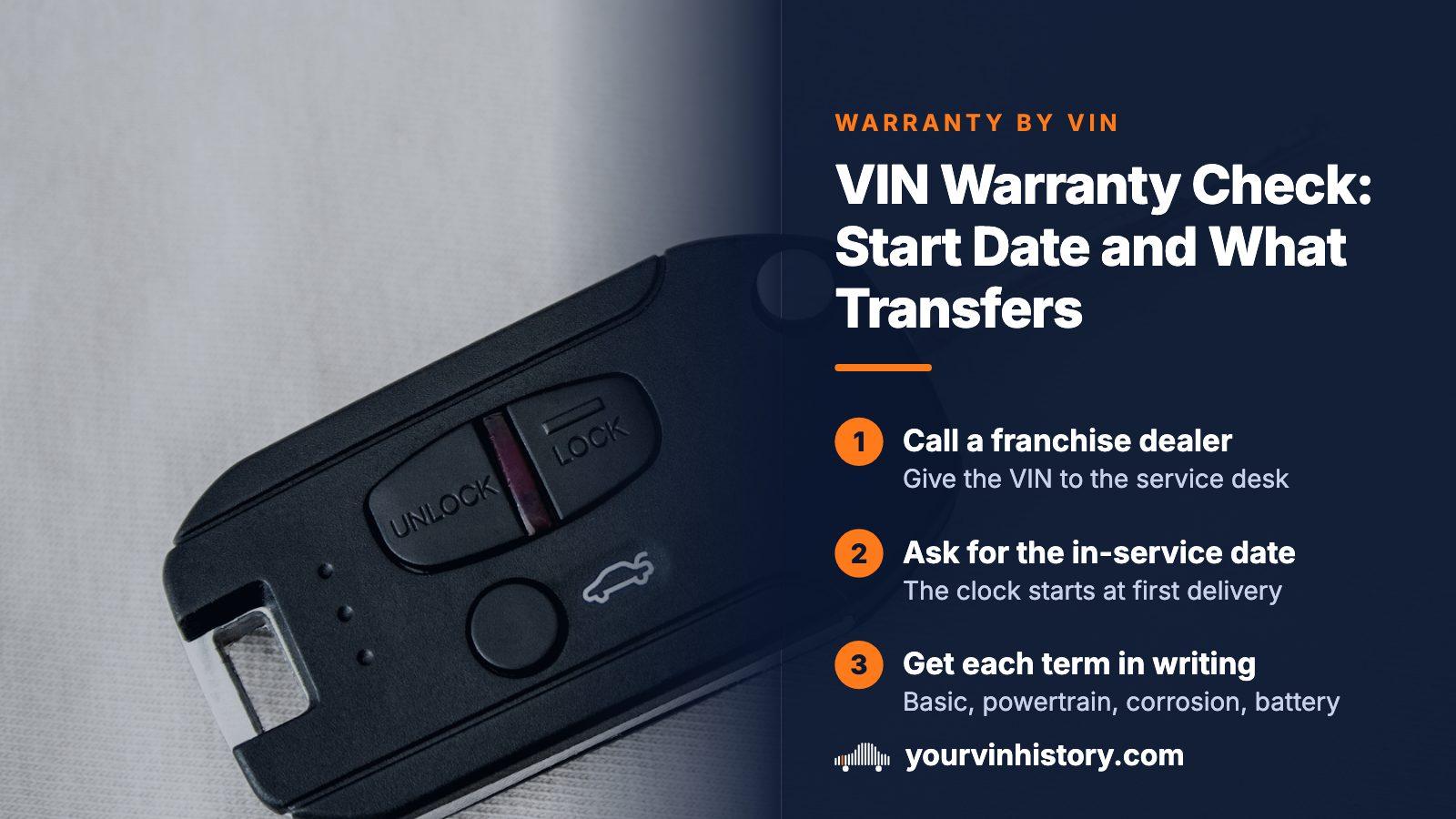
Call the service department at any franchise dealer for the make, read out the 17-character VIN, and ask for the in-service date plus the remaining term on each coverage: basic, powertrain, corrosion, emissions and any battery. The clock starts at first delivery, not at the model year. Ask for the result in writing before you negotiate.
- Clock starts
- At first delivery or demo use, not the model year
- Who can confirm
- Any franchise dealer for the make, or the owner site
- Federal emissions term
- 8 years or 80,000 miles on three major parts
- Recalls
- A separate list from warranty, checked on its own
What the VIN gives you, and what it only points to
The 17 characters identify a vehicle: maker, model, model year, engine, assembly plant. They do not carry a warranty start date or a mileage limit. A decoder such as NHTSA's vPIC will confirm that the car matches the listing, and that comes first, because every coverage question assumes you are asking about the right vehicle.
The coverage facts sit in the manufacturer's own records, filed under the VIN when the car was first delivered. Decoding the characters alone cannot tell you how much warranty is left. The people who can are the maker's dealers and the maker's owner website. A decoder reads the characters; the maker's record holds the car's delivery history, which is what coverage depends on.
The in-service date starts every clock
Coverage is counted from the in-service date. That is the day a retail customer first took delivery, or the day a dealer started using the car as a demonstrator or loaner. The build date and the first day of the model year do not matter. A seller who subtracts the model year from today's date is guessing.
| How the car reached its first owner | What it does to your coverage |
|---|---|
| Built early, delivered late | Works for you. The clock started at delivery, so more is left than the model year suggests. |
| Run as a demonstrator or loaner first | Works against you. Dealer use started the clock before the retail sale. |
| Model year differs from the in-service year | Normal. Models are built ahead of time, so delivery may land in another calendar year. |
Getting the real answer, step by step
Both routes cost nothing and take a few minutes.
- Photograph the VIN at the base of the windshield or on the door-jamb sticker, so a misread character does not send you to the wrong car.
- Phone the service department of any franchise dealer for that make. It does not have to be the dealer selling the car. Ask for the in-service date and for every coverage still running.
- Or use the maker's owner website, where the VIN can be added to an account. Many makes show coverage, recalls and service history there. Ask the seller to pull it up, or do it yourself once the car is yours.
- Get a printout or screenshot before you talk price. A written summary from the dealer settles any later argument about what the seller promised.
One car, several warranties, several end dates
Asking whether a car is 'still under warranty' gets you half an answer. Several coverages run side by side, all counted from the same start date, and each ends on its own schedule. Most terms are set by the maker, in years and miles.
| Coverage | What to know |
|---|---|
| Basic (bumper-to-bumper) | Most parts, for flaws in materials or workmanship. It has the shortest term, so it lapses first. |
| Powertrain | Engine, transmission and drive components. Lasts longer, and is the one most often still running on a used car. |
| Corrosion | Rust that eats through a body panel. A long term, but surface rust normally does not count. |
| Emissions | Set by federal law, not the maker. See the next section. |
| Hybrid and EV battery | A long term on the drive battery and its supporting hardware. The maker chooses the length. |
| Roadside assistance | A service benefit, not a repair promise. Often stays with the first owner. |
Ask for each line separately and write down its end date and mileage.
The one warranty that federal law fixes
The Clean Air Act requires manufacturers to stand behind emission controls. EPA describes two tiers. A shorter term applies to emissions-related parts in general. A longer one, eight years or 80,000 miles, whichever comes first, applies to specified major components: the catalytic converter, the electronic emissions control unit and the onboard diagnostic device. EPA also says these warranties apply to used vehicles.
When a catalytic converter fails
Owners often write off a failed converter as out of warranty because the basic coverage ended years ago. Check the longer emissions term first, and have a dealer look it up by VIN. The term runs from the first sale, so the original delivery date matters.
Hybrid and electric battery coverage comes from somewhere else
It is easy to assume the eight-year, 80,000-mile emissions term protects a traction battery. EPA's list of covered components does not include one. The long battery terms in brochures, commonly eight years and 100,000 miles, are the manufacturer's own promise. California also sets warranty periods of its own, including a separate battery term for certain partial zero-emission models.
- Find out whether the promise is a replacement or a repair, and whether it hinges on a stated capacity level.
- Read the booklet's wording on gradual loss of range. Some guides exclude it, so a battery that merely holds less charge than when new may not be a claim.
- Ask whether the battery was ever replaced, since that can change the coverage.
A seller who says the battery is 'still under warranty' has told you nothing about how much range is left.
What passes to you as the second owner
Factory coverage generally follows the car rather than the person, so what is left of the basic and powertrain terms normally carries to the next buyer. Details differ by maker, and the warranty booklet governs.
- Some makers cut powertrain coverage for later owners, so check the exact make.
- Roadside help and courtesy perks often stay with the first owner.
- Some transfers need a form or a small fee. Ask what must be filed.
- Emissions coverage stays with the vehicle because the law requires it.
- Battery coverage on a hybrid or EV normally goes with the car, but confirm the term.
One printed guide applies its restraint-system warranty only to cars first sold and registered in one named state. A dealer for the make can supply a replacement copy if the car came without one.
What actually ends a warranty early
Sellers of add-on products like to suggest that one slip voids everything. The truth is narrower, because a maker generally has to tie a denied repair to its cause.
| What you hear | How it usually works out |
|---|---|
| An independent shop voids the warranty | No. Routine maintenance can be done anywhere if it meets the specification and you keep records. |
| Any aftermarket part voids everything | Not automatically. A modification can void coverage on the parts it affects, but the maker generally has to show it caused the failure. |
| Skipped services do no harm | Missed required maintenance can support a denial when it caused the breakdown. |
| A branded title leaves coverage alone | A salvage or rebuilt brand generally ends factory coverage, so this claim is usually wrong. |
| Track days are fine | Most warranties exclude racing and track use. |
Brands live on the title, and a yourvinhistory report built from the VIN will show one if it exists. Keep dated invoices with the mileage on each, because they settle disputes.
Recalls sit outside the warranty
A safety recall is a duty the maker owes once a defect is identified. Warranty is a commercial promise about faulty materials and workmanship. They are different lists, so ask the dealer about both against the VIN, or run the VIN through NHTSA's recall lookup yourself.
A recall remedy does not depend on the warranty still running, and a car whose coverage ended long ago can still qualify for the repair at no charge. One limit applies: federal law ends the free-repair duty for vehicles first bought more than 15 calendar years before the notice, so a very old car can fall outside it.
Certified programs, service contracts and the 'final notice' call
A manufacturer's certified pre-owned program layers extra coverage over what is left of the factory warranty, and that maker's dealers honor it. It says little about the car's past, so a certified car can still carry an accident or a brand. Run the VIN anyway.
An extended warranty, as sold, is usually a vehicle service contract: a separate agreement to pay for certain repairs. Read the exclusions before the coverage list. Find out who pays the shop, whether you must use its network, and whether the contract can be cancelled or passed on.
The recorded call warning that your warranty is about to expire is a pitch for those contracts. The caller works from a list and often does not know your car. Give a cold caller neither payment details nor your VIN, and phone a dealer yourself instead.
When something fails and you need to claim
- Book the car in at a franchise dealer for the make. Factory repairs go through that network, and an independent shop cannot file against the factory warranty for you.
- Describe what the car does, when, and under what conditions, rather than offering your own diagnosis, since a ready-made diagnosis can narrow what gets checked.
- Bring the service records, especially if maintenance happened outside the dealer network, with the invoices that show mileage at each visit.
- If the claim is denied, ask for the reason in writing.
- Escalate to the manufacturer's customer relations office. It can review a dealer's decision and sometimes offers goodwill help on a car just past its limit.
Where this information comes from
- EPA: frequent questions on transportation and air — Lays out the shorter and longer federal emissions warranty tiers and the three components the longer tier covers.
- CARB: California vehicle and emissions warranty periods — Shows that California sets its own warranty periods, including a separate battery term for certain partial zero-emission models.
- NHTSA: recalls — The federal lookup for open recalls by VIN, a separate check from warranty status.
- NHTSA: vPIC VIN decoder — Decodes a VIN so you can confirm the make, model and year before asking about coverage.
Sources and photos: Facts checked against the sources above in October 2026. Photo by Jake Kling on Unsplash; diagrams by YourVINHistory.
Keep reading
- Vehicle service contractWhat an extended warranty really is, and what to read before signing one.
- Recall check by VINThe recall side of the check, which runs on its own list.
- What is a branded title?A brand on the title can end factory coverage, so learn the labels.
- As is, no warrantyWhat you have left when a seller waives the warranty altogether.
Frequently asked questions
Can I check a warranty by VIN online without calling a dealer?
Often, yes. Many manufacturers let an owner add a car by VIN to an account on their website. If the portal will not accept a car you do not own yet, a call to a franchise dealer's service department returns the same in-service date and remaining terms.
Why did my warranty end sooner than I expected?
Three causes are common. The car may have served as a demonstrator or loaner, which starts the clock before the retail sale. You may have reached the mileage limit before the year limit. Or the maker may give later owners a shorter powertrain term. A dealer lookup by VIN shows which one applies.
Does the 8-year, 80,000-mile warranty cover a hybrid battery?
Not under the federal emissions rule. EPA's longer term covers the catalytic converter, the emissions control unit and the onboard diagnostic device. Battery coverage comes from the maker's own warranty and, in California, from state rules as well. Look for a separate battery term in the booklet and have a dealer confirm it by VIN.
What should I do if the seller says the car is still under warranty?
Treat it as a claim to be checked, not a fact. Read the VIN to a franchise dealer, collect the in-service date and the remaining term of each coverage, then compare them with what the seller said. If the figures differ, price the car on the dealer's numbers. An accurate seller will not mind the call.
Is an extended warranty just a longer manufacturer warranty?
No. The manufacturer's warranty is the maker's promise on a new vehicle, counted from the in-service date. An extended warranty is usually a service contract with its own exclusions, claims process and administrator. Judge it by its written terms, and ask whether it can be passed to the next buyer if you sell.
Now check the car itself
The guide explains what to look for. The report shows what this VIN has on record.