THE SHORT ANSWER
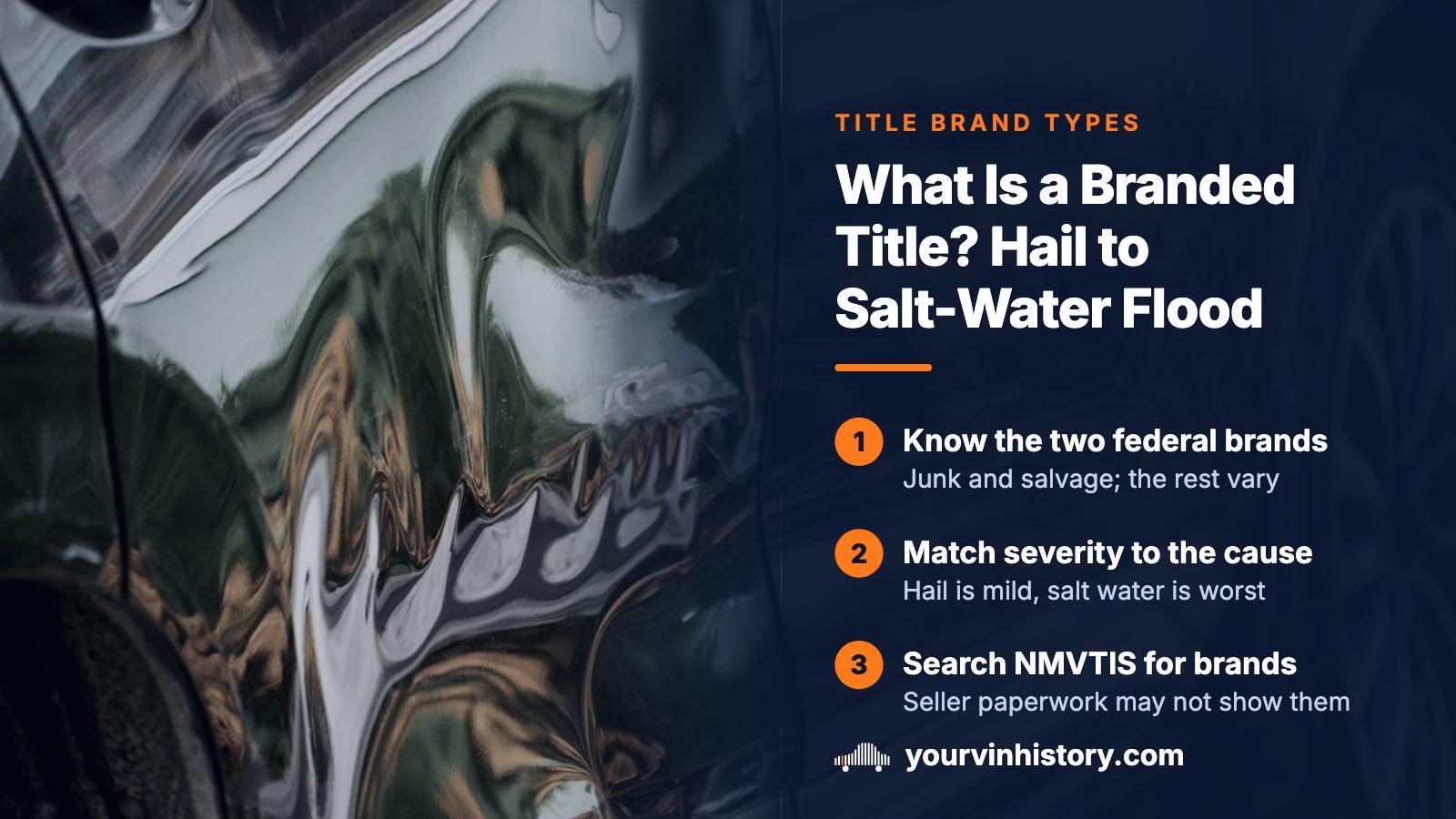
A branded title is a title with a permanent note, added by a state, recording a serious event in the vehicle's history. Common brands include salvage, rebuilt, flood, lemon buyback, odometer and junk. The brand follows the VIN and is reported to a federal title system, so it should be visible from other states. Severity varies widely: hail is often cosmetic, while salt-water flooding is the hardest damage to repair.
- Federal definitions
- Only two: junk automobile and salvage automobile
- Everything else
- Rebuilt, flood, lemon and similar words are state wording
- Where brands are tracked
- NMVTIS, the Justice Department's national title system
- Common price gap
- Often put at 20 to 40 percent below a clean-title match
A brand is a state's permanent note, not a grade
Federal law treats a title as nothing grander than a state-issued record of who owns a car. A brand is a notation the state's titling agency adds when something significant happened to the vehicle. Its purpose is disclosure: every later buyer learns about the event even if the seller stays quiet.
Watch the vocabulary. In this area federal law defines just two conditions, a junk automobile and a salvage automobile. Rebuilt, reconstructed, flood, lemon and hail are words individual states chose, so one history can carry different labels in different states. Compare the event underneath, not the wording on top.
Clean is not the same as uneventful
A clean title means no brand was ever recorded. A car can be crashed and repaired several times and still hold one, provided no insurer or state declared it a total loss. The title records the event, never the repair.
Finding a brand the seller's paperwork may not show
Brands are meant to travel with the VIN. NMVTIS, the Justice Department's national title system, exists so a mark applied in one state can be seen from another. Federal law also directs each state to run an instant verification before titling a car bought out of state, passing along the VIN, the state that issued the latest title and the titleholder's name.
That is the defense against title washing, where a branded car is retitled through other states until the paperwork looks clean. Records can lag, so a recent brand deserves a second look just before you pay. Warning signs include quick transfers with no real change of owner, a title issued far from where the car is sold, and a seller who offers a report screenshot instead of letting you run the VIN.
- Read the VIN off the car itself, at the windshield and the driver's door jamb, and confirm it matches the title.
- Run it through an NMVTIS-approved provider. A yourvinhistory report takes its NMVTIS title records from ClearVin LLC, an approved NMVTIS data provider.
- Try NICB's free VINCheck, which searches theft and salvage reports from participating insurers. It is a second angle, not a full title record.
- Ask the seller in writing whether the car was ever totaled, flooded or bought back by the manufacturer.
- Pay an independent shop to find repaired structure or water exposure that never produced a claim, and so no brand.
What any brand does to price, insurance and loans
Details vary by brand, but the money effects follow a pattern. Buyers commonly put the price gap at 20 to 40 percent under a comparable clean-title car. That is a market rule of thumb, not an official figure, and it is not a saving you keep: your own buyer will ask for the same cut, and trade-in offers run low.
Insurance and lending cause more trouble than price. Liability coverage is generally easy to get. Coverage for the car itself is harder, since some carriers decline it or want dated photos and an inspection first. Many mainstream lenders will not finance a branded car at all, though some credit unions and specialty lenders will. Phone both with the actual VIN before you hand over a deposit.
Hail: usually the gentlest reason for a brand
From here the labels run from least to most worrying, and hail sits at the bottom. A storm can dent every flat panel and crack the glass on a car that is mechanically untouched. On an older car with modest value, the repair estimate can cross the state's total-loss line anyway, so the car is branded for a mostly cosmetic problem. Depending on the state, the title may carry a general salvage word or one that names the cause.
Check the hidden part too. Cracked glass and damaged seals let rain in afterward, so look for damp carpet, a musty smell and fresh sealant around the windows. Ask for the repair invoice showing which panels were fixed and which were replaced.
Theft recovery: the damage depends on the thief
A car reported stolen and later found can carry a note about it. The label alone says little, because recovered cars come back in every condition. Some return missing nothing more than wheels or a stereo. Others come back with a gutted interior, a cut wiring harness or a broken steering column and ignition.
So ask what was taken, what was replaced and who did the work. The VIN record shows the recovery; the repair file and an inspection show whether the wiring and locks were put right. Confirm the VIN plates on the dash and door jamb match each other and the paperwork, because altered identification is a much bigger problem.
Fire: from a scorched engine bay to cooked structure
Fire damage covers a wide span. A small blaze that stayed in the engine bay may have cost a harness, some hoses and paint. One that reached the cabin can ruin wiring, melt plastics and heat the body structure and airbag parts, and heat damage to metal is hard to spot by eye.
Ask where the fire started and why. A fault in the car should have had its cause found and fixed. Have a shop examine the wiring, fuel and cooling lines, airbag modules and underbody, then run the VIN through NHTSA's recall lookup, a free search, since some fires trace back to a defect the maker has already announced.
Collision: how salvage turns into rebuilt
This is the brand most people picture. Under federal law a car counts as salvage when damage from a crash, fire, flood or similar event leaves it in a spot where the cost of repairing it for the road, added to its fair salvage value, would top what it was worth just before the event. Fire and flood sit inside that definition, which is why several labels in this guide often end up as salvage.
The test compares money, not injury. A decade-old commuter car worth little can be written off by damage a newer one would absorb, while a costly car with worse damage can stay clean. Each state sets its own trigger.
After repair, a state inspection can clear the car for registration under a rebuilt or reconstructed brand, depending on the state. That exam usually checks identity, parts sources and basic safety. It does not certify that the structure went back to factory dimensions, so the quality of the repair stays your question to answer.
Odometer, lemon and fleet brands: no crash required
Some brands say nothing about physical harm. An odometer brand, which a state may word as not actual mileage or true mileage unknown, means the state has reason to doubt the number on record. A replaced instrument cluster can cause it innocently; deliberate rollback is illegal. Either way, the dash reading cannot guide your price, so lean on service records and an inspection.
A lemon or manufacturer buyback brand means the maker repurchased the car under a state lemon law after defects it could not repair. The car was not wrecked. The question is whether the original fault was properly fixed before resale, so ask for the defect description and the repair record.
A few states also record police, taxi or fleet use. That is not damage. It points to hard duty and long idling hours, so weigh engine and interior wear accordingly.
Junk and non-repairable: the end of the line
Federal law defines a junk automobile with two tests that must both be true: it cannot operate on public roads, and it has no value except as parts or scrap. States word the brand as junk, non-repairable or certificate of destruction. Unlike salvage, it cannot legally be rebuilt, retitled or registered.
If a seller offers one as a car to drive, treat that as a warning. It may be a different vehicle wearing this one's identity, or you may be left unable to register what you bought. Ask to see the paperwork that explains the status.
Flood: fresh water is bad, salt water is worse
Flooding ends the ladder because it behaves unlike the rest. A collision is local and visible. Water seeps into harnesses and plugs, computers, seat mounts, belt retractors and the hollow sections of the body, and corrosion carries on quietly. Faults appear months or years after the sale, often intermittent and costly to chase. Flood is sometimes a brand of its own and sometimes the cause behind a salvage brand.
- Dried mud or fine silt in the spare-tire well, under the carpet or along the seat tracks
- A damp odor, or strong air freshener hiding one
- Water lines or stains on door panels and interior trim
- Rust on unpainted metal, screw heads and connector pins
- Moisture or a waterline inside headlight and taillight housings
- Carpet or upholstery newer than everything around it
- Electrical faults that come and go
Fresh-water immersion is serious. Salt water is worse, because rust sets in fast and no fix dependably halts it. After major storms, NMVTIS posts flood-damage notices to the entities that report into it. A car from a coastal storm-surge area deserves a firm pass unless you can show it never went under.
Where this information comes from
- 49 U.S.C. 30501: Definitions — Source for the federal wording of certificate of title, junk automobile and salvage automobile, the only two vehicle conditions defined there.
- 49 U.S.C. 30503: State participation — Requires the instant title verification check before a state titles a car bought from another state, and lists what the check passes along.
- NMVTIS: National Motor Vehicle Title Information System — The Justice Department's page for the national title record that lets a brand be seen across state lines, including its flood-damage notices.
- NICB: VINCheck — A free lookup of theft and salvage reports from participating insurers, useful as a second check beside a title record.
- NHTSA: Recalls lookup — Free open-recall search by VIN, worth running on any branded car whatever the title says.
Sources and photos: Facts checked against the sources above in October 2026. Photo by Maxim Tolchinskiy on Unsplash; diagrams by YourVINHistory.
Keep reading
- What is a rebuilt title?The brand you will meet most often on cars for sale, with value, coverage and loan effects.
- Title washingHow a brand can seem to vanish across a state line, and how to catch it.
- NMVTIS reportThe federal title record that carries brands from state to state, in plain terms.
- Lemon law buybackA closer look at the brand that marks cars the factory itself walked away from.
Frequently asked questions
Is a branded title always a dealbreaker?
No. A brand is a prompt to investigate, not a verdict. Hail damage on an older car may be purely cosmetic, while a salt-water flood is close to disqualifying. Decide on the cause, the repair file, an independent inspection and the price, and confirm before paying that you can insure and finance the car.
Is a salvage title the same as a branded title?
Salvage is one kind of brand, so every salvage title is branded but not every brand is salvage. Odometer, lemon buyback, junk and flood brands record other events. Salvage is also a federal term, as is junk automobile, while rebuilt and reconstructed are state wording for a salvage car that was repaired and cleared.
Can a brand be removed from a title?
Not legitimately. A salvage car that is repaired and inspected moves to a rebuilt brand, which adds a new designation rather than erasing the old one. Anyone offering a clean title for a branded VIN is describing title washing, which is fraud, and the national record exists to expose it.
How can I tell if a title is branded when the paper looks clean?
Do not rely on the paper. Run the VIN through an NMVTIS-approved provider and compare the title history with the seller's story: states, dates and owners. A title issued recently in a distant state, with no matching change of ownership, deserves suspicion. So do overspray or uneven panel gaps on a car with a spotless record.
Does hail damage always put a brand on the title?
No. A brand follows a total-loss decision by an insurer or a state, based on repair cost against the car's value. A hail-dented car that was never declared a total loss keeps a clean title, so a freshly repainted roof and hood on a clean-title car is worth asking about even when no brand appears.
Now check the car itself
The guide explains what to look for. The report shows what this VIN has on record.