THE SHORT ANSWER
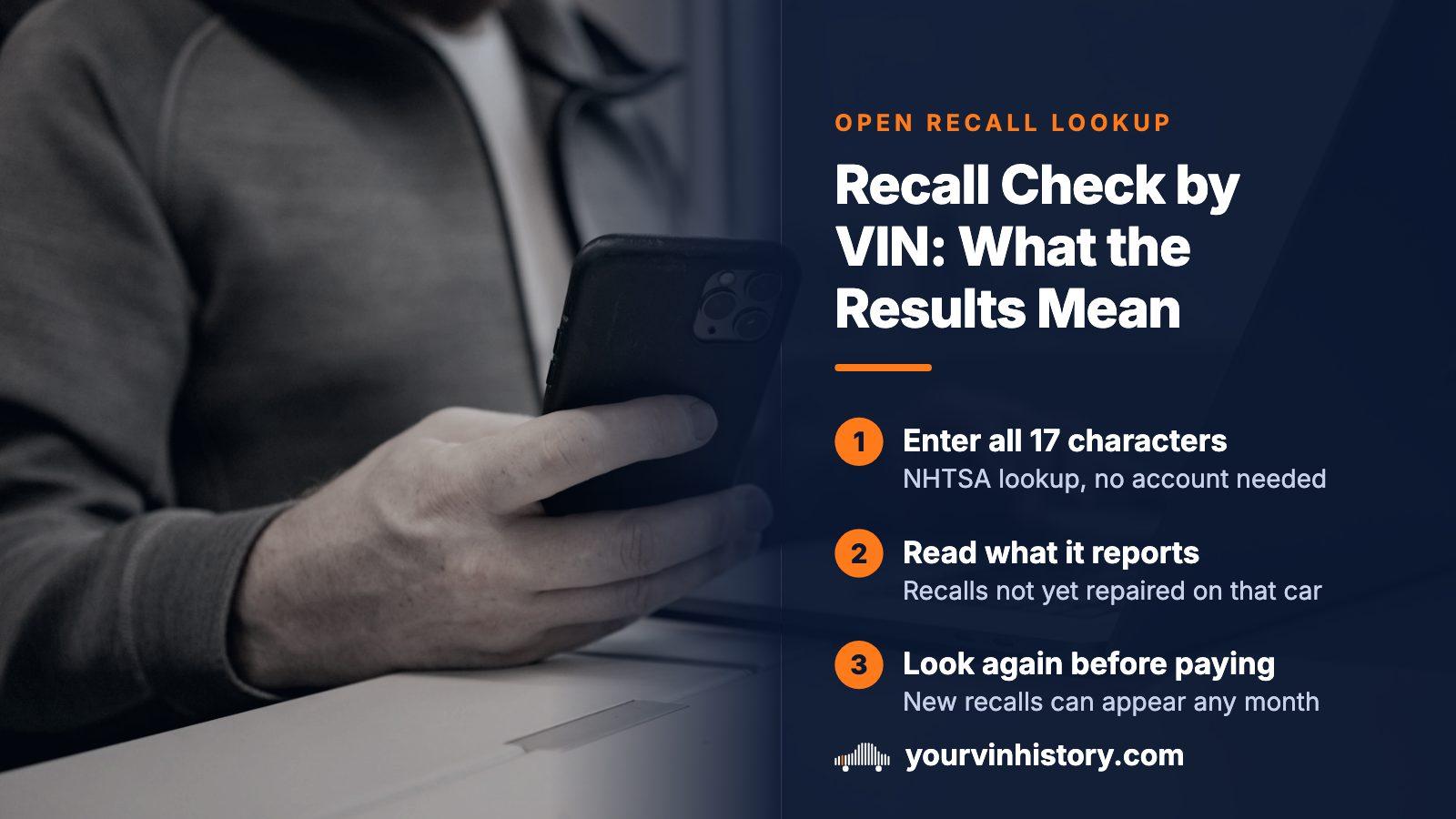
Enter the 17-character VIN in NHTSA's recall lookup. It reports safety recalls not yet repaired on that specific vehicle, costs nothing, and needs no sign-up. An empty result means no open recall today. It cannot speak for defects that have not become recalls, the quality of past repairs, or accident and title history, and a car can pick up a new recall next month, so look again before you pay.
- Where to look
- NHTSA recall lookup, 17-character VIN, no account
- What it reports
- Recalls not yet repaired on that one vehicle
- Same model year, different counts
- From 3 to 33 recalls among five 2020 models
- Age limit on no-charge repairs
- 15 calendar years from first purchase to notice (5 for tires)
What the VIN lookup actually returns
NHTSA's recall lookup is built around a single question: does this particular car have a safety recall whose repair has not been done? You enter the 17 characters, and the answer is a list of open campaigns or a statement that none is outstanding. Repaired recalls drop off the list, which is why a well-kept used car often comes back with little or nothing.
Behind the lookup sits a record each maker must keep under 49 CFR 573.8: for every vehicle in a campaign, the VIN, the registered owner's name and address from state records where available, and the remedy status, refreshed each quarter. Owner letters follow whoever was registered when they went out, so the person driving the car now may never have received one.
Why a model list and a VIN answer disagree
NHTSA also publishes recall data as a feed that developers can query. It is organized by make, model and model year, and it returns every campaign filed for the combination, repaired or not. A site can decode your VIN into those three fields, pull the feed, and show the result beside a box where you typed your VIN. The page feels personal, but the data describes a whole model year.
| 2020 model | Campaigns on file for that model year |
|---|---|
| Toyota Camry | 3 |
| Honda Civic | 5 |
| Subaru Outback | 6 |
| Tesla Model 3 | 21 |
| Ford Explorer | 33 |
These counts come from queries of the public feed and creep upward over time. A big number says how many campaigns exist for a model year, not how many are open on your car. Only the VIN lookup answers that.
Reading a single recall record
Every campaign in the data carries the same fields, and a handful of them do most of the work for a buyer.
| Field | What it tells you |
|---|---|
| Campaign number | The reference to quote when you call a dealer. In a number beginning 19V, the 19 is the filing year and the V marks a vehicle campaign. |
| Component | The affected system, often quite specific, such as a pump inside the fuel delivery line. |
| Consequence | What the defect can do to a driver. Severity lives here, since the records carry no ranking. |
| Remedy | The fix the manufacturer has committed to offer. |
| Report received date | The filing date, which separates an old campaign from a new one. |
Read the consequence text first. Two campaigns with similar titles can differ greatly in what they threaten, and the number of results will not tell you which kind you have. The leading digits help too: 19V is a vehicle campaign from 2019 that earlier owners had years to address, while 26V was filed this year.
Three fields to look for before the test drive
The recall data includes true-or-false fields that rarely make it into a summary but change what you should do. Park It means the vehicle should not be driven until the repair is done. Park Outside means keep it away from garages and buildings, because the defect can cause a fire while parked. The third, over-the-air update, is the pleasant one: the remedy can arrive as software with no shop visit.
If either warning is set
An open campaign marked Park It or Park Outside is not a haggling point. Find out whether the repair has been done before the car goes anywhere, including on a test drive, and do not accept a promise to sort it out later.
Most campaigns have neither warning. In the 2020 sample above, none did.
Why a clean result goes stale
A recall list is not fixed at the factory. The 2020 Ford Explorer has 33 campaigns on file, filed across seven different years: 4 in 2019, 6 in 2020, 2 in 2021, 7 in 2023, 3 in 2024, 6 in 2025 and 5 so far in 2026. Someone who checked that model before 2023 would have missed 21 of the 33, because those had not been filed yet.
Manufacturer pages age as well. The federal rule covered below requires an update at least every seven calendar days, so a printout, a screenshot or a seller's claim that it was clean last year describes a past date. Run the VIN again close to the day you pay.
Carmaker lookup pages and the rule behind them
Under 49 CFR 573.15, a manufacturer that built, sold or imported at least 25,000 light vehicles, or at least 5,000 motorcycles, during either the current or the previous calendar year must post recall information online, with a search that works by make and model or by VIN. The rule sets terms: no charge, no sign-up beyond make, model and VIN, no sales or marketing messages on the search or results pages, open recalls shown first, and a visible date for the last update.
Small builders sit under the size line. A specialty importer or a low-volume motorcycle maker may have no VIN page of its own, though its recall duties still apply, and for those vehicles NHTSA's tool is the only search. The rule requires completion data for at least the campaigns begun in the previous 15 calendar years, so on a very old vehicle, ask a franchised dealer for that brand to run the VIN.
Who pays for the repair, and where the limit sits
When a safety defect or noncompliance triggers a manufacturer notification, federal law makes the manufacturer remedy it without charge when the vehicle is presented. The manufacturer picks the remedy: a repair, an equivalent replacement vehicle, or a refund of the purchase price less an allowance for depreciation.
A change of owner does not by itself end that duty, but age can. Under 49 U.S.C. 30120(g), the no-charge requirement does not apply when the first purchaser bought the vehicle more than 15 calendar years before the notice, or more than 5 for a tire.
The measurement runs to the notice date, not to today. A car that was 13 years old when the notice went out is inside the line even if it is older now, while one already beyond the 15-year mark then has no statutory right to a no-charge fix. Before treating an open campaign on an older car as a costless repair, ask a dealer, with the VIN and campaign number, what the manufacturer will do.
If someone already paid to fix it
Sometimes a recall lands after a repair for the same problem was already paid for. Section 573.13 requires each manufacturer to have a plan for reimbursing that earlier repair, which the rule calls a pre-notification remedy. The claimant is whoever paid, so on a used car that may be a former owner, not you.
The plan must define a window. For a defect found without a formal NHTSA engineering analysis, the window opens no later than one year before the maker told NHTSA, and it closes at least 10 calendar days after the final owner letters were mailed. A plan may exclude work that warranty would have covered, unless a franchised dealer refused coverage or the warranty repair failed to fix the problem.
- A receipt showing the repair addressed the recalled problem and what was paid
- The VIN and the recall's campaign number
- Who owned the car when the work was done
- If it was under warranty then, proof the dealer refused or the fix did not hold
Two limits apply. Reimbursement need not be offered when the first purchaser bought the vehicle more than 10 calendar years before the notice, or 5 for tires, and NHTSA does not mediate disputes over eligibility or amount.
What an empty result does not cover
- Whether earlier recall repairs were done well, since the record shows that work was performed and nothing about its quality
- Defects that are real but have not yet become recalls
- Problems the maker handled through technical service bulletins, which are repair instructions rather than recalls
- Tire recalls, which run on first-purchaser lists and tire identification numbers rather than vehicle VINs
- Accident history, title brands, odometer problems, liens and theft, none of which belong to recall data
That last gap is the job of a vehicle history report, which assembles title brands, accidents with a damage map, odometer readings, salvage and auction records, liens and theft from other sources. A careful buyer wants both answers before paying.
A routine for the day you hand over money
- Read the VIN off the car itself, from the dashboard plate and the door-jamb label, and confirm both match the title and the listing.
- Enter it in NHTSA's lookup and write down the date you ran it.
- For each open campaign, read the consequence line and check for Park It or Park Outside.
- Ask a franchised dealer for that brand to confirm the status by VIN, since its system shows the maker's own repair records.
- Run the VIN once more on the day you sign, then set a yearly reminder.
If a campaign is open, get its number in writing and settle who books the repair before money changes hands.
Where this information comes from
- NHTSA: Recalls lookup by VIN — The federal agency's own search, entered by VIN, which reports recalls not yet repaired on one specific vehicle.
- NHTSA: Recalls API, recallsByVehicle — The public feed queried by make, model and model year, used here for the 2020 campaign counts and the Park It, Park Outside and over-the-air fields.
- eCFR: 49 CFR 573.15, public availability of recall information — Sets the size thresholds and the no-charge, no-marketing and weekly-update terms for a carmaker's VIN-searchable recall page.
- eCFR: 49 CFR 573.13, reimbursement for pre-notification remedies — Defines the claimant, the reimbursement window, the permitted conditions and the paperwork a plan may ask for.
- eCFR: 49 CFR 573.8, lists of owners and remedy status — Requires the per-vehicle list of VINs and remedy status that makes a lookup answer for one car instead of one model.
Sources and photos: Facts checked against the sources above in October 2026. Photo by Anastasiia Nelen on Unsplash; diagrams by YourVINHistory.
Keep reading
- Buying a car with an open recallWhat an open campaign means for the sale and for the price you agree.
- TSB vs recallWhy a service bulletin is a different document from a recall, and who pays.
- Tire recall checkTire notices follow the first buyer, so the VIN lookup is the wrong tool.
- VIN accident checkThe next gap after recalls: which accident facts turn up in records.
Frequently asked questions
How do I check for recalls with a VIN?
Enter the 17-character VIN in NHTSA's recall lookup. Copy it from the car, not from an ad, because a VIN taken from a listing repeats any typo the seller made. The result shows open recalls only, so repaired ones will not appear. If it shows nothing, a franchised dealer for the brand can confirm against the maker's own records.
Why does one site list many recalls when NHTSA shows none?
The site is probably printing the model-year list, which includes every campaign ever filed, repaired or not. NHTSA's VIN lookup only reports what remains unrepaired on your car. A long list under a VIN box is a hint that the page decoded your number and then fell back to model-level data.
Is a service bulletin the same as a recall?
No. A recall follows a safety defect or noncompliance and carries a federal duty to remedy without charge, subject to the age limit described above. A service bulletin is the maker's instruction to dealers about a known problem. It carries no such duty, so the repair is often at the owner's expense.
Do recalls expire on older cars?
In one sense, yes. The legal duty to repair without charge has an age ceiling, measured from first purchase to the notice date, so an older car may not be owed a no-charge fix. Carmaker lookup pages also need to cover only the previous 15 calendar years of campaigns. For an older car, ask a dealer to run the VIN and state the manufacturer's position in writing.
What if I find an open recall after buying the car?
Call a franchised dealer with the VIN and campaign number and ask whether the remedy is available yet. A carmaker's lookup must state when a recall has been announced but the remedy is not ready, so a wait is possible. If the car was repaired for the same problem before the recall, the reimbursement rules may apply, and a receipt matters.
Now check the car itself
The guide explains what to look for. The report shows what this VIN has on record.