THE SHORT ANSWER
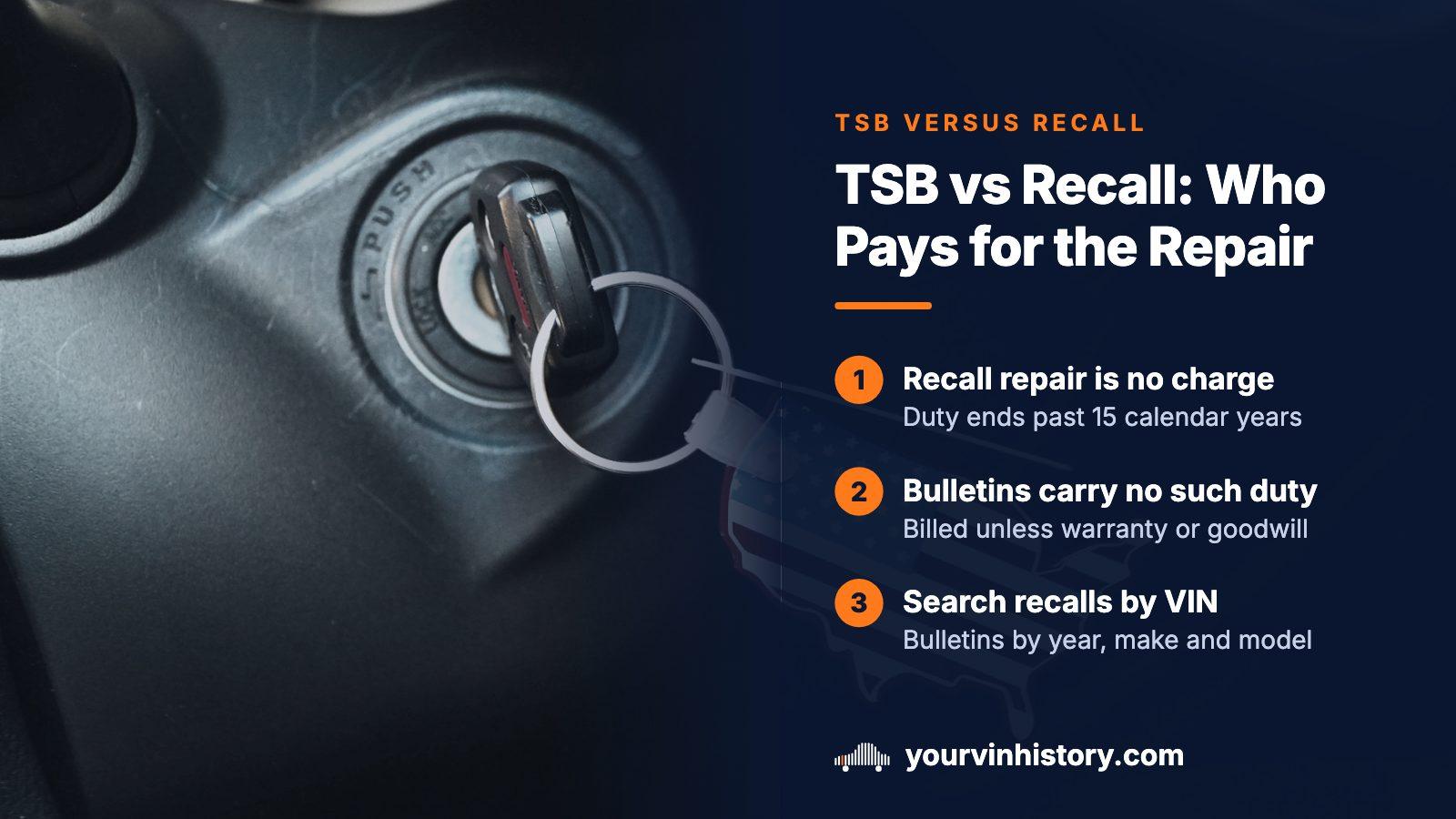
A recall repair is owed to the owner at no charge, because federal law requires the manufacturer to remedy a safety defect or a standards violation, though that duty ends for vehicles first bought more than 15 calendar years before the notice. A technical service bulletin carries no such duty. It tells dealers how to fix a known problem, and you pay unless warranty, a published coverage extension or goodwill applies.
- Recall repair
- Without charge under 49 U.S.C. 30120, with a 15-year age cutoff
- Bulletin repair
- No federal duty to pay; billed unless warranty, an extension or goodwill applies
- Why bulletins are public
- 49 CFR 579.5 sends copies to NHTSA, safety-related or not
- VIN lookup
- Answers for recalls; bulletins are searched by year, make and model
Two documents, two very different promises
People lump these together because both describe a known problem. Their legal weight is not close. A recall begins when the manufacturer, or NHTSA, concludes that a vehicle carries a safety-related defect or breaks a federal safety standard. From that point the manufacturer owes owners a remedy, and the law says it must come at no charge.
A technical service bulletin, or TSB, starts in the engineering and warranty departments. The manufacturer has seen the same fault often enough to write down a fix and send it to its dealers. Nothing in that act admits a safety defect, sets a deadline or promises anyone a free repair. It is a set of shop instructions that happens to reveal what tends to break.
What the recall obligation guarantees, and where it stops
The no-cost duty comes from 49 U.S.C. 30120. Once a recall notice is required, the manufacturer must fix the problem without charge when the vehicle is presented for the remedy. For a vehicle, the statute also lets the manufacturer refund the purchase price, less a depreciation allowance, instead of repairing it. Every remedy program must include a plan to reimburse owners who paid for the fix themselves before the manufacturer sent its notice.
The age limit on free recall repairs
The no-charge rule is not unlimited. Under subsection (g) of that statute, it does not apply to a vehicle first bought more than 15 calendar years before the earlier of the owner notice or the recall order. For tires the cutoff is 5 calendar years. A very old car can carry an open recall and still sit outside the federal free-repair rule, so ask the manufacturer before assuming the work costs nothing.
What a service bulletin contains
Bulletins are written for technicians, not customers. A typical one lists the affected models and build window, describes the symptom in plain terms, walks through a diagnostic procedure, names the corrected part and sets a labor time. They tend to be blunt about weaknesses that a brochure would never mention.
Do not read the sheer count as a verdict. A manufacturer with many bulletins may simply be good at turning warranty claims into engineering fixes. A better test is which component a bulletin covers, on which model year, and whether the symptom matches what the car in front of you is doing.
Why you are allowed to read bulletins at all
Manufacturers do not publish these by choice. Under 49 CFR 579.5(a), a manufacturer must send NHTSA a copy of its notices, bulletins and other communications about defects whenever they go to more than one dealer, owner or purchaser. The rule expressly includes product improvement bulletins and the notices that extend warranty or policy coverage, and it reaches electronic messages as well as paper.
The detail that matters most is that the duty holds even when the defect has no safety angle at all. The rule treats a defect broadly: any failure beyond normal wear, any performance failure, any flaw or departure from the design specification. Subsection (b) adds customer satisfaction campaigns, consumer advisories and recalls. Copies are due within five working days after the end of the month in which a communication was issued.
That is how a shuddering transmission or a rebooting touchscreen, neither of which is a recall item, can still end up in a public record.
Why a VIN search cannot return bulletins
A recall lookup accepts a VIN, so a bulletin lookup ought to as well. The gap comes from how each document is filed. Under 49 CFR 573.6(c)(2), a recall report must pin down the affected vehicles. A passenger car is described by make, line and model year, plus the span of build months and years. That is a defined population, and a given VIN either falls inside it or does not.
A bulletin reaches NHTSA as a copy of a communication under 579.5. No population is drawn and no build-date boundary is committed to, so a VIN has nothing to be matched against. When a bulletin applies to particular cars, the limits sit inside the document itself, usually as a production window or a range of serial numbers. The workable route takes a few minutes:
- Decode the VIN to get the model year, make and model.
- Search for bulletins and manufacturer communications under that year, make and model.
- Read the applicability range printed inside any bulletin that matches your symptom.
- Run the recall lookup on the full VIN as a separate step.
The bulletin that does mean a free repair
Look again at what 579.5(a) lists: warranty and policy extension communiqués. Manufacturers sometimes extend coverage on a part that fails more often than it should, with a longer term, a higher mileage cap or reimbursement for owners who already paid. These notices travel through the same channel as ordinary repair instructions, so they land in the same public pile.
For a used-car buyer this is the best find in the stack. An extension can make a known, costly fault a covered one, and nobody has a duty to send you a notice, which is the opposite of how recalls work. Age, mileage and the model years or engines involved are written into each program, and they are often tighter than a forum summary suggests. Read the manufacturer's own document.
Who pays in each situation
| Situation | What it costs you |
|---|---|
| Open recall, vehicle inside the federal age limit | Nothing. The remedy is without charge. |
| Open recall, vehicle past the 15-year cutoff | Not guaranteed. The federal rule no longer reaches it, so ask the manufacturer. |
| Recall announced, remedy not yet ready | Nothing yet, and no repair yet. Ask for the campaign number and where the remedy stands. |
| Bulletin repair, car under warranty | Usually nothing, because the warranty pays, not the bulletin. |
| Bulletin repair, car out of warranty | Usually the whole bill, unless the manufacturer chooses to extend goodwill. |
| Published warranty or policy extension | Nothing, inside its stated terms. |
| Open NHTSA investigation | Nothing, because nothing is owed yet. It poses a question and offers no remedy. |
Where complaints and investigations fit
Two more layers surround these documents. Complaints are reports owners file with NHTSA. Any single one is unverified, but a cluster on one component and model year says something. Investigations are opened by NHTSA when a pattern justifies a closer look. An open investigation asks whether a defect exists, imposes no repair duty and can close without a recall.
A bulletin sits between the two and recall at the top. It concedes more than an investigation does, since the manufacturer has accepted that a problem is real and has authored a repair, yet it entitles you to less than a recall. When a bulletin and a spike in complaints point at the same part, treat that as a stronger signal than either alone.
A sequence to follow before you hand over money
- Run NHTSA's recall lookup on the VIN. It is free, and an open campaign means a repair the earlier owner never collected.
- Search bulletins and manufacturer communications for that year, make and model.
- Scan the results for wording such as coverage extension, product improvement or customer satisfaction, because a no-cost repair can hide there.
- Compare what you found with the complaint record for the same model year.
- Bring the bulletin number to the pre-purchase inspection so the mechanic can test that symptom on purpose.
A yourvinhistory report covers the VIN-specific piece, listing open recalls next to the accident, title and odometer records. Bulletins still have to be searched by model year.
What a bulletin cannot tell you
- Whether the specific car you are eyeing suffers from the fault. Bulletins describe patterns across a model, and only an inspection can settle one vehicle.
- Whether the work was ever done. No public per-VIN record of bulletin repairs exists the way one does for recalls.
- How common the problem is. A bulletin follows an identified pattern, not a fixed failure rate.
- Whether the manufacturer will pay anything. Goodwill is optional for the company, and results swing with the dealer, the odometer and how you ask.
- Whether a newer revision has replaced it. Check the date before trusting a procedure.
Used well, bulletins sharpen your list of things to check on one car. The answers come from the inspection.
Where this information comes from
- eCFR: 49 CFR 579.5, notices, bulletins and other communications — Backs the duty to send NHTSA copies of defect communications, the named extension communiqués and the safety-related-or-not language.
- eCFR: 49 CFR 573.6, defect and noncompliance information report — Shows how a recall population is defined by make, line, model year and manufacture dates, and the five-working-day filing clock.
- GovInfo: 49 U.S.C. 30120, remedies for defects and noncompliance — Source of the without-charge remedy, the refund option, owner reimbursement and the age cutoff on free repairs.
- NHTSA: recalls lookup — The free VIN-based search for open recall campaigns, the one layer that resolves to a single car.
Sources and photos: Facts checked against the sources above in October 2026. Photo by Jake Kling on Unsplash; diagrams by YourVINHistory.
Keep reading
- Recall check by VINShows how the VIN search works and why model-level searches return different answers.
- Buying a car with an open recallCovers what the recall statute requires when the car you want already has an unfixed campaign.
- NHTSA investigation checkExplains the reporting activity that comes before any recall and how to read it.
- VIN warranty checkHelps you work out whether a bulletin repair or an extension falls inside coverage.
Frequently asked questions
Is a TSB the same as a recall?
No. A recall follows a determination about safety or a standards violation, gets a campaign number from NHTSA, and carries a repair the manufacturer must provide without charge. A TSB is a bulletin to dealers with no campaign number, no filed list of affected cars and no promise about who pays. Cost is the practical difference you will feel at the service desk.
Can a TSB repair ever be done for free?
Yes, when something other than the bulletin pays for it. A factory warranty that is still active will cover a covered part, a published warranty or policy extension can reach past the original terms, and some manufacturers approve goodwill on a case-by-case basis. Ask the dealer to check your exact build date and mileage against the bulletin before authorizing the work.
Are recall repairs free on a very old car?
Not always. Federal law stops requiring a no-charge remedy once a vehicle was first bought more than 15 calendar years before the owner notice or recall order, and tires use a 5-year cutoff. That is the legal minimum rather than a ban on help, so contact the manufacturer or a dealer about your specific car before you budget for the repair.
Where do I find technical service bulletins for a car?
Start by decoding the VIN to confirm the model year, make and model, then search NHTSA for manufacturer communications under those three details. Read the applicability range inside any bulletin that matches your symptom. A dealer service department can also tell you whether a bulletin on that symptom applies to your build range, which saves guesswork when the wording is ambiguous.
Should a TSB stop me from buying a used car?
Rarely on its own, since well-built vehicles collect bulletins too. Weigh the cost of the component involved, whether your model year is the one affected, and whether complaints for that year stand out from neighboring years. Ask the seller for repair records showing the bulletin work was done, and have the inspecting mechanic check that exact symptom.
Now check the car itself
The guide explains what to look for. The report shows what this VIN has on record.