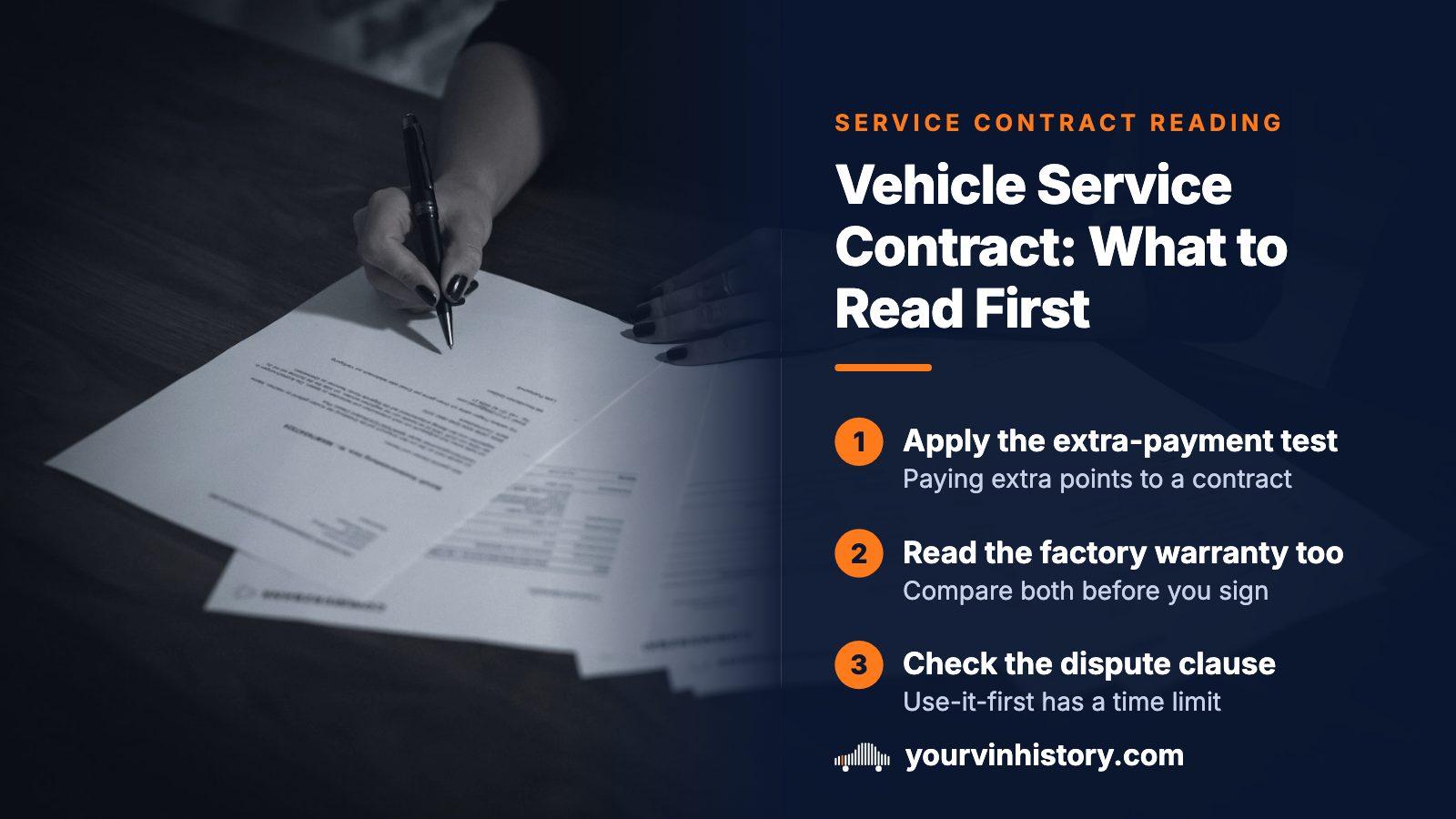
THE SHORT ANSWER
An extended warranty you pay extra for normally counts as a service contract, which federal rules keep apart from a written warranty. The split comes from 16 CFR 700.11, and it matters because the federal disclosure rules were drafted for warranties. Ask to read the factory warranty and the full contract before signing, hold both against the 701.3 list, and know that where Part 703 applies, a use-it-first dispute clause is met 40 days after you notify the mechanism.
- The dividing test
- Paying extra for the coverage points to a service contract (16 CFR 700.11)
- Reading before the sale
- Seller duty for written warranty text (16 CFR 702.3)
- Dispute clause limit
- Resort-first requirement is met 40 days after notice
- Disclosure threshold
- Products costing more than $15
The label on the offer and the product underneath
Somewhere between the signature on the loan and the handoff of the keys, a brochure for an extended warranty slides across the desk. The wording is a sales habit. In the regulations that govern vehicle coverage, the thing you pay extra for usually belongs to a different category, called a service contract, while a written warranty is something else.
That is not wordplay. The category decides which federal disclosure rules were drafted with the document in mind, what a seller owes you before the sale, and how a dispute clause is allowed to work. Nobody at the desk is likely to lay this out, so it helps to arrive already knowing it.
The extra-payment test in 16 CFR 700.11
The Federal Trade Commission's interpretation at 16 CFR 700.11 hangs on one question: did you hand over anything beyond the price of the vehicle to get this coverage? A written warranty is conveyed when the product is sold, with no separate charge. Coverage you pay extra for, whether at the desk or later, is a service contract. That single test explains why the product pitched at the finance office generally falls on the contract side.
| Instrument | What marks it |
|---|---|
| Written warranty | Part of the deal at the sale, with no added charge |
| Service contract | Bought for an added price, at the desk or later |
| Breakdown insurance | Falls under state insurance law and its regulators |
When the contract is really an insurance policy
Section 700.11 also describes a third bucket. Some agreements fit the federal definitions of a warranty or a service contract and are still sold and regulated by the states as insurance. The FTC's own example is the automobile breakdown insurance policy.
Behind that sits the McCarran-Ferguson Act, codified in part at 15 U.S.C. section 1011, which says federal law should not be read to override state laws written to regulate insurance. In practice, the paper in your hand may answer to your state's insurance rules in place of, or beside, the federal text this guide describes. Ask the seller which of the three you are being offered, and where the paperwork says so.
Which paper gets which protections
Buyers often assume the reverse of the truth. The disclosure machinery under the Magnuson-Moss Warranty Act is built around written warranties, so the document that came with the car at no separate charge is the one most heavily regulated. The paid contract sits outside a good part of that structure.
This is not an argument against buying a contract. It is an argument against assuming that a federal law about vehicle warranties automatically governs whatever you are about to sign. Work out which instrument it is, then judge it on its own text. The label on the brochure settles nothing; the test in 700.11 does.
Reading the terms before you commit
Section 702.3 puts a duty on the seller, not on you. For a product that carries a written warranty, the seller has to let a prospective buyer examine the terms ahead of the sale. Two methods are accepted: keep the text on display beside the product, or hand it over on request while posting signs that tell shoppers warranties are available. The warrantor has a matching job of equipping the seller, whether by packing a copy with each product, attaching a tag or label bearing the full text, printing it on display packaging, or supplying a notice or poster.
At a dealership the practical move is a plain request to see the complete factory warranty before deciding. Then make a second request for the full service contract, not the one-page brochure that summarizes it. The first request rests on a federal rule. The second rests on common sense, since a contract is cheaper to read before signing than to argue about afterward.
A checklist borrowed from 16 CFR 701.3
Section 701.3 lists what a written warranty must say, all inside one document and in language an ordinary reader can follow. The rule may not reach a paid contract, but the list works as a yardstick for any coverage paper you are handed. Hold the pages against it and mark what is missing.
- Who is covered, including whether coverage stops with the original purchaser or follows the car to later owners
- Which parts and components are included, plus exclusions where needed for clarity
- What the company will do about a defect or failure, and which costs it will and will not pay
- The start date, when it differs from the purchase date, and the length of the term
- A step-by-step claim procedure, with the company's name and address or a toll-free number
- Whether an informal dispute mechanism under Part 703 applies
- Any limit on the duration of implied warranties, shown on the face of the document
The section also calls for a notice about limits on incidental or consequential damages and a statement that the warranty gives specific legal rights, with others that vary by state. Watch the one-document rule most closely. If exclusions sit on a website and the claim steps are in a separate leaflet, a written warranty would fall short. Both 701.3 and 702.3 apply to consumer products costing more than $15, a floor set for consumer goods generally, which a vehicle clears easily.
Reading the dispute clause
Many coverage documents send disagreements to an informal dispute mechanism before anything else. Part 703 governs such mechanisms, and it begins with disclosure. Under 703.2(b), the warranty must state on its face that the mechanism exists, give its name with an address or a telephone number consumers can call without charge, say whether you must use it before pursuing remedies under Title I of the Act, add that rights outside Title I do not require it, and point to where more information appears.
A warrantor may not build in a mechanism that falls short of 703.3 through 703.8. The mechanism cannot charge consumers a fee, must be funded and staffed to decide disputes fairly and quickly, and must be insulated from the warrantor and its sponsor. Section 703.4 regulates the panel too: nobody deciding your case may be a party to it, and on a panel of three or more, no fewer than two-thirds of the members may have a hands-on role in building, distributing, selling or servicing products.
The 40-day limit on use-it-first clauses
Section 703.5(d) tells the mechanism to decide an unsettled dispute as quickly as it can and within 40 days of notification. Paragraph (i) covers the courtroom side. A clause requiring use of the mechanism before a suit under section 110(d) of the Act is met 40 days after notification, or when the mechanism completes its work, if that happens sooner. Paragraph (e) lets the mechanism delay in specified situations, and a delay under it pushes that date back.
A clock, not a wall
Where Part 703 applies, a clause that makes you go through the mechanism before filing suit does not run forever. Write down the date you notified the mechanism, because the 40 days are counted from notification.
The provision caps a precondition; it does not decide your dispute or say anyone was right. A separate duty in 703.5(h) applies when performance has been promised: the mechanism must check with you, within 10 working days of the performance date, whether the work actually happened.
A routine for the ten minutes you get at the desk
Offers like this arrive at the end of a long afternoon, so keep the routine short.
- Ask which kind of product it is: a warranty bundled into the price, a contract you are buying separately, or a policy your state regulates as insurance.
- Request the complete document and start with the exclusions, then move to the coverage summary.
- Run the 701.3 list against the pages you were handed and mark every gap.
- Find the dispute clause and write down the mechanism's name. If you must use it first, the 40-day limit applies where Part 703 does.
- Find out what factory coverage remains on the vehicle before paying for a second layer.
For the last step, a yourvinhistory report is one input: it ties open recalls, title brands and odometer readings to the VIN, though it cannot read a contract. NHTSA's recall lookup by VIN is a no-cost government tool for open recalls alone. The related guide on VIN warranty checks covers how to find out what the maker still backs.
What this guide cannot settle
This is general information, not legal advice, and it says nothing about whether a particular contract is worth its price. That depends on the vehicle, the deductible, the exclusions and how much repair risk you are willing to carry yourself. Nor can a federal checklist tell you which rules bind a given contract. The disclosure rules cited above were drafted for warranties, and a paid contract may fall under state law instead, including state insurance law when it is regulated as insurance. What the text does give you is a set of questions and the vocabulary to ask them. Check your state's rules too before leaning on any of this.
Where this information comes from
- 16 CFR 700.11: warranties, service contracts and insurance — The extra-payment test that separates a written warranty from a service contract, and the insurance carve-out.
- 16 CFR 702.3: pre-sale availability of warranty terms — What a seller must do so a shopper can examine the warranty text before buying, and what the warrantor must supply.
- 16 CFR 701.3: written warranty terms — The list of items a written warranty must disclose, used here as a checklist for any coverage document.
- 16 CFR 703.2: warrantor duties on the dispute mechanism — What the face of the warranty must say about the mechanism, and the bar on non-compliant mechanisms.
- 16 CFR 703.3: mechanism funding, fees and independence — The ban on consumer fees and the insulation rules; the neighboring section 703.4 sets the panel makeup.
- 16 CFR 703.5: how the mechanism operates — The 40-day decision duty and the point at which a use-it-first requirement is met.
Sources and photos: Facts checked against the sources above in October 2026. Photo by Dimitri Karastelev on Unsplash; diagrams by YourVINHistory.
Keep reading
- VIN warranty checkShows how to find out what factory coverage is still running before you pay for more.
- Vehicle maintenance reportCovers where service records live and where repairs may be done without losing coverage.
- As is, no warrantyExplains what a waiver of warranties does and does not take away from a buyer.
- Financing fell throughCovers the other paperwork signed at the same desk and the notice buried in it.
Frequently asked questions
Does an extended warranty count as a factory warranty?
Usually not. A factory warranty comes with the vehicle at the sale. Coverage you pay extra for is generally a service contract under the FTC's 16 CFR 700.11 test, even when the dealer or the brochure calls it an extended warranty. Some of these products are sold as insurance under state law, so ask which one you are being offered.
Can I take the contract home to read before I sign?
The pre-sale rule in 702.3 is written for products with a written warranty, so it plainly covers the factory coverage. With a paid contract you are relying on asking. Request the full document, not the summary brochure, and treat a seller who will not show it before you sign as telling you something about the deal.
Does the 40-day rule apply to every extended warranty?
No. It sits in Part 703, which governs informal dispute mechanisms tied to written warranties. A paid service contract may be governed by state law instead. Check whether your document names a mechanism, and if it does, remember the clock starts when you notify the mechanism, not when you first complain to the dealer.
Who pays for the dispute mechanism?
Not you. Under 703.3 the mechanism cannot charge consumers any fee, and it has to be funded and staffed well enough to decide disputes fairly and quickly. Under 703.8, the semiannual statistics it compiles are open to inspection by anyone, including counts of disputes decided against consumers and disputes delayed past 40 days.
Should I buy the coverage?
A guide cannot answer that for you. Price, deductible, exclusions, the age of the vehicle and how badly a large repair bill would hurt all matter. Read the full document, compare it against the 701.3 list, and confirm what factory coverage is still running.
Now check the car itself
The guide explains what to look for. The report shows what this VIN has on record.