THE SHORT ANSWER
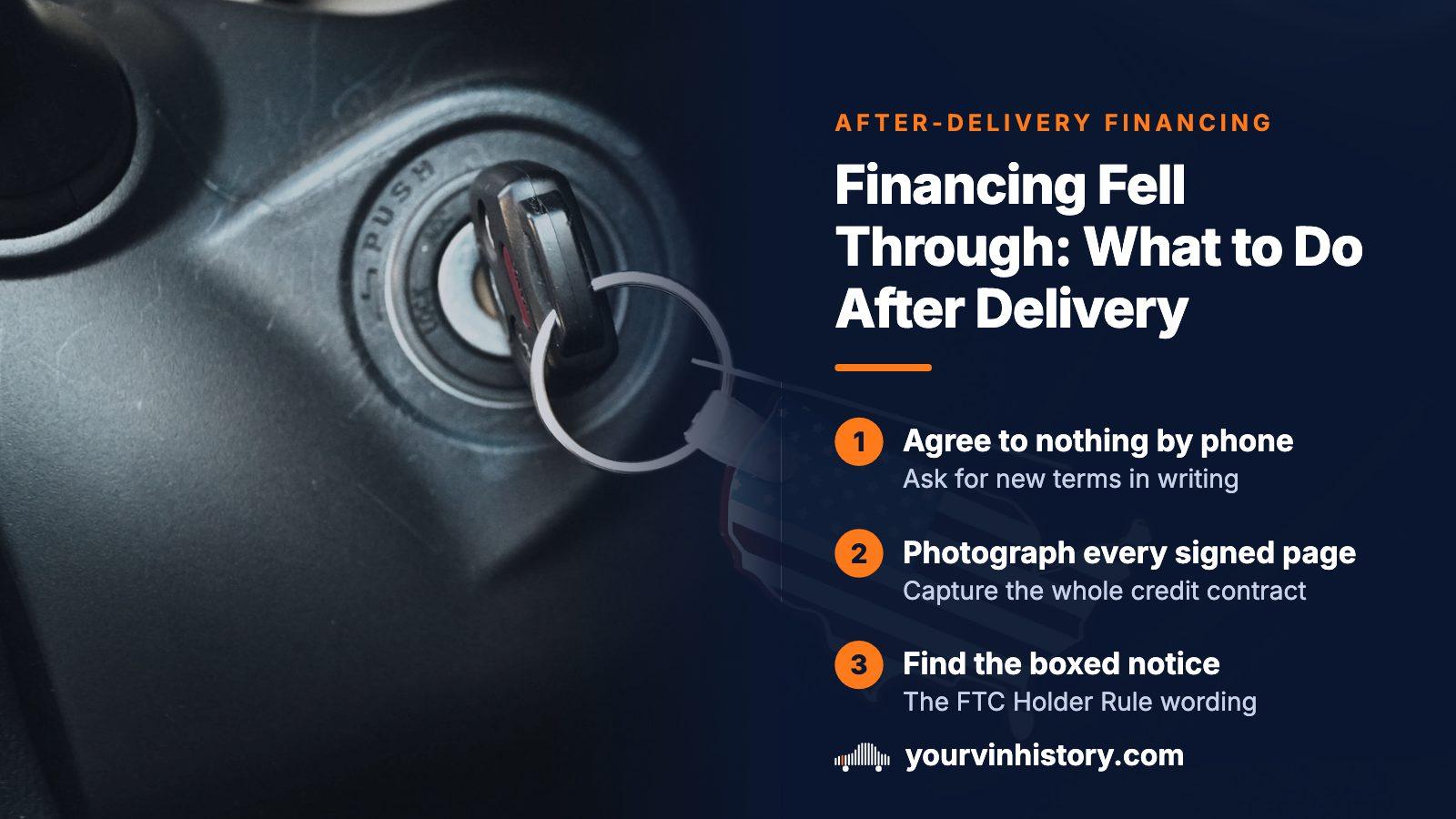
When a dealer calls to say financing fell through after you took the car, agree to nothing by phone. Photograph every page you signed, look for the boxed notice that 16 CFR 433.2 requires in dealer-arranged credit contracts, and ask for any new terms in writing. Whether the first contract still stands depends on its wording and your state's law, so confirm that with a lawyer or your attorney general's office.
- The rule
- 16 CFR 433.2, the FTC Holder Rule
- Where to look
- A boxed notice inside the credit contract
- Type requirement
- Bold, at least ten points
- Best comparison
- Total of payments, old contract against new
Why the call can arrive after you already drove home
Spot delivery means the dealership lets you leave with the car before a lender has formally accepted the loan. That alone is legal and common. The trouble starts when the lender passes, or comes back with worse terms, and the dealer phones to say the deal must be redone. Consumer lawyers call that sequence yo-yo financing.
Some contracts describe the arrangement in gentler words, such as conditional delivery or a delivery agreement, often on a separate sheet signed in the same pile as everything else. Whether that wording exists in your stack is the first fact to settle, because it shows what the dealership said the deal depended on. Neither label settles who is right.
Photograph everything before you answer the phone again
The call usually arrives with a deadline attached: come in today, bring the car, sign by Friday. That deadline belongs to the dealership, not to you. Spend the first hour on evidence, because paperwork can be swapped and memories blur.
- Every page of the retail installment contract or purchase agreement, front and back
- Any sheet that mentions delivery, conditional terms or lender approval
- The Buyers Guide from the window, if the car came from a dealer
- Trade-in paperwork, including the payoff figure quoted for your old loan
- The odometer and dashboard of the car you are driving now, with the date visible
- Receipts for any deposit, down payment or fee you handed over
Dated photos of your own copy matter if the dealership later produces a version that reads differently. The FTC's used-car guidance makes a related point: get prices and promises in writing, since spoken assurances are hard to enforce.
The boxed notice that federal rules put in dealer-arranged credit contracts
Look for a short paragraph in capital letters, usually boxed and often close to the signature lines. It comes from 16 CFR 433.2, the FTC's rule on preserving consumers' claims and defenses, known as the Holder Rule. A seller who takes such a contract without the notice commits an unfair or deceptive practice, the rule says, citing section 5 of the FTC Act.
The notice, in plain terms
Whoever ends up holding the contract, including a bank or finance company that bought it from the dealer, takes it subject to every claim and defense you could raise against the seller. Whatever you recover through the notice cannot exceed what you have paid under the contract.
Finding it tells you the contract was written to be sold on to a lender. That matters in a dispute, since the company calling you and the company holding your loan may differ.
What the notice gives you, and where it stops
The paragraph does two jobs. It keeps your claims and defenses against the seller alive when the contract moves to someone else, so a lender cannot treat the dealership's conduct as none of its business. It also sets a ceiling on what you can get back through the notice.
| Part of the notice | Effect for you |
|---|---|
| Claims and defenses travel with the contract | A holder takes it subject to whatever you could assert against the seller |
| Recovery ceiling | Money recovered under the notice cannot exceed the amounts you paid under the contract |
The ceiling counts payments you have made. That differs from the car's price, from the balance you owe, and from any loss you feel you took, so take it literally.
Just as important is what the notice leaves alone. It does not cancel your debt, say whether your contract is binding, or decide if the dealership can reclaim the car. Those answers come from your contract's terms and state law.
Type size, a second wording, and a narrow exemption from 1977
The rule specifies formatting as well as words: bold type, at least ten points. A protection buried in fine print protects nobody, so the regulation sets a floor on how small and how light the notice can be. If yours is tiny or faint, note that when you photograph the page.
A second version of the wording, in paragraph (b) of the same section, applies when a seller accepts the proceeds of a purchase money loan. It differs by a few words, with the same effect.
The rule dates from 1975. Its only exemption, in 16 CFR 433.3, covers sellers who took open end consumer credit contracts before November 1, 1977, and only where the contract did not cut off the consumer's claims and defenses. That is a transitional carve-out for old open end accounts, not an escape hatch for a modern car loan. If a vehicle contract signed this year has no notice, ask the dealer and your attorney general why.
Sent to a separate lender? The rule can still reach the loan
Buyers often assume the notice only matters when the dealer lends the money directly. The definitions in 16 CFR 433.1 say otherwise. A consumer is a natural person who buys for personal, family or household use, so a vehicle bought for a business falls outside it. A creditor is a business that regularly lends purchase money to consumers or finances their purchases on deferred payment.
The purchase money loan definition is where the dealership's lender comes in. It covers a cash advance, made in return for a finance charge as federal truth-in-lending rules define the term, that is spent mostly on goods from a dealer who sends customers to that lender or is tied to it through common control, contract or business arrangement.
A fact worth recording
If the finance manager steered you to a particular bank or credit company, write down its name and the date. A referral is the link the definition looks for.
Your trade-in and deposit come first
A dealership can resell a trade-in within days, which makes it the item most easily lost in a failed-financing dispute. Ask in writing whether it still sits on the lot. An email beats a call, because the answer is then on record.
- Ask whether the trade-in has been sold and, if not, where it is stored
- If the deal is being undone, ask for it back in the condition you left it
- Keep the payoff figure quoted for your old loan; the amount actually paid off can be different
- Keep the receipt for any deposit or down payment
- Log the date, time and name for every call
Whether a dealership may keep a deposit or a trade-in is decided by your contract and your state's law. Do not settle it on a verbal assurance.
Run the VIN of both vehicles, the one in your driveway and the one you traded, and keep the results in your file. A VIN preview shows whether records exist before you pay, and the full report is a one-time paid purchase covering title brands, odometer readings and liens. NHTSA's recall lookup costs nothing and covers open recalls on either car.
Handed a new contract? Compare these figures line by line
If you decide to go in, the new paperwork has to state specific terms. Regulation Z, the rule behind the Truth in Lending Act, spells out what a closed-end credit disclosure must contain, in 12 CFR 1026.18. Lay the old contract beside the new one and check these five.
| Figure | What it tells you |
|---|---|
| Amount financed (b) | Credit extended for you, after your down payment and any prepaid finance charge |
| Finance charge (d) | The dollar amount the credit will cost |
| Annual percentage rate (e) | The cost of the credit as a yearly rate |
| Payment schedule (g) | How many payments, how large, and when due |
| Total of payments (h) | What you will have paid once every scheduled payment is made |
Paragraph (a) names the creditor, so you learn whether the lender changed. Paragraph (j) gives the total sale price, down payment included. If you can compare only one number, pick the total of payments: a pitch built around the monthly figure can hold it steady while the term stretches and the cost grows.
Paragraph (c) adds a right many buyers never use: a written breakdown, apart from the contract, of where the financed money goes, including payments to third parties on your behalf. A creditor may skip it only if it offers a statement of your right to ask and you do not ask.
Saying no, and why your state decides what follows
Signing is your choice. No one can push you into a pricier rate, a stretched term or a bigger down payment, and a fresh agreement exists only once you put your name to it. What differs by state is the aftermath of refusing: whether the first agreement survives and what legal options the dealer has for getting the car back. The FTC's used-car guidance also notes that federal law gives no three-day right to cancel.
- Ask the dealership to email why the financing failed and which lender declined.
- Request any new terms in writing before you travel anywhere.
- Ask in writing what happens to your trade-in, deposit and the original contract if you decline.
- Compare any new paperwork with the first set using the figures above.
- Contact your state attorney general's office or a consumer attorney licensed in your state before you sign or surrender anything.
This guide explains what federal rules require to appear in a credit contract, so you can find it and read it yourself. It is not legal advice, and it cannot say whether the dealer is entitled to the car.
Where this information comes from
- eCFR: 16 CFR 433.2, preservation of consumers' claims and defenses — Source for the required notice, its bold ten-point minimum, the section 5 language and the second wording for purchase money loans.
- eCFR: 16 CFR 433.1, definitions — Defines consumer, creditor, seller and purchase money loan, including the referral and affiliation test.
- eCFR: 16 CFR 433.3, exemption for older open end contracts — Shows how narrow the November 1, 1977 exemption is and which contracts it covered.
- eCFR: 12 CFR 1026.18, content of disclosures — Lists the figures a credit disclosure must state and the itemization right used in the comparison table.
- FTC Consumer Advice: Buying a used car from a dealer — Federal guidance on getting terms in writing, comparing total financing cost and the absence of a federal three-day cancellation right.
- NHTSA: Recalls lookup by VIN — Government search for open recalls on either the new purchase or the trade-in.
Sources and photos: Facts checked against the sources above in October 2026. Photo by Jake Kling on Unsplash; diagrams by YourVINHistory.
Keep reading
- Can I return a used car?Explains when a three-day return rule applies and when it does not.
- The dealer ran my creditCovers the notices that follow a credit check, useful if a new application is on the table.
- After buying a used carLays out the paperwork sequence for the first week after you take the car home.
- Temporary tagDescribes the driving time a temporary tag allows and the deadline behind it.
Frequently asked questions
Can a dealer take the car back after I drove it home?
That turns on the contract you signed and the law of your state, which is why the paperwork comes first. Look for conditional delivery wording, photograph every page, and do not hand the car over before you have written answers about your trade-in, your deposit and the status of the original agreement.
Do I have to accept a higher interest rate?
No one can force you to sign different terms, and a new contract exists only if you sign it. What you need to learn, ideally in writing and from a lawyer or your attorney general's office, is what happens to the first agreement if you decline, because that answer varies by state.
What if my credit contract has no boxed notice?
Photograph the page showing its absence and ask the dealership, in writing, where the notice is. The Holder Rule treats taking a consumer credit contract without it as an unfair or deceptive practice. Whether that changes your dispute is a question for your attorney general or a consumer lawyer.
Does the Holder Rule cover a private-party sale?
The rule defines a seller as someone who sells goods to consumers in the ordinary course of business, so it is aimed at dealers and other businesses, not one-time sales between individuals. After a private-party purchase, check your state's rules and read whatever paperwork you signed.
Who should I contact about yo-yo financing?
Start with your state attorney general's consumer protection office, which can explain how your state treats spot delivery. A consumer attorney licensed where you live can read your actual contract. Bring photographed pages, a written timeline of every call, and the figures from both versions of the deal.
Now check the car itself
The guide explains what to look for. The report shows what this VIN has on record.