THE SHORT ANSWER
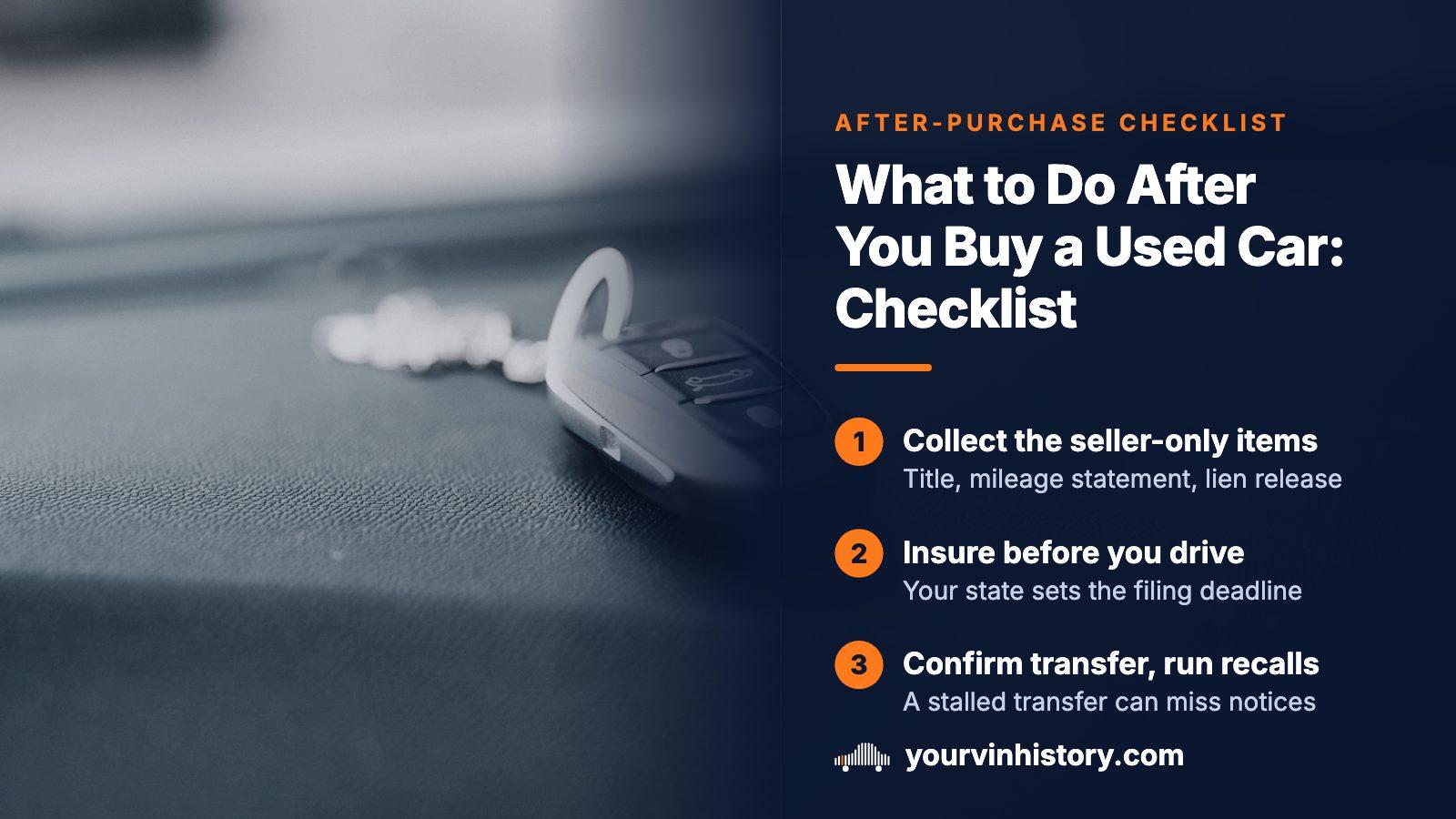
Before the seller leaves, collect a signed title, the odometer statement, proof that any loan was paid off, and a bill of sale showing the VIN. Then insure the car, apply for the title and registration within your state's deadline, run the VIN through the NHTSA recall lookup, and confirm that the transfer was recorded. Your state's motor vehicle agency sets the registration deadline.
- Seller-only items
- Title signature, mileage statement, lien release, bill of sale
- Registration deadline
- Set by your state, not by federal law
- Recall mailing
- Goes to the registered owner, then the last known purchaser
- No-charge recall repair
- Federal duty has a 15-calendar-year age limit
What only the seller can give you, and only today
Most post-purchase chores can slip a day or two without harm. A handful cannot, because they need a signature or a statement from the person who just sold you the car, who has little reason to answer the phone once paid. Settle these before anyone drives off.
- A title signed by the person named on its front, in the box meant for the seller. If that name belongs to someone else, you have a problem to solve on the spot.
- The mileage statement, finished on the title with the reading, the date and both signatures.
- Proof that any loan is paid off: if a lender is named on the title, ask for its release in writing.
- A bill of sale with the date, the price, both names and the full 17-character VIN.
- The VIN on the dash plate, the door-jamb sticker and every document, all matching.
Photograph each page before you part ways, along with the VIN plate and the dashboard. If a dealer sold you the car, take a copy of everything you signed.
Who owes you an odometer statement
Federal rules make the seller state the mileage when ownership changes. The form prints a warning that leaving it blank or giving a false figure can bring fines or prison. Part 580 also exempts some vehicles, so check the model year before asking for something nobody owes.
| Vehicle | Statement at the sale |
|---|---|
| Model year 2010 or earlier | Exempt once 10 years have passed since January 1 of the model year, which now covers all of them |
| Model year 2011 or newer | Required until 20 years have passed since January 1 of the model year |
| Gross vehicle weight rating above 16,000 pounds | Exempt |
| Trailers and anything not self-propelled | Exempt |
On a covered car, each statement is a link in a chain. Investigators and later buyers compare readings from sale to sale to spot a rollback, so a missing one leaves a gap the next owner inherits.
Insurance comes before the first drive
Call your insurer with the full VIN in hand before the car moves, by phone or app at the curb if you can. Policies treat a newly acquired vehicle differently, so ask whether coverage begins at purchase or only after you report it, and get a card or written confirmation, not a verbal yes. A wrong character in the VIN can attach the policy to a different vehicle, so copy the number from the title.
Your motor vehicle agency will tell you whether it wants proof of coverage at registration. Having the card ready, on paper or on your phone, saves a second trip.
The title and registration clock belongs to your state
No federal rule sets the deadline for putting a bought car in your name. Each state does, and the length, the way days are counted and the late penalty all differ, so a forum post may give you the wrong figure. Count from the purchase date shown on the bill of sale unless your agency says otherwise.
- Find your state agency's page for buying from a private seller or a dealer.
- Gather the signed title, bill of sale, mileage statement, ID, proof of insurance and any inspection or emissions certificate your state requires for registration.
- File in whichever way the agency allows, and keep the receipt that carries the date.
- Write down when the new title should arrive, and call the agency if it does not.
Confirming the transfer was actually recorded
Handing in an application is not the same as the state recording it. Titling is a state act, so your agency is the authority on your own transfer. If anything seems stuck, bring the VIN, the sale date and your filing receipt.
A federal cross-check exists too. The rule at 28 CFR 25.53(b) requires NMVTIS, the national title system, to let a user establish whether a car with a given VIN is titled in a particular state and whether a title document is valid. A consumer report built on it names the state where the car is currently titled and the date of the latest title. If that date still predates your purchase weeks after you filed, the transfer has probably stalled.
States report on their own schedules, so a record that has not caught up in the first few days means little. A yourvinhistory report takes its title records from ClearVin LLC, an approved NMVTIS data provider, and a free preview comes first.
Why a stalled transfer can cost you the recall notice
Recall letters go where the state's records point. Under 49 CFR 577.7, a manufacturer sends notice by first class mail to every registered owner it can reasonably identify from state records or other sources. Only when it cannot does it fall back on the most recent purchaser it knows about, and after a private sale that is often the person who sold you the car.
The notice is due within 60 days after the manufacturer files its report on the defect, and a second notice follows if the remedy was not ready the first time. A transfer unrecorded for a couple of months can span both mailings.
File early for a reason beyond penalties
Filing promptly puts your name and address in the record manufacturers search, which is the record a recall letter follows. The late fee is the lesser reason.
Running the recall lookup, and what a repair costs
Enter the full VIN in the NHTSA recall lookup. It is a free government tool, and it lists open campaigns on that specific vehicle rather than on the model in general. A recall belongs to the car, not to whoever owned it when the notice went out.
Cost has a limit that many owners miss. Under 49 U.S.C. 30120, the manufacturer covers the remedy at no charge to the owner, but that duty lapses once the first retail purchase lies more than 15 calendar years behind the recall. Inside that window, the number of previous owners changes nothing. Beyond it, ask the manufacturer or an authorized dealer what applies to your VIN.
A repair you paid for before the recall existed
A shop diagnoses a fault, you pay for the fix, and months later the manufacturer announces a recall on that same part. Federal law anticipates this: 49 U.S.C. 30120(d) requires every remedy program to set out how it will repay an owner or purchaser who already paid for the repair a reasonable time before the notice went out.
The statute sets no number of days for a reasonable time, so the details sit in each manufacturer's plan. What decides a claim is paper: an invoice naming the part, the date and the amount, plus proof you paid. Keep service invoices with the title for at least the first year.
Paperwork snags and what each one usually means
When a title application comes back, the cause is nearly always on a short list, and each cause has its own fix. Work out which one you have before resubmitting the same pile of paper.
| What went wrong | What it usually means | First move |
|---|---|---|
| Seller's name differs from the title | The seller may never have held title, and states refuse to record a transfer from someone who did not own the car | Ask your agency what documents would cure it |
| A lender is still recorded | The state has a lien to clear before it can issue a title to you | Have the seller obtain the lender's release |
| Mileage statement missing or wrong | A defective statement can send the application back | Return to the seller, who must complete it |
| Signature in the wrong box | A signature outside its designated field can void the assignment | Ask the agency how it handles corrections |
| Test certificate missing | Some states tie registration to a current inspection or emissions test | Check your state's rules, then book the test |
| Deadline passed | Late filing usually brings a penalty, not a cancelled transfer | File now and show the purchase date |
Most are cheap to fix at the handoff and slow to fix afterward.
The first month: learn what you actually bought
- Have an independent mechanic look the car over if no pre-purchase inspection was done.
- Read the complaint listings for your exact model year, not just the model name, and point the mechanic at the component with the most reports.
- Treat any service you cannot document as undone, and compare the owner's manual schedule with what the previous owner can show.
- Work out what factory coverage remains, counted from the date the car first entered service rather than the model year.
None of this has a deadline, which is why it gets skipped. One afternoon in the first month gives you a baseline for every later repair decision.
Keep one folder, on paper and on your phone
Put the bill of sale, a copy of the signed title and mileage statement, the lender's release, your filing receipt, the dated recall result and every service invoice in a single place. The folder serves you twice: it is your evidence if a state, a lender or a manufacturer disputes something, and it is what the next buyer will ask to see. A seller who can produce it gets fewer questions. Date each item as you add it.
Phone photos make a fine backup, but keep the originals of the title and the lender's release in a dry drawer at home, not in the glovebox.
Where this information comes from
- 49 CFR Part 580: Odometer disclosure requirements — Backs the seller's mileage statement, the printed warning on the form and the model-year and weight exemptions.
- 49 U.S.C. 30120: Remedies for defects and noncompliance — Backs the reimbursement plan in subsection (d) and the 15-calendar-year limit on the no-charge remedy.
- 49 CFR Part 577: Defect and noncompliance notification — Backs who gets the recall mailing, the 60-day timing and the second notice when a remedy is not ready.
- NHTSA: Recalls lookup by VIN — The lookup for open campaigns on the exact vehicle you bought.
- 28 CFR 25.53: Responsibilities of the NMVTIS operator — Backs what the federal title system must let a user check about a VIN and a title document.
- NMVTIS: Consumer information and approved providers — Where consumers find approved data providers for the federal title record.
Sources and photos: Facts checked against the sources above in October 2026. Photo by tim on Unsplash; diagrams by YourVINHistory.
Keep reading
- Bill of sale for a carWhat a bill of sale proves, and why the mileage statement still belongs on the title.
- Vehicle lien checkHow a lender's claim can outlast the sale and what to look for.
- Title jumpingWhat it means when the seller's name is not the name on the title.
- Recall check by VINHow the VIN search differs from a search by model, and what each one returns.
Frequently asked questions
What should I do first after buying a used car?
Finish the seller's part of the paperwork while they are still there. Then call your insurer before driving anywhere. That evening, photograph each document and run the VIN through the NHTSA recall lookup. The title application can follow within your state's deadline.
How long do I have to register a car after buying it?
Your state decides, and the rules differ in ways that trip people up: some count business days, others calendar days, and a new resident may face a different deadline than a local buyer. Find the deadline on your agency's site, count from the sale date, and note the late penalty.
Is there a cooling-off period after buying a used car?
Usually not. No general rule gives car buyers a cooling-off period, though a narrow exception can turn on where the contract was signed. Assume the sale is final unless a written agreement says otherwise, which is why a dealer's spoken promise to take the car back is worth little.
Do I pay for a recall repair on a used car?
Within the federal limits, the manufacturer covers the remedy at no charge, and previous owners do not change that. The limit is age: the duty lapses once the first retail sale is more than 15 calendar years back. For an older car, ask the manufacturer or an authorized dealer what applies to your VIN.
What if the seller left the mileage blank on the title?
First check whether the car is exempt by model year or weight. If a statement is required, go back to the seller promptly and ask your state agency what correction it accepts. Do not fill in the seller's section yourself, because federal form rules generally bar one person from signing as both seller and buyer.
Now check the car itself
The guide explains what to look for. The report shows what this VIN has on record.