THE SHORT ANSWER
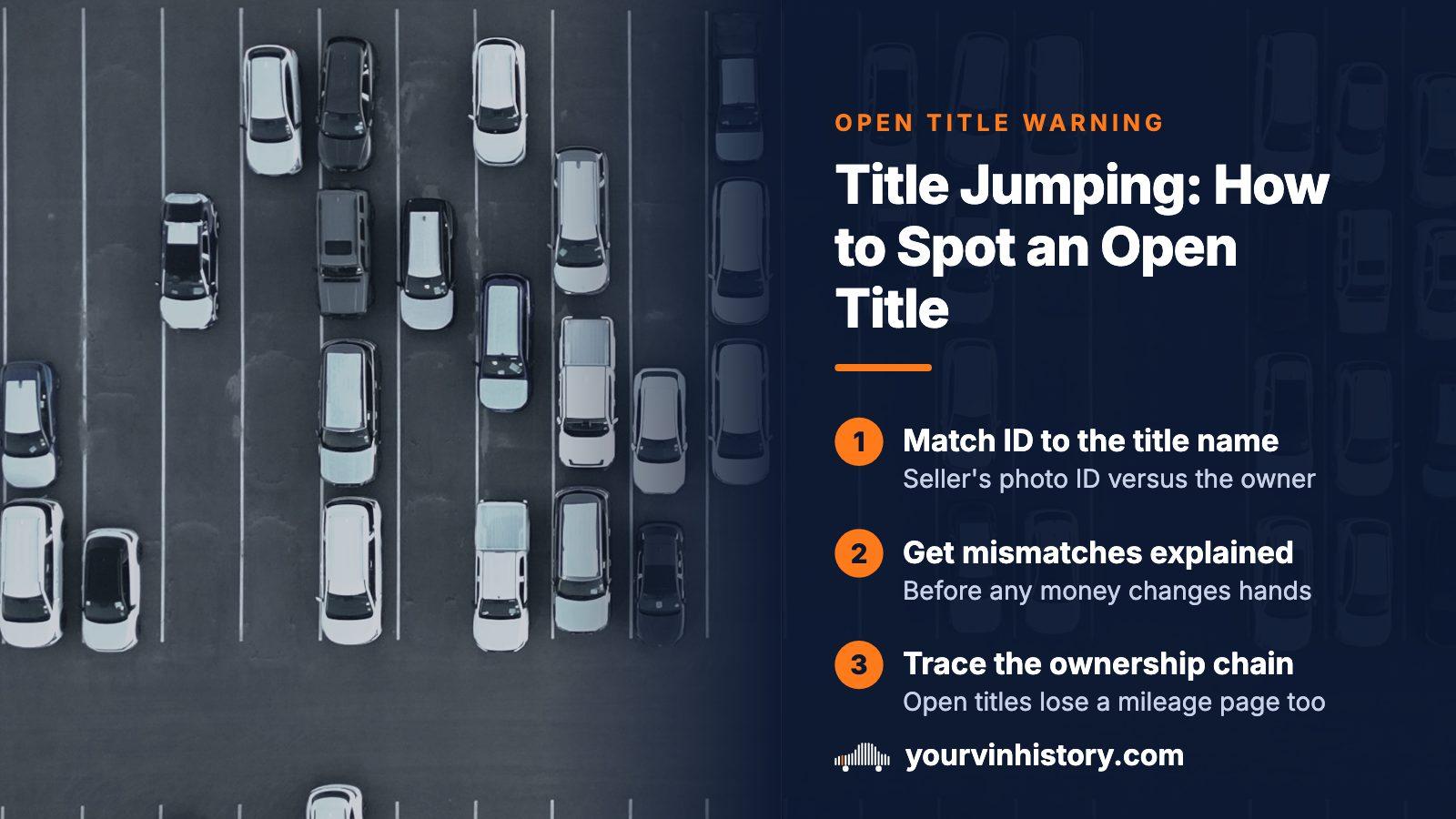
An open title is one signed by the last recorded owner but never transferred to the person now selling the car. That seller is a middleman who skipped the state. Your titling office cannot register the car, because the paperwork shows a sale by someone other than your seller. Compare the name printed on the title with the seller's photo ID before you pay, and get any mismatch explained first.
- What it is
- Reselling a car on a title the seller never moved into their own name
- What it blocks
- Registering the car in your name
- Quickest check
- Seller's photo ID against the owner name on the title
- Also lost
- The mileage statement for the skipped handover
An open title is a signature with no new owner behind it
A normal sale takes two steps. The owner of record signs the title over, then the buyer takes it to the state, pays whatever is due and receives a fresh title in their own name. Only at that point is the buyer the owner of record, able to sell the car cleanly later.
Title jumping drops the second step. A middleman buys the car, collects the signed title and never visits the state. When the car is resold, the same piece of paper changes hands again, still carrying the earlier owner's name and signature. Nothing printed on it hints that the middleman existed.
The result is called an open title, and the practice is sometimes called title skipping. The buyer at the end of the line is usually the first person to discover the gap.
Why the counter will not record a sale from the wrong name
A clerk's file needs a transfer from the person the state lists as owner to the person applying, and the signature on your paper belongs to someone who sold to a third party, not to you.
That strictness is deliberate. A title history is the thread that liens, brand labels and theft reports hang on, so a break in it is the one defect the system is designed to reject, however sympathetic the story behind it.
Holding the keys is not the same as owning on paper
You paid, the car sits in your driveway, and you may still be unable to register it, sort out insurance without surprises, or pass it on to the next buyer. Possession and title are separate things, and a private sale guarantees only the first.
Tracing the ownership chain link by link
Take a car that has passed through four hands. The first two sales were done properly and the record is tidy up to the third owner. The break comes at the fourth.
| Handover | What the buyer did | What the state holds afterward |
|---|---|---|
| First owner to second | Applied, paid and received a title in their own name | A new title and a dated entry |
| Second owner to third | Same steps, same result | The chain continues unbroken |
| Third owner to the middleman | Took the signed title and never contacted the state | Third owner still listed, middleman invisible |
| Middleman to you | Passed along the third owner's signed title | Nothing to match, since the listed owner never sold to you |
Every earlier link is sound, and the vehicle itself is blameless. What failed is a single application that was never filed, and an absent step leaves no mark on the paper. That is why the age or condition of the document tells you nothing, while the owner name printed on it, set against the person in front of you, tells you a great deal.
The mileage record loses a page too
The federal odometer rule at 49 CFR Part 580 puts the duty on the transferor, meaning anyone who passes ownership by sale, gift or any route other than creating a security interest. The transferor writes the mileage on the title, signs with a printed name, and adds the date, both parties' names and addresses and the vehicle's identifying details. The title also warns that skipping the statement or giving false information can bring fines or imprisonment.
Each recorded handover therefore adds a reading, and rollback shows up when readings are lined up in order and one comes in lower than the one before. A jumped sale is a change of hands with no reading attached. That gap becomes a permanent part of the vehicle's history, and it follows the car to whoever buys it from you next.
The two problems often arrive as a pair. A seller who avoids paperwork to hide how many cars they move has no motive to record mileage either, so a name mismatch beside an oddly low reading for the car's age deserves a hard stare, not a shrug.
Three reasons a seller skips the state
The motives differ, and your response should differ with them.
- Saving time and fees on a flip. The car was bought to resell within weeks, and titling it first means paying and filing for something the seller never planned to keep. Sellers who explain themselves usually cite this one.
- Hiding volume. The FTC's Used Car Rule, found at 16 CFR Part 455, treats a seller as a dealer once they have sold or offered five or more used vehicles in the previous twelve months and then sell another. A run of titles in the seller's own name documents exactly that volume, which someone posing as a private owner would rather not create.
- Honest muddle. Estates, family handovers and gifts can leave a title tangled with no scheme behind it.
Either way, the repair has to happen before you pay, since after payment you are the person left with a car no office will register. The second motive is why open titles show up so often in curbstoning, where the private-seller disguise is the whole business.
What a federal title check can confirm, and where it goes blind
NMVTIS, the national title database, exists for questions like the one an open title raises. Under 28 CFR § 25.53, its operator must hand a prospective buyer who asks the information the system holds on that vehicle, and the system must let users check whether a paper claiming to be a title is genuine and what its status is.
The same section covers whether a VIN is titled in a given state, whether the car has been reported as junk or salvage, and the odometer disclosure tied to the date the title was issued. A yourvinhistory report carries NMVTIS title records from ClearVin LLC, an approved NMVTIS data provider, so a buyer can judge whether the title in hand is current and what brands sit on it.
Two limits to plan around
The rule bars the system from giving an individual buyer personal details such as an owner's name or address, so a report will not say who the state lists as owner. And an unrecorded sale leaves nothing to find: the middleman filed nothing, so the record looks the same as if no middleman existed. Use the report to judge the title, then match the paper to the ID in front of you.
The ten-second test before any money moves
Florida's highway safety department boils the defense down to one instruction: check the seller's driver license or ID card against the owner name on the title. It takes seconds, and an open title cannot survive it.
- Read the owner name printed on the title, then read the name on the seller's identification. Both should belong to one person.
- Look at the assignment area. A signature from someone who is not present, with the buyer lines still blank, is what an open title looks like.
- On a paper title, scan for erasures and misspelled names. Florida lists both as title-fraud indicators.
- Match the VIN on the vehicle to the VIN on the title, character for character.
- Ask how long the seller has had the car, then ask for something dated from that period, such as an insurance card, a repair invoice or a registration.
- Treat 'I'm selling it for a friend' as the start of the conversation. If it is true, the friend can sign the title over to you in person.
If you already hold an open title
Speed and paperwork decide how this goes.
- Contact the seller at once. The cleanest repair is the missing step: the middleman titles the car in their own name, then transfers it to you. That window closes the day the seller stops answering.
- Take the title, bill of sale, proof of payment, the original listing and your messages to your own titling office. States offer different fixes, among them a bond, a court order or an administrative procedure, and only your office can say which one fits.
- If the seller has vanished, report it as title fraud. Florida runs a dedicated form and a fraud unit for this, and your state may have an equivalent. A report also leaves a paper record.
- Leave the car parked until the paperwork is sorted. Driving an unregistered vehicle adds a second problem, and discovering an insurance gap after a collision is worse than discovering it beforehand.
Selling your own car without starting someone else's problem
The reverse case is easy to create by accident. If you sign your title over and the buyer never registers the car, the vehicle can stay tied to you in the state's records, along with the tolls, tickets and other liabilities that follow it.
Fill in the seller's side completely. Write in the buyer's details instead of leaving them blank, since a blank buyer line is the very thing that turns an ordinary title into an open one. Complete the odometer disclosure, use your state's release-of-liability filing if it has one, and keep a copy of the bill of sale.
Where this information comes from
- FLHSMV: Title Fraud — Florida's buyer advice on matching the seller's ID to the title, spotting erasures and misspellings, comparing VINs and reporting suspected fraud.
- 49 CFR Part 580: Odometer disclosure requirements — Defines the transferor and lists what the mileage statement on a title must contain and warn about.
- 28 CFR § 25.53: Responsibilities of the operator of NMVTIS — Sets what the national title system must provide to a prospective buyer, the title-validity check and the limit on personal details.
- 16 CFR Part 455: FTC Used Motor Vehicle Trade Regulation Rule — Source for the dealer definition based on used vehicles sold or offered over twelve months.
- NMVTIS: Consumer information and approved providers — The federal list of approved providers that sell NMVTIS-based reports to the public.
Sources and photos: Facts checked against the sources above in October 2026. Photo by Iain on Unsplash; diagrams by YourVINHistory.
Keep reading
- CurbstoningThe disguised-dealer scheme that most often leaves an open title behind.
- Odometer rollback checkHow readings are compared against each other to catch a clocked car.
- Bonded titleOne of the routes some states offer when the paper trail cannot be repaired.
- NMVTIS reportWhat the federal title record shows, in plain terms, before you buy.
Frequently asked questions
Is title jumping illegal?
Titling rules belong to each state, so the offense and the penalty depend on where it happens. Florida, for one, counts a doctored title, or one obtained by false means, as title fraud and takes reports. The federal mileage rule applies everywhere: whoever transfers ownership owes a signed odometer statement, and the title warns that false statements can bring fines or imprisonment.
Can I register a car with an open title?
Not on the paper you hold. The office needs a transfer from the owner of record, and your seller was never that person. Your state's deadline to register after a purchase keeps running while you sort things out, so contact the office early and keep a dated record of every attempt to reach the seller.
Does a bill of sale fix an open title?
It helps your case but does not repair the chain. A bill of sale records what you paid and to whom, which is useful evidence when you ask your titling office for a remedy. What the office still lacks is a transfer signed by the owner of record, and a receipt from a middleman cannot supply one.
Can a vehicle history report show title jumping?
Not directly. A report built on NMVTIS data can show the state of title, brands and salvage reporting, plus the odometer disclosure tied to the title date, which helps you judge whether the paper in your hand is current. It cannot expose a sale that was never filed, so you still need to compare the title name with the seller's ID.
I signed my title and the buyer never registered the car. What now?
Contact your titling office with your copy of the bill of sale and ask what notice of sale your state accepts. Until the buyer is on record, tolls and tickets connected to the vehicle can still reach you, so act before notices arrive, and keep every message you exchanged with the buyer.
Now check the car itself
The guide explains what to look for. The report shows what this VIN has on record.