THE SHORT ANSWER
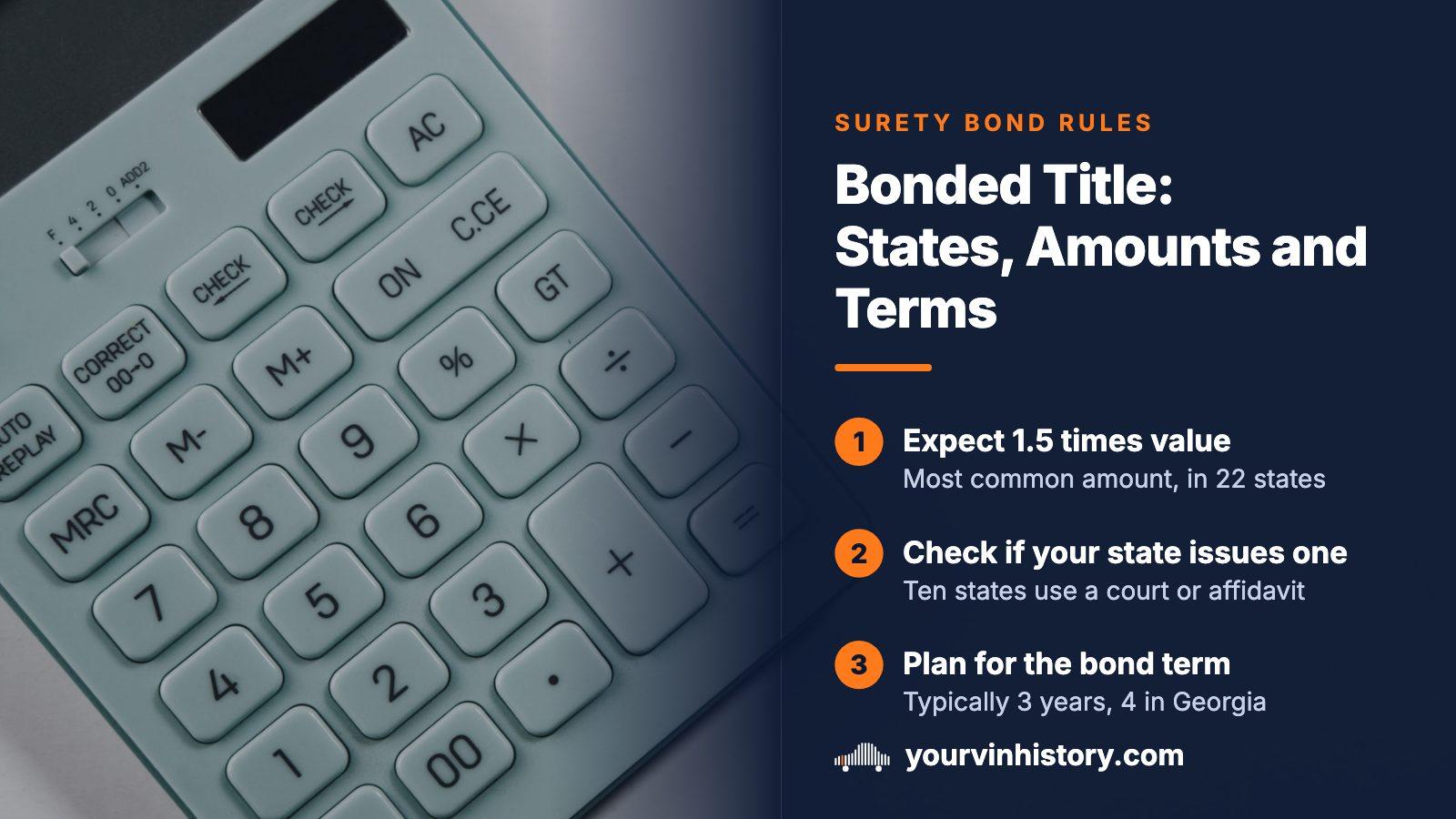
A bonded title lets a state issue a title when nobody can sign the old one over, in exchange for a surety bond. Of the 34 states sorted here, 22 set the bond at 1.5 times the vehicle's value and 9 at double. Two use the value as is, and Alabama prices from a fixed table. Ten states issue none and send you to a court or an affidavit.
- States with no bonded title
- 10 of 50
- Most common amount
- 1.5 times value, in 22 states
- Usual term
- 3 years; 4 in Georgia, 5 in Connecticut and Wisconsin
- Texas state fee
- $15 administrative fee
What the bond promises, and to whom
A title normally changes hands with a signature. Sometimes none can be had: the owner has vanished, the paperwork was lost, or an earlier seller never titled the car. A state with a bonded title program will issue a certificate anyway if the applicant first buys a surety bond.
The bond does not protect the applicant. It guarantees the state and any later claimant that someone who proves better ownership will be paid. The surety pays a valid claim, then turns to the applicant for reimbursement. Most states set the amount above the car's value, which leaves a margin beyond what the car is worth.
Four separate numbers decide your bond
Pages that quote one price treat the bond as a single setting. It is four settings, and a neighboring state tells you nothing about any of them.
- Existence: 34 states are sorted below as issuing a bond, and 10 publish a different route.
- Size: the bond is set at the vehicle's value, at 1.5 times it, or at double, and Alabama works from a fixed table.
- Base: the figure that size is applied to, which is market value in most places and something else in a few.
- Duration: three years is common, not universal.
Georgia doubles the value and holds the bond for 4 years. Tennessee, across the line, uses 1.5 times and sends cars worth less than $3,000 down a different process.
Where each state falls on the multiple
Among the 34 states sorted here, 1.5 times value is the most common rule. Alabama drops the multiple and sets the bond from a table keyed to the model year, so cheap and expensive cars in one band post the same amount.
| Bond rule | States |
|---|---|
| 1.5 times value, Northeast | Maine, Massachusetts, New Hampshire, New York, Rhode Island, Vermont |
| 1.5 times value, South | Arkansas, Maryland, Mississippi, North Carolina, Tennessee, Texas |
| 1.5 times value, Midwest and Plains | Iowa, Minnesota, Nebraska, South Dakota, Wisconsin |
| 1.5 times value, West | Alaska, Arizona, Idaho, Nevada, Washington |
| Twice the value | Connecticut, Florida, Georgia, Michigan, Missouri, Colorado, New Mexico, Utah, Wyoming |
| The value itself | California, Montana |
| Fixed table by model year | Alabama |
Six states are left unsorted
Hawaii, Illinois, Kentucky, Louisiana, Ohio and West Virginia sit in no row because their rules could not be confirmed against a primary source. Circulating Illinois summaries disagree on whether the base is appraised or wholesale value. For those six, rely on the agency's current requirements.
Ten states that issue no bonded title
Nothing to price here and no surety to call. A missing signature goes to a judge or to a sworn statement, and a judge's ruling leaves no bond behind for a surety to collect on later.
| State | What it publishes instead |
|---|---|
| Delaware | Court order establishing ownership |
| Kansas | Quiet title action in district court |
| South Carolina | Magistrate's order of sale |
| Indiana | Affidavit for vehicles valued at $5,000 or less by NADA; a court order above that |
| Oklahoma | Form 753 ownership affidavit |
| Virginia | Form VSA 12, Affidavit in Lieu of Title Certificate |
| North Dakota | Administrative process for untitled vehicles |
| Pennsylvania | Five acceptable ownership documents, none of them a bond |
| New Jersey | Twelve-step process with newspaper publication and affidavits from three disinterested parties |
| Oregon | Treats bonded titles as other states' practice, yet accepts theirs |
A multiple of what: value is not always value
The headline multiple matters less than the figure it multiplies.
- Texas starts from its Standard Presumptive Value, falls back to a national reference guide, and accepts an appraisal only when neither produces a figure.
- California uses fair market value once, shown by a written appraisal or a Statement of Facts built on a recognized valuation handbook.
- Nevada multiplies the manufacturer's suggested retail price, fixed when the car was new, so an old car can carry a bond far above its resale value.
- Alabama uses no value at all, only the model-year band.
Texas lets you price the bond yourself. Its public calculator asks for a VIN and an odometer reading, with mileage skipped for motorcycles. Multiply the result by 1.5 and treat it as an estimate, because the page says values are for estimation only. On a car 25 years old or older, an appraisal can stand in, and anything under $4,000 is lifted to $4,000.
How long the bond stands
A surety prices the premium from the amount, the term and the applicant's credit, so a longer term costs more even when the multiple looks ordinary.
| State | Published term |
|---|---|
| Texas | 3 years, ending on the third anniversary of the bond's effective date |
| New York | 3 years, under the Vehicle and Traffic Law |
| Georgia | 4 years, printed on the bond form |
| Connecticut | 5 years since a 2002 public act |
| Wisconsin | 5 years |
| Colorado | None published beside the amount |
| Wyoming | None published; the bond is described as one-time and non-refundable |
Connecticut is the state most often described wrong. The 2002 act raised it from 1.5 times and three years to twice the value and five, so a page giving the older pair is out of date. Oregon's manual adds that where a bonded brand is stamped, it can come off once the period passes without a claim.
One dollar figure, four different jobs
Nine states print a dollar figure beside their bond rule, and summaries file every one under 'minimum'. They do different things.
- A floor under the bond: Missouri and North Carolina $100 each, Wisconsin $2,500, Georgia $5,000. The bond cannot go lower, whatever the car is worth.
- An exemption: Wyoming $2,500, Utah $3,000, California $5,000. Below that value, no bond is asked for.
- A routing threshold: Tennessee $3,000. Cheaper cars take another process instead of a smaller bond.
- A substituted value: Texas $4,000, which replaces a lower appraisal on a car aged 25 years or more.
Georgia and California both print $5,000. Take a car worth eight hundred dollars: Georgia would still require a $5,000 bond, while California would require none.
California's exemption has conditions
The $5,000 mark is one trigger among several. The state's manual also calls for a bond or an alternative when the vehicle is nontransferable or the lienholder's release cannot be obtained, whatever the car is worth.
Age rules that point in opposite directions
Eight states gate eligibility on age, and they do not agree.
- South Dakota accepts only vehicles at least 30 years old. Tennessee accepts only those younger than 30.
- Idaho limits the bond to vehicles under 10 years old and sends older ones to a conditional title.
- Florida turns away model year 2011 and newer. Georgia turns away 1985 and earlier.
- New York issues no titles through model year 1972, New Hampshire none through 1999, and Maine keeps a rolling 25-year window.
A car just past 30 years old qualifies in South Dakota and not in Tennessee. The last three work differently: an old car there is turned away by the lack of any title, not by the bond rule, and the vehicle is registered on other evidence.
What a bond cannot fix
A bond cures a single problem: no one is available to sign the title over. It does not reach a recorded lien, which belongs to someone who can still be found, and it does not erase a salvage brand, which describes what happened to the car.
Texas draws the lien line by age. The route is open when no security interest is recorded, when any lien is 10 years old or more, or when the applicant supplies a release of all liens with the bond. A rule amendment adopted in 2024 dropped wording that let a surety promise to satisfy a lien, so the release is the applicant's job. The statute also bars salvage and nonrepairable vehicles.
Check liens first. A VIN-based history report lists recorded liens and title brands, which can end the matter before any pricing.
Out-of-state bonds, nonresidents and New York
Oregon DMV says it cannot put a brand on a title application that rests on another state's bonded title. It accepts the document as proof of ownership and issues an Oregon title showing no brand and no sign of a bond, provided a Certification of Ownership Facts, Form 550, comes with the application.
Vermont's bond section sets 1.5 times value, returned after three years, and directs that nonresidents receive no titles under it. The state's bond form carries a residents-only heading.
New York has a bond in its statute and little else. The Vehicle and Traffic Law provides for one at 1.5 times value for three years, yet the commissioner imposes it at discretion, and the section ends by saying nothing obliges a title to follow a bond.
The same bond can be a temporary branded instrument where it was written and an ordinary title where it lands. Ask the state where you will register what it does with one before buying anywhere.
If you are the buyer, not the applicant
On a car you are buying, the bond appears as a brand on the title while it stands, and history checks pick brands up. Before paying:
- Find out which state issued the title, and read the bond's end date off the document itself.
- Ask the seller why the title was bonded. Lost paperwork is routine; a trail of unrecorded transfers is a different story.
- Run the VIN for title records, brands and liens. A yourvinhistory report covers these, after a free preview.
- Confirm your own state will register a bonded title from the issuing state.
Where this information comes from
- Texas Statutes: Transportation Code 501.053, bond as alternative to hearing — Supports the 1.5 times value amount, the third-anniversary expiry, the three lien conditions and the bar on salvage and nonrepairable vehicles.
- TxDMV: Bought a Vehicle Without a Title — The agency's consumer page on eligibility, the $15 fee and the order of value sources, from Standard Presumptive Value down to an appraisal.
- TxDMV: Standard Presumptive Value calculator — Shows the two inputs the lookup asks for, a VIN and an odometer reading, and the estimation-only caution.
- TxDMV: 43 TAC Chapter 217, section 217.9 Bonded Titles — The rule text on how value is set, the $4,000 substituted value for older cars, and the 2024 change on lien releases.
- Oregon DMV: Vehicle Procedures Manual, Chapter F — Where Oregon explains how it treats bonded titles from other states and when the Form 550 certification is needed.
- California DMV: Motor Vehicle Ownership Surety Bond — Lists California's triggers for a bond and shows that the bond is written for fair market value.
Sources and photos: Facts checked against the sources above in October 2026. Photo by Sasun Bughdaryan on Unsplash; diagrams by YourVINHistory.
Keep reading
- Register a car without a titleOnce you know whether your state offers a bond, this covers the counter steps that follow.
- Vehicle lien checkA recorded lien is outside what a bond can fix, so check for one first.
- What is a branded title?Bonded is one brand among several, and each kind reads differently to the next buyer.
- Title washingOregon's unbranded reissue shows how a brand can disappear when a title crosses a state line.
Frequently asked questions
How much does a bonded title cost?
The bond amount is not what you pay. A surety charges a fraction of it, set by the amount, the term and your credit, so quotes vary. State fees come on top, such as Texas's $15 administrative fee and Georgia's $18 for the bonded title. If a claim is ever paid, you owe that money back to the surety.
Which states issue no bonded title?
Delaware, Kansas, Indiana, South Carolina, Oklahoma, Virginia, North Dakota, Pennsylvania, New Jersey and Oregon. In those, skip the surety quotes and ask the motor vehicle agency for the route it publishes, usually a court order, an affidavit or an administrative process.
What happens when the bond expires?
If nobody files a claim during the term, the exposure ends. Oregon's manual says the bonded brand can then be removed from the title. Whether the issuing state reissues a clean certificate on request or lets the record age out varies, so ask that agency. The premium you paid is not refunded.
Is a bonded title a clean title?
No. It is a valid certificate for registering, insuring and selling the car, but it carries a bonded brand while the bond stands. It admits the ownership record had a hole rather than repairing it, and it leaves any lien, salvage brand or break in the chain of assignments exactly where it was.
Can a nonresident get a bonded title?
Usually not. Vermont's statute keeps titles from nonresidents under its bond section. The better question is what the receiving state does with the paper. Oregon reissues an out-of-state bonded title without a brand, while other states may look hard at a fresh title from somewhere the car never went.
Now check the car itself
The guide explains what to look for. The report shows what this VIN has on record.