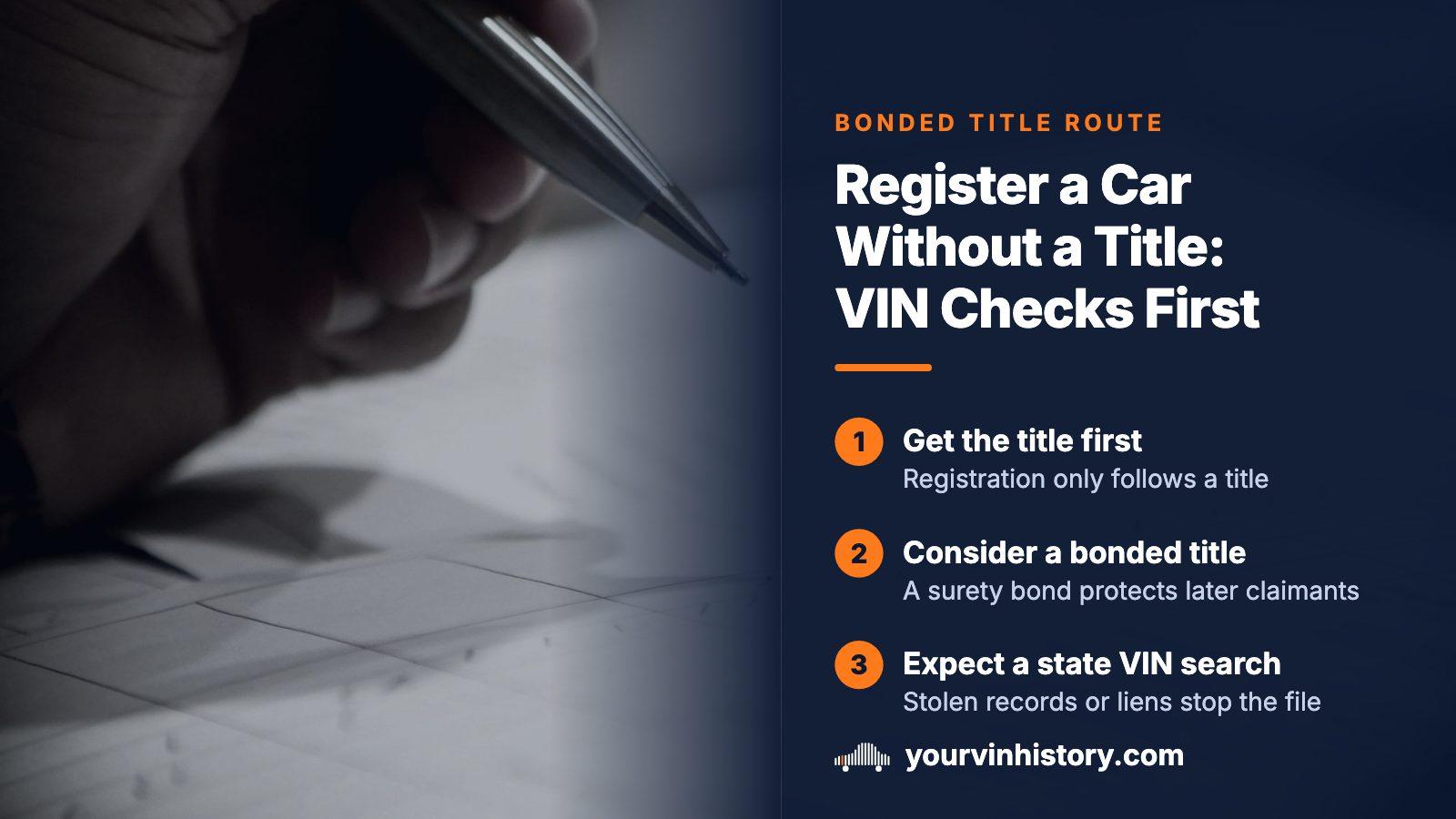
THE SHORT ANSWER
Not directly. A state registers a vehicle after it has titled it, so a car with no usable title needs one first. When ownership cannot be documented, most states offer a bonded title: the state issues the title, and you buy a surety bond sized to the car's value to protect anyone who later proves a better claim. Before issuing it, the state runs the VIN, and a stolen record or a recent lien can stop the file.
- Usual fix
- A bonded title, issued after the state searches the VIN
- Texas bond
- 1.5 times the vehicle's value
- Georgia bond
- Twice average retail value, never under $5,000
- Recent lien
- Texas wants an original release or a letter of no interest
Why the counter asks for a title before anything else
Registration lets you drive a vehicle on public roads for a set period. A state grants it to someone it already accepts as the owner, and the certificate of title is how it knows. Without that document the clerk has nothing to attach your name to.
So the real job is getting the state to issue a title for a car whose paperwork has a hole in it, and the state will inspect the car's record before it agrees. Fees, multiples and deadlines differ by state and shift over time, so treat the figures below as examples and confirm yours with your titling agency.
Sort out which missing-title problem you have
Most of these have a cheaper fix than a bond, so identify yours first.
| What is actually true | Where it usually leads |
|---|---|
| The state has a title in your name, but you misplaced the paper | A duplicate title from your own state |
| A title exists, but the seller never handed it over | Pressure on the seller; this is a transfer problem |
| The seller signed over a title that never carried the seller's name | Title jumping, which a bond does not repair |
| Nobody can produce a title for the car | A bonded title or your state's no-title procedure |
If a lender is on record, the replacement may go to the lender, and if another state issued the title, the duplicate generally comes from that state. Surety ads dominate these searches, and people do pay for bonds on cars whose titles were sitting in a state database all along.
The lookups the state runs on your VIN
A bonded title looks like paperwork, but the state's first move is a search. It wants to know whether it has titled this number before, whether the car was reported stolen, whether an insurer has a claim on record, and what the national title system says. Texas shows the sequence openly. The back page of its bonded title application, Form VTR-130-SOF, has a checklist for department staff, and five of its seven items are lookups keyed to the VIN: an internal state check, the Texas title record, the stolen-vehicle file, an insurance claim search and NMVTIS.
The list is conditional. With no Texas record of the VIN, the state widens the search to the stolen file and the claim database, and asks for a law-enforcement VIN inspection on Form VTR-68-A. A car already in Texas records gets the short path; one arriving from elsewhere gets the long one.
Georgia reaches the same place by making you run the search. Its packet must include an NMVTIS report, or one from an equivalent system the Department of Revenue authorizes. Either way, the state sees what a careful buyer could have seen before paying.
A brand on the record survives the bond
A brand does not necessarily end the application, but it comes along. Under 28 CFR 25.54(a)(2), states send titling data to the national system every 24 hours, and that data includes every brand on the certificate. A bond covers a flaw in your ownership. It says nothing about what happened to the vehicle, so a salvage-branded car is bonded and titled with the brand intact.
The Texas checklist has a row for the brands NMVTIS might return, among them salvage, junk, flood, replica, rebuilt, reconstructed, buyback and not-actual-mileage. Another provision, 28 CFR 25.54(c), has states query NMVTIS before titling a vehicle bought elsewhere, which explains why brands usually follow a car across state lines and what title washing tries to dodge.
A recent lien is where applications die
Of everything in the file, an unreleased lien blocks the most applications. Texas will not proceed when a recorded lien is no more than ten years old and you cannot get the lender's original release or a letter of no interest. Its website points stuck applicants toward a court order awarding the vehicle free of liens. A photocopy does not substitute, and neither does the seller's word that the loan was paid.
Georgia finds liens through the paper trail. The NMVTIS report and the certified title history from the issuing state surface any security interest, and a Form T-4 satisfaction notice or lienholder affidavit then joins the packet.
This is how a cheap cash deal turns expensive. The seller stopped paying, the lender kept a recorded interest, and that interest travels with whoever holds the car.
The Texas route, step by step
- File Form VTR-130-SOF at a TxDMV Regional Service Center with the $15 administrative fee. Include whatever shows ownership, such as a bill of sale or invoice, any original lien releases, and photo identification.
- If the vehicle comes from out of state and has never been titled or registered in Texas, add the law-enforcement VIN inspection, Form VTR-68-A. TxDMV does not perform that inspection itself.
- Wait for the Notice of Determination, Form VTR-130-ND, which states your bond amount: one and a half times the vehicle's value.
- Buy the surety bond within one year of the notice date. After that, you need a new notice.
- Within thirty days of buying the bond, take the original notice and your earlier documents, plus Form 130-U, to your county tax office.
Applicants need Texas residency or a military posting there. The vehicle must be complete, meaning frame, body and motor, or frame and motor for a motorcycle, though it need not run.
How Georgia packages the same request
Georgia works through a County Tag Office and sets its gate first: the owner lives in Georgia, the vehicle needs a Georgia title, the model year is later than 1985, and the vehicle is not abandoned.
The filing is a stack. Form MV-1 is the ordinary title application, Form MV-46 is the bond, and Form MV-46A is a notarized affidavit in the same name. Form T-22B certifies a physical inspection, required every time; Form T-128 applies only if the serial plate is missing. The NMVTIS report completes the stack, joined by a certified title history from another state when the report points to one, and by Form T-4 when it shows a lien.
The bond must equal twice the average retail value the Department of Revenue assigns, with a $5,000 minimum. Expect an $18 title fee, and apply within six months of the date the bond was issued.
Cars and situations the bond route will not take
Check this list before you buy anything with missing paperwork.
- Vehicles recorded as junk or nonrepairable. Texas excludes them, and a certificate of destruction has no route back.
- Incomplete vehicles. A shell without a motor does not qualify in Texas until it has one.
- Abandoned vehicles and model years 1985 and older, in Georgia.
- Applicants who live elsewhere. Both states covered here require residency, with a military exception in Texas.
- Cars carrying a recent lien that nobody can release.
A bond cannot settle a real ownership dispute either. It makes you the titled owner and pays if someone proves otherwise. With a contested estate, an unpaid lender or a former owner claiming theft in the picture, the bond only makes you the target.
Run the same lookups before you hand over cash
Everything above is the remedy. The cheaper path is learning what the state will learn while the car is still the seller's problem. The national system exists for that: 28 CFR 25.53(b) says it must let a user tell, quickly and dependably, whether a VIN is titled in a given state and whether the car is or was a junk or salvage vehicle. The Justice Department's NMVTIS page lists approved providers that supply reports to consumers.
A yourvinhistory check starts with a free preview, and the one-time paid report adds title brands, salvage and auction records, liens, theft and insurance entries. Its NMVTIS title records come from ClearVin LLC, an approved NMVTIS data provider. Run it first, and compare the VIN on the dash with the paperwork. A mismatch is not something a bond repairs.
Where this information comes from
- TxDMV: Bought a Vehicle Without a Title — Texas eligibility, the bond multiple, the fee, the filing windows and the out-of-state VIN inspection.
- TxDMV: Form VTR-130-SOF, Bonded Title Application — The application whose staff checklist lists the VIN lookups and the brands a clerk may record.
- Georgia Department of Revenue: Bonded Vehicle Title — Georgia's conditions, document stack, bond multiple and floor, fee and filing window.
- 28 CFR 25.54: Responsibilities of the states — Brand reporting to the national system and the NMVTIS check before an out-of-state title.
- 28 CFR 25.53: Responsibilities of the NMVTIS operator — What the national system must tell a user about a VIN.
- US Department of Justice: NMVTIS vehicle history — Where consumers find approved providers of NMVTIS reports.
Sources and photos: Facts checked against the sources above in October 2026. Photo by Masjid MABA on Unsplash; diagrams by YourVINHistory.
Keep reading
- Bonded titleWhich states issue one at all, and how the bond multiple compares.
- Title jumpingWhat to do when the seller signed over a title that never carried their name.
- NMVTIS reportWhat the national title record holds and how a buyer gets a copy.
- Vehicle lien checkHow to find a recorded lien before it becomes your problem.
Frequently asked questions
Is it possible to register a car that has no title?
Not in the ordinary way, because registration follows a title. If the paper is only lost, a duplicate from the issuing state fixes it. If no title exists, a bonded title or your state's equivalent comes first. In Texas, one form, 130-U, covers both a title and a registration application, so the two requests can travel together once the bond is bought.
How much does a bonded title cost?
Three things add up: state fees, the surety premium and any inspection. Texas charges a $15 administrative fee at the first step and Georgia an $18 title fee. The premium is a fraction of the face amount and depends on your credit and the insurer, so a quote only makes sense after the state names the bond amount.
Will the state check whether the car is stolen?
Yes, one way or another. Texas checks the stolen-vehicle file when it has no record of the VIN and may require a law-enforcement VIN inspection. Georgia requires a certified physical inspection every time plus an NMVTIS report. If the number on the car does not match the paperwork, expect the application to stall there.
Is a bill of sale enough to register a car?
No. A bill of sale records the deal, not who the state recognizes as owner. In a Texas bonded title file it counts as supporting evidence of ownership, not as a replacement for the title. Keep it safe, along with the seller's name and contact details, in case a claim ever surfaces.
What if the seller says the loan is paid off but has no release?
Ask for the lender's name and the payoff date, then contact the lender directly and request a written release or letter of no interest. A verbal assurance does not satisfy Texas, which wants the original document for liens that recent. Check the VIN record first. If a lien still shows, no bond substitutes for the lender's paper.
Now check the car itself
The guide explains what to look for. The report shows what this VIN has on record.