THE SHORT ANSWER
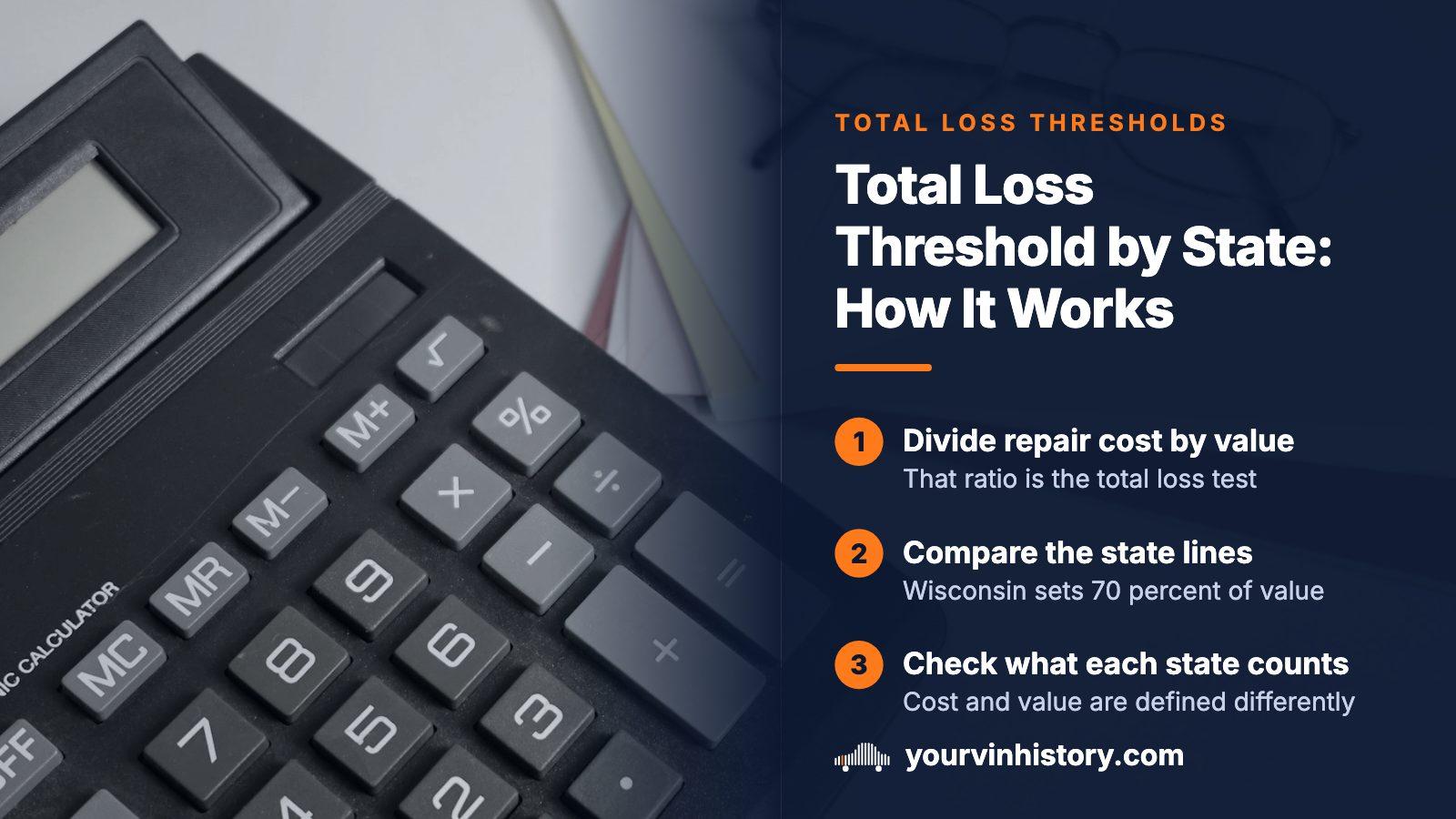
A total loss threshold is a ratio: repair cost divided by vehicle value, measured against a line the state draws. Wisconsin draws it at 70 percent of fair market value for vehicles under seven years old. Texas draws it where repair cost passes the value just before the damage, for any model year. California names no figure and asks whether repair is considered uneconomical. What each state counts as cost and as value moves the result as much as the percentage does.
- Wisconsin salvage line
- Over 70 percent of fair market value, vehicle under seven years old
- Texas salvage line
- Repair cost above the value before the damage, any model year
- California
- No percentage; turns on whether repair is considered uneconomical
- Federal insurer report
- Current model year plus the four before it
The ratio behind every total loss call
Strip away the paperwork and a total loss decision is a fraction. The top is the cost to fix the car; the bottom is what the car was worth before the damage. The state draws a line, and a fraction that crosses it makes the vehicle a total loss, with a possible brand on its title.
States differ in four ways: where the line sits, what may count as cost, what counts as value, and whether the rule reaches the vehicle at all, which can depend on its age or the cause of the damage. Tables print only the first.
A settlement from an insurer and a brand on the title are separate events under separate rules, and a car can get one without the other.
Three kinds of rule, read from the source
These three examples come straight from a state form, manual or statute, and each uses a different instrument.
| State | Kind of rule | What the source says |
|---|---|---|
| Wisconsin | Fixed percentage | Salvage applies to a vehicle under seven years old when repair cost is above 70 percent of its market value. |
| Texas | Cost compared with value | Salvage applies to any model year when repair cost passes the car's value just before the damage and a major component part is damaged or missing. |
| California | Judgment | A total loss salvage vehicle is one the owner, leasing company, lender or insurer considers uneconomical to repair. No percentage appears. |
Seventy percent and a figure over 100 percent are two settings on the same dial. A judgment standard is a different instrument with no dial at all, so any percentage printed beside California came from a compiler, not from the Vehicle Code.
Input one: what goes into the repair cost
Wisconsin's branding form takes the larger of two figures, the written estimate and the actual repair bill. A high estimate still counts after a cheaper repair, and a bill that ran over still counts after a low estimate.
Texas works by subtraction. Its manual defines cost of repair as parts and labor, taken from a repair-cost guide the industry generally uses or from an estimate built on reasonable local labor rates. It then leaves out repainting materials and labor, sales tax on the total, repairs for gradual damage, hail repairs, and damage confined to exterior paint.
Why paint matters
On a car with extensive panel damage, refinishing can be a large line item. Removing it can pull a borderline car back under the line, so two states with identical percentages can still total different vehicles.
Input two: what the car was worth
Wisconsin measures its brands against fair market value. Texas uses the car's actual value at the instant before the damage, a snapshot rather than a general market figure. California never has to define a value, since its test asks what the paying party concluded rather than what a division produced.
Texas defines actual cash value as market value drawn from price guides the auto and insurance industries commonly use, or from another recognized method such as a market survey applied uniformly.
A dispute has room to move here, because value is an estimate and a different set of comparable sales gives a different number. A lower value pulls the car toward the line; a higher one pushes it away.
Conditions that sit outside the fraction
Before any division happens, a state may decide whether its rule covers the vehicle at all. Percentage tables rarely carry these conditions.
- Age: Wisconsin's salvage and hail brands apply only under seven years old. Texas applies its definitions regardless of model year, and its manual records that a seven-year condition existed before September 2003.
- Flood: Wisconsin's flood brand uses the same 70 percent test with no age condition.
- Hail: Wisconsin has a Hail Damage brand. Texas excludes hail from damage and from repair cost, and a vehicle whose insurer paid a hail-repair claim is not salvage there.
- Theft: in Texas a paid theft claim does not make a salvage vehicle unless the car was damaged during the theft, before recovery, past the value test.
- Component damage: Texas requires a major component part to be damaged or missing, such as the engine, transmission, frame, fender, hood or a bumper.
An age condition changes what a clean title means. On an older car in an age-gated state, no brand could have attached however badly the car was hurt.
A worked example: one car, three rulebooks
Picture a car worth 100 points just before a crash. Points stand in for dollars so only the structure shows. Now slide the repair cost up the scale and watch what each rulebook does.
| Repair cost (points) | Wisconsin, vehicle under seven years | Texas salvage test, any model year | California |
|---|---|---|---|
| 30 | Claim-paid brand if an insurer paid and took the car | Below 100: no | Not a numbers question |
| 70 | Not salvage, since the test says exceeds; claim-paid band still applies | Below 100: no | Not a numbers question |
| A point above 70 | Salvage | Below 100: no | Not a numbers question |
| 100 | Salvage | Cost must pass the value, so equal is not enough: no | Not a numbers question |
| A point above 100 after paint and tax are removed | Salvage | Salvage, if a major component part is damaged or missing | Not a numbers question |
Three things fall out of the table. The same bill can be salvage in one state and not another with no disagreement about the facts. The edges are strict, because both tests say exceeds. And California's column never changes, since no number was ever involved.
One refinement: if the written estimate lands a point above 70 but the finished job costs 30, Wisconsin takes the larger figure, so the car is still over its line. The claim-paid band is worded as damages, not repair cost, so read that row as a position on the scale.
Why the published tables disagree with each other
Tables are built around a single column of percentages. A fixed percentage fits, cost compared with value can be shown as roughly 100 percent, and a judgment standard fits nowhere, so the table builder picks a number for it.
Different compilers pick differently, which is how two tables can name different states as the lowest in the country. The statutes did not change between the tables; the guesses did. The columns also drop age conditions, cost exclusions and brands by cause.
Brands that sit below the salvage line
Percentage tables imply nothing happens until the line is crossed. Wisconsin shows otherwise: a younger car, under seven years old, that an insurer took over after paying a claim worth 30 through 70 percent of market value gets an Insurance Claim Paid brand. That car never reached salvage territory.
For a buyer this cuts both ways. Where a brand like this exists, its absence says something about mid-range damage. Where it does not, damage of that size leaves no mark on the title, and the paper cannot rule it out.
What the federal insurer report records
Under 28 CFR 25.55, insurers must report, each month, which junk or salvage automobiles came into their possession. The duty covers the current model year and the four before it, so an older car an insurer writes off may not appear in that report.
The required fields identify the car: the VIN, the date, who it came from and who owned it at filing. The reason for the loss, such as flood, collision, fire or theft and recovery, is something carriers are strongly encouraged to give, not required to give. The state rule decides whether a brand goes on the title; the federal report only logs the event.
Reading a clean title when you are buying
Use the thresholds to judge how much weight a clean title deserves, then check the car.
- Identify the state that issued the title. Its rules, not those of the state where the car sits now, governed the branding decision.
- Look for an age condition. If the car was too old when damaged, a brand could not attach.
- See whether the state brands by cause, since flood and hail are separate brands in one state and excluded from salvage in another.
- Look for a brand below the salvage line and note whether the state has one at all.
- Screen the VIN with NICB VINCheck, pull a national NMVTIS record, look for pre-repair auction photos, and have the structure inspected.
A yourvinhistory report draws on NMVTIS title records from ClearVin LLC, an approved NMVTIS data provider, and adds salvage and auction records with photos. The free preview shows what is on file before you buy the full report.
If your own car was just declared a total loss
Arguing about the threshold itself is the weakest ground. Check each input instead.
- Value: ask for the comparable sales behind the insurer's figure. A different set of sales moves the bottom of the fraction.
- Cost: where a state removes items, as Texas does with repainting and sales tax, check whether the estimate included them.
- Judgment: where a state uses a judgment test, there is no division to dispute, and the talk turns on reasons rather than arithmetic.
Because a settlement and a brand are separate events, being paid does not prove a brand will follow.
Where this information comes from
- TxDMV: Salvage/Nonrepairable Motor Vehicle Manual — Texas definitions of salvage and nonrepairable, the cost-of-repair exclusions, the actual cash value definition, the major component part list, the hail and theft carve-outs and the September 2003 change.
- Wisconsin DOT: Form MV2849, Title Application Branding Notification — The 70 percent and seven-year tests for salvage and hail, the flood brand without an age limit, and the claim-paid band.
- California Vehicle Code section 544: total loss salvage vehicle — The definition that turns on a judgment about repair economics and contains no percentage.
- 28 CFR 25.55: Responsibilities of insurance carriers — The monthly junk and salvage report, its five-model-year window, and the optional status of the reason for the loss.
- NMVTIS: Official vehicle history record — The federal title, brand and total-loss record, with the list of approved data providers.
- NICB: VINCheck — A search of theft and total-loss records reported by participating insurers, offered at no charge.
Sources and photos: Facts checked against the sources above in October 2026. Photo by Cht Gsml on Unsplash; diagrams by YourVINHistory.
Keep reading
- What is a branded title?Once you know how a line gets crossed, see what salvage, rebuilt, flood and other brands each admit.
- Salvage title VIN checkA three-step order for checking a car whose clean title may hide a salvage past.
- Totaled but still drivableIf an insurer wrote off your car and you want to keep it, this weighs the settlement against the brand.
- NMVTIS reportThe federal title and total-loss record explained in plain terms.
Frequently asked questions
What percentage of damage makes a car a total loss?
No single figure applies nationwide. Wisconsin's line is 70 percent of fair market value, but only for vehicles under seven years old. Texas uses repair cost above the value before the damage, and California uses no percentage. Even where one exists, ask what the state counts as cost and which value it divides by, since both change the result.
Is a car totaled when repairs cost more than it is worth?
In Texas, nearly: the counted repair cost, minus excluded items, must pass the car's value just before the damage, and a major component part must be damaged or missing. Elsewhere the line can sit lower or be a judgment call, so a car can be totaled well before repairs reach its value.
Does an older car avoid a salvage brand?
It depends on the state. In Wisconsin, salvage and hail brands apply only under seven years old, while the flood brand has no age limit. Texas applies its definitions to every model year. In an age-gated state an old car can be damaged past the line and still carry a clean title.
Which state's rule applies if the car was totaled somewhere else?
The brand should follow the car through national title records, but the threshold that created it belongs to the issuing state, so two similar-looking brands can describe very different damage. Texas also treats a vehicle arriving on an out-of-state document that says accident damage or flood damage on its face as salvage.
How can I check whether a car was reported as a total loss?
Start with the NICB's VINCheck, which searches total-loss and theft records that participating insurers reported, at no cost. Then pull a national NMVTIS record from an approved provider. The federal insurer report covers only the current model year and the four before it, so an older write-off may not show up.
Now check the car itself
The guide explains what to look for. The report shows what this VIN has on record.