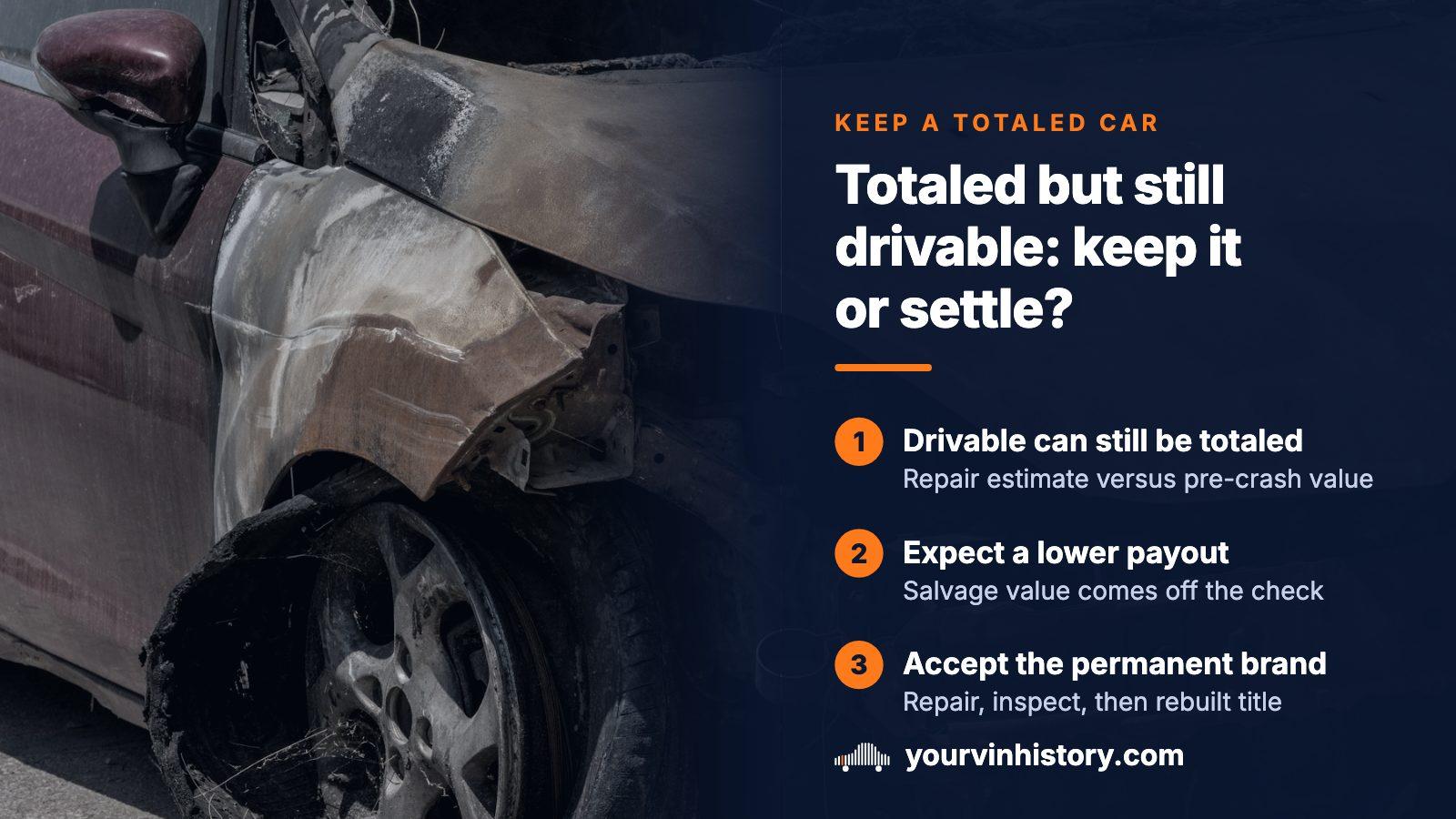
THE SHORT ANSWER
Insurers total a car when the repair estimate eats too large a share of its pre-crash value, so a drivable car qualifies easily if it is older or costly to fix. In most cases you may keep it. The payout drops by the salvage value, the title carries a permanent brand, and the car needs repairs, an inspection and a rebuilt title before it can be registered again.
- What decides it
- Repair estimate against pre-crash value, not whether the car runs
- Payout if you keep it
- Value, minus your deductible, minus the salvage value
- Title effect
- A permanent brand that follows the VIN
- Back on the road
- Repairs, inspection and a rebuilt title come first
A car that runs can still be a total loss on paper
The label has little to do with the engine. An adjuster writes a repair estimate, someone sets the value the car had just before the crash, and the two numbers are compared. When the estimate takes too big a bite out of the value, the claim is closed as a total loss. Whether you drove home from the scene never enters the formula.
Older cars get written off most easily. A ten-year-old sedan has a modest value, yet a deployed airbag, a sensor-packed bumper, a hood and a fender are priced the same as they would be on a newer car. Parts and labor do not shrink as the odometer climbs. The cut-off itself is set state by state, and a separate guide on this site covers those thresholds.
Taking the check versus keeping the car
Once the claim is closed as a total loss, you hold two options. They are not mirror images of each other.
| Option | What you receive | What you give up or take on |
|---|---|---|
| Take the settlement | The pre-crash value, minus your deductible | The car itself, which the insurer sends on to a salvage buyer. Repairs, inspection and registration never land on you. |
| Keep the car (owner retention) | The same value, minus the deductible and minus the salvage value the insurer no longer collects | A smaller check, a branded title, and the job of repairing, inspecting and re-registering the car. |
Owner retention does not hand you the full settlement and the car together. You get a reduced check, and the car comes back with a lower market worth than it had before the crash. That drop survives even an excellent repair.
Four costs that sit behind the word buyback
Pitches for keeping a totaled car treat the salvage deduction like a coupon. In practice you pay in four places, and the repair bill is often not the largest.
- The salvage value subtracted from your payout. You never see that money, and it is gone the moment you elect to retain the car.
- The repair, which becomes your project. You collect the estimates, pick the shop and cover the invoices.
- The paperwork afterward: an inspection, fees, trips to the motor vehicle agency and a real chance of failing the first time.
- The lasting drop in value, which comes due again on the day you sell.
Compare that total with the full settlement. On a newer car with light damage, retaining can come out ahead. On an older car with a low value it seldom does, because the brand shaves a share off a figure that was small to begin with.
The title brand is the part that never leaves
When an insurer closes a claim as a total loss, the event is reported and the title is branded. The wording depends on the state. Salvage is the familiar term, and some states use their own labels. The effect does not vary: the title now says the vehicle was once written off, and that statement follows the VIN into every later sale in every state.
Some owners assume the brand only exists if they file something, so they keep driving and say nothing. The brand does not wait on you. The settlement starts the reporting, and state title data feeds NMVTIS, the federal system built so a brand from one state shows up when the car appears in another.
Staying quiet does not keep the record clean
Driving a settled total loss under its old title only postpones the moment you learn the record has changed. That moment can arrive at registration, at an insurance quote or at the sale.
From salvage title to a car you can register again
The details differ by state, but the sequence is familiar. The odd twist is that a car you drove yesterday may be off the public road, legally, until the last step.
- Salvage title issued. The title is reissued to show the total loss. A vehicle in this status generally may not be driven on public roads, since the document describes a car waiting for repair.
- Repairs finished and documented. Keep receipts for parts, especially big components. Inspectors ask where parts came from, and missing paperwork is a common reason for a failed inspection.
- Inspection. A state-authorized inspector confirms the car is safe to drive and that its parts are not stolen. It checks identity and safety, and it does not grade the workmanship.
- Rebuilt title issued. After a pass, the state issues a rebuilt title or its local equivalent, and registration becomes possible. That wording records the repair history and does not cancel the salvage one.
Who may inspect and what the final title is called depend on your state, so read the motor vehicle agency's current instructions.
Coverage gets narrower once the brand is on
Insurers rarely shut the door, but the choices shrink. Liability cover is usually still on offer. Collision and other physical-damage coverage is where carriers turn picky, because pricing a future loss is harder when the car's past already includes a write-off. Lenders usually want that coverage on a financed car, and many decline branded vehicles outright.
Ask before you commit. If you are weighing retention, call your current insurer and one or two others, and ask what they would write on the car once it carries a rebuilt title. A call made before the repairs costs nothing. A surprise after the invoices are paid costs the whole repair.
What the brand does to resale value
A branded car sells for noticeably less than a clean-titled equivalent, and the gap is not an opening bid you can talk past. It is the market pricing a disclosure that cannot be withdrawn. Many shoppers filter out branded cars before looking at anything else, and loans are harder to arrange on them, so your pool of buyers is thinner than for a twin with a clean title.
Time and good workmanship do not soften the discount; a carefully rebuilt car still carries its brand a decade on. If the plan is to drive the car until it is scrap, the discount is mostly theoretical. If you expect to sell within a few years, it can be the biggest figure in the whole calculation.
Situations where keeping the car holds up
- Damage is mostly cosmetic, and parts prices rather than structural work inflated the estimate.
- You intend to own the car for many years, so the resale gap may never cost you anything.
- You, or a shop you trust, can do the work for little more than the price of parts.
- The car is unusual or sentimental, and the settlement would not buy a comparable one.
- Your insurer has told you in advance what it will cover once the car is rebuilt.
Low repair cost, long ownership and no insurance surprises: remove any one of those and the case gets thinner.
Situations where the check is the better choice
The warning signs have more to do with what was damaged than with the car as a whole.
- Structural or frame damage. Nobody can easily confirm the quality of that repair, and a weak one puts people at risk.
- Flooding. Electrical trouble in a submerged car turns up on no one's schedule, and a car that drives well today says little about next year.
- Several deployed airbags. The restraint system must be restored correctly, and doing it properly eats a large share of the value.
- A common older model, where a clean-titled example costs about what the payout would.
- Any plan that depends on borrowing for the repair, since lenders often decline branded vehicles.
If the other driver caused the crash
Fault settles who writes the check. Whether the car counts as a total loss, and what happens to its title, are separate matters that fault never touches. When the other driver's insurer pays, the same comparison applies under the same state rules, and the brand records the settlement rather than the blame.
The money side differs. You deal with a company you have no policy with, and some states offer a way to claim the lost value that a total-loss history leaves on a repaired car. Those are questions about a claim, not the vehicle, so a claims attorney is the right contact. This guide covers the car and its title, not settlement advice.
Four steps before you sign anything
- Get two figures in writing: the full settlement and the retention payout. The gap between them is the salvage value, the true price of keeping the car before a dollar goes to repairs.
- Collect your own repair estimate from a shop willing to do the work. The insurer's number was built to answer a different question.
- Pull the VIN's record. If an earlier event already left a brand on the car, that history lowered its value before this crash, and the valuation talk should reflect it. Run the NHTSA recall lookup too, so any open safety recall gets handled alongside the repair.
- Ask your insurer what it will write after the rebuild, before you commit and not after.
For the record check, a vehicle history report from this site lists title brands, accidents with a damage map, salvage and auction records with photos, and open recalls. A VIN lookup here starts with a free preview, and the full report is a one-time purchase.
Where this information comes from
- U.S. Department of Justice: NMVTIS — The federal title database where state brands are reported. It states the program's aim of curbing title fraud and resale of stolen vehicles, and points to where buyers can purchase a history report.
- NHTSA: Recalls — Government lookup for open safety recalls by VIN, worth running before you spend money on repairs.
- NHTSA: vPIC VIN decoder — Federal decoder that returns what the manufacturer reported about the build, handy for confirming the factory configuration before ordering replacement parts.
Sources and photos: Facts checked against the sources above in October 2026. Photo by engin akyurt on Unsplash; diagrams by YourVINHistory.
Keep reading
- Total loss threshold by stateWhy your car crossed the line, and why published state tables disagree.
- What is a rebuilt title?What the brand means after repairs, including value and coverage.
- Rebuilt title inspectionWhat an inspector actually checks before a salvage car is cleared.
- Salvage title VIN checkCatching a washed or hidden brand by running the checks in order.
Frequently asked questions
Can an insurance company total a car that runs fine?
Yes. The ratio of repair cost to pre-crash value decides it, and running condition is not a factor. If the valuation looks too low, that figure is the lever, so gather comparable local listings and recent sale prices before you accept the offer.
Can I keep a car my insurer totaled?
Usually, through owner retention, sometimes called a buyback. The insurer pays the value minus your deductible and minus the salvage value. Procedures differ by state and by company, so ask what paperwork applies. After that, the title steps, repairs and inspection are yours to handle before the car can be registered.
Will keeping the car change its title?
Yes. A total-loss settlement leads to a branded title, usually salvage, and the brand stays with the VIN through every later owner and state. Repairing the car and passing inspection earns a rebuilt title, which is a different brand rather than a clean one.
What happens if I keep driving a car that was already settled as a total loss?
The record moves without your input, since the insurer reports the settlement. Once the title carries a salvage brand, the car is generally not legal on the road until it is repaired, inspected and retitled. Skipping that process can leave you with a car you cannot register, insure properly or sell.
Where can I see whether a car was ever branded as a total loss?
Start with the federal title record. NMVTIS holds brands that states report, so a brand applied elsewhere should surface there. Reports on this site draw their NMVTIS title records from ClearVin LLC, an approved NMVTIS data provider. The National Insurance Crime Bureau also offers a free VINCheck screen for theft and salvage records.
Now check the car itself
The guide explains what to look for. The report shows what this VIN has on record.