THE SHORT ANSWER
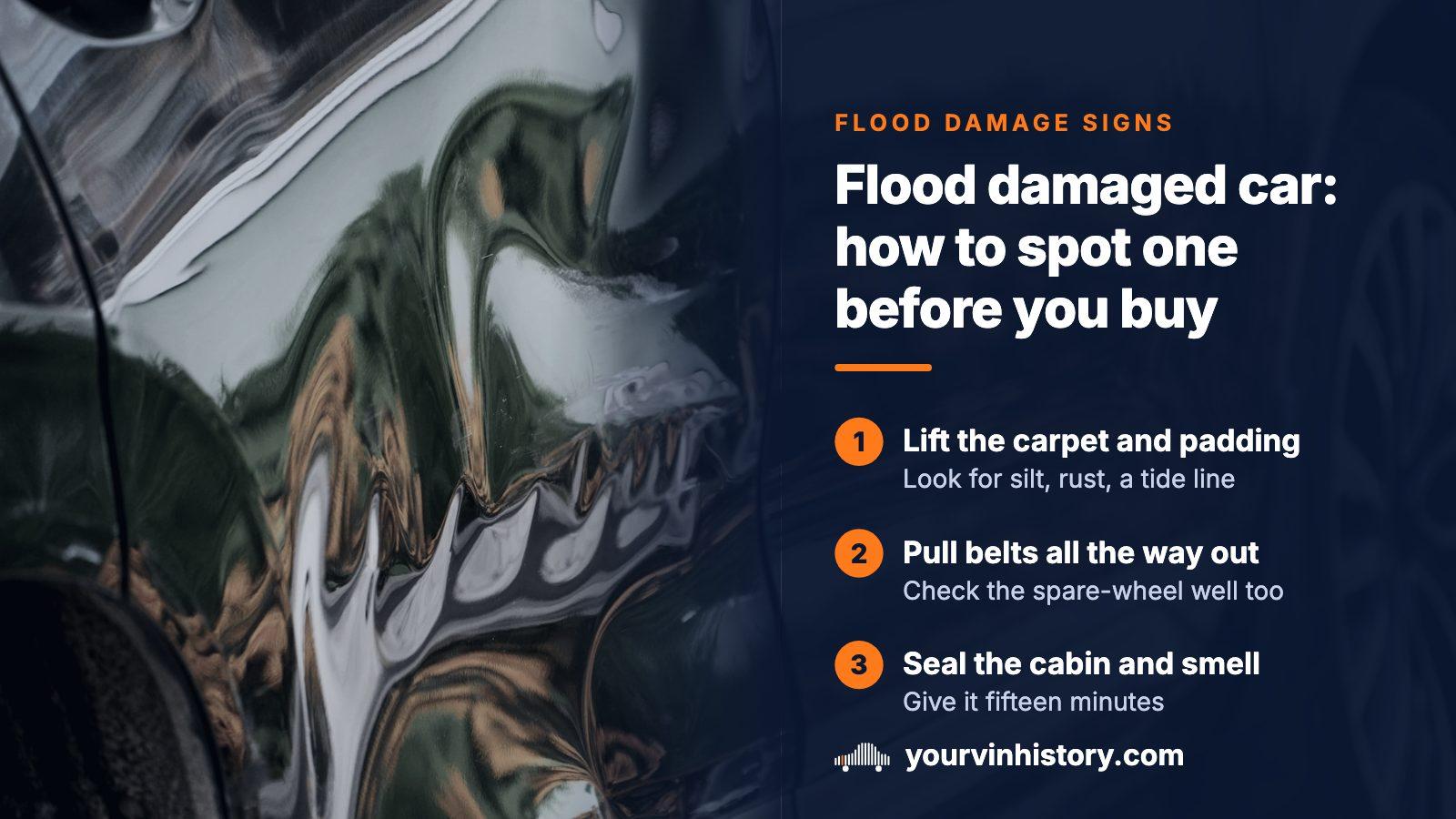
Lift a corner of the carpet and look at the padding, check the spare-wheel well, and pull each seat belt all the way out, looking for silt, rust or a tide line. Then seal the cabin and smell it. Run NICB VINCheck and a title-brand report as well, but a clean result only means no insurer or state ever recorded a flood loss on that car.
- Brand trigger
- An insurer total loss that a state records
- Best hiding place to check
- Under the carpet, not on top of it
- Smell test
- Sealed cabin for at least fifteen minutes
- Federal record
- Flood declarations outnumber hurricane ones about two to one
Why a flooded car can still come back clean
A flood brand is a record, and a record needs a trigger. In the usual case the trigger is an insurer declaring the car a total loss and a state writing that decision onto the title. Without the trigger, the brand never exists.
Two ordinary situations skip it. The owner may have carried liability coverage only, so no insurer ever inspected the car and no claim was opened. Or the seller dried the car out, cleaned it and sold it before anyone filed anything. A database search on either vehicle is accurate and still tells you nothing, because there was never an entry to find.
Reports therefore suit one group of cars: the insured, totaled and branded ones. The undocumented group has to be caught by looking. Even a vendor's damage reported wording is just that vendor's label, not a legal finding, so its absence proves little.
What water does once it gets inside
Not all flooding is equal. Salt water is close to a death sentence for wiring and connectors. Fresh water is kinder, but once it rises above the floor pan it can reach control modules, the pretensioners that tighten the belts, and airbag hardware, the parts you most want working in a crash.
The damage is also slow. Corrosion creeps through connector pins and copper strands in dozens of places at once, so the car can behave normally at the sale and then pick up electrical faults that no mechanic can trace to one cause.
Why a discount does not solve it
A lower price pays for a problem you can see. The worst faults in a flooded car have not arrived yet, and some sit in safety systems, so most buyers are better off walking away than negotiating.
Checks to run before you drive out
Records cannot clear a car, but they can eliminate one in a few minutes, so run them before you spend an afternoon on a viewing.
- NICB VINCheck: a no-cost search that flags insurer-reported total losses, flood write-offs included.
- An NMVTIS-based report: the federal title system carries flood brands from state to state, so a brand issued elsewhere should still turn up.
- State tools: some states run their own title lookup, such as Florida's free FLHSMV check.
- Auction history: an appearance in a salvage lane is the strongest documentary hint, and the photos often show the car as it was bought, before repairs.
A yourvinhistory report pulls title brands, salvage and auction records with photos, and insurance records for one VIN into a single document. The preview is free; the full report is a one-time purchase.
A walk-around that goes where detailers do not
Detailers shampoo carpets and wipe down plastic. They rarely touch the foam beneath the carpet, the bare metal under the seats or the hardware in the engine bay, where water leaves marks that outlast a cleaning. Bring a flashlight.
| Spot | What to look for |
|---|---|
| Carpet corner lifted, padding beneath | Dampness, silt, staining or a line left by receding water |
| Spare-wheel well | Water in the bottom, grit in the corners, rust on the jack |
| Seat rails and bolts | Rust on bare metal that should be dry and clean |
| Seat belts pulled to the stop | A stain line, grit or a sour smell in the webbing |
| Under the dash and behind kick panels | Green or white crust on connector pins and terminals |
| Interior fuse box and ground points | Residue, rust, or parts that look new on an aging car |
| Headlamp and tail lamp housings | A waterline or beads of moisture inside the lens |
| Engine bay hardware | Shiny new bolts sitting beside badly rusted ones |
The smell test, done so it actually works
Almost everyone sniffs the cabin on arrival, the worst moment to do it. A car that sat with the windows down all morning, or got a dose of deodorizer, will smell fine at the curb.
Do it in a better order. Shut every door and window as soon as you arrive. Leave the car shut up for fifteen minutes or longer and spend that time working through the other checks. Then pull the driver's door open and lower your face toward the footwell before the air changes. A damp smell that comes back in a closed cabin points to the padding underneath, which airing out cannot reach.
Treat the reverse signal just as seriously. A heavy cloud of air freshener or carpet shampoo in an otherwise ordinary used car is something to ask the seller about.
Making the wiring work hard on the test drive
Corrosion needs time to eat through connector pins, which is why a flooded car can feel fine for the first week. Use the drive to put every circuit under load.
- Run each power window up and down, then the sunroof, mirrors, seat motors and seat heaters.
- Cycle the wipers through every speed and switch on every light inside and out, hazards and turn signals included.
- Test the infotainment screen, climate controls, horn and each gauge.
- Write down anything that works only some of the time. An intermittent fault is a finding, not a quirk.
- Ask a mechanic to scan every control module, not only the engine computer. Stored codes from unrelated systems suggest wiring, not a bad part.
Hiring a mechanic, and what the paperwork can and cannot do
The FTC advises paying an independent mechanic to inspect any used car, even one a dealer has certified. It also notes that a history report may list accidents and flood damage but typically will not show mechanical problems, so it is no substitute. Ask for a written report naming the make, model and VIN, with repair estimates you can use to bargain.
Dealers must display a Buyers Guide on every used car. It says whether the car is sold as is or with a warranty, and it overrides conflicting wording in the sales contract. An as-is box is a reason to settle the flood question before you sign, not afterward. Spoken promises are hard to enforce, so get any assurance about the car's history in writing.
If a dealer will not let an independent mechanic look at the car, the FTC suggests considering another dealer. A private seller who refuses is giving you the same answer.
Flooding is not only a hurricane problem
Most flood-car advice starts with hurricane season. The OpenFEMA disaster declarations file logs each federal declaration with an incident type, a state and a start date. It holds one row per county, which inflates any total made by counting rows. Counted once per declaration, flood entries since 1953 outnumber hurricane entries by about two to one.
Season tells you less than people assume. Roughly nine in ten hurricane declarations begin in August, September or October, but only about one in five flood declarations start in those months. For floods, March is the busiest month with 116 declarations and November the quietest with 35, so no stretch of the calendar is quiet.
Remember what is being counted. Each entry records a federal decision covering a county. It shows where and when serious flooding happened, not how many cars were ruined.
Which states: the map is wider than the Gulf Coast
Rank states by distinct flood declarations and the top of the list is not the hurricane coast.
| State | Flood declarations |
|---|---|
| Texas | 44 |
| California | 41 |
| West Virginia | 36 |
| Washington | 35 |
| North Dakota | 33 |
Florida leads the hurricane ranking with 59, and Texas and Louisiana are the only states near the top of both lists. Eight states show flood declarations but not one hurricane declaration: Washington, North Dakota, South Dakota, Alaska, Oregon, Colorado, Utah and Wyoming. A title chain that stayed inland is therefore neutral information, and no reason to shorten the inspection.
How a flooded car ends up on your local lot
A flood produces a batch of damaged cars all at once. Over the next few weeks, salvage auctions move them along, and buyers haul the cars into other states, clean them up and advertise them in markets with no tie to the water. Retail listings tend to appear several months after the event, when nobody is thinking about it anymore.
That lag, plus the spread of flood declarations above, is why the physical checks belong on every candidate, not only on cars with a coastal or storm-year past. Records still do their job on the branded cars, the easier group. The carpet lift and sealed-cabin test catch the quiet one-owner sedan that was dried and sold without a claim.
If you find signs of water
- Walk away. Flood damage is progressive and reaches safety systems, so a price cut does not cover a fault that has yet to appear.
- Mention the problem to the seller one time. If they were honest, they likely did not know; if not, they now know you do. Either way the deal is over.
- Report mislabeled paperwork. If the title or ad misstates the car's history, complaints about title fraud go to your state DMV or attorney general, and a pile of similar reports is how investigators spot organized rings.
- Give the next car the same ten minutes. After a big storm year the market holds more of these cars than usual.
Where this information comes from
- FEMA: OpenFEMA disaster declarations — Public file of federal declarations tagged by incident type, state and start date, used for the flood versus hurricane comparison.
- NICB: VINCheck and flood vehicle guidance — Home of the no-cost VINCheck search for insurer-reported thefts and total losses, plus post-disaster consumer alerts.
- NMVTIS: National Motor Vehicle Title Information System — The federal title-history program, which links to flood damage notices and a guide to reading an NMVTIS report.
- FTC: Buying a used car from a dealer — Explains the Buyers Guide and why a history report does not replace an independent mechanic's inspection.
Sources and photos: Facts checked against the sources above in October 2026. Photo by Maxim Tolchinskiy on Unsplash; diagrams by YourVINHistory.
Keep reading
- What is a branded title?Where a flood brand sits among the other damage labels a title can carry.
- Title washingHow a brand can disappear when a car crosses a state line.
- Pre-purchase inspectionWhat a mechanic's inspection covers and which systems fail first.
- NICB VINCheck explainedWhat the no-cost NICB search covers and where it has gaps.
Frequently asked questions
Can a VIN check tell me if a car was in a flood?
Only if the flood left a record. NICB VINCheck, NMVTIS-based reports and state title tools reveal insurer total losses and branded titles. A car dried out and sold without a claim leaves nothing for them to find. Use the VIN search to eliminate cars quickly, then let the inspection and a mechanic's scan decide whether a clean-looking car really is clean.
What does a flood-damaged car smell like?
Usually a damp, sour mustiness, like a basement or a gym bag left wet. Because it comes from the padding and not the air, it often returns after the car has been closed up for a while. A strong perfume or shampoo scent is just as telling, since it may be covering something.
Should I ever buy a flood-damaged car?
Seldom, and never on a small discount. A car openly branded as flood at least announces the problem and should be priced as one. The bigger risk is the unbranded car, where nobody has disclosed anything. Salt water is the worst case for wiring, and any water that reached modules or airbag parts puts safety systems in doubt.
When do flood damage problems start showing up?
Often months, sometimes years. The first symptoms are usually small and scattered: a window that stalls, a warning light that comes and goes, a door lock that quits. Each looks like a separate repair, while the real cause, corroded connectors, sits behind trim where nobody looks. That delay is why flood cars sell easily and cost more to own.
Are cars from inland states safe from flood damage?
No. Federal flood declarations have been issued in places such as North Dakota, Washington, West Virginia, California and Texas, not just along the hurricane coast. Damaged cars are also moved across state lines to be cleaned and sold, so where a car sits today says little about where the water reached it.
Now check the car itself
The guide explains what to look for. The report shows what this VIN has on record.