THE SHORT ANSWER
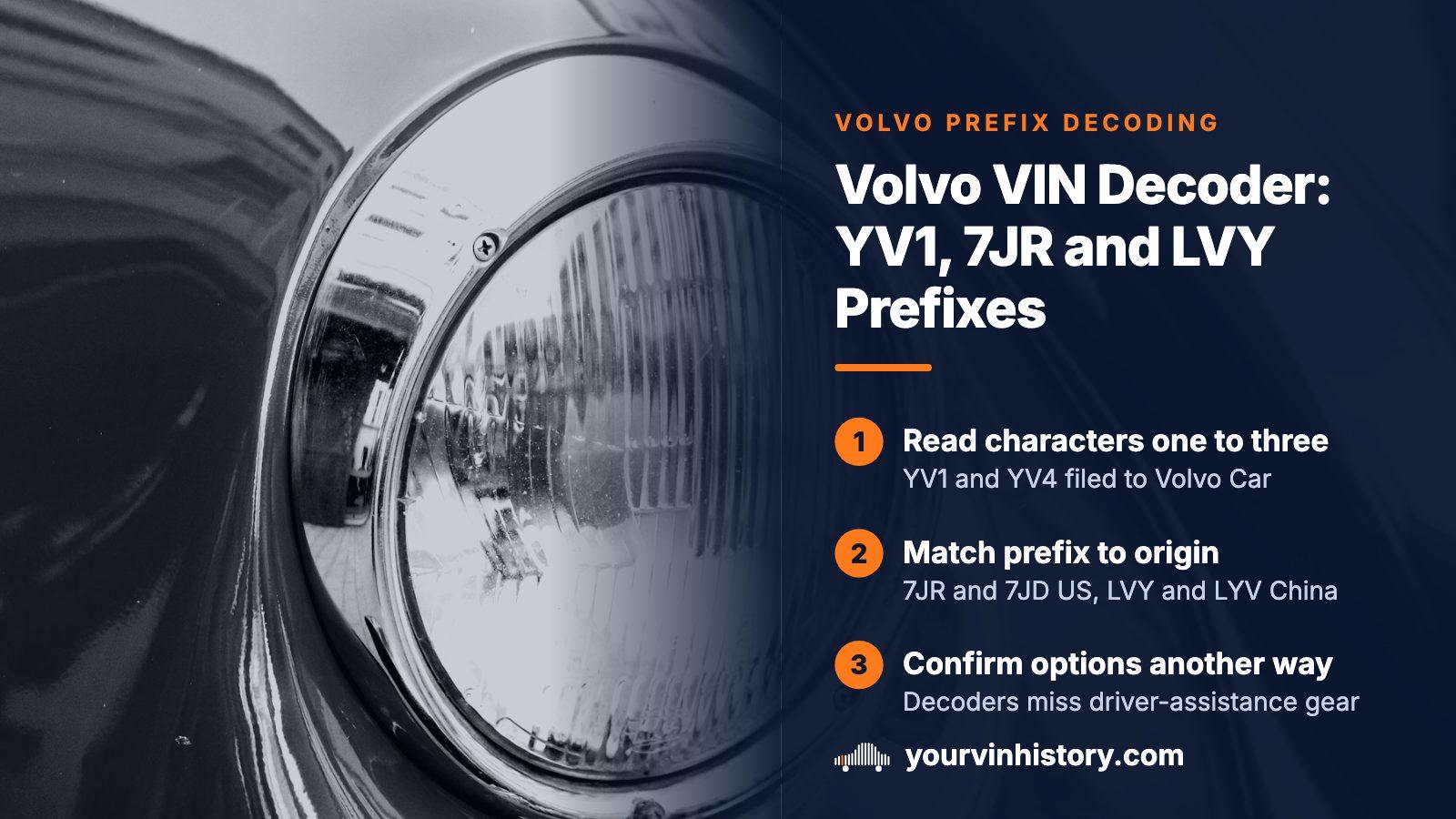
Read characters one to three first: YV1 and YV4 are filed to Volvo Car Corporation, 7JR and 7JD to Volvo Car USA, and LVY and LYV to Daqing Volvo Car Manufacturing in China. The rest of the number covers the car's description, a check digit, the model year, the plant and a serial. A federal decode confirms engine, drivetrain and plant, but not which driver-assistance options were fitted.
- Swedish-filed prefixes
- YV1 for passenger cars, YV4 for SUV-style vehicles
- US prefixes
- 7JR and 7JD, filed to Volvo Car USA, LLC
- Chinese prefixes
- LVY and LYV, filed to Daqing Volvo Car Manufacturing
- Heavy trucks
- A separate registrant, Volvo Group North America, under 4V4
The first three characters: registrant and vehicle class
Every VIN begins with a world manufacturer identifier, and Volvo holds several. NHTSA's register lists each with the company it was issued to and a vehicle type, so the prefix sorts a listing into car, SUV-style vehicle or truck. The leading letter also carries geography: Y covers Sweden and Finland.
| Prefix | Registered to | Type in the federal register |
|---|---|---|
| YV1 | Volvo Car Corporation | Passenger car |
| YV4 | Volvo Car Corporation | Multipurpose passenger vehicle |
| 7JR | Volvo Car USA, LLC | Passenger car |
| 7JD | Volvo Car USA, LLC | Multipurpose passenger vehicle |
| LVY | Daqing Volvo Car Manufacturing Co Ltd | Passenger car |
| LYV | Daqing Volvo Car Manufacturing Co Ltd | Multipurpose passenger vehicle |
Multipurpose passenger vehicle is the register's label for SUVs and crossovers. A prefix missing from this table is not automatically a red flag; Volvo has built in several countries and eras, and these are only the ones checked.
Volvo trucks are another business. The prefix 4V4 is filed under the make Volvo Truck, registered to Volvo Group North America, with the type truck. A listing that calls such a vehicle a Volvo is not describing a Volvo Cars product, and its parts, recalls and service network are separate.
Sweden, South Carolina and China: why the prefix can differ
Volvo Cars has had Chinese ownership since 2010, and assembly now runs in Sweden, the United States and China. Some models sold here are built in South Carolina, while others arrive from Sweden or China depending on model and year. A Volvo that does not start with Y is therefore ordinary.
The federal decoder shows this directly. In test decodes of sample numbers, a 7JR number returned South Carolina as the plant state, an LVY number returned China as the plant country, and a YV4 number returned Sweden with Torslanda as the city. The check digit failed on all three, as it should, since the samples were not real cars.
None of this suggests a gray-market import or a problem car; the plant is simply where assembly happened. At resale, some shoppers weigh build country when they set a price, though a prefix says nothing about how well a car was built.
Match the prefix to the paperwork
If the title, the windshield plate and the door jamb label all show the same number, an unfamiliar prefix is just a different plant. If they disagree, that is the problem, whichever country the prefix points to.
Positions four to seventeen and what NHTSA's decoder returns
After the prefix, a Volvo follows the standard 17-character layout. Look for the number on the plate visible through the windshield on the driver's side and on the door jamb sticker. Photograph both and compare them with the title.
- Positions four to eight: the descriptor covering model, body, engine and restraints
- Position nine: the check digit, a calculation that catches mistyped numbers
- Position ten: the model year
- Position eleven: the assembly plant
- Positions twelve to seventeen: the serial number within that plant's output
Volvo files its VIN structure with NHTSA, so the public vPIC decoder reads it with no account and no fee, returning model year, model, body class, engine, fuel type, drive layout, airbag positions and plant. It is built for vehicles meant for sale in the United States and for the modern VIN format, so a car sold elsewhere or built long ago returns a thin result. If the check digit fails, the error text says so; recheck the characters against the car before assuming anything worse.
Research the generation, not the model name
Volvo model names stay in the catalog for years while the cars beneath them change. One name can cover a design early in its run and a quite different one after a mid-life revision or a full redesign. Parts catalogs, service intervals and known faults all follow the generation, not the badge on the tailgate.
- Write down the model and model year the decode returns.
- Place that pair in a generation, using the maker's model history or a specialist's.
- Read fault reports and parts prices for that generation only.
- Compare the engine in the decode with the engine the listing claims.
A review that averages every year a name was sold describes a car that never existed. Use the decode to narrow the research before reading any buyer's guide.
Plug-in hybrids and electric models: what the decode confirms
Plug-in hybrids now sit across most of Volvo's lineup, and fully electric models arrived later. The decoder tells you which one the car was built as. A test decode of a sample plug-in SUV number set the electrification field to plug-in hybrid, with electric as the primary fuel and gasoline as the secondary. A conventional sample returned gasoline and left the electrification level blank.
What no database shows is the condition of the traction battery, the biggest swing factor in the value of a used electrified car. Paperwork and the car itself have to answer that.
- Ask whether the battery was ever replaced, and request the invoice.
- Confirm what hybrid or battery coverage remains, using the in-service date and the odometer reading.
- On a plug-in hybrid, ask how often the last owner plugged it in, since a car run mostly on gasoline has aged differently.
- Compare the electric range the car reports with the EPA figure for that model year on fueleconomy.gov.
- Ask whether the charging cable and any home charging hardware come with the car.
Older Volvos: a durable reputation and the deferred bills behind it
Older Volvos keep a loyal following because many outlasted rivals from their era. The reputation is earned and also overused. A design that was built to last still needs fluids, belts and seals on schedule, and a car that went without them is a project, whatever the badge says.
- Look for corrosion first: wheel arches, sills and subframes decide more purchases than the engine does.
- Ask for records of cooling system and timing work, the jobs owners most often postpone.
- Expect electrical faults to take time to trace, and price the diagnosis before you buy.
- Check that parts exist for a rarer model before committing.
- Weigh a thick service file above a low odometer reading.
- Find out where the car lived, because road salt does more damage than miles.
The decode also gets thinner with age. Cars built before the modern VIN standard sit outside vPIC's scope, so an old Volvo may need a dealer, a club or a specialist for details the federal tool cannot supply.
Driver-assistance equipment: the number will not settle it
Volvo's name is tied to safety, and buyers sometimes assume every car carries every system. Much of the assistance equipment was optional, so what a given car has depends on how the first buyer ordered it. On safety, the VIN vouches for the factory restraint system and rarely for the assistance packages.
NHTSA's decoder makes the split visible. In a test decode of a sample SUV number, forward collision warning and automatic emergency braking came back as standard, while adaptive cruise control, blind spot monitoring, lane keeping and park assist came back as optional. A field marked optional says the system existed for that model, not that this car has it.
- Ask a Volvo dealer to pull the build record for the VIN and compare it with the car.
- Use adaptive cruise and lane functions on the test drive instead of trusting the listing.
- Ask whether a camera or sensor was replaced after a windshield change.
- Have a scan confirm that the systems calibrate and report no faults.
Recalls are searched by VIN, and the free-repair rule has an age limit
Recalls attach to ranges of VINs, not to model names, so a search by name can surface campaigns that never touched the car in front of you. NHTSA's recall lookup answers the question for one VIN, costs nothing and takes seconds. Enter the full 17 characters, and repeat the search on the day you pay.
A manufacturer is generally required to remedy a recall at no charge, with an age limit written into federal law. The requirement does not apply when the first retail purchase happened more than 15 calendar years before the recall notice or order, whichever came first. A long-lived older Volvo can fall on the wrong side of that line, so ask a dealer to quote the repair in writing before you count on it being covered.
A used-Volvo checklist, in the order that saves the most time
- Read the VIN from the windshield and the door jamb, and confirm both match the title.
- Decode it. Note the registrant, the plant country and the model year, then compare them with the seller's account.
- Turn the model and year into a generation and read about that generation alone.
- If driver-assistance packages affect the price, ask a dealer for the build record.
- On a plug-in hybrid or electric model, request battery paperwork and confirm remaining coverage.
- On an older car, inspect for rust before anything mechanical.
- Run NHTSA's recall lookup with the full VIN.
- Add a vehicle history report for title brands, accident and salvage records and odometer readings. A yourvinhistory.com report covers these, and the preview comes before any purchase.
- Pay a Volvo specialist to inspect the car; they know where each generation tends to wear.
Where this information comes from
- NHTSA vPIC: VIN decoder — The federal decoder built from manufacturer filings; supports the field list and the limits on non-US vehicles and older cars.
- NHTSA vPIC: manufacturer identifier lookup — Returns the make, registrant and vehicle type for any three-character prefix; the basis for the prefix table.
- NHTSA: Ratings and recalls — Federal crash ratings plus the open-recall check by VIN.
- U.S. Code: 49 U.S.C. 30120, remedy of defect or noncompliance — The statute behind the no-charge recall remedy and its limit tied to the first purchase date.
- EPA and DOE: Fuel Economy — Official economy figures, including plug-in hybrids and electric models, for comparing a used car's reported range.
Sources and photos: Facts checked against the sources above in October 2026. Photo by Rafał Karoń on Unsplash; diagrams by YourVINHistory.
Keep reading
- How to read a VINWalks through every character position, the model year letters and the check digit calculation.
- Safety features by VINExplains how build date decides which safety equipment the law required.
- Used electric car checkCovers battery requirements and checks for an electrified Volvo.
- VIN warranty checkShows how the in-service date works and which warranty parts transfer to you.
Frequently asked questions
How do I decode a Volvo VIN for free?
Type all 17 characters into NHTSA's vPIC decoder. It needs no account, and because Volvo files its VIN structure there, you get model year, model, body class, engine, fuel type, drive layout, airbags and plant. Copy the number from the car, not the listing: one wrong character changes the result or triggers a check digit error.
What does a YV1 prefix mean on a Volvo?
YV1 is a manufacturer identifier filed to Volvo Car Corporation for passenger cars, and the Y points to Sweden or Finland. YV4 belongs to the same company but is filed for SUV-style vehicles. The US and Chinese plants use other prefixes, so a number starting 7JR or LVY is neither a different brand nor a typing error.
Is a Volvo with a 7JR or LVY number genuine?
Usually, yes. Both are registered to Volvo-named companies in NHTSA's register, and a 7JR sample decoded to a South Carolina plant. Genuine still means matching: the number on the windshield, the door jamb label and the title must agree, and the decoded make, model and year must fit the car in front of you.
Does the VIN show which driver-assistance systems a Volvo has?
Only in part. The decode lists the restraint system, and NHTSA's data may mark certain assistance features standard or optional for the model. Whether this particular car has adaptive cruise or lane keeping depends on its original order. A dealer can read the build record, and a test drive plus a scan confirm the systems still work.
Will a Volvo VIN decode show accidents or title brands?
No. A decode describes how the car left the factory: model, engine, drivetrain, plant. Title brands, accident and salvage records, odometer readings and liens sit in separate records, including state titling data and NMVTIS. Run a vehicle history report alongside the decode before you pay.
Now check the car itself
The guide explains what to look for. The report shows what this VIN has on record.