THE SHORT ANSWER
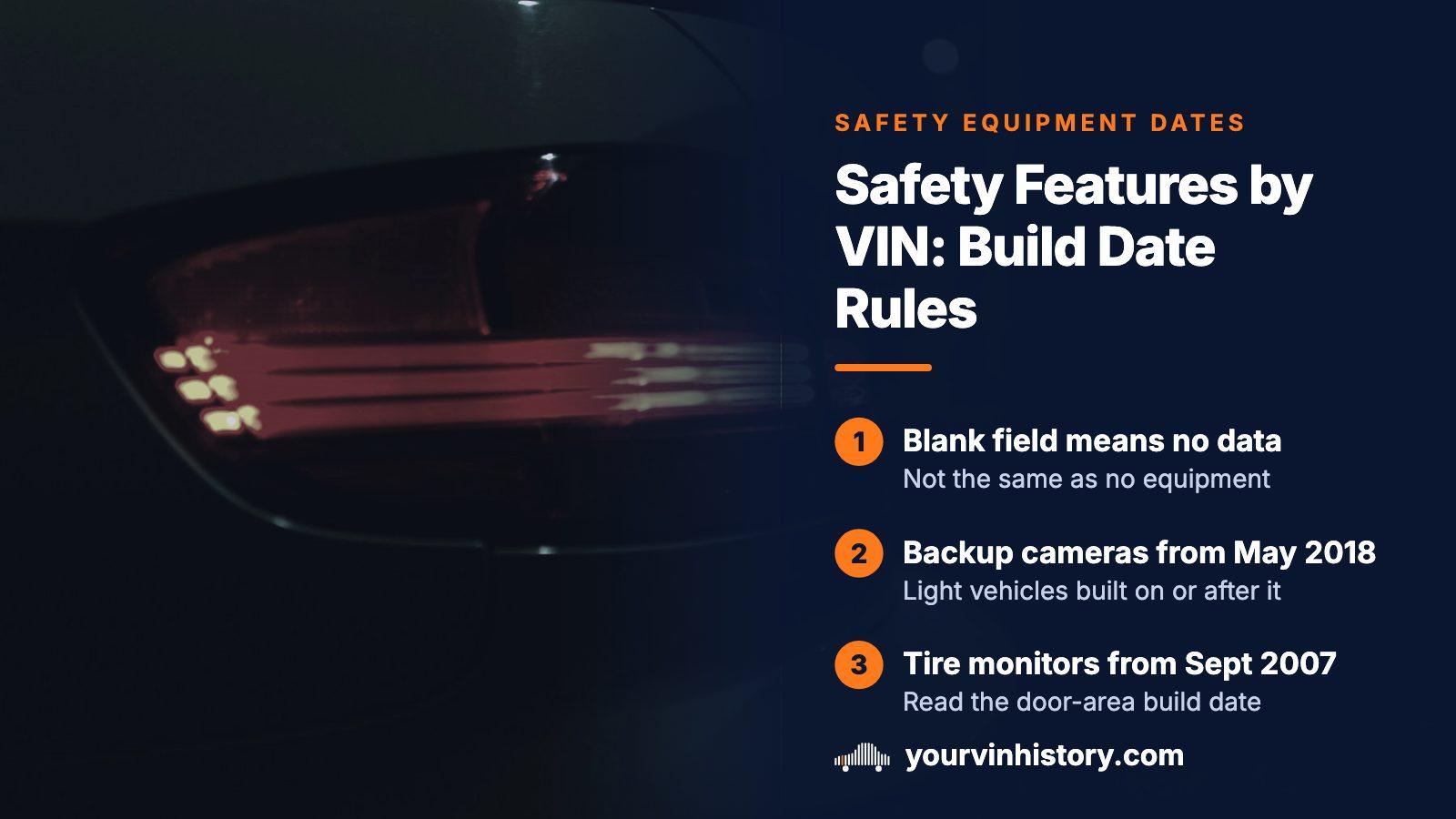
A VIN gives you the model year and, when the maker filed them, fields for airbags, stability control and a rear camera. A blank field means no data, not no equipment. Federal rules follow the build date on the door-area label: backup cameras on light vehicles built on or after May 1, 2018, and tire pressure monitors on covered vehicles built on or after September 1, 2007.
- Camera rule
- Light vehicles built on or after May 1, 2018
- Tire monitor rule
- Covered vehicles built on or after September 1, 2007
- Build date
- Certification label in the driver door area
- What the VIN adds
- Model year, plus safety fields only if the maker filed them
What a VIN decode actually reports about safety gear
Run a VIN through NHTSA's public decoder, vPIC, and the result includes safety fields: airbag locations, seat belt and pretensioner details, the tire pressure monitor type, and entries for ABS, stability control and a rear visibility system. The data comes from specifications the manufacturer filed, so the decode is only as full as that filing.
Blanks are the trap. An empty field means the agency holds no data for that item, not that the car lacks it. Airbag lines can be filled in beside an empty camera line, and reading that blank as no camera would be a mistake.
The entry you can always count on is the model year, taken from the tenth character. It is a starting point, because the federal safety rules do not run on model years.
Model year versus build date, and where to read the real one
A model year is a label the maker picks, and it can begin months before the calendar year it names. The build date is when the car was actually assembled, and federal safety standards are written against that.
| Date | Where it appears | Federal standards use it |
|---|---|---|
| Model year | Tenth VIN character, and the title | No |
| Build month and year | Certification label in the door area | Yes |
A car titled as a 2018 model could have been assembled the year before or in the spring of 2018, and the title reads the same either way. If a requirement began on May 1, 2018, those two cars land on opposite sides of it, and the VIN cannot tell you which is which.
The date sits on the certification label, the sticker that also carries the maker's name and the weight ratings. Check the driver door pillar and door edge, read the month and year, and photograph it. Confirm the VIN on the car matches the paperwork while you are there.
Backup cameras: the line sits at May 1, 2018
Rear visibility lives in Federal Motor Vehicle Safety Standard 111 (49 CFR 571.111). The rule arrived in two stages, and only the second reaches every car.
| Stage | Vehicle built | Maker's duty |
|---|---|---|
| Phase-in | May 1, 2016 through April 30, 2018 | A set percentage of each maker's production must show a rearview image |
| Final | May 1, 2018 and later | Every covered passenger car must show one |
Read the first row slowly. In that window the duty attached to a share of each maker's output, not every vehicle, so two cars of one model year could both be lawful, one with a camera and one without. Nothing was removed from the second car; the rule had not reached it.
The standard also stops at 4,536 kg gross vehicle weight rating, or 10,000 pounds. Heavier trucks sit outside its camera provisions.
SUVs, pickups and vans: a different paragraph, the same dates
The passenger-car rule is paragraph S5.5, which raises the question of whether SUV and truck buyers get another calendar. They do not. Paragraph S6.2 handles the rest of the light fleet: multipurpose passenger vehicles, a class that includes many SUVs and vans, plus trucks, buses and low-speed vehicles, with the same phase-in window and the same May 1, 2018 final date. Only the paragraph you would cite differs.
Mirrors survived the camera rule. Paragraph S6.1 still calls for conforming mirrors, or outside mirrors with at least 126 square centimeters of reflective surface on each side, adjustable in both directions. The camera sits beside them.
Testing a camera against what the standard describes
The standard specifies the picture, not just the hardware, so you can run checks on the lot.
- Select reverse and count. The screen should come alive inside 2.0 seconds.
- Shift out of reverse. The image should not linger afterward.
- Change the view if the screen allows it, then shift out and back. The display should return to the standard view instead of keeping whatever the last driver left.
- Look at the picture. The standard sets a minimum apparent size for test objects and expects the image to survive durability testing, so a dim, foggy or distorted view on a newer car deserves a question.
A slow or sticky camera is worth raising
If the image drags well past two seconds, or holds a view the previous driver picked, it is not behaving as the standard describes. Raise it before you sign, while the price can still move.
Tire pressure monitors: the line sits at September 1, 2007
Tire pressure monitoring comes from Federal Motor Vehicle Safety Standard 138 (49 CFR 571.138). It applies to buses, trucks, multipurpose passenger vehicles and passenger cars at or under 4,536 kilograms, or 10,000 pounds. The S7 schedule ran in three steps.
| Paragraph | Vehicles built | Requirement |
|---|---|---|
| S7.1 | From October 5, 2005, before September 1, 2006 | A specified minimum share of each maker's vehicles |
| S7.2 | From September 1, 2006, before September 1, 2007 | A larger specified share |
| S7.3 | September 1, 2007 and later | All covered vehicles, apart from some multi-stage builds |
For a used-car buyer the working line is September 2007. Before it, a monitor may or may not be present, depending on the maker and the individual vehicle. From that date, a covered vehicle had to have one.
Coverage has gaps. Standard 138 does not reach a vehicle with dual wheels on one axle, which puts a dually pickup outside it however recent the build. On a truck or van, do not infer a monitor from the year: watch for the telltale at startup and ask what is fitted.
What the low tire pressure light really signals
Most drivers read the symbol as a polite reminder to top up. The standard sets a higher bar. The telltale must light once one or more tires, up to four, reach 25 percent below the maker's recommended cold pressure, or a minimum level the standard lists for that tire type, and the system may take as long as 20 minutes to react.
Two things follow. A lit symbol means a tire sits a full quarter or more under the placard pressure, which is far from slightly soft. And a tire may be far down before anything lights. Neither is a flaw; both are the standard working as written.
So a light already glowing when you arrive to view a car is not a top-up-and-forget item. Check every tire with your own gauge against the placard before driving.
The second tire light: when the monitor itself has failed
The standard also demands a second warning that people mix up with the first. Under S4.4, the vehicle must alert the driver within 20 minutes of a fault in how the system generates or sends its signals. That is not a low-tire message. It says the monitor itself has stopped working.
Makers may fit a dedicated lamp under S4.4(b) or fold the function into the pressure lamp under S4.4(c). On a combined lamp, the symbol typically flashes briefly at startup, then stays lit, when the fault is in the system.
- Flashing at startup, then steady, points at the system rather than the pressure.
- Sensor batteries wear out, which is ordinary on an older car.
- Careless tire fitting can damage sensors, which says something about repair quality.
- Find out if the light was on before the last tire change.
A lit system light is not a reason to walk away. It is a question whose answer says how the car was looked after.
Stability control, options and repairs: what the dates cannot settle
Stability control is the third mandate shoppers raise beside cameras and tire monitors. Its standard is FMVSS 126, and the same logic applies: compliance dates follow manufacture, not model year, so the label decides there too. A blank stability field in a decode is as uninformative as a blank camera field.
Optional equipment has no legal cutoff to check. For those items your evidence is the decode, the record of what was ordered, and a hands-on test.
Even where a rule certainly applied, the dates show what should have left the factory, not what is on the car now. A budget repair can leave a camera or sensor unplugged. A vehicle history report adds accident records with a damage map and open recalls, which helps you judge whether a missing or dead feature traces back to a repair.
A five-minute routine for the car in front of you
Run these in order and each question above gets answered for that one vehicle.
- Decode the VIN with NHTSA's vPIC for the model year and any safety fields the maker filed.
- Read the build month and year off the certification label.
- Compare that date with May 1, 2018 for cameras and September 1, 2007 for tire monitoring, and check whether weight or dual wheels exclude the vehicle.
- Select reverse, count, and confirm the camera returns to its standard view.
- Watch the dashboard at startup. The tire symbol should light briefly during the bulb check, then go out.
- Run the VIN through NHTSA's free recall lookup while the car is in front of you.
Anything the date says should be there and is not goes on your question list before you agree on a price.
Where this information comes from
- eCFR: 49 CFR 571.111, rear visibility — Backup camera phase-in dates, the final date, the image timing rules and the mirror requirement.
- eCFR: 49 CFR 571.138, tire pressure monitoring — The three-step schedule, the 25 percent and 20 minute warning rule, the malfunction telltale and the dual-wheel exclusion.
- NHTSA: vPIC VIN decoder — Public decoder that returns the model year and the safety fields manufacturers reported.
- NHTSA: Recalls lookup — Search for open safety recalls on a specific VIN, at no charge.
Sources and photos: Facts checked against the sources above in October 2026. Photo by A n v e s h on Unsplash; diagrams by YourVINHistory.
Keep reading
- Car specs by VINSee which specification fields a decode tends to return and which it leaves blank.
- Window sticker by VINPull the label that came on the car new, a record of its original equipment.
- Tire size by VINFind the placard that gives the pressure the tire light is measured against.
- Airbag deployed checkCheck whether a car's airbags have already deployed, a question the build date cannot answer.
Frequently asked questions
Does a VIN show whether a car has a backup camera?
The decode includes a rear visibility field, but it is filled only when the maker reported the equipment, and a blank proves nothing. For the legal side, read the build date on the door-area label and compare it with May 1, 2018. Then select reverse and look at the screen.
Do all 2018 cars have backup cameras?
No. A car titled as a 2018 model may have been built before May 1, 2018, and a vehicle above the 4,536 kg weight limit falls outside the camera provisions. During the earlier phase-in only a share of each maker's output needed one. Check the label date and weight rating instead of the year.
Is a tire pressure light on a used car a reason to walk away?
Not by itself. It means a tire is down 25 percent or more from the recommended pressure, or that the monitor has a fault. Measure each tire with your own gauge against the placard. If pressures are right and the light stays on, ask when the sensors were last serviced.
Do I have to add safety equipment to an older car that lacks it?
Nothing in these two standards asks that. Both are written about vehicles manufactured on or after a date, so a car built earlier was never covered. Whether your state expects more at registration or inspection is a separate question for its motor vehicle agency.
Where is the manufacture date on a car?
On the certification label in the driver door area, beside the maker's name and the weight ratings. It shows a month and a year. The VIN carries only the model year, so the label is the quick way to see whether a car predates a cutoff. Photograph it for your records.
Now check the car itself
The guide explains what to look for. The report shows what this VIN has on record.