THE SHORT ANSWER
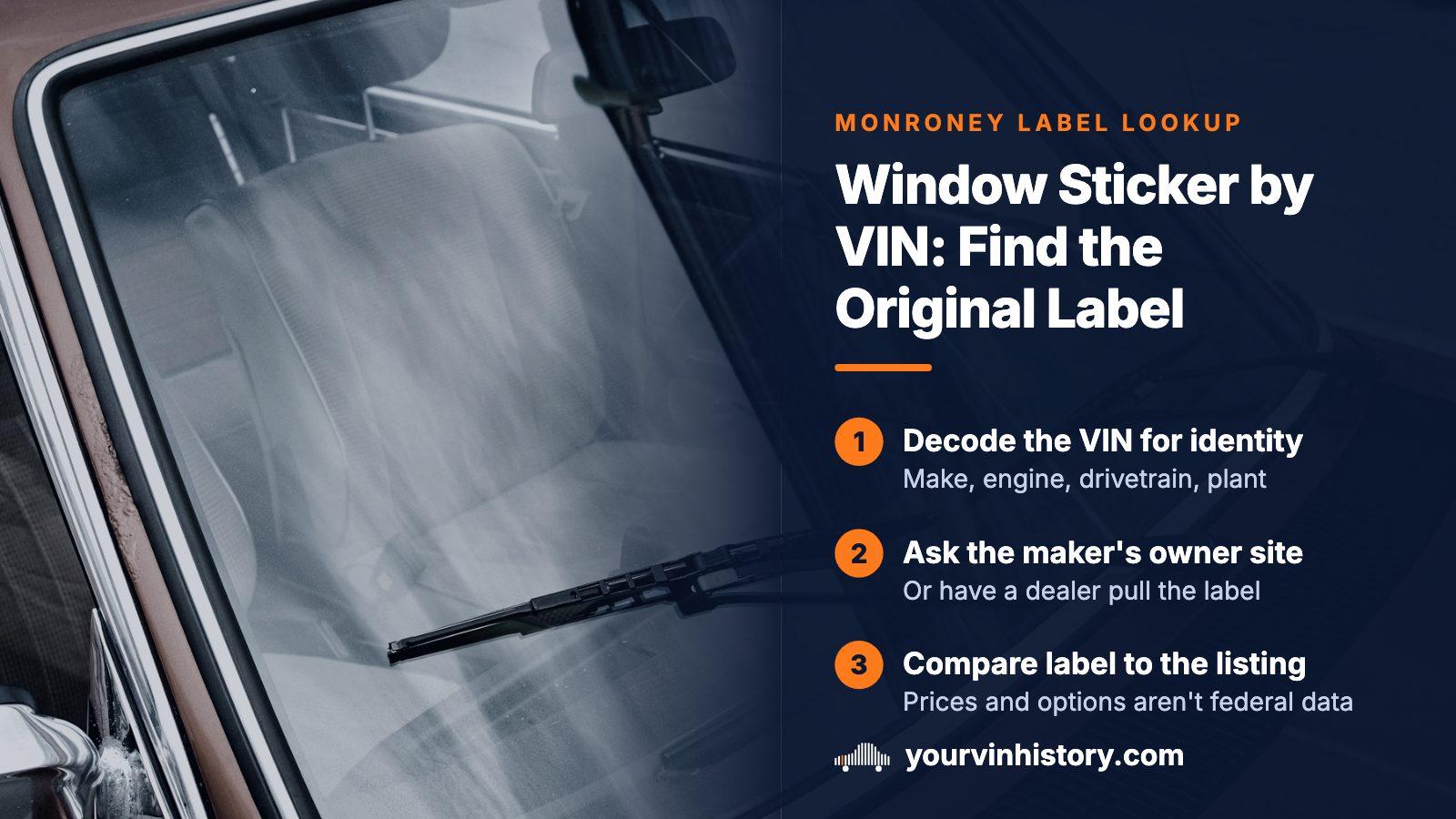
Partly. A Monroney label is generated from the maker's build record for one VIN, so it can often be rebuilt years after the paper was removed. NHTSA's free decoder returns the identity lines: make, model, engine, drivetrain, body class and assembly plant. Original prices and itemized options are not published federally. Try the maker's owner website, ask a dealer for the brand to retrieve the label, and use the decode to confirm the car matches the listing.
- Law behind it
- 1958 federal act, codified at 15 U.S.C. § 1232
- Free decode returns
- Make, model, plant, engine, drive type, body class
- Not published federally
- Base price, priced options, destination charge
- Early removal penalty
- Fine of $1,000 at most, a year in prison at most, or both
What the Monroney label is and who has to print it
A Monroney label is the sticker on a new car's window that lists its price and equipment. Congress made it mandatory through the Automobile Information Disclosure Act of 1958, and it carries the name of the bill's sponsor, Senator Almer Stillwell Monroney. Under 15 U.S.C. § 1232, the manufacturer must put it on the windshield or on a side window ahead of delivery to the dealer.
Each sheet is produced for one specific vehicle, using the build record tied to its VIN. That is why a maker can often regenerate it years later, after the paper has been peeled off and thrown away. Most sheets are gone for a legal reason. Under 15 U.S.C. § 1233(c), willfully removing or altering the label, or making it illegible, before the car reaches its ultimate purchaser can bring a fine of up to $1,000, a prison term of up to one year, or both, and each car counts as a separate offense. Once you take delivery, the sheet is yours, and plenty of owners simply discard it.
What a free VIN decode returns and what it leaves blank
The sticker is really several kinds of information sharing one sheet of paper, and they come from different places. The identity lines are available from NHTSA's public vPIC decoder, which asks for no account. The money lines are not published by any federal agency.
A test decode of a 2013 F-150 shows the split. The decode populated the make, model and model year, the body class, engine size and cylinders, fuel, drive type, and the plant's city and country. Base price, trim, series and destination market came back empty.
| Entry on the label | Returned by a free decode |
|---|---|
| Make, model, identification number | Yes, returned by vPIC |
| Final assembly point | Yes, the plant's city and country |
| Engine, fuel type, drivetrain, body class | Yes, as the car was built |
| Suggested retail price | No, the price field comes back empty |
| Each option with its own price | No, manufacturer records only |
| Transportation charge to the dealer | No, manufacturer records only |
| NHTSA safety ratings | Yes, published separately by NHTSA |
| Trim and series names | Often empty, even when the car has a trim |
Read the table by the question you are asking. To learn what the car is, such as its engine, its drive type or its plant, a decode answers in seconds. To learn what it listed for and which options were ticked, treat any no-charge claim with caution, because those figures live in the manufacturer's records.
Routes to the original price and option lines
When you want the dollar figures, go to whoever holds the build record. These steps run from least effort to most.
- Copy the VIN from the dashboard plate and from the label in the driver's door frame, and confirm both match the title before you search anything.
- Check the manufacturer's owner website for a window sticker or Monroney tool. Search that site directly, since general web searches often surface resellers first.
- Expect a model-year cutoff. Maker tools tend to cover newer vehicles and stop short of older ones.
- Ask a dealer for the brand whether it can retrieve the original label for that VIN. A seller trying to close a deal has little reason to refuse, and a reluctant answer is information too.
- If nothing turns up, rely on the decode for engine, drivetrain, body and plant, and have a mechanic confirm anything the listing leans on.
Paid reproduction services sell access to the same manufacturer data, so compare a sample of their output with your decode before paying. Lookup pages move whenever a maker redesigns its site, so this guide skips web addresses.
Reading the sheet from top to bottom
Layouts differ by brand, but the anatomy repeats.
- Identity block: model, trim name, VIN, color codes and assembly plant.
- Standard equipment: what every car of that trim carries at no extra charge.
- Optional equipment: each factory-fitted extra, with its own price.
- Pricing block: base price, options and the destination charge, added into a total.
- Fuel economy: EPA estimates for city, highway and combined driving, tied to this powertrain.
- Safety ratings: NHTSA stars, on models that were tested.
- Parts content: the share of U.S. and Canadian parts, plus where the engine and transmission come from.
One detail in the statute is easy to miss. It describes the optional items as those physically attached to the car when it was delivered to the dealer. Anything a dealer bolts on afterward falls outside the federal label, which explains a listing total that runs above the factory figure.
The delivery lines most buyers skip
Beyond the price, the law asks for four facts about the car's first trip: the final assembly point, the dealer it was sent to, the city or town where it was delivered, and the method of transportation if it was driven or towed from the plant.
On a used car those lines read like a short biography. The assembly point matters when a model was built at more than one plant. The delivery city shows where the car started out. One that began life in a region that salts its winter roads may deserve a closer look underneath than an identical car delivered somewhere dry. Treat it as a hint about where to look, since cars move.
The transportation line can also explain odd mileage on a nearly new car. A vehicle driven from the plant carries miles that no owner drove.
Matching the sticker to the car on the lot
Listing text and tailgate badges are claims, while the build record is evidence. Walk the car with the data open and check:
- Engine size and cylinder count against what is under the hood.
- Drive type, two-wheel or four-wheel, as built.
- Wheel size and style against the packages on the sheet.
- Tow equipment, which is sometimes just a hitch added later rather than a factory option.
- Driver-assist and safety equipment that the trim name implies.
- Sunroof, audio and interior packages.
Badge swaps are cheap and not always deceptive. They become a problem when a later buyer treats the badge as proof. If the record says the car left the factory with the smaller engine and a mid-level trim, that is the car you are buying, whatever the trunk lid says. Original equipment also carries into the used market, so two cars sharing a model year and name can sit thousands of dollars apart for that reason alone.
MSRP and addendum sheets are not the price paid
The bottom-line figure is what the manufacturer suggested, not what the first owner paid. Depending on the market, the real deal could have landed well below or above it.
Use that number as an anchor in a negotiation. A car that was well equipped when new supports a stronger used price, but today's value turns on odometer reading, condition, title history and the going rate for comparable cars.
Two sheets, two authorities
Dealers often add a second sheet beside the label, listing market adjustments, protection packages and installed accessories. The dealer writes that one, and the federal label statute does not cover it. If both are on a car, read them as separate documents, and give the manufacturer's sheet the weight.
Safety stars, mileage estimates and parts content
Congress added the safety-rating requirement to the statute in 2005 and adjusted it in 2012. When NHTSA has published New Car Assessment Program ratings, the label shows stars in categories that may include frontal impact, side impact and rollover resistance. The ratings block has to take up either 8 percent of the label's total area or a box measuring at least 4½ inches by 3½ inches. A car that was never tested, or not rated in a category, has to say so.
Stars describe the model as tested when new, not this example after years of use, and test methods have changed, so ratings from different generations compare poorly.
The fuel economy numbers come from EPA testing of that engine, transmission and drive combination. They compare vehicles against each other well, but they do not predict your commute. The EPA's fueleconomy.gov lets you search estimates by year, make and model, and it includes a Used Car Label tool aimed at people selling a car. A big gap between label and real mileage is a reason to check maintenance, not proof of a fault.
What the sticker cannot tell you
A window sticker records the car on the day it was built and shipped. Everything after that is somebody else's paperwork, and none of it appears on the sheet:
- Collisions, insurance claims and any structural repair work
- Title brands, whether salvage, flood, lemon or rebuilt
- Mileage history, including any rollback
- The number of previous owners
- Recalls announced after the car was sold
- Liens, thefts and auction sales
A history report fills that gap with title brands, accidents, odometer readings, auction and salvage records, liens and open recalls tied to the VIN. This site offers one, with a free preview before any purchase. Together, the sticker shows what the car was and the history shows what happened to it.
Where this information comes from
- 15 U.S.C. § 1232: automobile information disclosure — The statute text for the entries the label must carry, where it goes on the car, and how large the safety rating block must be.
- 15 U.S.C. § 1233: violations and penalties — Source for the fine and prison term for removing or altering the label before delivery, and for the relabeling exception.
- NHTSA: vPIC VIN decoder — The public decoder that returns manufacturer build data from a VIN, which is the free half of the sticker.
- EPA: fueleconomy.gov — Official fuel economy estimates by year, make and model, plus a label tool for sellers.
Sources and photos: Facts checked against the sources above in October 2026. Photo by Max Tokarev on Unsplash; diagrams by YourVINHistory.
Keep reading
- Car specs by VINShows which specifications a free decode returns and which ones stay in other records.
- Trim level by VINExplains why trim often comes back blank and how to confirm it another way.
- Ford window stickerApplies the same idea to a single brand, if the car in front of you is a Ford.
- Vehicle history reportCovers the post-factory records that a window sticker leaves out.
Frequently asked questions
Can I get a window sticker for a used car?
Often, yes. The label is built from the manufacturer's record for that VIN, so the maker or a dealer for the brand can sometimes regenerate it long after the original is gone. Availability varies by brand and model year, and a copy shows how the car left the factory, not what has happened to it since.
Is a window sticker lookup free?
Sometimes. NHTSA's decoder costs nothing and returns engine, drivetrain, body class and plant, and some manufacturers publish their own lookup for their vehicles. Third-party sites that sell a reproduced label are charging for access to the manufacturer data behind the price and option lines, so compare their sample against your free decode first.
Why is it called a Monroney sticker?
The name belongs to Almer Stillwell Monroney, a senator from Oklahoma whose 1958 bill became the Automobile Information Disclosure Act. The law gave buyers a uniform price and equipment sheet to compare across dealers, and the sheet it requires has been known by his surname ever since.
Can I legally take a window sticker off a car?
Not once the car is yours. The federal ban covers anyone who removes or alters the label before the car is in the hands of its ultimate purchaser, which includes a dealer peeling it off stock. If you buy new, photograph the sheet before you take it off, since it documents every option the car was built with.
What if the sticker and the VIN point to different plants?
Treat it as a red flag to resolve before you pay. The eleventh VIN character identifies the assembly plant, so the plant on a sticker copy should match what a decode reports. A mismatch can mean a clerical slip, a copy from the wrong car, or a VIN that does not belong. Compare the plates on the car with the title and ask the seller where the copy came from.
Now check the car itself
The guide explains what to look for. The report shows what this VIN has on record.