THE SHORT ANSWER
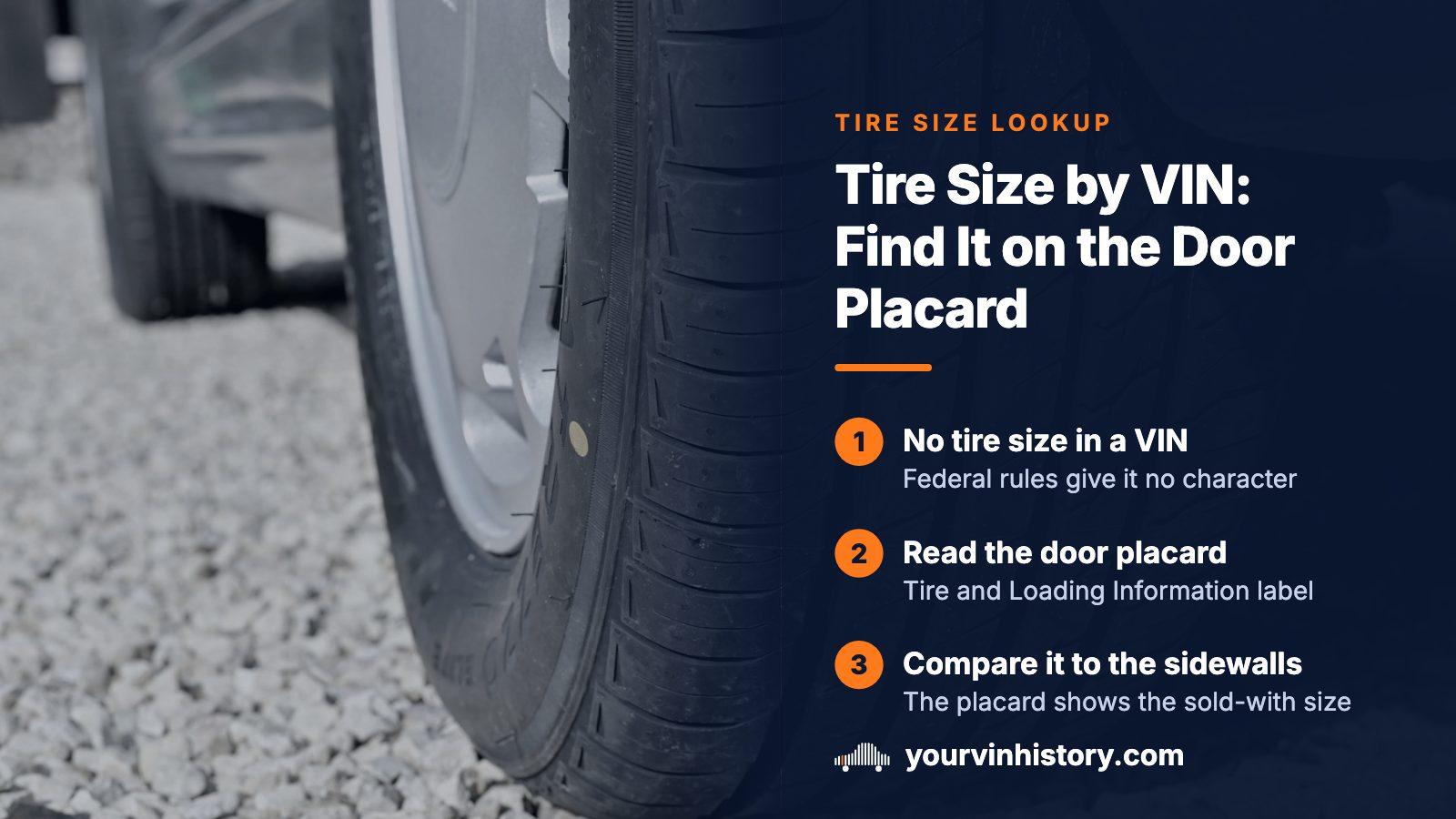
A VIN cannot give you a tire size, because the federal VIN rules assign no character to tires. Read the size from the Tire and Loading Information placard, usually on the driver's door pillar. It lists the size the vehicle was sold with, so compare it with the sidewalls of the tires on the car now. Retail sites that accept a VIN match the car to a separate fitment catalog.
- In the VIN?
- No tire size field exists
- Placard heading
- Tire and Loading Information
- First place to look
- Driver's side door pillar
- Tire age
- Last four digits of the DOT code
What seventeen characters say about a car, and what they skip
The federal VIN rule spells out which attributes the middle characters must make decipherable, and the list varies by vehicle type. A passenger car's list covers make, line, series, body style, engine and restraints. A truck's list swaps body style for chassis and cab type, and adds brakes and the weight rating. No list mentions tires, so no position in the number is set aside for them.
NHTSA's public decoder, vPIC, shows the same gap. Its wheel-related fields are front and rear wheel size, a wheel count and the kind of tire pressure monitoring system. A size designation such as 225/65R17 is not among them, since nothing in the number holds it.
A tire shop's website that asks for your VIN does something else. It identifies the vehicle, then checks it against a separate fitment catalog. That is a reasonable method, but it is a second lookup in someone else's data.
The placard federal law puts on the car
Tire selection falls under Federal Motor Vehicle Safety Standard No. 110, at 49 CFR 571.110. The placard requirement covers anything with a gross vehicle weight rating up to 10,000 pounds (4,536 kilograms), apart from motorcycles. Trailers and incomplete vehicles fall outside it.
The regulation fixes the heading: Tire and Loading Information. Makers cannot reword it, so the same three words mark the right label on a pickup, a hatchback or a minivan. A door sticker without that heading is something else, such as the certification label covered below. The placard is meant to be permanently affixed, so ask the seller if it is gone.
Four places to look, in the order the rule sets
The standard names one preferred spot and three fallbacks, and each fallback applies only when the one before it cannot work.
- Driver's side B-pillar, the post between the front and rear doors. Open the driver's door and look here first.
- Front edge of the rear door on that side, for cars with no B-pillar where the two doors open in opposite directions.
- Back edge of the driver's door, when neither earlier spot gives room for a label that is legible, visible and prominent.
- A surface beside the driver's seat that faces inward, the final option.
That order keeps the search short. An empty pillar does not mean a hidden label; on some cars the rule sends the placard elsewhere.
What else the placard prints beside the size
Tire size is one entry on a short list, and the rest describes what the vehicle can safely carry. Reading it while you stand at the door costs nothing.
| Entry | What it shows |
|---|---|
| Capacity weight | The most that occupants and cargo together should weigh |
| Seated capacity | Total occupants, plus how many fit in the front and rear seats |
| Cold inflation pressure | The maker's recommended figures for front, rear and spare tires |
| Tire size | Appears under one of three labels: size, original tire size or original size; the spare gets its own line |
| Owner's manual line | A pointer to the manual for further information |
Look at how the size line is defined. It covers the tires fitted at first purchase for purposes other than resale, so it records how the vehicle left the dealer, not necessarily what is on it today. Makers may add a load range, load index and speed rating, but are not required to.
Reading a code like 225/65R17
A designation such as 225/65R17 splits into four parts. The 225 is the section width in millimeters. The 65 is the aspect ratio, sidewall height expressed as a share of that width. R marks radial construction, and the 17 is the wheel diameter in inches.
A letter ahead of the width matters too. P stands for passenger tire and LT for light truck tire, and their load ratings are worked out differently. The load index and speed rating after the size describe the tire, so look for them on the sidewall, not the door. Copy the whole string, prefix included, because P225/65R17 and LT225/65R17 are different tires.
Why wheel diameter alone leads to the wrong tire
A decode may report 17-inch wheels. That omits the two figures that actually settle fitment, width and aspect ratio. Cars on identical 17-inch wheels can take different tires depending on trim, drivetrain and factory package, and a tire picked by diameter alone may rub at full lock or sit oddly in the wheel arch.
Some performance and luxury cars run different sizes front and rear, so any single quoted size is wrong for one axle. The placard is where both figures should appear.
If you want the build confirmed before you call a tire shop, a yourvinhistory report includes factory specs for the VIN, and you see a preview first. The door label still supplies the size itself.
The certification label and its axle ratings
A second federal label, the certification label defined in 49 CFR 567.4, shows the manufacturer, build month and year, gross vehicle weight rating, a gross axle weight rating for each axle, the VIN and the vehicle type.
Tire size is not a separate required line, yet it appears beside the axle ratings in two situations. Consecutive axles with identical ratings may be combined into one value, and the label then names the tire size. A passenger car offered with optional tire sizes may print more than one set of ratings, each tagged with the size it applies to.
That makes the label a cross-check on trucks and vans. If it names a size different from the placard, find out which combination the vehicle was built with before ordering tires.
When the tires on the car disagree with the placard
A mismatch on a used vehicle is common and not alarming by itself, since tires get replaced over a car's life. The catch is that the placard pressures are the maker's figures for the original size, so a changed size may need different numbers.
- Compare the four sidewalls with each other before comparing any of them to the placard.
- Different sizes on one axle deserve a direct answer from the seller, and sometimes a walk away.
- A taller overall tire changes what the speedometer and odometer report.
- Passenger tires on a truck that left the factory on light truck tires reduce the load margin.
- Check the spare separately, since it is often the original size and very old.
- If the seller chose a new size on purpose, ask why.
Tire age: reading the date code in the DOT number
Tires carry an identifier of their own, separate from the VIN and the placard. Under 49 CFR 574.5, a new tire has a 13-symbol Tire Identification Number molded into one sidewall. Its last group is the date code: two digits for the week of manufacture, then two for the year.
The regulation's own example is 0109, meaning the first full calendar week of 2009. Weeks run Sunday through Saturday, so that one began on Sunday, January 4 and ended on Saturday, January 10. A year's final week may borrow up to six days from the next.
Only one sidewall must carry the full number, so it can face inward. If one side shows nothing, check the other. Retreads carry a shorter 7-symbol number and are marked with the letter R, which signals a retread rather than damage.
A manufacture date, not a deadline
The federal rule requires the date to be stated and sets no retirement age. Tire and vehicle makers publish their own replacement guidance, so use the code to see how old the rubber is, then read what the maker advises.
Treadwear, traction and temperature: the grades beside the size
New passenger car tires also carry quality grades under 49 CFR 575.104, meant to help buyers compare. They are molded on the sidewall between the shoulder and the widest point.
| Word on the sidewall | What the grade says |
|---|---|
| TREADWEAR | A percentage of a government nominal value, in multiples of 20, such as 80, 120 or 160 |
| TRACTION | AA, A, B or C, where C means an adjusted coefficient of 0.38 or lower on the test asphalt, or 0.26 or lower on the test concrete |
| TEMPERATURE | A, B or C, based on how far the tire gets through laboratory test stages without separation, chunking or cracking |
People misread the treadwear figure most, because it reads like a mileage guarantee. It is measured on a government test course and corrected against monitoring tires driven alongside. A 400 means the tire projected to four times the government baseline over that course: a comparison, not a distance anyone owes you.
A five-step routine for the driveway
Put together, the whole check takes a few minutes and needs nothing but daylight.
- Open the driver's door and read the pillar label headed Tire and Loading Information.
- If the pillar is bare, work through the other three spots listed earlier.
- Read the size on each tire, and find the date code on at least one side of every tire, spare included.
- On a truck or van, read the certification label for axle ratings and any tire size printed with them.
- Run the VIN through NHTSA's decoder for model year, body and wheel size, then settle any gap between label and rubber before paying.
Where this information comes from
- GovInfo: 49 CFR 571.110, tire selection and rims — Sets which vehicles need the placard, what it must print and the four permitted locations.
- GovInfo: 49 CFR 567.4, certification label — Lists what the certification label shows and how tire sizes can appear beside the axle ratings.
- eCFR: 49 CFR Part 574, tire identification — Defines the identification number, the week and year date code and the retread marking.
- eCFR: 49 CFR 575.104, tire quality grading — Explains the treadwear, traction and temperature grades and the tires left out of the rule.
- NHTSA: vPIC VIN decoder — The public decoder, whose wheel fields stop at wheel size and have no tire size entry.
Sources and photos: Facts checked against the sources above in October 2026. Photo by Benjamin Brunner on Unsplash; diagrams by YourVINHistory.
Keep reading
- Bolt pattern by VINTire size is one fitment point; the wheel's bolt pattern is the next one to match.
- Tire recall checkOnce you have the size and date code, see how to look up a recall on a tire.
- Window sticker by VINThe original sticker can itemize the wheel and tire package the car was built with.
- Towing capacity by VINWeight ratings sit on the same labels as tire information, and they limit what you can tow.
Frequently asked questions
Can a VIN tell me what tires my car takes?
Only indirectly. No character in the VIN stands for tires, but some sites identify the car from the number and return a size from a fitment database, and the answer is only as good as that database. For a car you can walk up to, the door label and the sidewalls are quicker and more direct.
What if the door placard is missing or unreadable?
Begin with the size molded on the sidewalls, which shows what is fitted now. Then read the certification label, which may print a tire size beside the axle ratings. A retailer's fitment lookup can fill in the original specification, but treat it as a catalog match and confirm it against the tires.
How can I check how old a tire is?
Find the DOT number on the sidewall and read its last four digits, week first and year second. A code of 0109 would mean the first full calendar week of 2009. If the number is missing on the side you can see, check the inner side, since the rule asks for it on only one. It is a build date, not a retirement date.
Why does my tire show no treadwear, traction or temperature grades?
The grading rule skips deep tread and winter-type snow tires, space-saver and temporary spares, tires with a nominal rim diameter of 12 inches or less, and limited production tires, meaning small runs of up to 15,000 a year of one design and size, among other conditions. It also covers passenger car tires only.
What does none or see above mean on the placard's spare line?
The rule lets a maker write see above when a full-size spare matches the other tires. The word none replaces the size and pressure when the vehicle came without a spare. If the line says none on a car you were told had a spare, ask the seller.
Now check the car itself
The guide explains what to look for. The report shows what this VIN has on record.