THE SHORT ANSWER
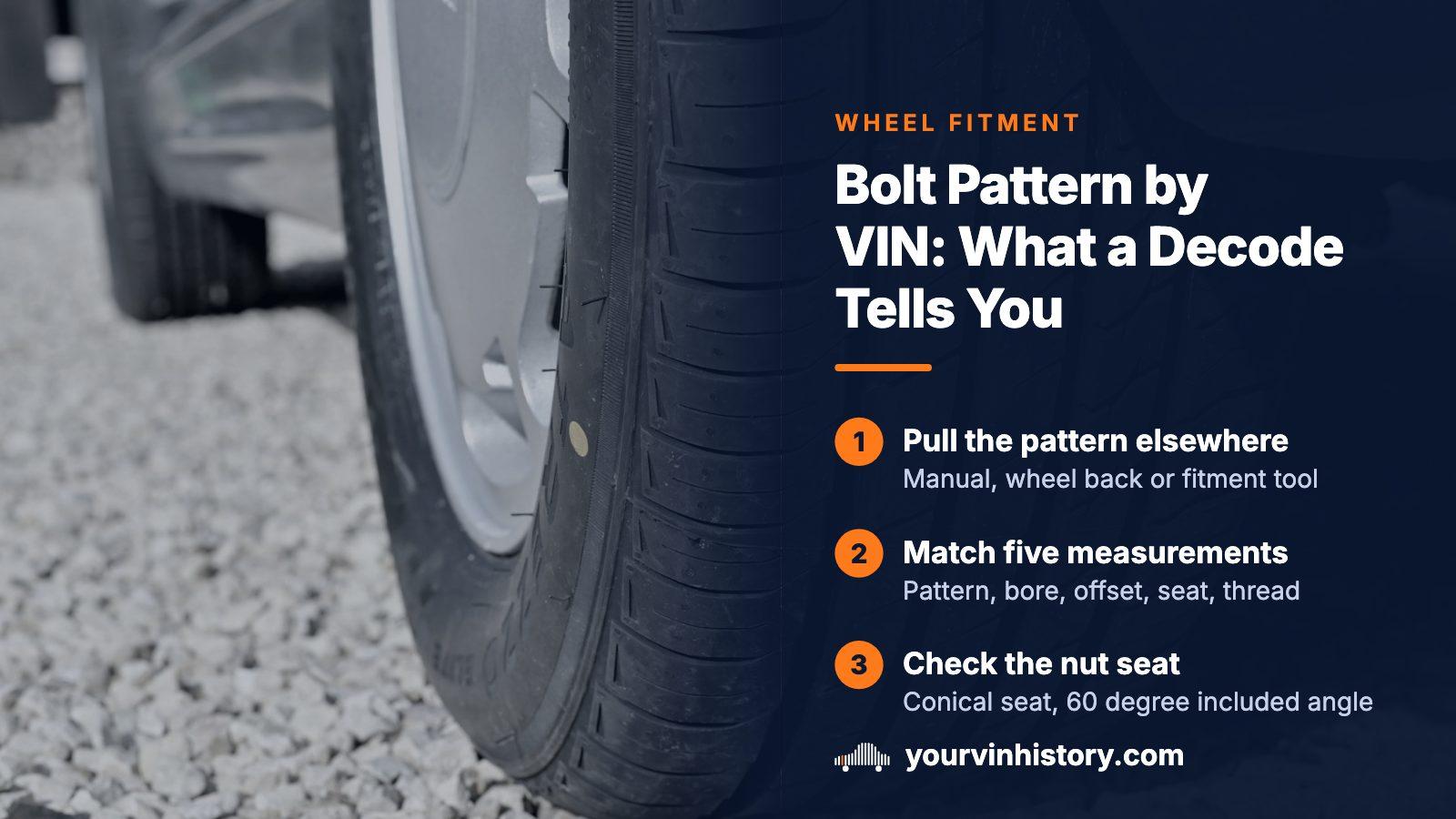
A VIN does not print a bolt pattern. It gives you the exact model, engine and usually the trim, and you carry that to the owner's manual, the back of the wheel, or a retailer's fitment tool to read the number. Then compare five things: pattern, bore, offset, how the nut seats, and thread. Only the pattern stops a wheel from mounting, so the other four can be wrong on a wheel that still goes on.
- Pattern in the VIN
- None, only the build behind it
- Wheel measurements
- Five must match, not one
- Weight carried by
- The hub, not the studs
- Typical conical seat
- 60 degree included angle
What a VIN decode holds, and the wheel data it leaves out
Run a VIN through the federal decoder and you get a build record covering make, model, year, body class, engine, fuel type and often the trim. Look through it for a bolt pattern and you will not find one. There is no field for center bore, offset or lug seat type either.
That sounds like a dead end, but the build record does the harder half of the job. Wheel specifications belong to a particular configuration, so once you know exactly which one you own, finding the pattern means reading a chart instead of guessing from the badge on the trunk lid. The VIN is the key to the lookup, not the answer.
Why the trim matters more than the model name
Two cars with the same name and model year can leave the factory on different wheel hardware. A bigger brake package or a sport trim can shift the offset and, now and then, the bore, even when the lug count and spacing look identical on paper.
So settle the trim before you search. Where a retailer's fitment tool accepts a VIN, give it the VIN instead of picking whichever trim name looks closest. If the decode leaves the trim blank, ask a wheel shop to check the car in person. The factory specifications in a vehicle history report can also help confirm which build you have, though they are no substitute for a wheel lookup.
Where the real figures come from, ranked by reliability
Once the build is pinned down, these are the places to read the numbers, most trustworthy first.
- The owner's manual, which states the factory wheel specification for the car as built.
- The wheel already on the car, since pattern, offset and bore are often cast or stamped into its back face.
- A wheel retailer's fitment tool, fed the exact trim or the VIN. These tend to be dependable when the trim is right.
- A tire or wheel shop that holds the part against your actual car. Only this route checks clearance and seat type on the vehicle itself.
- The maker's data sheet for the specific wheel you are considering, checking its bore and whether hub rings come with it, since a marketplace blurb may skip both.
Reading a pattern label such as 5x114.3
The label packs in two facts. The first number counts the lug holes. The second is the width, in millimeters, of the circle running through the center of every hole, called the pitch circle diameter. Some sellers write that second figure in inches, so one pattern can appear under two spellings.
| Written as | Reads as |
|---|---|
| 5x114.3 | Five holes on a circle 114.3 mm across |
| 5x4.5 | The same pattern, with the circle written in inches |
Skip the tape measure on a five-lug wheel. With an odd count, no hole sits straight across from another, so you cannot measure center to center, and an eyeballed estimate drifts. Use the published number. Patterns that are nearly equal are still different patterns, and a wheel that only almost fits is giving you a warning, not showing tolerance.
Five measurements that have to agree
Pattern gets the attention because it is one number you can type into a search box. Four more figures decide whether a wheel is right for the car, and only the first of the five prevents installation when it is wrong.
| Measurement | What it decides |
|---|---|
| Bolt pattern | Whether the wheel reaches the studs at all |
| Center bore | Whether the wheel rests on the hub, which bears the load on hub-centric cars |
| Offset | Position in the arch: clearance, steering feel and bearing load |
| Seat type | Whether the nuts or bolts can clamp the wheel |
| Thread pitch and length | Whether the thread engages cleanly and deeply enough to clamp |
A wheel can be wrong on any of the last four and still slide on, take the nuts and reach the specified torque.
The hub carries the car and the studs only clamp
Most modern passenger cars are hub-centric. A machined lip on the hub fits into a hole in the back of the wheel, which keeps the wheel concentric with the axle and puts the vehicle's weight onto the hub. The nuts or bolts then pull the wheel tight against the hub face. They were not designed to center it or to hold up the car.
Aftermarket wheels often arrive with an oversized center hole so one casting can fit many vehicles. A hub-centric ring fills the gap and restores the centering, a normal arrangement when the correct rings are fitted. When they are missing, the studs end up positioning the wheel. Patent descriptions of wheel nut hardware spell out the result: a nut that sits off-center can bend or overstress the stud, and the poor location leads to imbalance and stress cracking in the wheel.
Seat type, the check almost nobody makes
Each lug hole is machined to one of a few shapes, and the nut or bolt must carry the matching shape. A conical seat is tapered, with a typical included angle of 60 degrees. A ball or radius seat is rounded. A flat seat uses a washer against a flat face.
Mix them and the contact shrinks to a thin ring where a mated surface should be. The nut still turns and still reaches its torque reading, yet the clamping load lands in the wrong spot and the joint can loosen as that small patch deforms. Nothing feels wrong while you tighten it.
- New wheels often need their own nuts or bolts, so the ones from the old set may not suit.
- Match the seat type first, then the thread pitch, then the length.
- A nut that spins on freely but seats oddly, or sits proud of the wheel, is a reason to stop and ask.
Offset moves the wheel, and the load moves with it
Offset gets sold as a styling choice, but it is a mechanical one. It is the distance, in millimeters, between the wheel's mounting face and its centerline, often marked ET. A higher figure draws the wheel inboard, while a lower or negative one pushes it out toward the fender.
Two things follow. The first is clearance against the strut, the brake caliper, the inner fender liner at full steering lock and the lip of the arch over bumps. The second is lever action on the hub and bearing: a large departure from the factory number loads them in ways they were never designed for.
Thread pitch, thread engagement and pressure sensors
Pitch is the thread's diameter and spacing, with typical labels such as M12x1.5 and M14x1.25. Put a wrong-pitch nut on a stud and it may seem to thread while it quietly wrecks both parts. Engagement is a separate question: how much thread is in contact once the nut is home. Add a thicker wheel or a spacer but keep the old studs and nuts, and contact shrinks, taking the clamping force with it.
One practical item belongs here too. If the car has tire pressure monitoring, each wheel holds its own sensor, so a second set needs sensors, and on many cars they must be matched to the vehicle. Otherwise expect a warning lamp that stays lit however much air you add.
Looking at a used car that wears aftermarket wheels
Aftermarket wheels are not a defect. Plenty are specified correctly and fitted well. They do raise questions a factory-wheeled car never does.
- Are the original wheels included? A missing set can be a bargaining point, and sometimes a story.
- Do the nuts look like one matched set or a mixed handful?
- Where the wheel bore is oversized, are hub-centric rings present?
- Does the seller put any vibration at speed down to balancing?
- On the test drive, do the wheels rub the arches at full lock or over a bump?
A vibration already explained away
A confident explanation for a shake at highway speed deserves more suspicion than the shake. Ask a shop to look at how the wheels seat before you accept that the car just needs balancing. Wheels also reveal nothing about the car's past; accident records, title brands and odometer readings come from a history report run on the VIN.
Why a wrong fit stays hidden until later
A mismatched wheel almost never fails in the shop. It drives home. The consequence turns up weeks or months afterward as a vibration blamed on balancing, nuts that were tight and no longer are, or damaged studs. The shortcut carries no penalty on the day, so the check has to come before the work.
The routine is short. Decode the VIN to learn the precise model, engine and trim, then take those to the manual or a retailer for the factory figures. Compare all five measurements, and confirm the seat type against the hardware you plan to use. Fit the wheels, torque them, then re-torque after a short distance, as is standard after any wheel change. While the VIN is handy, run it through NHTSA's recall lookup, a no-cost tool, to see whether any recall is open.
Where this information comes from
- Discount Tire: hub-centric vs lug-centric wheels — Explains the two ways a wheel can be centered and which part does the centering in each.
- US Patent 5,711,581: wheel opening inserts and lug nut assemblies — Technical background on what happens when a lug nut sits out of concentric position, including stud stress and wheel cracking.
- US Patent 5,056,870: wheel nut assembly — Describes tapered nut seats, including the 60 degree included angle typical of conical designs.
- NHTSA: recalls — The federal lookup for open safety recalls by VIN, worth running while you have the number handy.
Sources and photos: Facts checked against the sources above in October 2026. Photo by Andres Siimon on Unsplash; diagrams by YourVINHistory.
Keep reading
- Tire size by VINThe tire that goes on the wheel has its own placard and rules.
- Trim level by VINTrim is the detail that changes wheel fitment within one model year.
- Parts by VINSee why parts catalogs want all seventeen characters before they answer.
- Used car red flagsA vibration the seller already explained away is one of the flags to weigh.
Frequently asked questions
Does a VIN tell me my bolt pattern?
Not directly. The decoder returns model, engine and often trim, with no field for pattern, bore, offset or seat type. Use that build information to read the pattern from the owner's manual, the back of a wheel already on the car, or a retailer's fitment tool, then treat the figure as one of five to match.
What does 5x114.3 mean on a wheel?
It means five lug holes on a circle 114.3 millimeters across. Read the first number as the stud count and the second as the circle's diameter. Inch listings write the same pattern as 5x4.5. A shared label only proves the wheel can reach the studs, so the bore, offset and seat still need checking before you buy.
Do I need hub-centric rings?
If a wheel's center bore is larger than your hub, something has to locate it concentrically, and the rings do that job. Without them the studs end up positioning the wheel, which they were not built for, and the usual signs are vibration and stress on the studs. What matters is that correct rings are actually installed, not just included in the box.
Will my current lug nuts work on a new set of wheels?
Only when the seat type matches the new wheel. Tapered, rounded and flat-with-washer seats are different shapes, and a mismatched nut will not clamp properly however tight it feels. Thread pitch has to agree too, and a thicker wheel may call for longer nuts so enough thread stays engaged.
If a wheel bolts on and reaches torque, is it safe?
Not necessarily. Reaching torque shows that the pattern and thread allowed installation, nothing more. A wrong bore, seat or offset can still be present and show itself later as vibration or loosening. If you are unsure, have a shop inspect how the wheel seats, and re-torque after a short distance.
Now check the car itself
The guide explains what to look for. The report shows what this VIN has on record.