THE SHORT ANSWER
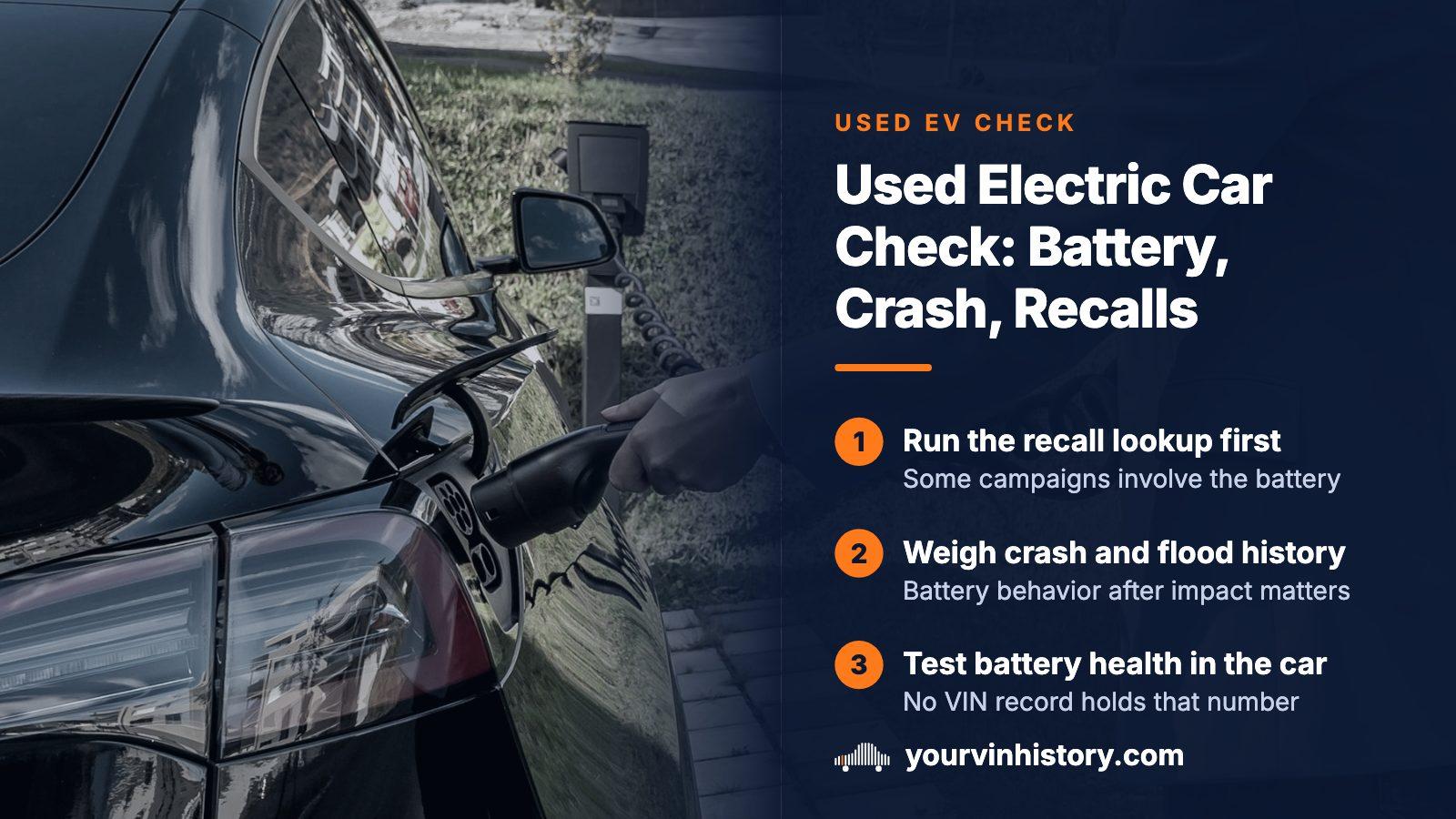
Run the VIN through NHTSA's recall lookup first, since it costs nothing and some EV campaigns involve the high-voltage battery. Then give accident and flood history extra weight, because the electric-vehicle crash standard, FMVSS 305, is about battery behavior after impact. Finally, have the battery's state of health read from the car itself. No VIN decode, report or federal database holds that number.
- Crash standard
- FMVSS 305, built around battery behavior after impact
- Spillage limit
- 5.0 L outside the cabin, timed for 30 minutes
- Isolation floor
- 500 ohms/volt AC or 100 ohms/volt DC, one of three routes
- Battery health
- Not in any VIN record; read it from the car
What actually changes when the car is electric
Tires, brakes, suspension, bodywork, title brands and odometer questions work the way they do on any used car, so those checks stay on your list. The new element is a big, expensive pack that the vehicle is designed around. It holds a lot of energy, and neither your eyes nor a test drive will reveal its condition. Mileage tells you little about it.
So the changes are in emphasis, not in kind. Crash history moves up, a live battery reading becomes close to mandatory, and the recall lookup counts for more. The sections below cover each, with the federal rule behind it where one exists.
The federal crash standard that only electric vehicles face
Federal Motor Vehicle Safety Standard 305, printed at 49 CFR 571.305, covers electric-powered vehicles and has no counterpart for gasoline cars. Its scope is notable for what it omits. Range, charging speed and pack longevity are absent. What it limits is electrolyte spillage, what it requires is that energy storage devices stay put, and what it protects against is electric shock, all during and after a crash.
Compliance is judged with barrier impacts followed by a static rollover, and the pass criteria apply to a vehicle design under controlled conditions. Nothing in the text speaks to one particular car that was hit, repaired and resold. Read it as a map of what can go wrong with a pack in a collision, and so as a guide to what to ask when the car you are considering has a past.
Five liters outside, nothing inside, and a half-hour clock
The spillage rule caps the electrolyte that may escape from propulsion batteries at 5.0 liters outside the passenger compartment, and it allows no visible trace inside the cabin. Measurement begins when the car stops moving after the barrier impact, runs for 30 minutes, and continues through any static rollover that follows.
For a buyer, that becomes a question about enclosures and seals. A pack that has been opened, moved or replaced after a collision is no longer exactly the assembly that passed. That is no reason to refuse every repaired EV, only a reason to ask for the repair order and the name of the shop.
Mounting hardware and underbody: what you can see in daylight
The retention requirement has two halves. An energy storage device must stay joined to the vehicle through at least one anchorage, bracket or structure that passes load into the body, and a device mounted outside the occupant compartment must not enter it. The wording sets a floor: the pack stays put. It does not promise that every mount comes through undamaged. Check the following in daylight.
- Look at the pack enclosure and at every point where it bolts to the body.
- Ask whether any underbody shield or skid plate has been removed, replaced or swapped for something improvised.
- Gouges or scrape marks on the pack casing need a specialist's opinion, not a shrug.
- Expect an explanation for missing, mismatched or corroded fasteners.
Electrical isolation: the measurement to request after a collision
The shock-protection requirement gives manufacturers three ways to comply. After each test, every high voltage source must satisfy at least one of them.
| Route | What it asks for |
|---|---|
| Electrical isolation | 500 ohms per volt or more where the source is AC, and 100 or more where it is DC |
| Voltage level | Measured voltages that stay within the limits the standard sets |
| Physical barrier | Barriers that meet the standard's protection requirements, so live parts cannot be touched |
Isolation describes how well the high voltage system stays electrically separate from the car's body. Of everything above, it is the item a technician can actually measure on a used vehicle. If an EV you like has any crash history, ask for an isolation reading by name, because a routine pre-purchase inspection does not include one unless someone asks.
Why crash and water history weigh more on an EV
If the electric-only standard centers on impacts, the record most worth your attention is what has happened to the car structurally. The usual limits still apply: a clean report proves little about moderate damage, since plenty of repairs paid for out of pocket never reach a database. What shifts is the stakes. On an EV, an undocumented repair also raises a question about a battery enclosure that may have been opened, moved or swapped.
A vehicle history report from yourvinhistory.com lists accidents with a damage map, title brands, salvage and auction records with photos, and open recalls. It cannot read the pack.
Two neighbors of the accident check deserve a run for the same reason. Water and high voltage mix badly, and flood damage often leaves no title brand at all. And a salvage-type brand means an insurer once judged the repair not worth paying for.
What the decoder tells you, and where the battery reading comes from
NHTSA's vPIC decoder has fields that gasoline cars leave blank, among them electrification level, battery type, battery kWh and charger power. The decoder's page notes that manufacturers report the data, and the battery fields show the effect: some makers fill them in, others leave them empty.
The electrification level is the dependable part. It settles whether a vague listing means a plug-in hybrid or a full battery-electric car. When a kWh figure does appear, it is the pack's design capacity from the factory, a specification and not a measurement of what the battery holds today.
No federal field for battery condition
Present capacity, degradation and state of health are not recorded in any federal field, and no VIN service has them either. That figure sits in software inside the car and drifts as the pack ages and gets used. A range quoted from a spec sheet describes the car on its first day.
Because no record holds the number, the only route is a diagnostic read taken from the car. Have a technician or a shop that handles that model do it while you watch. A seller's screenshot proves little, since it could come from another day, another car or another app. Ask that the result be tied to this car's VIN and today's date wherever the tool allows.
The ten-year, 120,000-mile figure is not a battery warranty
One federal number gets quoted as if it were a battery lifespan. The rule at 40 CFR 86.1805-17, headed Useful life, says that for the greenhouse gas standards the span is 10 years or 120,000 miles, whichever limit arrives first, and it covers light-duty vehicles and the lightest class of light-duty trucks.
That is the period over which a vehicle's emission standards are held to account. Nobody guarantees anything under it: it is no warranty, no manufacturer pledge and no forecast for a given battery. An EV past 10 years or beyond 120,000 miles has not expired. It has gone past the span the rule was written around.
Battery warranties come from the maker, and terms differ by make, model year and sometimes state, so read the statement for the exact car.
Battery recalls: the lookup, the remedy and the interim advice
The recall lookup is the one check that costs nothing and can change the deal. Some electric vehicle campaigns have involved the high-voltage battery, with remedies ranging from a software cap on charge level to replacing the pack.
- Run the VIN before driving out. A battery campaign that is still open should change the price you accept.
- Ask whether a completed recall was fixed with software or with new parts. A pack that was swapped on an older car may even help you.
- Read any interim advice, such as charge limits or parking guidance. It becomes your problem the day you buy.
- Settle who pays and when. Whether the remedy costs you anything depends on the campaign terms and the vehicle's age, and very old vehicles can fall outside the federal rule that puts repair costs on the manufacturer. Get the dealer's answer in writing.
Pricing a replacement pack without leaning on an average
The search most buyers make is what a new battery costs. A single figure here would be a guess dressed up with a citation, so none is printed. Prices vary with make, model year, pack size, module versus whole-pack repair, whether remanufactured units are sold, and labor rates. No federal source publishes a number you could recheck.
To price the risk on one car, put three questions to a franchised dealer: the part number and price of that model year's pack, whether modules can be repaired singly, and what a remanufactured pack costs if one exists. Written quotes keep the answers comparable.
A viewing-day checklist for a used EV
- VIN run through NHTSA's recall lookup before you travel, with interim advice read in full
- Accident, flood and title history reviewed with extra weight
- Pack enclosure, mounting hardware and underbody shielding inspected in daylight
- Battery state of health read from the car by a technician and tied to this VIN
- Isolation reading requested if there is any crash history
- A charging session observed at a public charger you did not bring
- The ordinary checks too: liens, odometer reading, tires and brakes
- The 12-volt battery tested, since it is separate from the traction pack and can strand an EV when it fails
Where this information comes from
- 49 CFR 571.305: FMVSS 305, electric-powered vehicles — The text behind the spillage cap, the retention rule and the three shock-protection routes discussed above.
- 40 CFR 86.1805-17: Useful life — Where the 10-year, 120,000-mile period for greenhouse gas standards comes from, and the whichever-comes-first wording.
- NHTSA: Recalls — The federal lookup for open recall campaigns by VIN.
- NHTSA: vPIC VIN decoder — The federal decoder, which notes that its data is reported by manufacturers.
Sources and photos: Facts checked against the sources above in October 2026. Photo by smart-me AG on Unsplash; diagrams by YourVINHistory.
Keep reading
- VIN accident checkShows which crashes reach a record and which never do, the gap that matters most on an EV.
- Flood-damaged carsCovers why water damage can leave a clean title, a worry with any high voltage system.
- Recall check by VINExplains why a search by VIN and a search by model answer different questions.
- Pre-purchase inspectionLays out what a shop visit covers, so you know which EV items to add to it.
Frequently asked questions
What should I check first on a used electric car?
Start with the VIN, before you travel. Run it through NHTSA's recall lookup, then pull accident, flood and title history. Only then is it worth paying a specialist to read the battery and inspect the underbody, since those visits cost real money.
Can a VIN check show the health of an EV battery?
No. A VIN decode or history report returns build details, records and recalls, none of which measure the pack's present capacity. If a site claims a health score from a VIN alone, treat it as an estimate. The real figure comes from a diagnostic tool connected to the car.
Can I safely buy a used EV with crash damage in its past?
It can be, but only if the repair is documented and inspected. Ask for the shop's repair order, a close look at the pack enclosure and mounts, and an isolation reading from a technician who works on that model. The federal standard cannot tell you how a given repaired car will behave, so the paperwork and the inspection have to.
How long does an electric car battery last?
No federal source gives a lifespan, and anyone quoting a precise one is guessing. It depends on the individual car's age, use and charging history. The 10 years or 120,000 miles in the EPA rule is a period for emission standards, not a prediction.
Does a used electric car still have a battery warranty?
Possibly, but it depends on the make, model year and the terms printed in the warranty statement, so check the statement for the exact car. Ask the seller or a franchised dealer whether a past collision or an outside repair could affect coverage. Get the answers in writing before you pay a deposit.
Now check the car itself
The guide explains what to look for. The report shows what this VIN has on record.