THE SHORT ANSWER
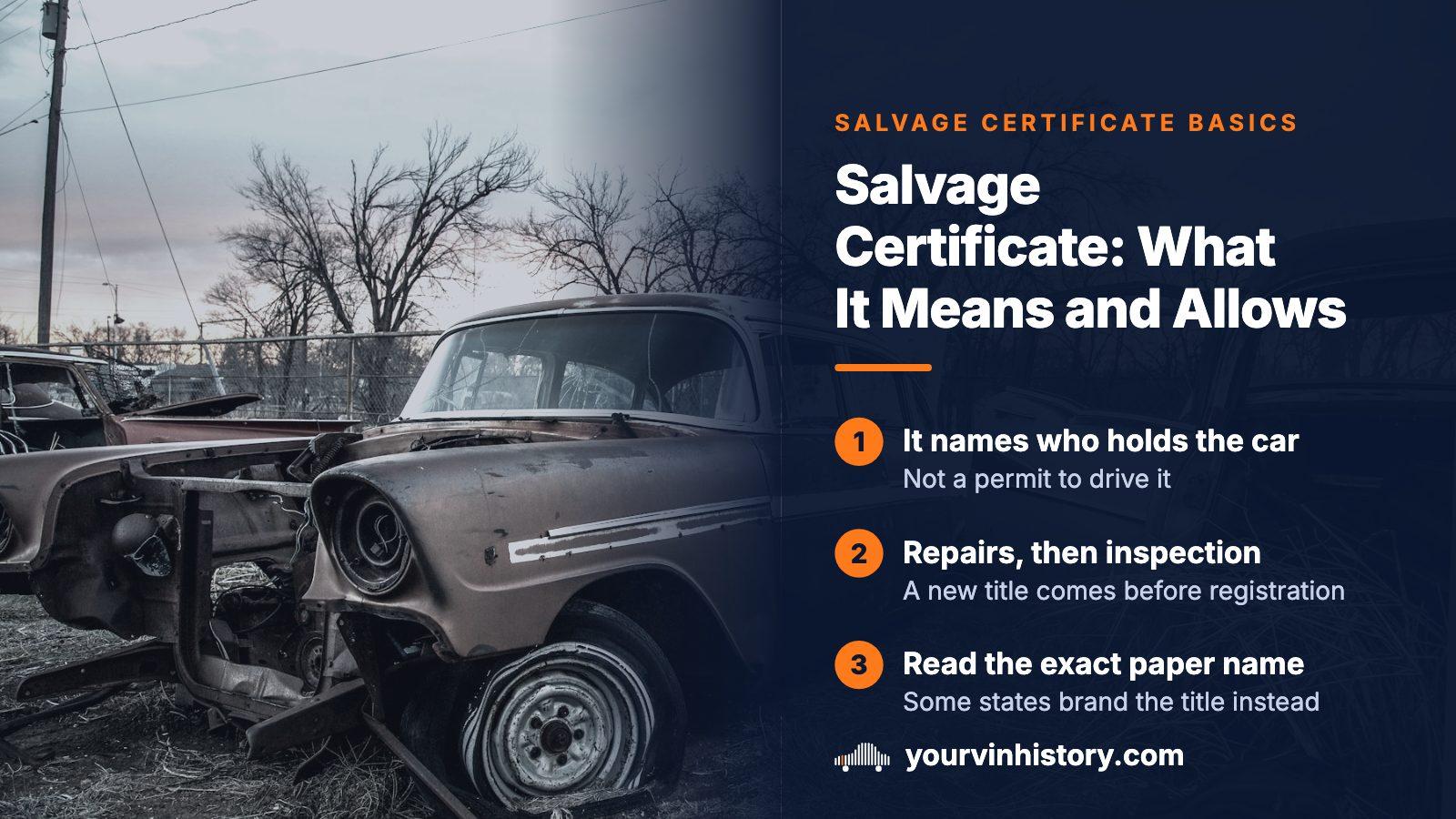
A salvage certificate is a state-issued record that a damaged or totaled vehicle belongs to a named holder. It is an ownership document for a car that is not yet fit for the road. Registration normally requires repairs, a state inspection and a new title, and vehicles marked non-repairable never get that chance. Some states skip the certificate and brand the title directly, so read the exact name on your paper.
- What it proves
- Who holds the vehicle, not that it may be driven
- State feed to NMVTIS
- Every 24 hours, brands included
- Insurer reporting window
- Current model year plus the four before it
- Deleting a report
- Federal rule bars removing a prior junk or salvage report
A record of who holds the car, not a license to drive it
Think of a salvage certificate as a custody receipt. Once a collision, fire, flood or insurance decision pulls a vehicle out of the pool of ordinary titled cars, the state needs a way to say who holds the wreck. The certificate is that statement, and it keeps ownership traceable while the vehicle is not a road vehicle in the state's eyes.
What it does not do is permit anything on public streets. Registration, plates and road insurance generally wait for a later step, and whether that step exists depends on the state and the exact document. The word salvage gets stuck on paper that leads back to the road and on paper that ends the car as a vehicle.
Four documents that all get called salvage
People use salvage as a catch-all, but states do not. Depending on where the damage happened, the paperwork takes one of these shapes.
| Document | What it records | Road future |
|---|---|---|
| Salvage certificate | Ownership of a damaged or totaled vehicle, issued as its own paper | Usually repair, inspection, then a new title, where the state offers that path |
| Title with a salvage brand | The same facts, printed on the title with no separate certificate | Usually the same repair and inspection route |
| Non-repairable certificate or title | A vehicle that is parts or scrap only | None; it may not be rebuilt for the road |
| Certificate of destruction | A vehicle that is finished as a vehicle | None in the states that use it |
A seller who says only that a car is salvage has named the category and skipped the part that decides what you can do with it. Ask for the name printed at the top of the paper.
Two states, two ways of papering the same wreck
California shows the certificate model. Its DMV can issue a salvage certificate when an insurer declares a total loss, and a separate non-repairable vehicle certificate for a car that is only parts or scrap. When an insurance settlement is involved the insurer applies; otherwise the owner does. A car given the non-repairable certificate cannot later be titled or registered as a revived salvage vehicle.
Texas works from titles instead. A vehicle carrying any of the listed brands in the federal record counts as a salvage vehicle there, and it must be rebuilt and inspected before it returns to the road. Until then it qualifies only for a salvage title, a nonrepairable title or authority to dispose of it.
So a salvage certificate in one state and a salvage title in another can describe the same damaged car. Only your own state's motor vehicle agency can name its documents correctly.
Salvage, junk and total loss: three federal tests
State paper varies, but the categories beneath it come from the federal rules behind the national title system, 28 CFR Part 25, subpart B.
| Term | How the federal rule frames it |
|---|---|
| Salvage automobile | Damaged by a collision, fire, flood or similar event so that its salvage value plus the cost of making it legal to operate would exceed what it was worth just before the damage. A vehicle declared a total loss under state law, or by an insurer, also counts, even when the owner keeps it. |
| Junk automobile | Cannot operate on public roads and has no value except as parts or scrap. Both conditions must hold. |
| Total loss | Repair cost, plus projected supplements, projected loss of resale value and rental reimbursement, exceeds the car's pre-accident value less what the wreck would bring as salvage. |
The difference is one of kind. Salvage is a money comparison, so a salvage automobile may well be repairable. Junk is a statement of condition, so it describes something finished.
What you can and cannot do while the car sits on the certificate
The permissions are narrow but real.
- Own it, store it and transfer it. The point of the paper is to keep ownership traceable during the stretch when the car is off the road.
- Sell it to a rebuilder, a salvage yard or anyone who understands the paperwork. The certificate goes with the car.
- Dismantle it for parts. For some vehicles that is the whole plan.
- Generally not on that paper alone: register it, drive it on public roads or buy road insurance for it.
- Never by repair alone: a clean title. Fixing the damage does not remove the brand, because the loss stays attached to the VIN.
A running engine changes none of this; the state's record decides when the car can be registered.
The way back to the road, where a state allows one
- Identify the document and your state's rules for it. A repairable salvage paper and a non-repairable one look alike and end very differently.
- Repair the vehicle and keep receipts, especially for major components. Inspectors want to know where parts came from, and parts with no paper trail can sink the inspection.
- Pass the state inspection. It is mostly an identity check that the VIN is genuine and the parts are not stolen, rather than a grade on the quality of the repair.
- Receive a new title, usually branded rebuilt, reconstructed or similar. The car can be registered, and the brand stays on its record for good.
When there is no inspection to pass
A non-repairable certificate or certificate of destruction has no repair-and-inspect step. The vehicle is legally parts or scrap in that state. That case has its own guide because the consequences are absolute.
Checks to make before any money moves
Rebuilders buy these vehicles on purpose, and plenty of deals are honest. Trouble starts when buyer and seller picture different documents.
- Ask for the exact name of the paper and read it yourself. A description over the phone is not evidence.
- Check whose name it carries. If that is not the seller, the seller cannot pass ownership, and this is where most deals fall apart.
- Find out which state issued it. Making the car legal again follows that state's procedure, not a national one.
- Learn what damaged the car. Structural damage and water leave the most risk behind after a repair.
- Price the inspection and retitling in money and weeks, not just parts and labor.
- Look the VIN up in the federal record. NHTSA's recall page lists open recalls at no cost. A yourvinhistory report starts with a free preview and draws its title records from ClearVin LLC, an approved NMVTIS data provider, so a salvage brand should show up whichever state issued the paper.
Why a salvage record does not stay in the state that made it
Two federal rules keep the record moving. States must send titling information for every automobile they maintain to the national system once every 24 hours, VIN and brands included. And before a state issues a title for a vehicle bought from another state, or in a title transfer, it is supposed to run the VIN through NMVTIS and look for junk or salvage history.
| Who reports | What reaches the system | Where it can fall short |
|---|---|---|
| State titling agency | Titling data on every automobile it maintains, with VIN and brands, every 24 hours | Only as complete as the state's own records |
| Insurance carrier | Monthly list of vehicles it took possession of and judged junk or salvage, total losses included | Covers only the current model year and the four before it |
| Junk or salvage yard | Monthly inventory: VIN, date obtained, source, and whether crushed or passed on | Operators handling fewer than five such vehicles a year are excused |
The feeds overlap, so one party's slip rarely erases the record.
Where a clean result deserves less trust
The insurer stream has a window. A carrier reports vehicles of the current model year and the four before it, so a total loss on an older car may never arrive through that channel. That leaves the state titling feed, or a yard that takes the car in, to record it.
Yards have exemptions too. An operator that already reports to its state need not file twice, and a shredder handling cars whose VINs cannot be read is excused once the supplier has reported. Add the monthly schedule and a loss from the last few weeks may not be filed yet.
None of this makes the federal record weak. It means a clean result carries less weight on an older car than on a recent one, so back it up with the paper, the VIN on the vehicle itself and a hands-on inspection.
If the record is wrong, the fix is a paper trail, not an erasure
Sometimes a VIN is reported as junk or salvage by mistake and a vehicle is destroyed under it, leaving the owner of the legitimate car holding a record that says otherwise. The federal rule is blunt: the operator may not let anyone delete a prior report of junk or salvage status, a safeguard against fraud.
What the rule asks of that owner is documentation. Get an inspection in the state that holds the title, where officials can confirm the car's true identity from concealed VIN locations. File the report with that state and keep a copy, so the vehicle's real history can be shown.
Red flag
Anyone offering to scrub a salvage brand from a VIN is promising something the system is built to refuse.
Where this information comes from
- eCFR: 28 CFR Part 25, subpart B (NMVTIS) — Source for the salvage, junk and total-loss definitions, the 24-hour state feed, the insurer window, yard reporting and the ban on deleting reports.
- NMVTIS: National Motor Vehicle Title Information System — The Justice Department home for the federal title record that carries brands between states.
- NHTSA: Recalls lookup — No-cost open-recall search by VIN, worth running before anyone starts a rebuild.
- California DMV: Total loss salvage and non-repairable vehicles — Shows a state that issues a salvage certificate and a separate non-repairable certificate, and who applies.
- TxDMV: Salvage vehicles — Shows a state that works from salvage and nonrepairable titles and requires a rebuild and inspection before road use.
Sources and photos: Facts checked against the sources above in October 2026. Photo by Leo_Visions on Unsplash; diagrams by YourVINHistory.
Keep reading
- Certificate of destructionThe paper with no way back to the road, and what it means for the car.
- What is a rebuilt title?What the vehicle becomes after it passes inspection, and how that title behaves.
- Salvage title VIN checkThe order of steps for finding out what a VIN already has on file.
- Total loss threshold by stateWhy identical damage starts this whole sequence in one state and not another.
Frequently asked questions
Can you drive a car that has a salvage certificate?
Not on the certificate alone. It records ownership of a vehicle the state does not yet treat as road-ready, so registration, plates and road insurance generally wait until the repaired car passes inspection and receives a new title. For a non-repairable document that day never comes.
Who gets the certificate when an insurer totals my car?
That varies. In California the insurer applies after a settlement and the owner applies when there is none. Federally, a total loss counts as salvage even if the owner keeps the vehicle, so a totaled car the owner keeps is still a salvage automobile under the federal rules.
Does a salvage certificate turn into a rebuilt title?
No, they sit at opposite ends of the process. The certificate describes a vehicle awaiting repair. A rebuilt-type title is issued after repair and inspection and allows registration. Even then the salvage history stays on the VIN, so the next buyer of the finished car still sees it in the record.
Is the federal salvage record the same as the state certificate?
Not exactly. The federal record is fed by three reporters: the state, the insurer and the yard. The certificate is only the state's paper. The sources run on different schedules, so the two can disagree for a while, which is a reason to compare the paper in your hand against a fresh VIN search.
How can I tell whether a VIN has a salvage record?
Run it through an approved NMVTIS data provider; the Justice Department's NMVTIS site is the official starting point. Compare the result with the paper in front of you, since the brand, issuing state and dates should tell the same story. Then examine the car, because a record shows what was reported, not how well anything was repaired.
Now check the car itself
The guide explains what to look for. The report shows what this VIN has on record.