THE SHORT ANSWER
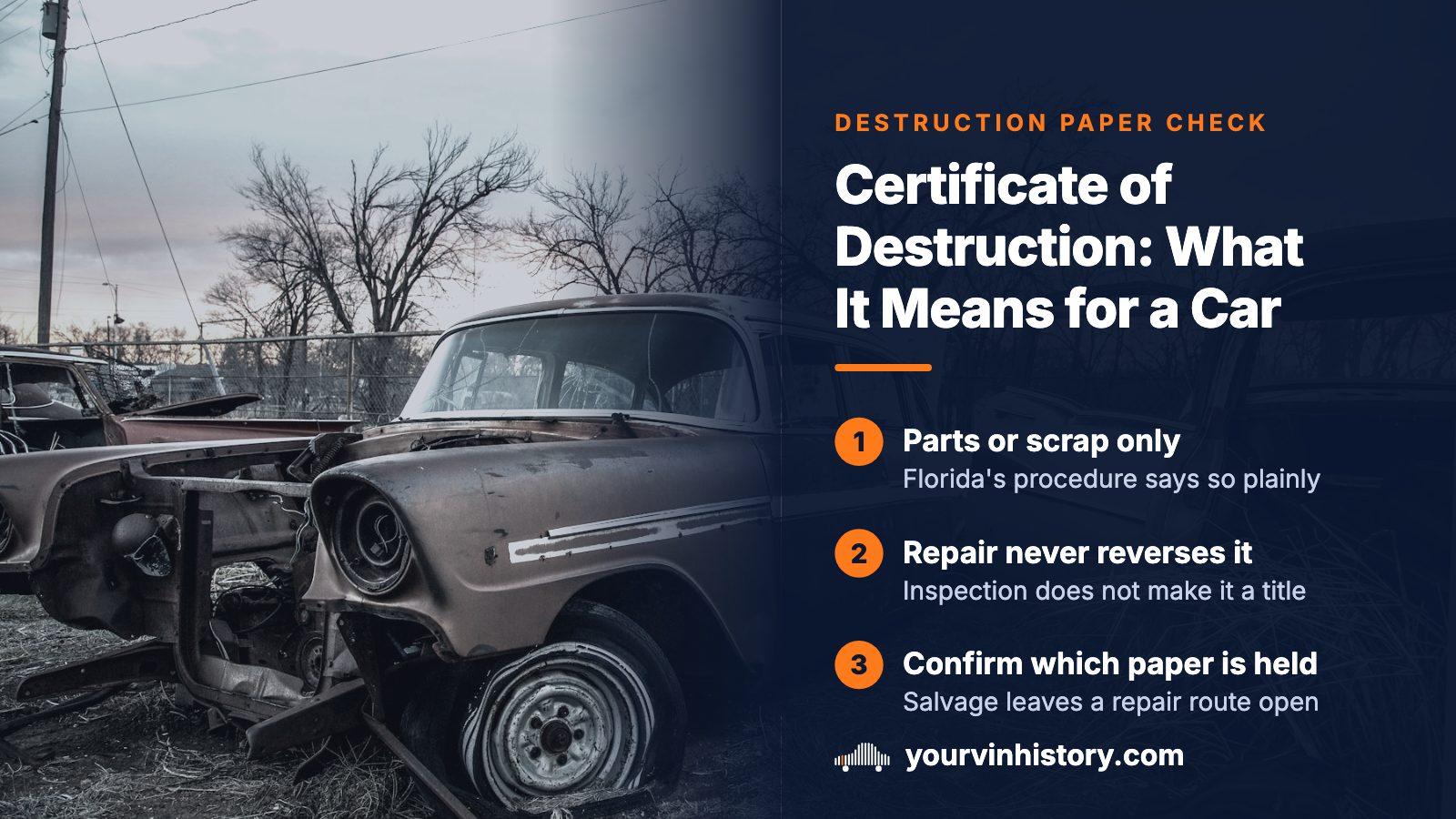
No. A certificate of destruction lets a vehicle be sold for parts or scrap and nothing more. Florida's titling procedure says so in terms, and no repair or inspection turns the paper into a registrable title. Texas goes further and bars reusing a body and frame to assemble another vehicle. A salvage title is the document that leaves a repair route open, so confirm which one a seller is actually holding.
- What it permits
- Sale for parts or scrap, per Florida's titling procedure
- Florida uninsured test
- Repair cost of 80 percent or more of like-kind replacement cost
- Florida filing deadline
- 72 hours after the vehicle becomes salvage
- Texas shell rule
- A nonrepairable body and frame cannot be used to build another vehicle
What the document does to a vehicle's legal life
Most title brands are labels. They record that a car was flooded, burned or wrecked, then leave the owner free to repair it and apply for the next stage. A certificate of destruction works differently. It is the ownership paper for a vehicle judged finished, drafted to keep that vehicle off public roads for good.
Its practical job is to let someone prove they own a wreck so they can sell it lawfully to a dismantler or scrap yard. In the title system the object has stopped being a car, so the buyer's usual sums, repair cost against discount, never start. A salvage title, by contrast, admits that a repair is coming and sets up the inspection that follows.
One purpose, several names
States do not agree on a name, and that is how buyers get caught. A seller who mentions a junk certificate and a buyer who read about certificates of destruction may be describing the same piece of paper. Labels you are likely to meet:
- Nonrepairable vehicle title
- Parts-only title
- Certificate of authority to demolish a vehicle
- Derelict motor vehicle certificate
- Junk certificate
Ignore the heading and find the sentence that says what the holder may do with the vehicle. If it names dismantling, scrapping, parts or export and never mentions repair or inspection, the document is final, whatever it is called.
Florida: the 80 percent test and the 72-hour clock
Florida is where many people first meet the phrase, and its rule has a detail that summaries tend to flatten. For an uninsured vehicle, the state counts a loss as total when the cost to repair or rebuild, measured at the time of loss, comes to 80 percent or higher of what a replacement of like kind and quality would cost.
The percentage was drafted with uninsured vehicles in mind, and the yardstick is replacement cost, which differs from market value or actual cash value. Quoting 80 percent as a universal Florida line misleads.
The owner has 72 hours after the vehicle becomes salvage to send the title to the department and file for one of two documents, a certificate of destruction or a salvage title. Below the 80 percent mark, a rebuildable salvage title is available on request, although state law does not demand one.
Why the fork matters
Which document a car receives is settled at the moment of application, using figures assessed once. A buyer rarely sees that arithmetic later, so the paper is the only reliable evidence.
Texas: five ways in, one of them unrelated to damage
Texas calls its final category nonrepairable, and its salvage manual describes five ways a vehicle can land there.
- The damage is so severe that the only value left is as parts or scrap.
- The vehicle is sold for export only.
- It arrives from another state carrying a junk or dismantle-only document.
- A dealer files a report about it with the department.
- The owner surrenders ownership so that it can be dismantled, scrapped or destroyed.
The export route catches people out, because the car may be in fine shape. It carries a final document because of where it was going, not what happened to it. If it drifts back into the domestic market, the paper still says what it said, and no mechanic will find a fact that lives only in paperwork.
Why repair and inspection do not reverse it
Florida's titling procedure limits a certificate of destruction to one use, selling the vehicle for parts or scrap. That leaves no room for a repair-and-retitle sequel, and no application accepts the certificate as its starting point. The bar is not set high. There is no door.
| Plan someone proposes | Why it does not work |
|---|---|
| Fix it well and have it inspected back onto the road | Rebuilt-vehicle inspections are built around salvage documents. This paper is not an input to that process. |
| Retitle it in a state with looser rules | The retired status follows the VIN into the federal record, which a receiving state can consult before it issues anything. |
| Sell it as a project and leave the paperwork to the buyer | The seller would be misrepresenting a vehicle whose paper does not allow road use. |
| Break it up for parts | The one plan the document supports. Dismantlers pay real money for components. |
The shell cannot be borrowed either
The obvious workaround is to keep the retired body, transplant sound running gear and register the finished vehicle as something else. Texas forbids this directly. Under its manual, a nonrepairable body and frame may not become the foundation of a repaired, rebuilt, reconstructed or assembled vehicle.
Add the parts-or-scrap limit on the paper itself and the structure has reached its end, while the removable components keep a lawful future. There is a security reason for the tight drafting. A body with a VIN plate and no legitimate future is what a car thief wants, since the number can be copied onto a stolen vehicle of the same description.
Why these cars are advertised at all
Most listings are honest. Dismantlers buy these cars because the parts are worth more sold separately, and a newer vehicle can hold thousands of dollars in pieces that resell on their own. Scrap buyers want the metal. Both trades are lawful.
The trouble is a smaller slice of the market. Treat these as warnings:
- A car called salvage and an easy fix, with no photo of the document.
- Photographs and a price, with the kind of title left unnamed.
- A seller who promises the title will be delivered once you have paid.
- An asking price close to what the same car would fetch running.
- A story that the car was moved to a state with friendlier rules.
If you want parts, buy them as parts and haggle on that footing. Overpaying for a parts car is the usual way buyers get hurt.
The federal trail a destroyed car leaves
The national title system was built to follow vehicles like these. Any junk yard, salvage yard or auto recycler has to file a monthly inventory of what it takes in, stating whether each vehicle was crushed or otherwise disposed of, who received it and whether it is meant for export. If the final outcome was unknown at first filing, a supplemental report can follow. Insurance carriers carry their own monthly duty to report vehicles they have declared junk or salvage.
Two gaps keep a clean search from proving anything. The insurer duty covers the current model year and the four before it, so an older car totaled by a carrier falls outside it. And a yard that handles under five such vehicles in a year is exempt from the yard rule. A thin record is a reason to ask more questions, not a pass.
Five checks before any money moves
- Get the document itself, photographed in full. A description, a plate number or a listing screenshot does not show the restriction.
- Find the sentence that states what the holder may do with the vehicle, and read it.
- Run the NICB VINCheck, a no-cost screen for theft and total-loss entries from insurers that participate.
- Order the federal title record from an approved NMVTIS provider. A yourvinhistory report is one route: its title records come from ClearVin LLC, an approved provider, alongside salvage and auction records with photos.
- If the seller cannot produce the ownership paper before you pay, stop there.
Four things to read on the paper itself
With the document in front of you, the heading at the top matters least. Four items decide the question.
| Item on the paper | What it reveals |
|---|---|
| The permitted use | Dismantling, scrapping, parts or export means no road future. If the text talks about repair and inspection instead, the document is a salvage one. |
| Issuing state and date | A recently issued destruction certificate on a car marketed as drivable needs an explanation before any payment. |
| Reassignment limits | Some states cap how many times the certificate can change hands before dismantling is required, which shows how far along the chain you stand. |
| The VIN on paper and car | Compare the number on the dash and door jamb with the number printed on the paper. A mismatch suggests a swapped plate or a cloned identity. |
If a certificate of destruction is already in your hands
The options are narrow but real. A licensed dismantler or scrap processor is the lawful buyer, and the paper exists to serve that sale. You can also strip and sell components yourself where state rules allow. You cannot repair it onto the road, and you should not hand it to a private buyer while hinting that it could be driven, because that exposes you to claims along with the buyer.
If you think the document was issued wrongly, say because the car was in fact insured when treated as uninsured, or because the repair estimate was padded past the threshold, raise it with the issuing department quickly. Such a dispute rests on policy records, estimates and valuation figures, not mechanical arguments.
Where this information comes from
- FLHSMV: Procedure TL-35, salvage and derelict titling — Backs the parts-or-scrap limit, the 80 percent uninsured test and the 72-hour deadline described for Florida.
- TxDMV: Salvage/Nonrepairable Motor Vehicle Manual — Source for Texas's list of ways into the nonrepairable category, the export-only route and the rule against reusing a body and frame.
- 28 CFR 25.56: junk yards, salvage yards and auto recyclers — Sets out the monthly yard inventory, the supplemental disposition report and the exemption for very small operators.
- 28 CFR 25.55: responsibilities of insurance carriers — Explains the insurer's monthly report and the five-model-year window it covers.
- NMVTIS: official vehicle history record — The Justice Department page listing the approved providers that sell the federal title record.
- NICB: VINCheck — A no-cost screen for theft and total-loss records from participating insurers.
Sources and photos: Facts checked against the sources above in October 2026. Photo by Leo_Visions on Unsplash; diagrams by YourVINHistory.
Keep reading
- Salvage certificateThe paper that keeps the repair route open, which is the contrast with this one.
- Total loss threshold by stateWhy the percentage that triggers a write-off differs from state to state.
- NMVTIS reportWhat the federal title record contains and how to read it.
- VIN cloningHow a retired body with a VIN plate becomes a stolen car's disguise.
Frequently asked questions
Is it possible to register a car that carries a certificate of destruction?
No. The document is designed to end a vehicle's road life, and Florida's procedure limits it to parts or scrap sales. Repair quality is irrelevant because no inspection route starts from this paper. A seller who talks about registering the car is either mistaken or misleading you.
Is a certificate of destruction the same as a salvage title?
No. A salvage title is a pause: repairs, an inspection and, in states that offer it, a rebuilt title can follow. A certificate of destruction is an endpoint that allows dismantling or scrap sale. Ask for the exact document name in writing, because sellers sometimes use the word salvage loosely for both.
Can I sell a car that has a certificate of destruction?
Yes, to the right buyers. Dismantlers and scrap processors buy them, and parts carry real value. Trouble starts when a private buyer expects to drive the car, since the seller can face misrepresentation claims. Put what the paper says in the ad and the bill of sale, and keep a copy.
Why would a car in good shape carry a certificate of destruction?
Damage is not the only trigger. In Texas, a vehicle sold for export only, or surrendered by its owner for dismantling, enters the nonrepairable category without any crash. The car can look and run fine while the paper says otherwise, and only the document and the title record reveal that.
Does a certificate of destruction show up on a VIN check?
It can. Yards and insurers file reports into the federal title system, and approved providers sell the resulting record. The NICB search is a no-cost screen for total-loss entries. Gaps exist, though: small yards and older insurer totals fall outside the duties, so a clean result is not proof. Ask for the paper as well.
Now check the car itself
The guide explains what to look for. The report shows what this VIN has on record.