THE SHORT ANSWER
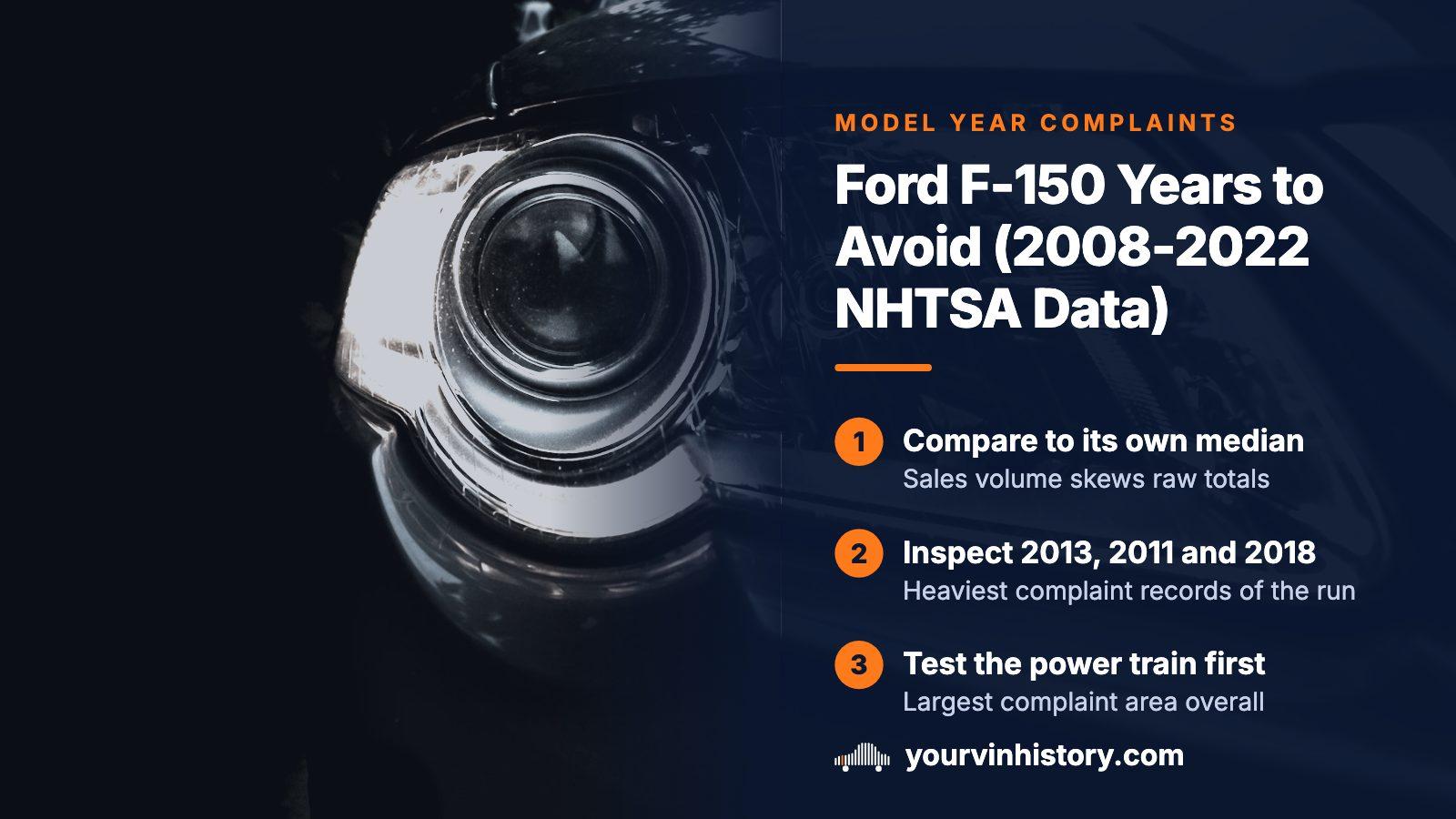
On NHTSA complaint volume, the 2013, 2011 and 2018 model years stand out, with 2,796, 2,137 and 1,870 complaints against a yearly median of 1,221. The lightest records belong to 2009, 2008 and 2020. Power train is the largest complaint area over the whole run. A complaint count is not a failure rate, so a flagged year means inspect harder and bargain, not walk away.
- Complaints on record
- 19,248 across 2008 to 2022
- Median year
- 1,221 complaints
- Heaviest year
- 2013, with 2,796 complaints
- Largest complaint area
- Power train, 6,106 reports
How each F-150 year is scored against its own median
Sales volume skews raw complaint totals, because a bestselling year collects more reports than a rare one of the same quality. To blunt that, every F-150 model year from 2008 through 2022 is compared with the middle value of the 15 yearly counts, which is 1,221. A year at 2 times that figure drew about twice the filings of a typical F-150 year.
The counts are NHTSA owner complaints. Duplicates were removed using each complaint's ODI number, the data was pulled on 2026-08-15, and the total is 19,248. Every one is a single owner's unverified account, so the totals show where attention gathered. They are not a failure rate, and they ignore owners who never filed.
All 15 model years side by side
The yardstick is the median year's 1,221 complaints, so a multiple of 1 means a year matches it. Standing is a plain label drawn from that multiple: one year reads heavy, four elevated, three light and seven typical. The 2021 trucks land exactly on the median because their own count is the median.
| Model year | Standing | Times the median | Complaints | Recalls tallied |
|---|---|---|---|---|
| 2008 | Light | 0.3× | 368 | 1 |
| 2009 | Light | 0.27× | 324 | 2 |
| 2010 | Typical | 0.7× | 850 | 1 |
| 2011 | Elevated | 1.75× | 2,137 | 6 |
| 2012 | Elevated | 1.41× | 1,717 | 4 |
| 2013 | Heavy | 2.29× | 2,796 | 3 |
| 2014 | Typical | 1.12× | 1,362 | 8 |
| 2015 | Typical | 1.17× | 1,425 | 14 |
| 2016 | Elevated | 1.41× | 1,716 | 14 |
| 2017 | Typical | 0.89× | 1,085 | 18 |
| 2018 | Elevated | 1.53× | 1,870 | 19 |
| 2019 | Typical | 0.8× | 979 | 9 |
| 2020 | Light | 0.43× | 529 | 11 |
| 2021 | Typical, the median itself | 1× | 1,221 | 29 |
| 2022 | Typical | 0.71× | 869 | 23 |
The recall column is a tally from the same data pull, so treat it as a rough guide, not NHTSA's live list for any one truck.
The cliff between 2010 and 2011
Two neighboring rows tell most of the story. The 2010 trucks drew 850 complaints and the 2011 trucks drew 2,137, the steepest climb anywhere in the run. A jump of that size is more likely tied to a change in how the truck was built than to ordinary aging, though the complaint record itself does not say which change.
The high stretch lasts. Counts stay elevated through 2012, peak at 2,796 for 2013, then fall to 1,362 for 2014. Anyone shopping near the 2010 and 2011 line should first learn which side a given truck sits on.
The VIN settles it. Positions 4 through 8 describe the model, body and engine, and position 10 holds the model year, so a decoded VIN shows what the truck really has instead of what an ad claims.
The five years that sit highest
Five model years stand clear of the pack, and power train is the most-reported area on every one of them.
- 2013: 2,796 complaints, 2.29 times the median and the peak of the run. Engine reports also stand out for this year.
- 2011: 2,137 complaints, 1.75 times the median, the first year after the climb.
- 2018: 1,870 complaints, 1.53 times the median, with 19 recalls tallied, the most of any flagged year.
- 2012: 1,717 complaints, 1.41 times the median.
- 2016: 1,716 complaints, also 1.41 times the median and nearly identical to 2012.
Flagged does not mean condemned. These are the years that justify an extra hour with a mechanic and a firmer offer, and sound trucks were built in every one.
The lightest records, and the caveat on one of them
Three model years sit well under the median. The 2009 trucks show 324 complaints (0.27 times the median) and 2 recalls. The 2008 trucks show 368 (0.3 times) and 1 recall. The 2020 trucks show 529 (0.43 times) and 11 recalls.
Only settled years are judged for a cleanest list, because the newest trucks have had little time to collect reports. Of these three, 2020 is the youngest by a wide margin, so part of its light count may reflect age rather than quality. At the other end, the two lightest records are also the two oldest trucks, and a low count on a vehicle that old says little about how this one was kept.
Recall counts rise as complaint counts calm down
The recall column runs the opposite way from the complaint column. Tallies stay between 1 and 8 from 2008 through 2014, then jump: 14 for both 2015 and 2016, 18 for 2017, 19 for 2018 and 29 for 2021. The 2022 trucks carry 23.
A recall is a defect the manufacturer has acknowledged and must repair at no charge, whereas a complaint is a single owner's unverified account. Many recalls with moderate complaints can indicate defects found early and repaired under warranty. It can also simply mean a long list of campaigns to verify on a newer truck.
The no-charge repair has an age limit. Under 49 U.S.C. §30120(g), the duty does not apply to a vehicle first bought more than 15 years before the recall notice. The oldest rows in the table are already past that age, so a campaign announced now on a 2008 or 2009 truck may not carry a right to a no-charge repair. Ask the dealer first.
Where the complaints land: power train first
Across all 15 model years, six NHTSA categories hold the biggest piles of reports.
| NHTSA category | Reports, 2008 to 2022 |
|---|---|
| Power train | 6,106 |
| Engine | 3,530 |
| Electrical system | 1,809 |
| Service brakes | 1,387 |
| Unknown or other | 1,114 |
| Steering | 814 |
Power train leads by a wide margin and tops the list for every flagged year. A category is a bucket, not a part. Power train reaches beyond the transmission, engine covers every kind of engine fault, and the electrical system takes in the battery, wiring, lighting and control modules. Brake reports are owners describing defects, not ordinary pad wear. The ranking tells a mechanic where to start on any F-150, not which component failed.
What to check on an F-150 from a flagged year
Aim the inspection at the systems where the complaints cluster.
- Records first. A stack of dated invoices tells you more about a truck this old than any model-year chart.
- Power train: drive it cold and again warm. Watch for delayed, harsh or slipping shifts, shudders, whines and any warning light, and ask whether the transmission and driveline were ever serviced.
- Engine: listen to a cold start and the first minute of idle, look for oil or coolant residue, and have a shop read stored codes with a scan tool.
- Electrical: run every window, lock, light, screen and camera, then inspect the battery and its cables.
- Brakes and steering: press the pedal firmly, check for warning lights, drive straight and through a tight turn, and note any odd effort or noise.
- Have an independent mechanic put the truck on a lift, then compare what they find with the title and recall record for that VIN.
Why these numbers can mislead
- Volume: a bestselling year attracts more reports than a rare one of equal quality, which is why each year is judged against the F-150's own median.
- Time on the road: older years have had longer to collect complaints, so the newest years are treated as provisional, not ranked best.
- Accuracy: each complaint reflects an owner's belief about what went wrong, so it informs in aggregate and misleads one case at a time.
- Recalls point the other way: they are manufacturer-acknowledged defects with a stated repair, so a high count is not automatically bad news.
- Single trucks: none of this describes the F-150 on the lot, whose past can only be read from its VIN.
A flag is a bargaining position
Every year in the table contains well-kept trucks and neglected ones. Treat a flag as a reason to look longer and bargain harder. It is no grounds for dismissing a truck you have not even driven.
Putting the F-150 beside other pickups
Totals for rival pickups look smaller, but each covers its own span of years and its own sales volume. NHTSA holds 12,743 complaints for the Chevrolet Silverado 1500 over 2008 to 2022, 12,186 for the Ram 1500 over 2011 to 2022, 5,544 for the GMC Sierra 1500 over 2009 to 2022 and 3,245 for the Toyota Tacoma over 2008 to 2022. Set against the F-150's 19,248, none of those figures ranks one truck above another. What carries over is shape: how far a model's worst year climbs above its own median, and whether the heavy years cluster. A smaller total for a rival says nothing about the example you are shopping for.
Checking the actual truck before you pay
A model year describes a group of trucks, and the one on the lot is a single member. Four checks belong to that truck alone.
- NHTSA's recall lookup takes the VIN and lists open campaigns at no cost. Recalls follow production ranges, not whole model years.
- The NMVTIS title record is the national source for title history and brands.
- NICB's VINCheck is a no-cost screen for theft and total-loss records.
- A vehicle history report gathers accident, odometer, lien and salvage records in one place. This site's preview is free, and the full report is a one-time purchase.
Add a mechanic's lift inspection, and the price can rest on facts about that truck instead of its model year.
Where this information comes from
- NHTSA: Vehicle safety and complaints — Where owners file and search the complaint reports behind the counts in the tables.
- NHTSA: Recalls — The VIN lookup for open campaigns on one specific truck.
- BJA: NMVTIS vehicle history — The federal title-record system, which covers one truck's title history where model-year data cannot.
- NICB: VINCheck — A no-cost theft and total-loss screen run on a single VIN.
Sources and photos: Facts checked against the sources above in October 2026. Photo by Alexandru Goman on Unsplash; diagrams by YourVINHistory.
Keep reading
- 2017 Ford F-150 recalls, 1,085 complaints and what to inspectOne F-150 model year in detail, with its recall campaigns and complaint areas.
- Ford recallsHow to look up Ford recalls for the exact truck in front of you.
- Ford F-150 transmission replacement cost: which gearbox, which fault, who paysPower train leads the complaints, so see what a transmission repair can involve.
- Chevrolet Silverado 1500 years to avoid: 2014, 2015 and 2019 stand outThe same year-by-year comparison for a full-size rival, for a side-by-side read.
Frequently asked questions
Which F-150 model years should I avoid?
Going by NHTSA complaint volume, 2013, 2011 and 2018 draw the most, with 2012 and 2016 close behind at 1.41 times the median. None of that bans a truck. A flagged year with dated service records, a clean title and every recall completed can be a fair buy at the right price, and a neglected truck from a quiet year can be a bad one.
Which F-150 years have the fewest complaints?
The 2009, 2008 and 2020 model years carry the lightest records, at 324, 368 and 529 complaints. A low count is not a reliability score, though. Owners of newer trucks have had less time to file, and the oldest trucks may sit past the 15-year window for no-charge recall repairs, so judge any example by its own records.
What is the most common problem on the Ford F-150?
Power train leads the whole run with 6,106 reports, followed by engine at 3,530 and the electrical system at 1,809. These are broad NHTSA buckets, each spanning many parts, so they show where an inspection should start rather than one failing component. A test drive that exercises shifting, plus a stored-code scan, will say more than the totals.
Is a 2013 Ford F-150 a bad truck?
Not on this evidence alone. The 2013 year has the heaviest record, 2,796 complaints or 2.29 times the median, and power train and engine both stand out. Only 3 recalls are tallied for it, though, and complaints are unverified accounts. Price a 2013 against comparable trucks with full records, and treat gaps in the history as a reason to bargain.
How do I check a used F-150 for open recalls?
Enter the 17-character VIN in NHTSA's recall lookup. Campaigns follow production ranges, so two F-150s from the same year can differ, and the tally in the table is not a live list. Dealers repair open recalls at no charge only within the federal age limit, so ask for paperwork on completed work and run the VIN again right before you buy.
Now check the car itself
The guide explains what to look for. The report shows what this VIN has on record.