THE SHORT ANSWER
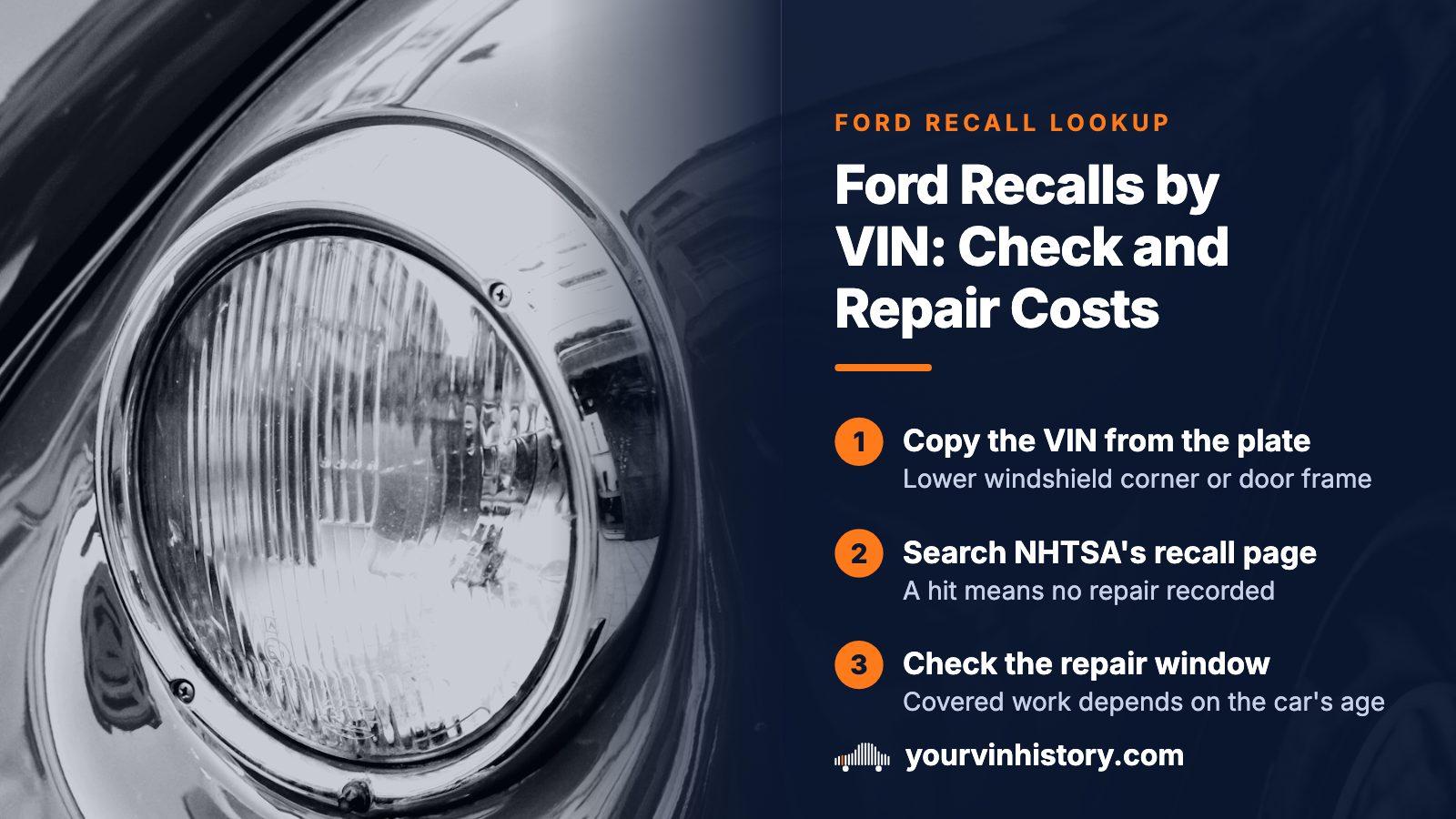
Copy the 17-character VIN from the plate at the lower windshield corner or from the door-frame sticker, then search it on NHTSA's recall page. A hit means a safety recall has no repair recorded; an empty result means nothing is open today. Any Ford dealer can do the work at no charge to the owner, provided the car was first sold no more than 15 calendar years before the recall notice.
- Where the VIN sits
- Lower windshield corner, driver's side, or the door-frame sticker
- Cost of a covered repair
- Nothing owed for parts or labor while the car is inside the federal age window
- Age window
- First sold no more than 15 calendar years before the recall notice
- Empty result
- Nothing open today, not proof of a recall-free history
Start with the number stamped on the vehicle itself
Stand beside the driver's door and look through the glass at the lower corner of the windshield. A small plate there carries the 17 characters. Open the door and you will find the same number on the sticker along the frame. Read both and confirm they match; a mismatch is a bigger problem than any recall.
Photograph the number rather than copying it by hand. A recall search rejects a VIN with one wrong character, and a plate read at a slant through windshield glass is easy to get wrong. Listings and old paperwork carry typos too, so the car itself is the version to trust.
If you want to confirm what the number describes before looking for campaigns, NHTSA's vPIC decoder returns the basic details the manufacturer reported. It is built around modern 17-character VINs and covers vehicles intended for sale in the United States.
Three places to search, and what each one adds
No single lookup shows everything a Ford owner might care about, so a careful check uses three sources in order.
- NHTSA's recall page. Enter the VIN and read what comes back. This is the federal database, and it reports safety recalls with no repair recorded against the vehicle.
- Ford's owner site. Use the same VIN. Ford's pages also describe programs the company runs on its own, which may never have been filed as formal safety recalls.
- A Ford dealer's service desk. Give them the VIN and ask for the full campaign history, including work a previous owner had done and any program the public sites leave out.
When two sources disagree, treat that as a reason to ask a question, not as a verdict. A recall that shows on one screen and not another usually comes down to timing or to the build range the campaign covers, and a service advisor can tell you which.
What an open recall on the screen actually says
Open means a campaign applies to your VIN and no completed repair is recorded for it. Once a dealer performs the remedy and files it, the entry leaves the open list. That is why a clean screen cannot tell you whether the car was ever recalled: a previous owner may have taken care of it years ago.
Open recalls on used Fords are common and rarely a sign of anything sinister. Owners move, notices chase old addresses, appointments slip. Ford's own site says safety recalls do not expire, so one that sat ignored is still waiting when you arrive.
Read the notice, not only the headline
Recall notices describe how the part fails and what the risk is. Some tell owners to park outdoors or stop driving the vehicle until the repair is done, usually when fire is possible. Follow that wording literally.
Where the no-charge repair comes from, and where it stops
The obligation is written into federal safety law, federal motor vehicle safety law, which sits in the U.S. Code. When a defect or a noncompliance is declared, the manufacturer must remedy it without charge once the vehicle is presented. The statute lets the maker choose how: repair the car, replace it with an identical or reasonably equivalent one, or refund the price less a reasonable allowance for depreciation.
The duty attaches to the vehicle, not to the name of the first buyer. A second or fifth owner can bring the car to a Ford dealer and cite the recall number. What does change the answer is age. The no-charge requirement does not apply when the first purchaser bought the vehicle more than 15 calendar years before the manufacturer's notice went out.
For a Ford older than that, the statute no longer forces the company to pay, and whether it helps becomes Ford's call. Phone a dealer with the VIN and get an answer on cost before you book the appointment.
Recall, customer program or bulletin: who pays
Owners and sellers call all three of these a recall. Only one carries a legal duty, and the difference decides who gets the bill.
| What it is | Who pays | Where it shows up |
|---|---|---|
| Safety recall | Ford, under the federal statute, while the vehicle is inside the age window | NHTSA lookup, Ford owner site, dealer |
| Customer satisfaction program or field service action | Ford, by its own choice, often with expiry dates and mileage limits | Ford owner site and dealer; frequently absent from NHTSA |
| Technical service bulletin | You, unless a warranty covers it | Dealer and technician references; not a recall at all |
Ask the service desk to check the VIN against all three on one call. The lookup sites only reliably surface the first row.
Why a search by model name misleads you
A list of recalls for a Ford model includes campaigns that never touched your car. Manufacturers scope each campaign to a block of VINs, and that block is frequently drawn around an assembly plant and a stretch of build dates, because that is how a batch of faulty parts reaches finished vehicles.
Picture two trucks with the same model year, trim and engine. One rolled out of a different plant, or a few weeks later, and its exposure to a given campaign differs from the other's. Only the VIN settles which side of the line your vehicle sits on, which is why brand reputation and model-level lists are weak guides.
When the repair parts have not arrived yet
A recall can be announced before replacement parts exist in volume, because owners of a known risk should not wait for a supply chain to catch up. If a dealer tells you the part is on back order, do not simply leave it there.
- Have the dealer put your VIN on the parts waiting list and note the date.
- Ask whether the notice describes a temporary measure that removes the risk until the final part arrives.
- Request any driving or parking guidance in writing and keep the paper.
- Ask whether alternative transportation is offered under that campaign.
- Search the VIN again each month instead of waiting for a second letter.
Buying or selling a used Ford with a recall still open
Nothing in federal law stops a private seller from handing over a car with an open safety recall, so the checking falls to the buyer. Run the VIN before you settle on a price. Where the car sits inside the age window the repair is the manufacturer's expense, so an open recall is not a bill you absorb. It is a chore you inherit, and it hints at how the last owner treated mail and maintenance.
Ask the seller to book the repair before delivery. A refusal to spend an hour on a repair that costs the seller nothing tells you something. Sellers should do exactly that on their side: a buyer who finds an unmentioned open recall starts to wonder what else went unmentioned.
Former rental cars follow stricter rules. After a recall notice arrives, a rental company may not rent, sell or lease the affected vehicle until the remedy is performed, with a narrow exception that allows renting after a temporary fix. A Ford with fleet history should therefore have the work done, but verify it by VIN rather than assume.
Reimbursement if you paid for a repair that was later recalled
Federal law requires a recall remedy program to include a plan for repaying owners who covered the cost of the fix themselves, for work done within a reasonable time before the manufacturer's notice. Federal regulation sets the conditions, and Ford's site directs refund questions to a dealer.
- Dig out the invoice that shows the work performed, the date and the amount you paid.
- Check that the repair addressed the same defect the recall remedy covers.
- Take the VIN and the campaign number to a Ford dealer, or to Ford customer service.
- Ask which reimbursement window that particular campaign uses.
- Keep copies of everything you hand over.
What a clean recall result still leaves out
An empty result is one narrow piece of good news: no open safety campaign is recorded against that VIN today. It says nothing about the rest of the car's past.
- Accidents and structural repairs
- Title brands: salvage, flood, lemon, rebuilt
- Odometer accuracy
- Service history and deferred maintenance
- Liens and theft records
- Normal wear, and any fault that never triggered a recall
NICB's VINCheck covers theft and salvage records, which a recall search never touches. A yourvinhistory report lists open recalls beside title, accident, odometer and lien records for the same VIN, which suits a buyer who wants everything read in one sitting before paying.
Where this information comes from
- NHTSA: Recalls — The federal VIN search where open safety recalls are looked up on any make.
- NHTSA: vPIC VIN decoder — Shows which vehicle a VIN describes, using manufacturer-reported data, before you check campaigns.
- NICB: VINCheck — A theft and salvage lookup for the records that recall searches do not hold.
Sources and photos: Facts checked against the sources above in October 2026. Photo by Rafał Karoń on Unsplash; diagrams by YourVINHistory.
Keep reading
- Recall check by VINThe general version of this check, for any make, and why a model search answers a different question.
- Buying a car with an open recallWhat to negotiate and what the law covers when the car you want has a recall open.
- Ford warranty by VINFord's warranty programs expire in ways recalls do not, so check coverage next.
- FordRead the same VIN position by position to confirm the plant, year and build.
Frequently asked questions
How can I look up Ford recalls using a VIN?
Type the 17-character VIN into NHTSA's recall lookup. No account is needed and the answer appears at once. Ford's owner site accepts the same number and may add programs of its own. If a lookup rejects the VIN, compare your entry with the windshield plate and the door-frame sticker before concluding the car has no recalls.
Can I keep driving a Ford that has an open recall?
Often it is legal to keep driving, but the notice decides whether it is sensible. Where the defect involves fire, a notice may tell owners to park outside or stop driving until the work is done. Read the wording for your campaign, and if it is a warning rather than a routine adjustment, call a dealer the same day.
Do Ford recall repairs have a deadline?
The statute's cost rule has an age edge: it stops applying once the first purchase was more than 15 calendar years before the manufacturer's notice. Ford's own site notes that other customer programs often carry expiry dates and mileage limits. For an older Ford, call a dealer with the VIN and ask what Ford will cover before booking.
Why does one site show a recall that my dealer cannot find?
Three explanations cover most cases: a mistyped VIN, a campaign that covers a different build range than your truck, or a repair a previous owner already had done. Ask the dealer to read the VIN back to you and to give you the campaign number for any recall they do find, so you can compare it with the screen.
What if a dealer wants to charge me for recall work?
Ask for an itemized estimate and the campaign number. A genuine open safety recall on a vehicle inside the federal age window carries no charge to the owner. A bill often reflects a separate repair found during the visit, or a bulletin item, and it should appear as its own line. You can decline that part and still have the recall done.
Now check the car itself
The guide explains what to look for. The report shows what this VIN has on record.