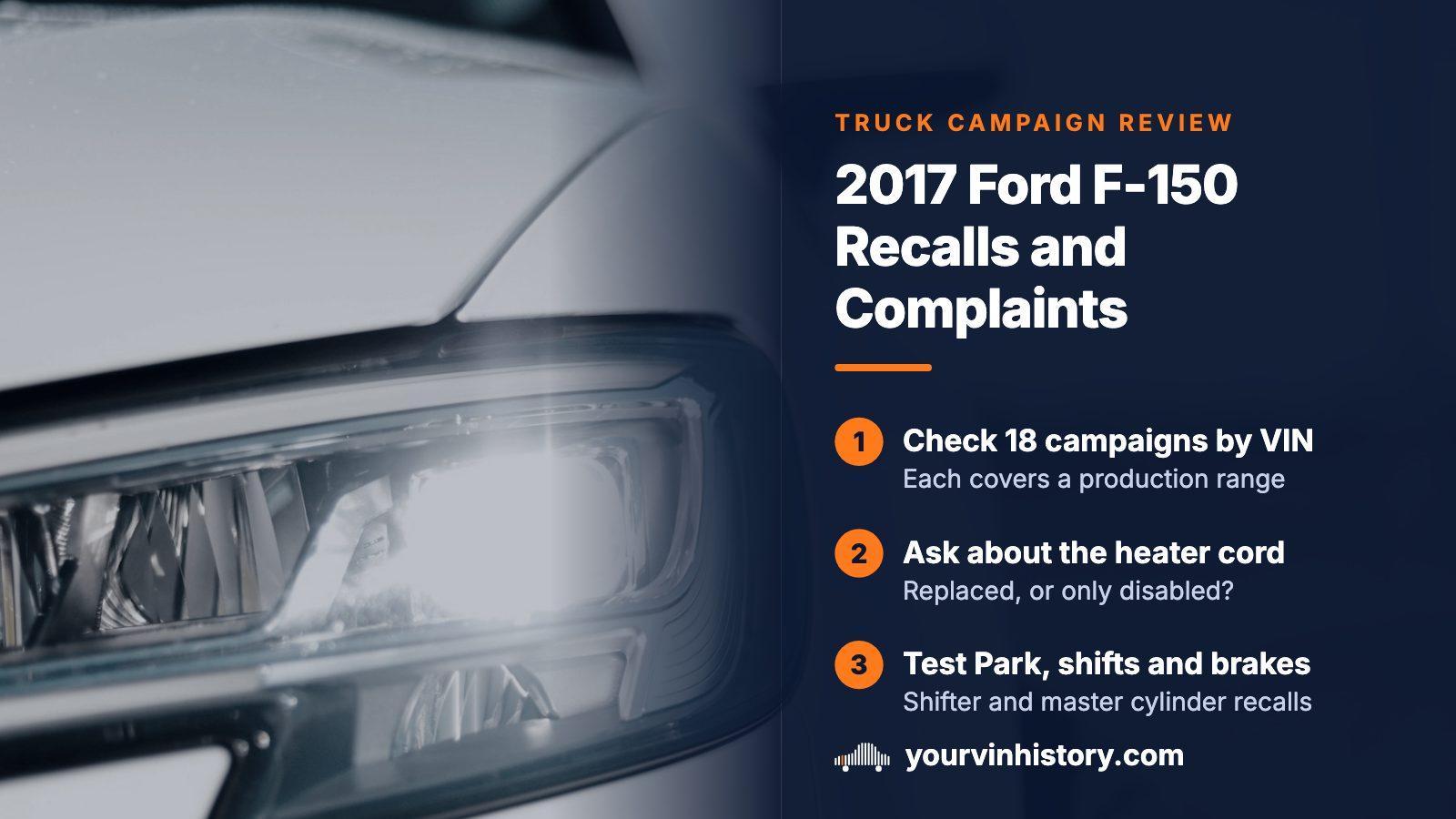
THE SHORT ANSWER
NHTSA lists 18 recall campaigns for the 2017 Ford F-150, touching engine block heater cables, seat belts, door latches, a passenger air bag inflator, seats, transmission and shifter parts, brakes and the instrument cluster. Owners filed 1,085 complaints, led by power train with 296 and engine with 266. NHTSA publishes no crash rating for this configuration. Recalls follow VIN ranges, so only a VIN lookup shows which ones apply to a single truck.
- Recall campaigns
- 18 on file with NHTSA
- Owner complaints
- 1,085, led by power train at 27%
- NHTSA crash rating
- None published for this configuration
- Against other F-150 years
- 0.89 times the median, 9th heaviest of 15
Recalls and complaints: two ledgers, two weights
NHTSA keeps two ledgers for every model year, and they carry different weight. A recall is a defect the manufacturer has accepted, with a repair owed through a dealer. A complaint is one owner's unchecked account. The 2017 F-150 has 18 campaigns in the first ledger and 1,085 entries in the second.
Among those entries, owners described a crash in 37, a fire in 19 and an injury in 32. The tags rest on the owner's wording, not an investigation, and one incident can generate several filings. They are still the reports to read in full before you hand over money.
All 18 campaigns, sorted by the system they touch
NHTSA files each campaign under the part involved. Grouped that way, the 18 fall into eight areas, and gear selection is the largest.
| System | Campaigns | The problem in short |
|---|---|---|
| Engine bay wiring | 18V894000, 19V278000 | Block heater cable corrodes and can burn |
| Seat belts | 18V568000, 17V526000 | Pretensioner sparks; rear buckle rivet |
| Doors | 17V652000, 17V331000 | Latch cable or ice; chrome handle covers |
| Air bag | 17V529000 | Passenger inflator can rupture |
| Seats | 17V332000, 17V599000 | Weak welds in recliner and belt anchor |
| Gear selection | 17V053000, 17V671000, 18V213000, 26V237000, 26V370000 | Dark gear indicator, shift pin, Park pin, downshift |
| Brakes | 20V332000, 22V150000, 25V236000 | Master cylinder leaks into booster |
| Front suspension | 21E027000 | Aftermarket ball joint |
Three campaigns where the notice mentions fire
Campaign 18V894000 reaches 2015 through 2019 F-150s fitted with an engine block heater. Water and grit can enter the splice connector on the heater cable, and the corrosion can short the wire and melt its insulation while the cord is plugged in. Dealers first disabled the cable, with a replacement to follow once parts arrived.
Campaign 19V278000 exists because that first repair could itself damage the connector, so a truck may need a second visit. If a seller says the block heater is handled, ask which campaign, and whether the cord was replaced or only disabled.
Campaign 18V568000 covers 2015 through 2018 Regular Cab and SuperCrew trucks. When a front belt pretensioner fires in a crash, its sparks can ignite carpet or insulation in the B-pillar. Dealers strip that insulation and harness tape and fit heat resistant tape.
Doors, seats and one air bag inflator
Campaign 17V652000 covers 2015 through 2017 F-150s. A kinked cable inside the door, or a latch that freezes after water gets in, can let a door swing open while the truck moves. Dealers check the cables and fit water shields over the latches. Campaign 17V331000 is narrower: it concerns chrome handle covers sold as a dealer accessory, which can let a door unlatch in a side impact. The remedy is removing the covers and refunding the purchase.
Campaign 17V529000 bears most on crash protection. The inflator in the passenger front air bag module of certain 2017 F-150s, and of Mustangs, may rupture and throw metal fragments. Dealers replace the module.
Three seat items round out the group: poor welds in a manual driver's recliner (17V332000), a belt anchor not welded properly to the manual passenger seat frame (17V599000) and the left rear inflatable belt buckle on crew cabs (17V526000).
Shifter, Park and the instrument cluster: five campaigns
Two campaigns concern the ten-speed automatic. Under 17V671000, a pin holding the shift linkage can come out, so the transmission may ignore the lever and, in Park without the parking brake set, the truck can roll. Under 18V213000, a roll pin may never have been installed, which can cost the truck its Park function. Dealers fit a new pin, or add the missing one.
Campaign 17V053000 covers 2017 trucks with the eight-inch productivity screen. After a cold start the cluster can lose power, leaving the gear indicator dark; dealers reprogram it. Campaign 26V370000 covers trucks where that repair was done incorrectly and calls for a software update.
Campaign 26V237000 is recent too. On 2015 through 2017 F-150s, a lost signal between the transmission range sensor and the powertrain control module can drop the transmission suddenly into second gear. Software fixes it. Because campaigns keep arriving, rerun the lookup right before signing.
Master cylinders, and a ball joint that was not Ford's
Campaign 20V332000 covers 2014 through 2017 F-150s with the 3.5L EcoBoost engine. The brake master cylinder can leak fluid into the booster, which changes pedal feel, raises pedal effort and weakens the front brakes. Dealers replace the master cylinder and inspect the booster.
Campaign 22V150000 stretches the problem to trucks through the 2018 model year, and 25V236000 extends it again for 2017 and 2018 F-150s. Each number is its own record on the VIN lookup, so check all three.
Campaign 21E027000 is different in kind. NHTSA classes it as an equipment recall, covering an aftermarket upper ball joint from MOOG that can be installed wrongly because of a misaligned dust boot. It matters only to a truck whose front suspension was repaired with that part, so ask what the shop installed.
Where the 1,085 complaints cluster
Owners pick the component when they file, so the table shows what people believed had failed, not what a shop confirmed.
| Reports | NHTSA category | Share |
|---|---|---|
| 296 | Power train | 27% |
| 266 | Engine | 25% |
| 135 | Unknown or other | 12% |
| 104 | Structure | 10% |
| 94 | Electrical system | 9% |
| 76 | Service brakes | 7% |
| 65 | Engine and engine cooling | 6% |
| 49 | Steering | 5% |
| 42 | Vehicle speed control | 4% |
| 41 | Latches, locks and linkages | 4% |
| 40 | Wheels | 4% |
| 37 | Visibility and wipers | 3% |
Power train and engine stand clear of the pack, yet both are wide buckets. Power train takes in the transmission and more, and electrical covers battery, wiring, lighting and modules, so a big count does not name a part. Brake entries are defect reports, not pad wear complaints.
How old the truck was when owners filed
Each complaint carries the failure date, and its gap from the 2017 model year gives the truck's age then. The table ranks the eight largest categories by median age.
| System | Median age in years | Filed inside first 3 years | Reports |
|---|---|---|---|
| Structure | 3 | 50% | 104 |
| Service brakes | 3.5 | 49% | 76 |
| Steering | 3.8 | 47% | 49 |
| Electrical system | 4.3 | 31% | 94 |
| Unknown or other | 5 | 32% | 135 |
| Engine | 6.5 | 14% | 266 |
| Power train | 6.9 | 15% | 296 |
| Engine and engine cooling | 7.2 | 3% | 65 |
Medians of owners who filed, not failure odds
A truck with full service records can outlast every number above, and a neglected one can break sooner.
Structure, brake and steering reports skew early, so warranty work may already have absorbed them; ask for the paperwork. Engine and engine cooling arrives latest, at 7.2 years, with power train and engine close behind. Those are the systems to budget for on a truck this old.
Near the middle among F-150 years, and no star rating
Raw counts depend partly on sales volume, so the useful yardstick is the F-150's own median model year. Against it, the 2017 sits at 0.89 times the median and ranks 9th heaviest of the 15 years on record, 2008 through 2022. The 2013 is heaviest at 2.29 times, and 2009 the lightest settled year at 0.27 times. On complaint volume alone, this is an ordinary F-150.
Filings for this model year peaked in 2024, which suggests age and mileage catching up with parts, the stage a second or third owner buys into.
NHTSA has published no crash-test rating for this configuration. Only some trims and body styles get tested in a given year, so a blank means untested, not poorly rated. Without stars, confirm the air bag and seat belt repairs above.
What to put in front of a mechanic
- Transmission: power train drew 296 reports. Judge shifting from a cold start and confirm the shifter, Park and range sensor campaigns were done.
- Engine: 266 reports. Look for leaks and warning lights, and ask what work was done.
- Wiring: fire reports exist, so examine the block heater cord, its splice and any amateur wiring for heat damage.
- Brakes: note pedal feel and fluid level, especially on a 3.5L EcoBoost.
- Front suspension: ask whether the upper ball joints were replaced, and with which brand.
- Frame rails and crossmembers: rust here is the costly kind.
- Bed mounts, tailgate hardware, hitch wear, a transmission cooler or spliced trailer wiring: signs of hauling beyond what the odometer says.
- Rear leaf springs and differential: sagging or weeping prices the truck.
Questions for the seller, then the VIN
- Which of the 18 campaigns were completed, and is there dealer paperwork?
- Was the block heater cord replaced or only disabled?
- Has the transmission or any power train part been repaired or replaced?
- Who services the truck, and are the records on hand?
- Has an insurer ever paid for crash damage on it?
- Is the title in your name, with no lien on it?
- Can my own mechanic inspect it before we settle a price?
Then check the VIN. NHTSA's recall lookup returns the open campaigns for that exact truck. Dealers repair open recalls at no charge, but the federal statute lets a manufacturer decline once the first buyer's purchase falls more than 15 calendar years before the recall notice. A 2017 truck is inside that window for every notice described here.
The recall lookup does not show title brands, accidents, odometer readings or liens. On this site, a VIN search opens with a free preview, and the full report is a one-time purchase adding those records next to open recalls.
Where this information comes from
- NHTSA: Recalls by vehicle — Where to run a VIN against open safety campaigns, including the ones listed above.
- NHTSA: Vehicle safety and consumer complaints — Home of the owner complaint database behind the counts and category shares quoted here.
- 49 U.S.C. section 30120: Remedies for defects and noncompliance — The statute behind repairs at no charge, including the 15 calendar year limit.
- NHTSA: 5-Star Safety Ratings — The federal crash-test program, and the place to see which configurations carry ratings.
- NMVTIS: National Motor Vehicle Title Information System — The federal title database, which holds brands and history the safety file leaves out.
Sources and photos: Facts checked against the sources above in October 2026. Photo by muhammad dennisa on Unsplash; diagrams by YourVINHistory.
Keep reading
- Ford F-150 years to avoid: 2013, 2011 and 2018 draw the most complaintsSee how the 2017 compares with every other F-150 model year.
- Ford recallsLook up Ford campaigns by VIN across the whole lineup.
- Ford F-150 transmission replacement cost: which gearbox, which fault, who paysWhat the transmission campaigns change about a repair quote.
- Buying a car with an open recallWhat to do when the lookup finds a repair nobody has done.
Frequently asked questions
How many recall campaigns cover the 2017 Ford F-150?
The count is 18 on NHTSA's list, but that is a model-year total. Each applies to a production span, and a few also reach other years or Super Duty trucks, so one F-150 may carry a handful or none. A VIN lookup separates open items from repairs already done.
What problems do 2017 F-150 owners report most often?
Power train leads with 296 of the 1,085 complaints, then engine with 266. Both are wide NHTSA categories, so neither points at one part. Unknown or other adds 135 and structure 104. These are unverified owner reports, a prompt for inspection and not proof of a defect.
Does the 2017 Ford F-150 have a crash-test rating?
NHTSA publishes none for this configuration. Only some trims and body styles get rated in a given year, and an unrated truck is untested, not failed. Look up the exact cab and drive layout on NHTSA's ratings page, and weigh the recall repairs more heavily when no stars exist.
Is a 2017 F-150 with a long recall list a bad buy?
Not by itself. A recall is a repair owed, and many of these 18 have a short dealer fix. Complaint volume sits at 0.89 times the median F-150 year, close to ordinary. What counts is whether the repairs on that VIN were completed and the truck was maintained.
Does a clean NHTSA recall check mean a clean history?
No. The lookup covers open safety recalls only, not title brands, accidents, odometer readings, liens or salvage records, which sit in other databases such as the federal NMVTIS title system. A truck can show zero open recalls and still carry a salvage brand or an unpaid lien.
Now check the car itself
The guide explains what to look for. The report shows what this VIN has on record.