THE SHORT ANSWER
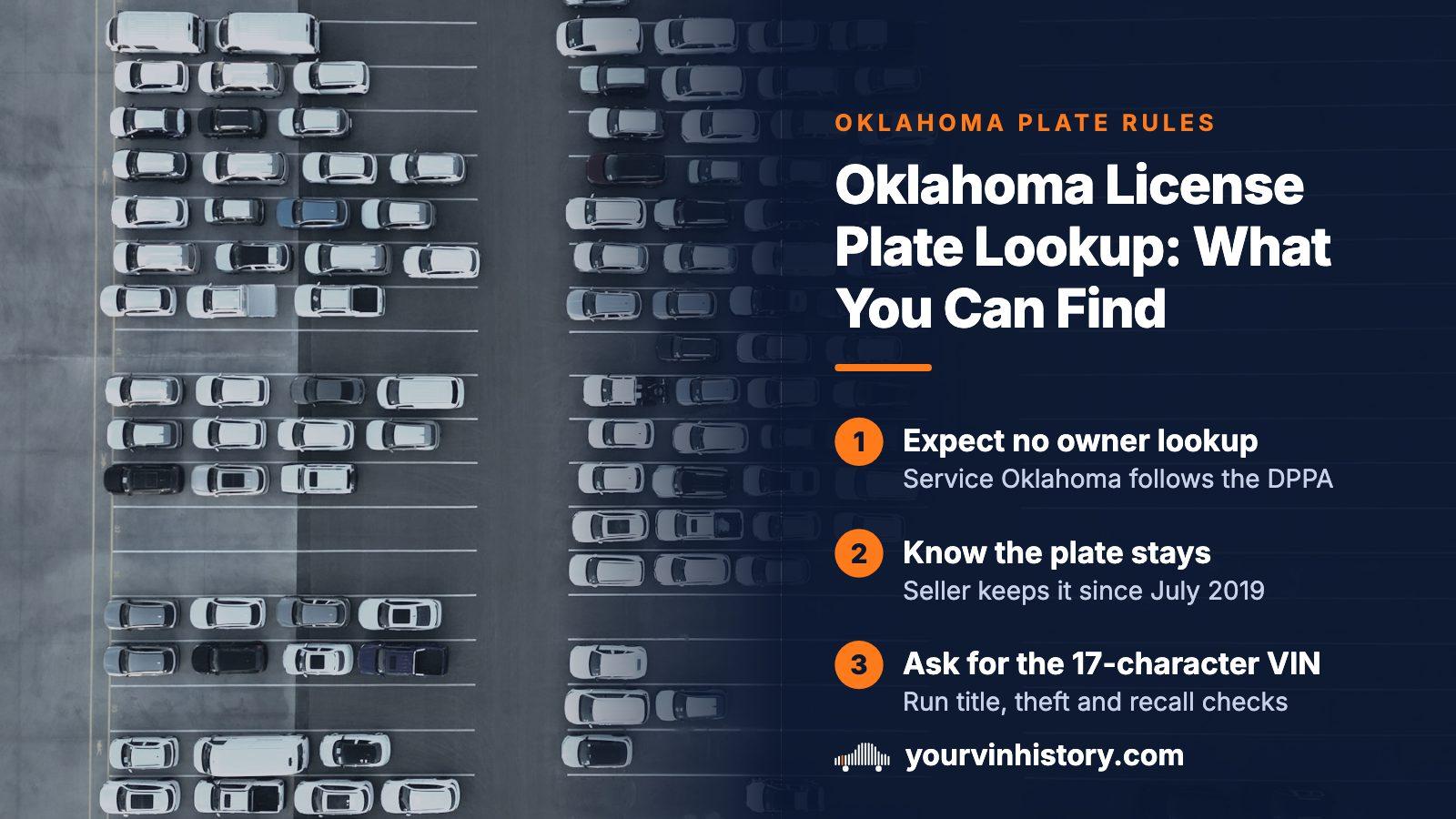
No public tool turns an Oklahoma plate number into an owner's name. Service Oklahoma releases owner details only for a use the federal Driver's Privacy Protection Act permits, such as an insurance claim or a court case. Since July 2019 the plate belongs to the seller, who removes it at sale. A buyer should ask for the 17-character VIN and run title, theft and recall checks on that.
- Owner records
- Released only for a use the federal privacy law permits
- At a private sale
- The seller keeps the plate, a rule in place since July 2019
- Pre-registration
- Due 2 business days after the sale
- Inspections
- No routine safety or emissions check for typical passenger cars
Why an Oklahoma plate will not give you an owner's name
A plate number is a pointer into a state record, and that record is the part the law protects. Under the Driver's Privacy Protection Act, a motor vehicle agency may not knowingly release personal information from its files except for a short list of permitted uses. Service Oklahoma, which handles the state's titles and registration, works inside that list.
Nothing on the agency's public-records page resembles a plate search. It offers yearly statistics on credentials and registered vehicles, plus county revenue reports, which are totals rather than people. Be skeptical of any website that advertises an Oklahoma owner's name for a fee: the state offers no public window for it to draw from, and what it resells tends to be stale.
The people who can request an owner record
The federal law names who may receive personal information and for what purpose. A requester states the use, and the agency decides whether it fits. The main categories are:
- Government agencies, courts and law enforcement doing their work
- Matters of vehicle safety, theft, recalls and emissions
- Insurers handling claims, fraud investigations or underwriting
- Civil, criminal, administrative and arbitration cases, including serving legal papers
- Notifying the owner of a towed or impounded vehicle
- Employers confirming a commercial driver's license
- Licensed private investigators, but only for one of the permitted purposes
- Anyone holding the individual's written consent
Curiosity about a seller, a neighbor or a driver who cut you off is not on that list. If someone hit your parked car and drove away, file a police report and call your insurer. Both can reach the record through a permitted use.
Since July 2019 the plate stays with the seller
Oklahoma once handled plates the way many states still do, leaving the tag on the car through a sale. A change that took effect in July 2019 reversed that. Service Oklahoma now says a license plate is assigned to the person, not to the vehicle, and its guidance for private sales says the seller keeps the plate that was on the car. The seller can carry it to the next vehicle.
That changes what you see at a viewing. A bare rear bumper on a privately sold car is normal, not a warning sign. The warning sign is a seller who offers to let you drive home on the old tag. The registration behind that plate belongs to the seller, and driving without your own plate and decals in place past the deadline risks a citation. Ask for the signed title and match the name on it to the seller's photo ID.
The clock that starts when you buy from a private seller
Service Oklahoma's Ready, Set, Tag process puts three deadlines on a private purchase. They apply to cars bought since the program began, so a car bought earlier followed an older timetable.
| Step | Deadline from the sale | What it involves |
|---|---|---|
| Pre-register | 2 business days | Buyer or seller files through the state's online portal or in person; there is no fee at this stage |
| Plate and decals on the car | 10 days | A metal plate carrying the pre-registration decals; the buyer handles this in a private sale |
| Full registration | 2 months | Title, sales and excise tax and proof of Oklahoma insurance, settled at a licensed operator or Service Oklahoma |
A buyer who already owns a plate can move it to the new car and add the decals to it. At a dealership the dealer does the pre-registration and issues a ten-day paper tag. Late registration carries daily penalties that the state says it cannot waive, so the two months are not a suggestion.
Licensed operators: the storefronts people still call tag agencies
Oklahoma's vehicle counters are run by private businesses the state used to call tag agencies and now calls licensed operators. They process titles, registration, renewals and plate orders under Service Oklahoma's rules, and you may pick a different one for each transaction. Because pre-registration and full registration are separate steps, you can start at one counter and finish at another.
Bring the paperwork the counter will ask for:
- The Oklahoma title, signed over by the seller
- The purchase agreement or the state's form for private sales
- Proof of Oklahoma insurance
- Your valid driver license
- An odometer disclosure statement, for vehicles new enough to need one
Convenient as it is, a licensed operator is a processor. The clerk checks that documents are in order and collects the money. Nobody examines the car or asks about its past, so a clean registration receipt says the paperwork was accepted and nothing more.
One plate on the back, and what holes up front suggest
Service Oklahoma's plate page asks for at least one plate properly installed on a registered vehicle, and an ordinary Oklahoma car carries that single plate at the back. The front bumper then becomes a quiet source of history. Two screw holes up front usually mean the car spent time in a two-plate state, and Texas next door requires a plate at both ends.
The holes prove nothing alone. They are a reason to read the title history for the states where the car was titled, and to ask the seller where it lived.
Design is a weaker clue. A newer standard design, the Iconic Oklahoma plate, is now issued, but current owners are not forced to swap, so two designs on the road do not date a car. The month and year decal matters more, and the state expects the registration receipt to stay in the vehicle. If the decal and the receipt disagree, ask before you pay.
Tribal, specialty and personalized plates
| Plate | What it tells you | Buyer's note |
|---|---|---|
| Standard | An ordinary registration | Two designs are legal on the road |
| Tribal | The owner qualifies through a tribal nation | The state itself issues them to Chickasaw and Choctaw members who live in Oklahoma; other nations use their own offices |
| Specialty | The owner chose a cause or organization from the state catalog | Like any plate, it stays with the seller |
| Personalized | Characters the owner picked and the state approved | Production can take months, so expect the seller to keep it |
Tribal plates are an everyday sight in Oklahoma. The state's tribal-plate page warns that holding one without authorization may lead to penalties, and that the Chickasaw and Choctaw versions cannot be sold to people with out-of-state addresses, with a narrow exception for active-duty military. Under the pre-registration rules a buyer can move a Chickasaw or Choctaw plate onto the new vehicle, while plates from other nations cannot be moved that way.
None of this changes how you check the car. A tribal plate describes its owner's eligibility, not the vehicle's past, and the VIN still carries the history.
No routine inspection, so the first exam is yours
Oklahoma does not run a periodic safety or emissions inspection for registering or renewing a typical passenger car. Registration is documents and fees. A car can pass through several Oklahoma owners without a professional ever looking at its brakes, frame or airbags, and the registration receipt reflects none of that.
Weather gives you another reason to look hard. Oklahoma sits in hail country, and a bad storm year sends damaged cars through insurers and auctions. Some return repaired and some return rebuilt. Look over the roof and hood in low, slanting light, ask about paintless dent repair, and read the title record for brands.
Pay a mechanic for lift time before you hand over money. In this state that is often the first inspection the car has had.
Reading the plate and paperwork at a viewing
Here is a short list to carry to a private-sale viewing:
- No plate on the car: expected, because the seller kept it. Check the signed title and photo ID instead.
- The seller's plate still mounted and an offer to drive home on it: decline, and register under your own pre-registration.
- Drilled holes on the front bumper: ask where the car was titled before Oklahoma.
- A decal that does not match the registration receipt: ask for an explanation before any money moves.
- A tribal plate: it speaks to the owner's eligibility, not to the car's record.
- Fresh paint on the roof or hood: ask about hail repair and look for a brand on the title history.
What to run on the VIN instead of the plate
If a seller texts only a plate number, ask for the 17-character VIN, which is on the car and printed on the title. Then work through these steps in order:
- Compare the VIN on the car, the title and the listing. A mismatch ends the conversation.
- Search NHTSA's no-cost recall lookup for open recalls on that VIN.
- Run the NICB VINCheck, a no-cost screen of theft and salvage records from participating insurers.
- Pull title records from NMVTIS, the federal system that tracks title brands, through an approved provider.
A vehicle history report from this site gathers title records, accident entries, odometer readings and auction history for a VIN into one document, after a free preview of what exists for that car.
Where this information comes from
- Service Oklahoma: vehicle registration and license plates — The agency's hub for plate ownership, Ready, Set, Tag deadlines, licensed operators, tribal plates and its public-records page.
- U.S. Code: 18 U.S.C. 2721, Driver's Privacy Protection Act — The federal rule that bars release of personal information from motor vehicle records except for listed uses.
- NMVTIS: National Motor Vehicle Title Information System — The federal title database and the route to consumer title reports through approved providers.
- NICB: VINCheck — A no-cost theft and salvage screen fed by participating insurers.
Sources and photos: Facts checked against the sources above in October 2026. Photo by Iain on Unsplash; diagrams by YourVINHistory.
Keep reading
- Oklahoma VIN checkThe state-level companion: what Oklahoma titles and a VIN search reveal about a car.
- License plate lookupThe national view of what a plate search can lawfully return.
- Bill of sale for a carWhat to get in writing when the seller keeps the plate and you take the car.
- What is a rebuilt title?Useful when hail repairs or a storm total shows up in a car's history.
Frequently asked questions
Is there a way to find out who owns an Oklahoma plate?
Not for curiosity. Owner details come from motor vehicle records that federal law restricts to permitted uses such as insurance claims, court cases and law enforcement. If you were hit by a driver who left, the police report and your insurer are the lawful routes. If you are buying, ask the seller for the VIN and the signed title.
Does the license plate stay with the car when you sell it in Oklahoma?
No. Since July 2019 the plate is assigned to the person, so a private seller keeps it and can use it on the next vehicle. The buyer starts a fresh registration. Dealer sales work differently: the dealer pre-registers the car and issues a ten-day paper tag until the metal plate and decals are on.
How long do I have to register a car I bought in Oklahoma?
Under the current process you pre-register within two business days of the sale, get a metal plate with pre-registration decals on the car within ten days, and fully register within two months. Pre-registration has no fee. Taxes, title and tag fees are paid at full registration, and late penalties cannot be waived.
Do Oklahoma cars need a plate on the front bumper?
No. An ordinary car needs one plate, mounted at the back, and the state's plate page asks for at least one installed. A bare front bumper is therefore normal. Screw holes there usually point to an earlier life in a two-plate state, which the title history can confirm.
Does Oklahoma require an inspection to register a car?
Not for a typical passenger car. Registration depends on the title, insurance, taxes and fees, with no routine safety or emissions test attached. Since no official process examines the vehicle, a pre-purchase inspection by your own mechanic and a records check on the VIN carry the whole verification load.
Now check the car itself
The guide explains what to look for. The report shows what this VIN has on record.