THE SHORT ANSWER
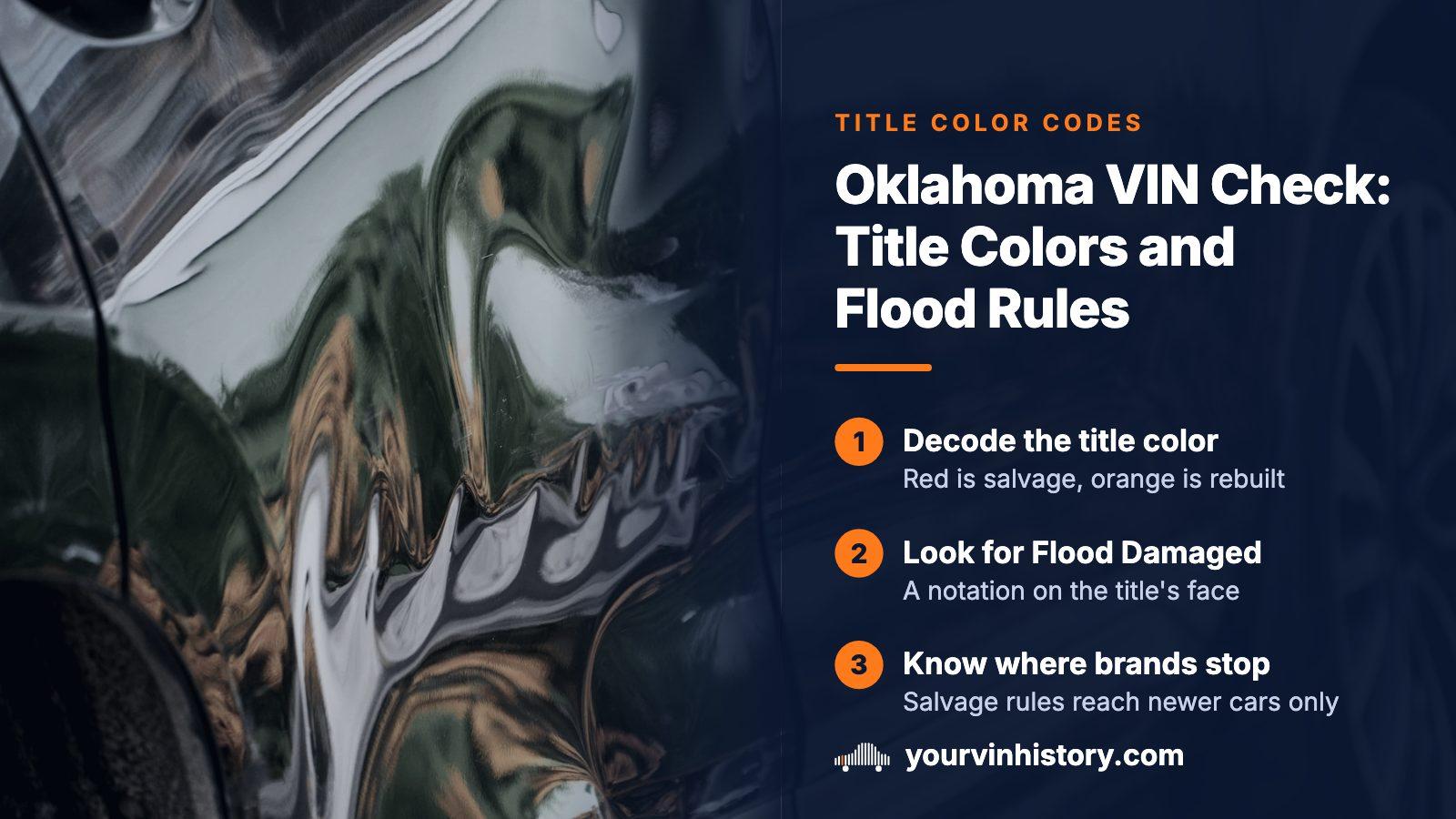
Match the VIN on the car to the title, then read the title color: green is standard, red is salvage, orange is rebuilt and blue is junked. Look for a Flood Damaged notation on the face. Add the NHTSA recall lookup, the NICB VINCheck and a national NMVTIS record, because the salvage rules reach only vehicles ten model years old or newer, and neither water nor hail damage always gets branded.
- Title colors
- Green standard, red salvage, orange rebuilt, blue junked
- Salvage age limit
- Vehicles ten model years old or newer
- Flood notation
- Flood Damaged, printed on the face of the title
- Entry inspection
- VIN and odometer check on cars arriving from other states
Oklahoma titles come in colors, and each color is a status
The Oklahoma Tax Commission assigns colors to its title types, so a vehicle's status shows before anyone reads a line of print. Chapter 60 of its rules sets the scheme.
| Color | Title type | What it tells a buyer |
|---|---|---|
| Green | Standard (classic titles are green too) | No salvage, rebuilt or junked classification on this certificate |
| Red | Salvage | Declared a salvage vehicle and not yet through a rebuilt inspection |
| Orange | Rebuilt | Was salvage, then repaired and passed a motor license agent's inspection |
| Blue | Junked | Unfit for road use, worth only parts or scrap, and permanently classed that way |
| Purple | Unrecovered theft | An insurer paid out a theft loss and the vehicle had not turned up |
| Yellow | Rebodied vehicle | A different body was fitted, so ask what it came from |
Notations can ride on top of the color. The rules call for Flood Damaged and Recovered Theft on qualifying titles, and vehicles bought by rental companies under their tax exemption carry a Rental Vehicle brand.
Where the brands stop: older cars and off-road machines
Oklahoma's salvage rule covers a vehicle ten model years old or newer. The age counts in model years, and the cutoff shifts when new models go on sale, which the rule treats as July 1.
Older vehicles can enter or leave salvage at any time, with no inspection needed to come out. An older car that arrives with another state's salvage title may receive either a red Oklahoma salvage title or a green standard title carrying a salvage date. On an older car, then, a green title proves little until you have read its face for a date and pulled a national record.
Off-road machines sit outside the system. ATVs, off-road motorcycles and utility vehicles receive only standard titles, and the salvage, rebuilt and junk procedures, the out-of-state VIN and odometer inspection and the damage declaration do not apply to them.
Red means salvage, and an inspection still stands between it and the road
In the Tax Commission's wording, a salvage vehicle is one damaged by collision or another occurrence badly enough that repairing it for safe highway use would cost more than a set share of its fair market value at the time of loss. The rule spells out that share, and the Service Oklahoma glossary repeats it.
Insurers have a part to play. One that pays a loss past that line, or pays a flood claim, has to tell the owner to surrender the title so a salvage title can replace it, and it also notifies the Motor Vehicle Division.
After repairs, the rule says the vehicle must pass a rebuilt inspection with a motor license agent before it goes into use. A red title on a car that is already being driven deserves a pointed question.
Orange means rebuilt, and the inspection tests identity more than workmanship
A rebuilt title follows an inspection by a motor license agent or the agent's staff. The rule lists what it consists of:
- The VIN on the car is compared with the number in the ownership records.
- The VIN and its plate are examined for alteration or other fraud.
- The VIN is run through the state's analysis system to confirm that it describes this model.
- The odometer is examined for rollback or alteration.
The owner brings the salvage title, receipts for every part added, which the agent validates, and proof of current liability insurance. A car that fails gets no rebuilt title unless an Oklahoma law enforcement agency authorizes one in writing.
What the list leaves out
None of those steps grades the repair work. Ask the seller for the parts receipts, which the agent returns to the owner, and pay an independent shop to look at the structure, airbags and wiring before you buy.
Blue means junked, and that classification does not wash out
A junked vehicle, per the rules, cannot be operated or used on the highway, has no resale value beyond parts or scrap, and has lost most of its fair market value. Anything another state brands junk, or the equivalent, receives an Oklahoma Junked Title, and once that title exists the classification is permanent.
An owner may also cancel the title by sending it to the Tax Commission with an affidavit, at no charge, once any lien is released and registration is current. After that, no later title or registration can be issued, and future transfers move on a certificate of ownership.
A blue title, or a seller offering a certificate of ownership where a title should be, usually points to a parts or scrap deal rather than a car you can register.
Flood Damaged: the dashboard line and the insurer payment
An Oklahoma title carries the Flood Damaged notation on its face in either of two situations:
- Any salvage or rebuilt vehicle whose damage came from flooding.
- A vehicle that sat in water up to the dashboard or higher and on which the insurer paid some amount of loss.
Read the second one closely, because it needs both facts together. A truck submerged past the dashboard whose owner lacked flood coverage, or never filed, produces no payment and so falls outside that test. The damage is identical either way. Only the record changes.
On the title application, an owner who reports water damage completes a flood disclosure, and a vehicle meeting the statutory criteria is branded Flood Damaged.
Water below the dashboard and hail rarely reach the title
A notation exists only where a rule triggers it, so common damage often goes unmarked. Water that stopped short of the dashboard still soaks carpet padding, seat mounts and any module bolted low in the cabin, and it keeps corroding after the car dries. Inspect for it regardless of the paper.
- Lift a carpet corner and look for silt, rust or a water line on the padding.
- Check seat rails and mounting bolts for corrosion.
- Smell the cabin for mildew or a heavy cover-up scent.
Hail runs the other way. A storm that dents panels but leaves repair costs under the salvage line earns no brand, and whether the car was claimed or fixed is the seller's story. Study the roof, hood and trunk lid in low, angled light, since dimples that vanish head-on show up in a reflection.
The entry inspection for cars arriving from another state
Before Oklahoma issues its first title on a car registered elsewhere, someone has to look at the car. The Tax Commission rule applies to previously registered vehicles entering from another state, except those meant for proportional registration.
The inspector compares the VIN on the vehicle with the number on the out-of-state paperwork and enters the odometer reading on the application. Motor license agents and authorized Tax Commission staff normally do the work. If the car is unavailable, the Oklahoma title is held until the inspection happens. The Commission may let another state's motor vehicle department or a state law enforcement agency carry it out there.
Two limits matter to a buyer. The inspection confirms identity and logs a dated mileage figure, but it does not research history. Separately, any brand on the other state's title must be carried onto the Oklahoma certificate unless the vehicle's age excludes it.
A brand that depends partly on the owner's own account
For a first Oklahoma title on a vehicle ten model years old or newer, the owner completes a declaration of damage or theft. New vehicles, and ones whose out-of-state titles already show a salvage or rebuilt brand, skip it. The owner answers to the best of their knowledge, and the answers steer the result:
- Stolen and recovered, repairs under the salvage line: the title is branded Recovered Theft.
- Damaged, repairs under the line: no brand.
- Damaged, repairs over the line: treated as a salvage title, whatever the cause.
- Flood or water damage meeting the statutory criteria: Flood Damaged.
That puts real weight on one person's account. Ask the seller the same questions directly, get the answers in writing, and compare them with a national title record before money changes hands.
An Oklahoma buying sequence, cheapest checks first
- Compare the VIN on the car, in more than one spot, with the VIN on the title.
- Read the color and the face of the title for a classification, a Flood Damaged or Recovered Theft notation, and any salvage date.
- Ask where the car was previously titled, how old it is in model years, and whether water or a large claim was ever involved.
- Run the NHTSA recall lookup by VIN and the NICB VINCheck, two no-cost searches from other organizations.
- Pull a national NMVTIS title record from an approved provider, which carries brands from every reporting state.
- Have an independent shop check for water, hail and repair quality before paying.
On recalls, the federal rule on no-charge repairs does not reach very old vehicles, so ask the manufacturer what an older car is still owed. A yourvinhistory report draws its NMVTIS title records from ClearVin LLC, an approved NMVTIS data provider, and starts with a preview before you decide to buy.
Where this information comes from
- Oklahoma Tax Commission: Motor Vehicle Rules, Chapter 60 — Source for the title colors, the salvage, rebuilt and junked rules, the Flood Damaged notation, the owner declaration and the entry inspection.
- Service Oklahoma: Motor Vehicle Glossary — Plain-language definitions of rebuilt, salvage and junk vehicles, including the repair-cost and value thresholds.
- NMVTIS: Vehicle History — The federal home of the national title record, with a path to approved providers that sell reports to consumers.
- NHTSA: Check for Recalls — The VIN search for open safety recalls, independent of any state title brand.
Sources and photos: Facts checked against the sources above in October 2026. Photo by Maxim Tolchinskiy on Unsplash; diagrams by YourVINHistory.
Keep reading
- Oklahoma platesSee how the 2019 plate change works and what a plate search can return.
- Flood-damaged carsFind the signs of water damage that a clean title can hide.
- What is a rebuilt title?Learn how an orange title affects value, loans and insurance.
- NMVTIS reportRead what the national record adds when a brand came from another state.
Frequently asked questions
Does Oklahoma require a VIN inspection when I buy a car?
The rule is written for vehicles entering the state from elsewhere, with an exception for those registered proportionally, so a car already titled in Oklahoma does not trigger it. If you are bringing a car in, a motor license agent or Tax Commission employee compares the VIN and records the odometer before the title issues.
Who performs an Oklahoma rebuilt inspection, and how long does scheduling take?
A motor license agent or someone the agent employs. After the owner files a request, the agent sets the date, time and place within ten working days. When the inspection is away from the rebuilder's shop, the agent issues a travel authorization for the drive. The inspection fee is paid only when the rebuilt title is issued.
Can a flooded car in Oklahoma still have a clean title?
Yes. The dashboard test needs an insurer payment, so an unclaimed flood leaves nothing under that branch. The water may also have stopped below the dash, or the flooding may have happened in a state that never branded it. A national title record and the NICB VINCheck can catch losses Oklahoma never saw, and a hands-on inspection covers the rest.
What does a certificate of ownership mean on an Oklahoma vehicle?
It is a transfer form the Tax Commission uses when a regular title has been canceled or is unavailable. For a vehicle ten model years old or newer, it may be used only after the title was canceled, with a scrap-dealer sale as the exception. Older vehicles that cannot be repaired for the road can use it after a lost title.
How do I check an Oklahoma car for open recalls?
Enter the 17-character VIN into NHTSA's recall lookup. It lists recalls not yet repaired on that exact vehicle. The federal rule on no-charge recall repairs does not cover very old vehicles, so an older Oklahoma car may call for a conversation with the manufacturer. A clean result says nothing about title brands, flood or hail.
Now check the car itself
The guide explains what to look for. The report shows what this VIN has on record.