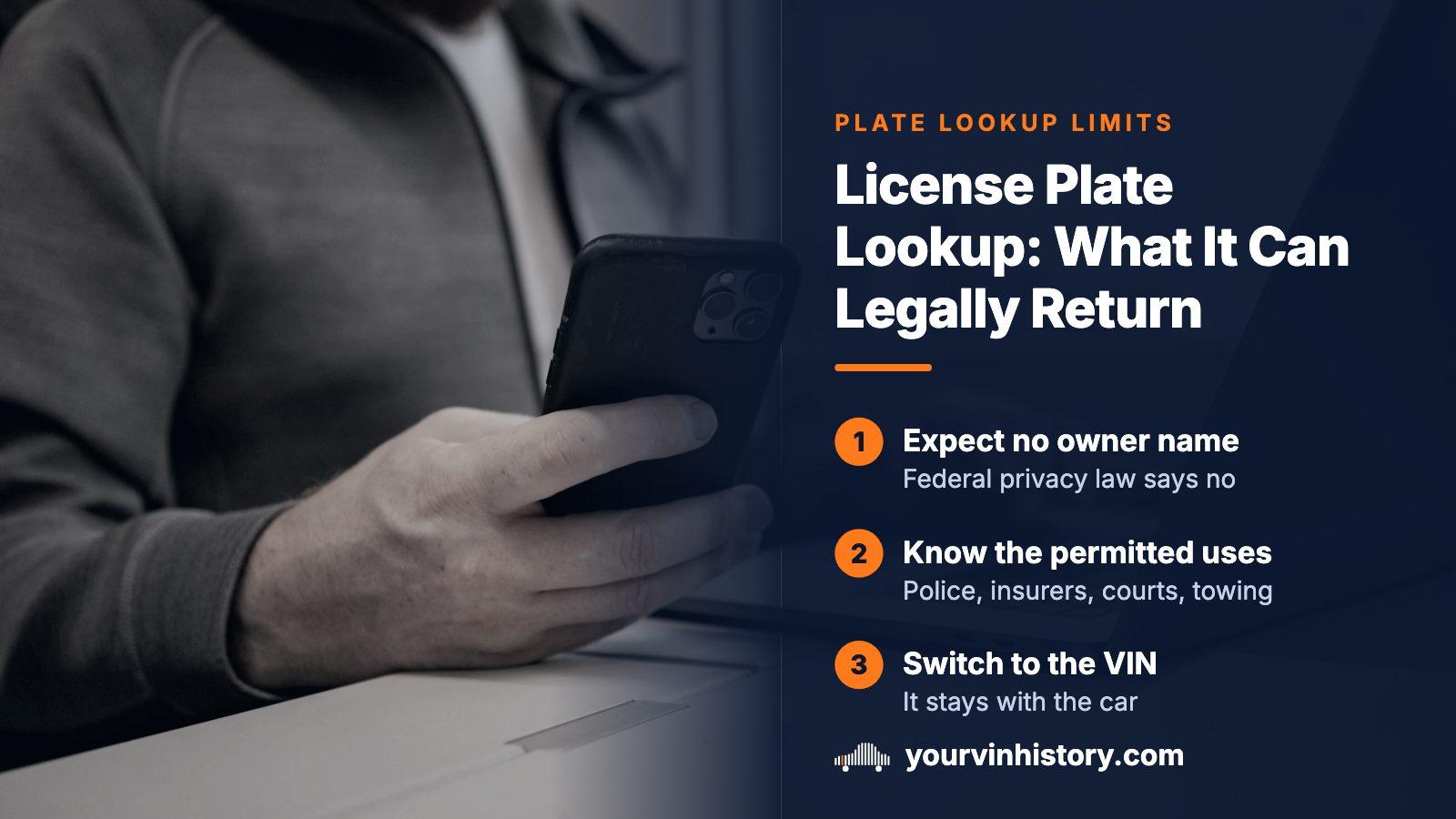
THE SHORT ANSWER
No consumer service can lawfully give you a plate owner's name or address. The Driver's Privacy Protection Act, passed in 1994, lets state agencies and anyone who receives their data release personal details only for listed purposes such as police work, insurance claims, litigation and towing notices. Idle curiosity is not on the list. A plate search can show vehicle facts, and the VIN is a more dependable way to get them.
- Governing law
- Driver's Privacy Protection Act, 1994
- Reach
- One federal floor in all 50 states
- Damages minimum
- $2,500 for the person whose record was pulled
- Better key
- The VIN, which stays with the car
What a plate search can and cannot hand back
Type a plate into a lookup box and two kinds of data are in play. One kind describes the vehicle: make, model, model year. The other kind points to a person: a name, a home address, a phone number, a photo. Federal law treats the two very differently.
The statute protects the second kind. Its definition of personal information covers anything that identifies an individual, including a name, address, telephone number, photograph, Social Security number and medical details. Facts about a vehicle are outside that definition, and so are accident records, driving violations and license status. That gap explains a common experience: a site shows a model year with confidence, then turns vague about whose name is on the registration.
The 1994 law behind the wall
The Driver's Privacy Protection Act became law in 1994, following the killing of an actress whom a stalker had located through her motor vehicle record. Before then, states commonly gave registration details to whoever asked. The statute reversed that default.
State motor vehicle agencies, along with their employees and contractors, may not release personal information from their files unless the request fits a use the statute lists. The restriction travels with the data. A company that buys records from a state, or from another reseller, may pass them on only for a listed use, and most recipients must keep records for five years showing who received the information and why. Penalties are criminal and civil, and data brokers are covered as fully as the agencies.
Who the statute lets through the door
The permitted uses sit in section 2721(b). They reduce to three ideas: an official duty, a business or legal relationship already in motion, or the individual's own consent.
| Permitted user | Purpose the statute recognizes |
|---|---|
| Police, courts and other government bodies | Official functions, which is the route a hit-and-run report takes |
| Insurers and their agents | Claims investigation, fraud work, rating and underwriting |
| Tow yards and impound lots | Notifying the owner of a towed or impounded vehicle |
| Licensed private investigators | Only a purpose the statute itself allows |
| Employers of commercial drivers | Verifying information on a commercial license holder |
| Parties to a legal proceeding | Serving papers, investigating before a suit, enforcing a judgment |
| Anyone holding the person's written consent | Records of the individual who agreed to share them |
Each entry rests on an official role, a transaction already under way or permission from the person concerned. A stranger who simply wants to know appears on no list, in any state.
Your state's name and local slang change nothing
The Act is federal, so adding a state name to the search produces no different rule. States may add limits on top of the federal floor, and several have; none can open owner identities to casual requests. A site claiming your state allows owner lookups is repeating its sales copy.
Vocabulary adds confusion. In Georgia, Florida, Alabama and much of the South, people say tag; elsewhere they say plate. Each word brings up different pages, so readers can conclude the answer depends on the word. It does not.
A temporary tag, the paper placard issued at the sale, often is not yet in any statewide database, so a blank result says nothing about the car. A vanity plate is a normal registration with custom characters, and its owner is as protected as anyone.
What lookup sites actually deliver after you pay
Search results for any plate phrase fill with sites that imply a name will appear. No consumer-facing service can lawfully supply one, so what follows payment is predictable.
- Make, model and year for the plate, offered as though that were the answer you asked for
- Unrelated public-records results under names the site is guessing at
- A subscription that was described as a single report
- A form that collects your contact information for the site to keep and use
- Nothing at all, with a refund process few people manage to complete
The promise is the warning
A site that offers to name the owner of any plate to any customer is advertising what the federal statute forbids. Treat the claim as the reason to close the page.
What the statute does to someone who pulls a record anyway
Most pages say the lookup is prohibited and stop. The useful half is who ends up on the hook, which explains why no reputable business sells owner searches to the public.
| Provision | What it establishes |
|---|---|
| Section 2722(a) | Knowingly taking or passing on personal details from a DMV file for an unpermitted use is unlawful |
| Section 2722(b) | Lying to get the information is a separate violation |
| Section 2723(a) | A person who knowingly breaks the chapter is fined under title 18 |
| Section 2723(b) | Civil penalty from the Attorney General, up to $5,000 per day, against a state agency that routinely ignores the chapter |
| Section 2724(a) | The person whose record was pulled may sue in federal district court |
| Section 2724(b) | Actual damages with a floor of $2,500, punitive damages for willful or reckless disregard, legal fees and costs, other equitable relief |
Subsection (b) of section 2724 deserves a close read. The $2,500 is liquidated damages, a minimum the statute sets without requiring a documented loss. So the law presses on both parties: the requester faces a damages minimum, and an agency that habitually ignores the rules faces a daily penalty.
Why a permitted-use dropdown is not a formality
Many data-broker checkouts show a menu of permitted purposes and ask you to pick one. That menu asks for a statement about yourself, and subsection (b) of section 2722 makes a false statement made to obtain the information a violation of its own. The violation lies in the request, not in the data that comes back.
- Choosing a purpose that is not truthfully yours is the conduct the subsection describes, not a box clicked in passing
- Liability under section 2724 runs to the person who obtained the data, not only to the seller
- A seller's willingness to take your money is no defense that the search was lawful
- Suspicion of a partner, a feud with a neighbor and plain curiosity are none of the permitted purposes
A reading of the text, not legal advice
This page describes what the statute says. Whether a given search was lawful depends on the facts; ask an attorney.
Plate or VIN: which number answers which question
Behind most plate searches sits one of two questions: is this car worth buying, or who is this person. The statute closes off the second. The first has better tools, and every one of them runs on the VIN, the identifier stamped into a vehicle for life. A plate can be swapped to another car or sold on, but the VIN stays with the vehicle.
| Question | Key | Where the answer lives |
|---|---|---|
| What the car is: build, engine, model year | VIN | A VIN decoder |
| Open safety recalls | VIN | NHTSA recall lookup, no charge |
| Reported stolen or declared a total loss | VIN | NICB VINCheck, no charge, built on participating insurers' data |
| Title brands and odometer records | VIN | An NMVTIS-based report, which costs money |
| Who owns it | Neither | Reserved to permitted users |
A yourvinhistory report is one paid route to the title and damage side. It starts from the VIN with a free preview, and the full report is a one-time purchase. Its title records come from ClearVIN LLC, an approved NMVTIS data provider.
Legitimate routes, matched to the situation
- Buying a car: ask the seller for the VIN. It can be read through the windshield, and a seller with nothing to hide has no reason to stall.
- Accident or hit and run: tell the police and your insurer. Both qualify under the statute, and identifying the driver is their job.
- Harassment or a safety threat: report it to law enforcement. A police report creates the record that lets officers act on the plate.
- Legal dispute: hire an attorney. Litigation is a permitted use, and counsel can obtain records in a form a court will accept.
- Abandoned vehicle: contact the city or county. Tracing the owner of an abandoned or towed vehicle is routine work for local authorities.
After a hit and run: the first day matters most
This is where the rule feels harshest, since you hold the plate and the damage and still cannot get a name. The route that works depends on what you collect before the scene clears.
- Write the plate down at once, because memory fades within minutes
- Take photos of the street, the damage to your car and loose debris before it is cleared
- Record the time, the place, the direction the car was heading and what it looked like
- Report the incident to the police that day, because the report is what lets officers act on the plate
- Give your insurer every detail, and ask about uninsured-motorist coverage, which often applies
- Ask nearby homes and shops about cameras soon, before recordings are overwritten
Sellers benefit from the same wall. Your name stays on the registration until the transfer is complete, so finish the paperwork promptly. Handing a buyer the VIN costs you nothing, since it describes the vehicle rather than you.
Where this information comes from
- 18 U.S.C. 2721: prohibition on release of motor vehicle records — The general rule against disclosure, the list of permitted uses and the limits on reselling the data.
- 18 U.S.C. 2722: additional unlawful acts — Makes it unlawful to obtain the data for an unpermitted use or to misrepresent yourself to get it.
- 18 U.S.C. 2723: penalties — Sets the criminal fine for individuals and the daily civil penalty for a noncompliant state agency.
- 18 U.S.C. 2724: civil action — Gives the person whose record was pulled the right to sue, with the damages floor and punitive damages.
- NHTSA: recalls — The no-charge open-recall check that runs on a VIN.
- NICB: VINCheck — A no-charge theft and salvage screen drawing on participating insurers.
Sources and photos: Facts checked against the sources above in October 2026. Photo by Anastasiia Nelen on Unsplash; diagrams by YourVINHistory.
Keep reading
- Where is the VIN number?Shows where to find the number worth asking a seller for in place of a plate.
- Vehicle registration lookupCovers what a registration record holds and who is allowed to see it.
- Motor vehicle recordsExplains the state files that the federal privacy rule protects.
- Free vehicle history reportSorts out which parts of a history check cost nothing and which only look that way.
Frequently asked questions
Can I find out who owns a license plate for free?
No lawful consumer service will do it, whether it charges or not. Price does not change what federal law allows. Owner details go to permitted users such as police, insurers and attorneys, or to someone holding the person's written consent. Everyone else is limited to facts about the vehicle.
Is it illegal to look up a license plate?
Typing a plate into a site is not the problem by itself. The statute targets knowingly taking someone's personal details from a DMV file for a use that is not permitted, and lying to get them. Seeing a car's make and model falls outside that definition. This summarizes the text and is not legal advice.
Can I check a used car's history from just the plate?
Only indirectly. Some sites turn a plate into make, model and year, but title brands, odometer entries and salvage events are filed under the VIN. Get the number from the seller or from the dash, then run the check on that. A plate can change hands and move between cars, while the VIN does not.
What if someone keeps parking outside my home and I have their plate?
Report it to the police with the plate, dates and times, and keep dated photos. A report gives officers a record to act on, and as a government agency they can identify the owner. Trying to identify the driver yourself through a lookup site can create legal trouble for you and may escalate a tense situation.
Can I look up my own license plate record?
The statute allows release with the individual's written consent, so your state motor vehicle agency, not a lookup site, is the place to ask for your own record. Request forms and any fees vary by state, so check your agency's website. That same consent route lets you authorize someone else to receive it.
Now check the car itself
The guide explains what to look for. The report shows what this VIN has on record.