THE SHORT ANSWER
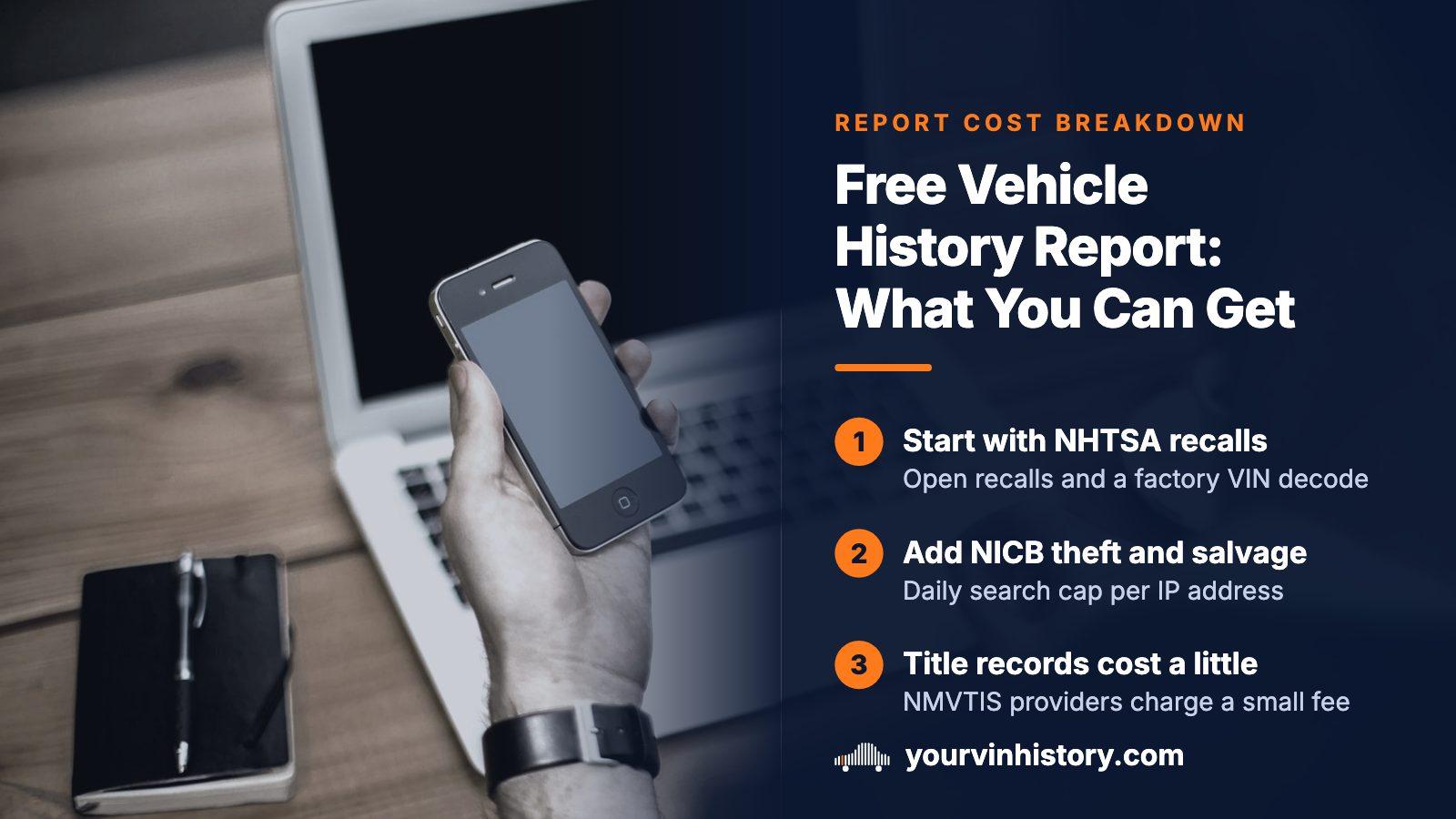
NHTSA gives you open safety recalls and a factory VIN decode at no cost, and NICB gives you a theft and salvage lookup, capped at five searches per IP address per day. Title brands and odometer data from the federal NMVTIS system cost a modest fee through approved providers. Detailed accident, service and owner history is licensed data, so no legitimate source hands it out free.
- Free from NHTSA
- Open recalls and a factory VIN decode
- Free from NICB
- Reported theft and salvage, five lookups daily
- Small fee
- Title brands and odometer data through NMVTIS providers
- Not free anywhere
- Detailed accident, service and owner history
A history report is three datasets stapled together
A history report reads like one document, but its contents come from three places that price their data very differently. Safety recalls and factory build records belong to the federal safety agency, which publishes them because publishing is its job. Title brands sit in a federal title system that states, insurers and salvage yards report into. Accident, service and ownership detail was gathered by private companies, and they sell it.
| Layer | Where it lives | What access costs |
|---|---|---|
| Recalls and factory build | NHTSA recall lookup and vPIC decoder | Nothing, and no account |
| Title brands and odometer at title | NMVTIS, through approved providers | A modest per-report fee |
| Accidents, service visits, owners | Insurers, repair networks and auctions, licensed commercially | Paid, with no free route |
The table doubles as a filter for sales pages. Whatever a site claims to show for nothing, ask which layer that information came from.
Three free checks and the question each one answers
Each free tool answers one narrow question. Run all three on any car you are seriously considering.
- NHTSA recall lookup: whether a manufacturer safety recall is still unrepaired on this exact VIN.
- NHTSA vPIC decoder: how the maker described this vehicle, which you can hold against the listing's year, body and engine.
- NICB VINCheck: whether a member insurer in the program filed the car as stolen and never found, or as salvage.
None of them asks for an account. The decoder works from patterns that manufacturers file with the government, so it tells you what the car was when it left the factory, not what has happened since. A mismatch between the decode and the ad is a cheap reason to stop early, before any title fee or report purchase.
The recall lookup is free to run and narrower than it sounds
NHTSA's tool accepts a 17-character VIN and returns safety recalls that are still unrepaired. Once the work is done, the recall drops off the list, so an empty result means nothing is outstanding, not that the car was never recalled. The search reaches back roughly 15 calendar years, and a recall announced last week may not show your VIN yet while the manufacturer finishes assigning them.
A maker's own lookup sometimes carries a brand-new campaign before the federal tool does, so on a late-model car it is worth checking both.
Free repair has an age cutoff
For most vehicles, a manufacturer must fix a safety recall at no charge to the owner. The federal rule stops applying once a vehicle was first sold more than 15 calendar years before the recall notice. On a very old car, ask the maker in writing what it will cover before you assume the repair costs nothing.
VINCheck is good for theft and salvage, weak as a clearance
The National Insurance Crime Bureau runs this lookup for the public. It needs no account and allows five searches per IP address per day, which matters when you are comparing several listings from one connection.
It flags vehicles that participating member insurers reported as stolen and not recovered, or as salvage. The qualifier carries the weight. A car written off by an insurer outside the program, or damaged and repaired without a claim, can return a clean screen. NICB states plainly that VINCheck is not a complete vehicle history.
- A hit is a reason to pause the sale and have the seller explain it in writing.
- A clean screen means no flag from this one source. It says nothing about repairs paid for out of pocket.
The title record costs a small fee, not nothing
NMVTIS is the federal system created to keep stolen vehicles from being resold and to curb title fraud. States, insurers and salvage yards report into it, but consumers do not query it directly. You request a report from an approved provider, and each provider sets its own price. The Justice Department's FAQ describes fees that vary by provider, from the high single digits to the low double digits in dollars.
A consumer report is built from these fields:
- Current and previous state of title, with the issue date
- The latest odometer reading on record
- Any brand and the date it was applied, such as salvage, junk or flood
- Total-loss and salvage history, plus theft history where it was reported
The limits are real. Not every state participates fully, some update in real time while others take days, and the system holds no repair history. An empty report may mean nothing was reported rather than nothing happened. The official provider list is alphabetical and says it is no endorsement, so compare prices yourself.
What stays behind the paywall, and why
The third layer costs money because somebody bought it. Companies that assemble it license records from insurers, repair chains, auction houses and fleet operators, and none of those parties publishes its data for free. Expect these items to sit on the paid side of the line:
- Accident detail, including severity and whether airbags deployed
- Service and repair visits logged by shops and dealers that share their records
- How many owners the car has had, and whether it served as a personal, rental, fleet or lease vehicle
- Odometer readings taken between title transfers, and not just at them
- Auction appearances and the prices they ended at
- Outstanding liens and loan holders
Anyone offering this layer at no cost is either showing a teaser or collecting something else from you.
Full reports you can see without buying one yourself
A full report does not always have to come out of your pocket. Several routes put one in front of you at no charge, each with a precaution.
- Dealers often run a history on their own inventory. Ask for it before you pay for one.
- A private seller who already ran a report may share it. Compare the VIN printed on it with the one on the car, and note when it was run. A report on another car, or a stale one, proves little.
- Certified pre-owned programs from some makers bundle a history report. Ask what the certification covers.
- Some insurance agents and public libraries can run a check for you, so asking costs nothing.
- Some state agencies offer a no-cost registration status tool. That is a different record from a title, which usually costs money.
Treat a report handed over by a seller as a lead to verify rather than proof, because the seller chose which one to share.
How sites that promise a free report usually work
Because the underlying data is licensed, a genuinely free full report is not a workable business. A site advertising one is doing something else. The common patterns:
- A free summary that charges to reveal the detail. That is legitimate if you know it going in.
- Your email address or phone number is the product being collected.
- A recurring subscription sold under the label of a single report.
- A free VIN decode presented as if it were a history.
- A request for payment details before the contents of the report are shown.
Read the scope before you enter a card
A trustworthy paid report spells out its scope ahead of payment. If the contents appear only after you pay, treat that as the warning sign.
An order of operations that spends nothing until it has to
- Read the VIN off the vehicle itself, at the lower corner of the windshield and on the door jamb label, and compare it with the title and the ad. Photograph it instead of retyping it.
- Decode it with the NHTSA decoder. A mismatch with the listing ends the process cheaply.
- Run the NHTSA recall lookup.
- Run NICB VINCheck before any money changes hands in a private sale.
- Order a title record from an approved NMVTIS provider.
- If the car is still a candidate, consider a full report for the accident, ownership and odometer detail.
- Pay for an independent inspection.
For step six, yourvinhistory.com shows a free preview for a VIN first, and the full report is a one-time purchase with no subscription. It covers title brands, accidents with a damage map, odometer readings, salvage and auction records with photos, liens, theft and open recalls.
What no report replaces: a mechanic's eyes
Every report, free or paid, lists what somebody recorded. Repairs paid in cash, damage nobody claimed, skipped maintenance and ordinary wear leave no filing anywhere. A pre-purchase inspection by a mechanic you choose, not the seller's, answers a larger question than any record can.
Carry the free results with you. An open recall, a decode that differs from the ad or a title brand gives the mechanic specific places to look. The free checks tell you whether the car deserves an inspection fee, and the inspection tells you whether it deserves your money. If the budget allows one step beyond the free tools, spend it there.
Where this information comes from
- NHTSA: Check for recalls — Where to search unrepaired safety recalls by VIN, and the source for how far back that search reaches.
- NHTSA: vPIC VIN decoder — The public decoder that reads the patterns manufacturers submit, used here for the factory-build check.
- Justice Department: NMVTIS (VehicleHistory.gov) — The federal title system, its list of approved providers, and its FAQ on report fields, provider fees and uneven state participation.
- NICB: VINCheck — The no-account theft and salvage lookup, with its daily search limit and its reliance on participating insurers.
Sources and photos: Facts checked against the sources above in October 2026. Photo by Alejandro Escamilla on Unsplash; diagrams by YourVINHistory.
Keep reading
- NMVTIS reportThe title record is the small-fee layer, and this goes deeper on what a provider's report lists.
- NICB VINCheck explainedVINCheck is the main free theft screen, so read what it matches and what it misses.
- What a report should costOnce you know which layers are free, see what a full report should cost.
- Pre-purchase inspectionThe one step no record replaces, and how to use the free results during it.
Frequently asked questions
Can I run a free vehicle history report by VIN?
Only in pieces. NHTSA covers open recalls and the factory decode, NICB covers reported theft and salvage, and a dealer or seller may share a report they already bought. Title brands cost a small fee, and detailed accident and owner records are not free from any legitimate source. Treat a site that promises everything as a paid product with a free front page.
Is NMVTIS free for consumers?
No. The data is federal, but consumers get it through approved providers, and each one sets its own fee. The Justice Department publishes the provider list at no charge and implies no preference among them. Ask to see exactly what the report includes, and remember that a state's own title record can hold more than the federal summary.
Does the NICB check show accidents?
No. VINCheck reports only vehicles that participating insurers listed as stolen and not recovered, or as salvage. A crash repaired through a body shop with no insurer total loss will not appear, and neither will a claim handled by a non-participating company. With five searches per day from one IP address, compare your shortlisted cars in one batch and save the results.
Are recall repairs free on an older car?
Usually, but not without limit. A manufacturer generally must fix a safety recall at no charge, and the federal rule stops covering a vehicle first sold more than 15 calendar years before the recall notice. A very old car may fall outside it, though some makers still help. Get the answer from a dealer before you buy, not after.
Why do free report sites ask for payment partway through?
The detail they show was licensed from insurers, repair networks and auctions, so someone has to cover the cost. Typical designs show a teaser, then ask for a card, an email address or a subscription. A free VIN decode is also sometimes dressed up as a history. Look for a clear statement of contents and price before you type any payment details.
Now check the car itself
The guide explains what to look for. The report shows what this VIN has on record.