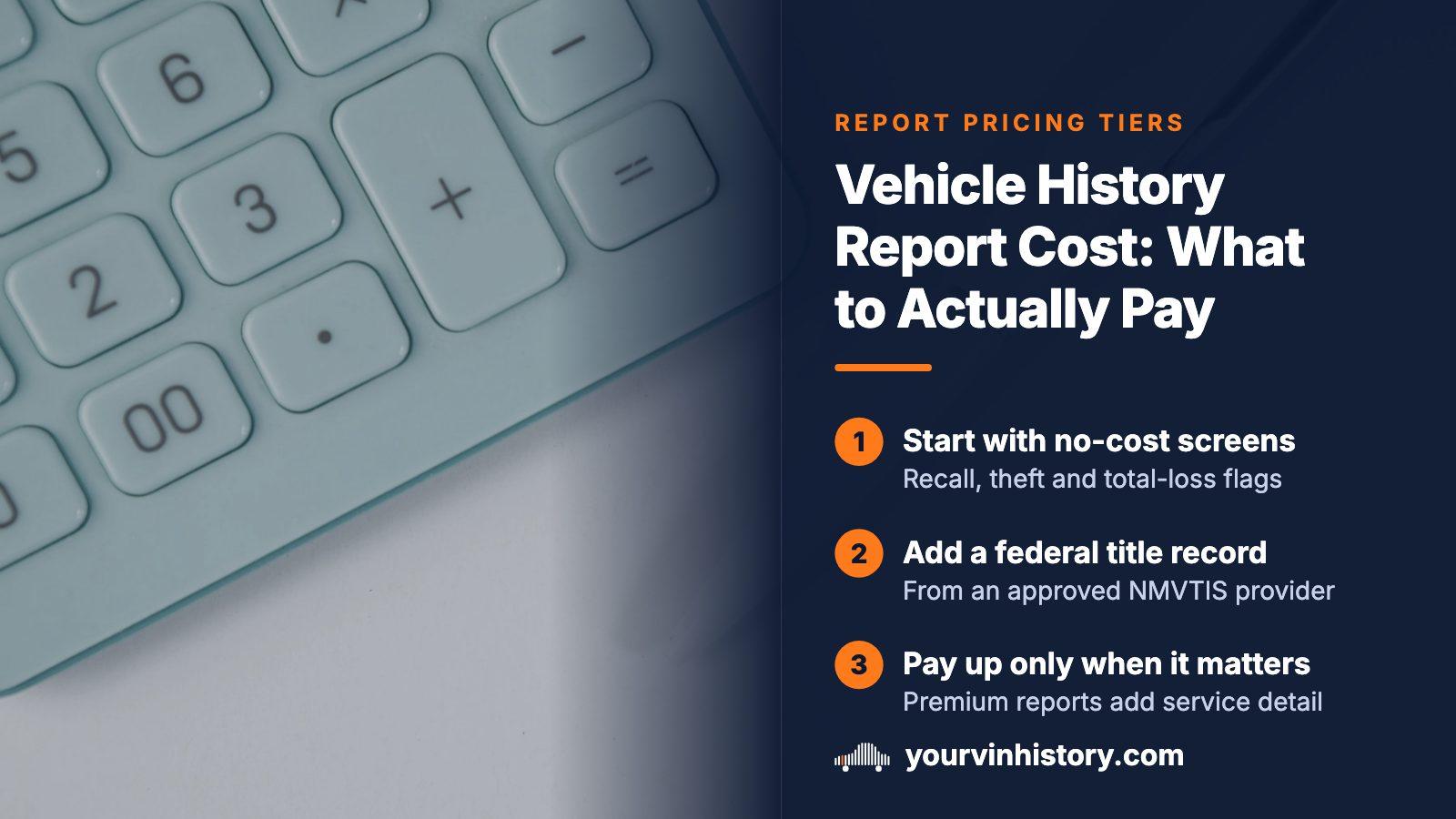
THE SHORT ANSWER
Pay nothing for recall, theft and total-loss screens, which come from NHTSA and NICB. Pay a few dollars for an NMVTIS title record from an approved provider once a car is a real candidate. Pay premium-network prices only when service and accident detail would change what the car is worth. Skip any site that promises a full history at no charge, and save your larger spend for a mechanic.
- Free lookups
- Open recalls, theft and total-loss flags, VIN decode
- Federal title record
- Usually single-digit dollars from an approved provider
- Premium network report
- Roughly ten times the price of the title record
- Not sold to consumers
- NMVTIS reports from Carfax, DMVDesk or Experian
Three price levels, three different kinds of data
Report prices make sense once you stop treating a report as a single product. Each price level draws on a different pool of records, and the pools answer different questions.
| Level | Typical cost | Where the data comes from | Best at |
|---|---|---|---|
| Free lookups | Nothing | NHTSA, NICB, VIN decoders | Open recalls, theft and total-loss flags, factory specs |
| Federal title record | Usually single-digit dollars | NMVTIS, sold by approved providers | Title brands, titling states, junk and salvage reports |
| Premium network report | Roughly ten times the title record | Dealers, repair shops, insurers, auctions | Service visits, accident detail, ownership timeline |
Prices drift by provider and over time, so read the ranges as a guide rather than a quote. Two mistakes cost people the most. One is paying premium rates for something a government site hands out. The other is skipping a title check that costs a few dollars on a car priced in the thousands.
What you can check without paying anything
Some useful checks cost nothing because someone other than a report vendor runs them. Do these on every car, before any money is on the table.
| Check | Run by | What it tells you |
|---|---|---|
| Recall lookup by VIN | NHTSA | Whether a safety recall is open on this exact vehicle |
| VINCheck | NICB | Whether a participating insurer logged the car as stolen or as a total loss |
| VIN decode | Free decoders online | Factory build, engine, trim and assembly plant |
| Title or emissions lookups | Some state agencies | Varies by state, so look on your state's motor vehicle site |
The limits matter as much as the price. None of these will show a salvage brand issued by another state, an odometer entry from a title transfer, or damage that never turned into a theft or total-loss claim.
A full history at no charge
A site that promises the complete history of any VIN at no charge is selling something else. The full title record is a paid product, so ask what you are paying with. Often it is your email address and phone number, or a trial that bills later.
The inexpensive federal record that does the heavy lifting
NMVTIS, the National Motor Vehicle Title Information System, is a federal title database overseen by the Justice Department's Bureau of Justice Assistance. State titling agencies, insurers and salvage businesses are required to feed it. That is why it can surface a salvage brand issued in one state after the car has been retitled in another.
You do not buy from the government directly. Approved providers sell reports built on the system, and the Justice Department publishes the list. Names that serve consumers include Bumper, CarVertical, ClearVIN, EpicVIN, GoodCar and VINAudit. The same page states that consumers cannot get NMVTIS reports from Carfax, DMVDesk or Experian, which serve dealerships. Consumer prices commonly land in single-digit dollars, though each provider sets its own.
Because the federal data underneath is shared, providers differ mainly in price, layout and any extra records they add. Check a provider's name against the list before you pay. This site's title records come from ClearVin LLC, one of the approved providers.
Price the whole search, not one report
A single report price hides how people actually shop. A search can look like this: a dozen listings, a few test drives, serious interest in two or three cars, and one purchase. What leaves your account is the cost of that whole funnel.
| Stage | Check | Cost |
|---|---|---|
| Every listing you shortlist | VIN decode, recall lookup, theft and total-loss screen | Nothing |
| The two or three you pursue | Federal title record | A few dollars each |
| The one you plan to buy | Premium report, if service history affects value | Premium price |
| Before money moves | Independent mechanic inspection | A shop's inspection fee |
The arithmetic makes the case. One premium report costs about what the title record costs across ten cars. Buying premium detail on a car you have not driven pays for a story about something you may never own. Breadth belongs early, when it is cheap and strikes cars off the list. Depth belongs late, when a single car is truly in play.
Matching the spend to the car in front of you
- A shortlist of cars you have not seen: free lookups only, with no cash out until one of them becomes a real candidate.
- A private sale above a couple of thousand dollars: free checks plus the federal title record.
- A car priced far under similar listings, or one that looks branded: pull the title record before you schedule a viewing.
- A late-model car at a high price: add a premium report if service history would change your offer.
- A dealer who hands you a report: read it, then run your own title check.
Age changes the picture. A two-year-old car has had little time to collect entries, so a quiet report on it says less than the same quiet report on a ten-year-old car. For young cars, title status is the part that is actually knowable, which makes the cheap federal record the better buy there.
Timing is the other lever. Running cheap checks before you travel saves the hour-long drive to see a car with a washed title. Premium spending can wait until you are close to an offer.
The report the seller hands you
Sellers often offer a report at no cost to you. Take it, because more data never hurts, but understand that it differs from a report you buy yourself. Three things set them apart.
- Choice of network: whoever paid for it picked the vendor, and vendors draw on different reporting partners, so two services can return different histories for one VIN.
- Timing: a report is a snapshot from the day it was run. If the car has sat on a lot for weeks, a title action, auction entry or new recall may have been logged after your copy was printed.
- Custody: you were shown a report, not given one. You usually cannot rerun it, compare it with a second vendor, or send it to your mechanic or bank.
Use it for the questions it raises, such as a service entry to ask about, a past address, or a date that should match the car's wear. It does not replace the federal title record, which you can pull against the VIN on your own.
Subscriptions, trials and packs
Some services charge for one report about what a month of unlimited access costs. That suits a heavy shopper and punishes anyone who forgets to cancel. Two patterns deserve suspicion: a trial that rolls into recurring billing, and a checkout labeled as one report that quietly enrolls you.
Read the terms on the payment page before entering a card. If a subscription really fits your search, put the cancellation date in your calendar on the day you sign up. Multi-report packs lower the per-report price, but a pack only saves money if you will run enough cars to use it.
For comparison, yourvinhistory.com shows a free preview first and sells the report as a one-time purchase, either a single report or a pack, with no subscription.
Where the bigger sum belongs: a mechanic
The Federal Trade Commission is blunt on this point: a history report is not a substitute for an independent inspection. Reports can reveal accidents and flood damage, but they usually miss mechanical problems, and a worn transmission leaves no entry anywhere.
The FTC advises paying an independent mechanic to inspect the car even when the dealer says it is certified. Ask for a written report listing the make, model, VIN and estimated repair costs, since those estimates give you something concrete to negotiate with. If a dealer will not allow an outside inspection, the agency's suggestion is to shop at another dealer.
Dealers must also post a Buyers Guide on each used car, stating whether it carries a warranty or is sold as is. Compare it with what the report and the inspection tell you before you sign.
Where this information comes from
- Bureau of Justice Assistance: NMVTIS approved data providers — Lists which providers sell NMVTIS reports to consumers and which sell only to dealerships and other commercial buyers.
- NHTSA: Recalls — The regulator's VIN lookup for open safety recalls, which costs nothing to run.
- NICB: VINCheck — A theft and total-loss lookup drawn from participating insurers, usable before any money is spent.
- FTC: Buying a Used Car From a Dealer — Says a history report does not replace an independent inspection, and explains the Buyers Guide dealers must display.
Sources and photos: Facts checked against the sources above in October 2026. Photo by Sasun Bughdaryan on Unsplash; diagrams by YourVINHistory.
Keep reading
- Carfax alternativesLower-cost routes to the same questions a premium report answers.
- NMVTIS reportWhat the inexpensive federal title record shows and what it leaves out.
- Billing transparencyHow a one-time purchase differs from recurring charges, and what the law says.
- Pre-purchase inspectionThe mechanic's check that no report at any price replaces.
Frequently asked questions
What should I expect to pay for a vehicle history report?
That depends on the data behind it. Recall and theft checks cost nothing. Title reports built on federal NMVTIS data usually run a few dollars from approved providers. Premium network reports from Carfax or AutoCheck cost roughly ten times more, though multi-report packs lower the per-report rate. Prices change, so compare the checkout page rather than trusting an old figure.
Do paid history reports earn their price?
For a car priced in the thousands, the cheap title record usually is, since it targets branding fraud that no test drive reveals. A premium report pays off less often. It earns its cost when service records or accident detail would shift your offer. No report replaces a mechanic, because reports record events, not the condition of the parts.
Why is Carfax more expensive than other reports?
The Justice Department's page says consumers cannot get NMVTIS reports from Carfax, DMVDesk or Experian, since those serve dealerships. So a Carfax price does not buy federal title access. It reflects feeds assembled from dealers, repair chains and insurers, and the cost of acquiring them is recovered report by report.
Can I get a vehicle history report for free?
Parts of one. NHTSA's recall lookup, NICB's VINCheck and a VIN decoder cost nothing, and a seller may hand you a report they already paid for. The full title record is a paid product, so a site claiming to give it away should explain how it earns money before you type your details into it.
When in the process should I pay for a report?
Run the free checks and a title record before you travel, since a washed title is cheaper to discover from your couch than after a long drive. Hold any premium report until you are close to making an offer on one car. After the viewing, the next spend is a mechanic's inspection, not another report.
Now check the car itself
The guide explains what to look for. The report shows what this VIN has on record.