THE SHORT ANSWER
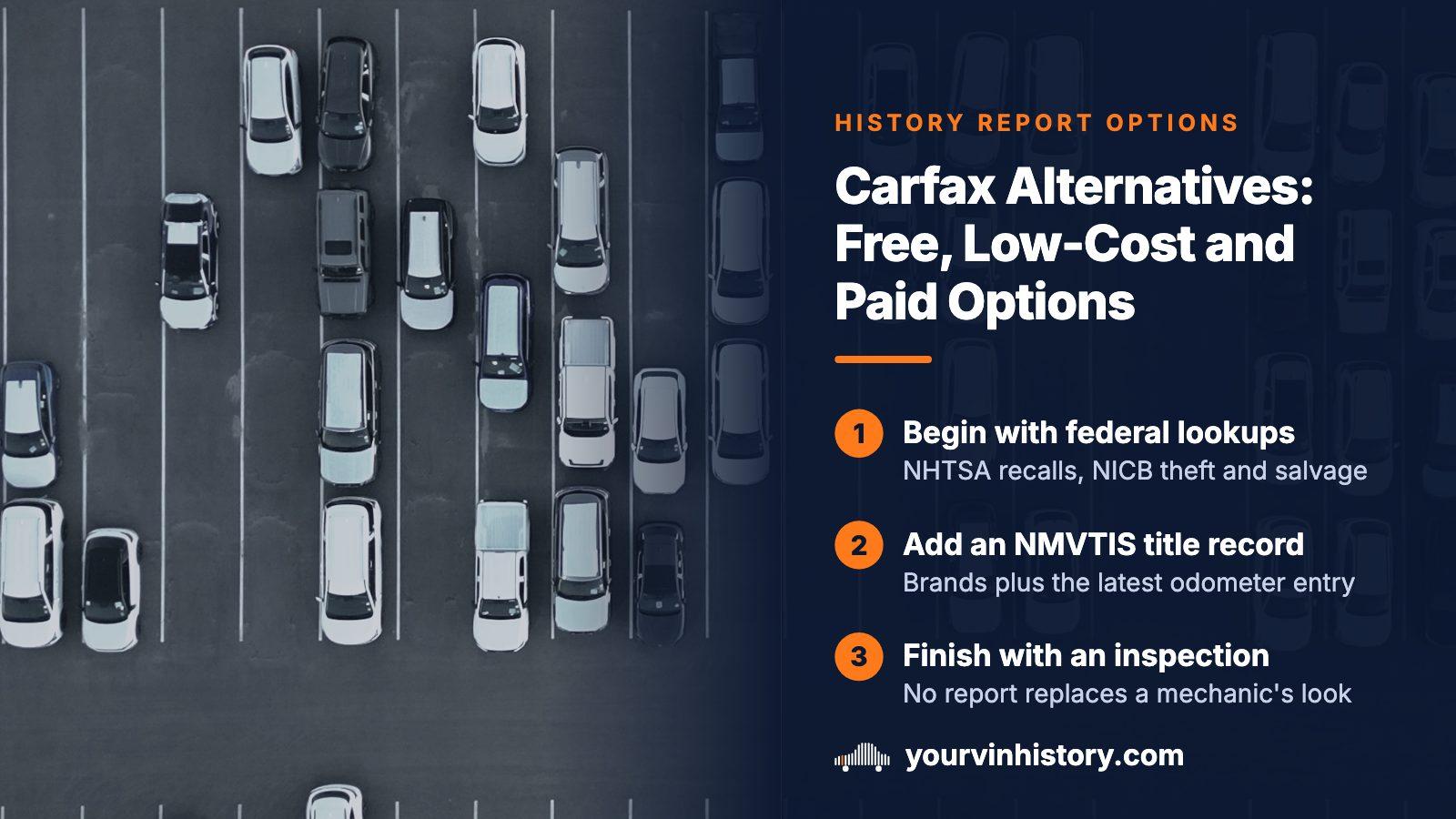
The best alternative depends on what you need to learn. Recalls, factory specs and theft or salvage flags come from free NHTSA and NICB tools. Title brands and the latest reported odometer entry come from an approved NMVTIS provider for a small fee. Accident, service and owner entries need a paid commercial report, and AutoCheck is the closest like-for-like. No free source offers a full history.
- Free tools
- NHTSA decoder and recall lookup, NICB theft and salvage search
- Title brands
- NMVTIS record from an approved provider, small fee
- Accident and service entries
- Paid commercial report only
- Never replaced by a report
- Independent pre-purchase inspection
Three reasons buyers go looking for a Carfax substitute
Most people who search for an alternative land in one of three spots. Some find the price of a commercial report hard to justify on a car they may never buy. Some have heard that the federal title record can be bought separately and want exactly that. Others already hold one report that looks thin and want a second opinion before they pay a seller.
Each motive points to a different product. A substitute is rarely the same data at a lower price. It is usually a different source that answers a narrower question, which can be a bargain or a trap depending on whether it matches the question you actually have.
Which source holds which piece of a car's record
Before comparing brands, sort your questions. The table pairs each thing a buyer wants to know with the place that actually keeps it.
| Question | Where the answer lives | Cost class |
|---|---|---|
| What was the car built as? | NHTSA vPIC decoder | No charge |
| Is a safety recall still open? | NHTSA recall lookup by VIN | No charge |
| Did an insurer report it stolen or salvaged? | NICB VINCheck | No charge |
| Is the title branded, and what is the latest odometer entry? | NMVTIS, through an approved provider | Small per-report fee |
| Which accidents, service visits and owners were logged? | A commercial history network | Paid report |
| Is it sound today, and was damage ever fixed off the books? | An independent mechanic | Shop's inspection fee |
Reading down the table, the cost climbs as the question gets broader. Each row answers its own question, and none of them stands in for another.
Start with the checks that cost nothing
Three public tools handle a surprising share of early screening. The vPIC decoder reads a VIN against patterns that manufacturers submit and returns basic build data, so a seller's claim about trim or engine gets tested in seconds. NHTSA's recall page takes a VIN and reports whether a recall repair is outstanding. NICB's VINCheck searches theft and salvage records supplied by participating member insurers, and it allows five searches a day.
Know the limits. A decode tells you how the factory built the car and nothing about its life since, and a vehicle never meant for the U.S. market returns a thin result. VINCheck sees only the insurers that take part, and NICB says plainly that it is not a full history report. On recalls, very old vehicles can fall outside the federal free-repair rule, and the lookup may not list their oldest campaigns, so ask a franchised dealer for that brand before assuming anything.
The small-fee tier: a federal title record
NMVTIS is the federal database that state titling agencies, insurers, junk yards, salvage yards and auto recyclers must report into. It exists so a brand stamped on a title in one state follows the car across a state line. Consumers reach it through approved providers, which charge a small fee. Pricing structure varies, so confirm you are buying one report before you enter a card.
The Justice Department calls the report intentionally concise and builds it around five items: current title state and last title date, brand history, odometer reading, total loss history and salvage history. A clean result is good news, with one caveat. Not every state and reporting entity feeds the system equally, so a search can miss something.
- Holds: title status, brands, the latest reported odometer reading, total loss and salvage entries
- Not meant to hold: repair histories, recall information and routine maintenance data
- Where to buy: a provider named on the Justice Department page, never just a search result
What the Justice Department's provider list says about Carfax
The Justice Department publishes its list of approved NMVTIS data providers, and the page sorts them into two groups. One group serves everyone, consumers included. The other is labeled for commercial customers only.
| Group on the list | Businesses named |
|---|---|
| Commercial and public customers | Bumper, Carsforsale, carVertical, CheckThatVIN, ClearVin, EpicVin, GoodCar, Titlecheck, VinAudit, VinData, VinReport, VINsmart |
| Commercial customers only | Six businesses, among them AIB, CARFAX, Experian, Vitu and Yassi |
CARFAX.com sits in the second group, with a parenthetical stating that its NMVTIS data is available to California commercial customers alone. The page also carries a standing note that consumers cannot receive NMVTIS reports from Carfax, DMVDesk or Experian, which it says serve car dealerships only. AutoCheck is a part of Experian.
Read that narrowly. It describes who may buy one federal dataset through one company. It says nothing about the quality of Carfax's own reports, and Carfax does appear on the list. Providers can change groups, so read the live page before relying on this table.
When only a commercial history report will answer
Accident entries, service visits and owner counts are not part of the federal record. They come from private networks fed by repair shops, dealers, auctions and similar reporters, and no free government tool carries them. If those facts decide whether you buy, a paid commercial report is the right instrument, and AutoCheck is the nearest like-for-like rival to Carfax.
Do not expect two commercial reports to match. Each draws on its own set of reporters, so one may hold an entry the other never received, and both can miss work paid for in cash at a shop that reports to nobody. Running both can make sense on an expensive purchase, though an inspection often adds more for the same money.
Questions to put to a lower-priced report service
Plenty of smaller services sell VIN reports for less than the big names. Many package NMVTIS records in their own layout, which is a legitimate product when brands and title history are what you need. It is the small-fee tier in a different interface, not a commercial report, and a provider built only on NMVTIS cannot show accident entries the federal system never held.
- Is the business on the Justice Department list, or does it merely claim federal data?
- Does the site describe what the report covers before it asks for a card?
- Is a sample report published where anyone can open it?
- Is this a single purchase or a recurring charge?
- Does the free portion show anything beyond what the government tools already give you?
For disclosure, this site also sells reports by VIN: the preview is free, the report is a one-time purchase, and its NMVTIS title records come from ClearVin LLC, an approved provider in the public group above.
Try a service on a car whose past you already know
Rankings and star ratings say little about whether a service will find anything on the car in your driveway. A cheaper test works better. Enter the VIN of a vehicle whose history you can confirm, such as your own, a relative's or one you sold, and compare the output with what you remember: a collision, a branded title, the mileage at the last sale.
Perfect agreement is not the goal, since records are incomplete everywhere. What matters is whether the service finds something on a car that has a past, and whether it fits what you know. A confident, spotless report on a car you know took a hard hit shows how much its silence is worth on the next VIN. The Justice Department raises the same caution about its own data, warning that a search can return a false negative.
Free full reports: the real routes and the imitations
Full commercial history data is licensed, so no provider gives it away. The genuine free routes are reports someone else already paid for. Dealers often supply one on cars they sell, a private seller may share one they ran, and some certified programs include one. Check that the VIN printed on it matches the car character for character, and look at the date it was run. A report on another car, or from last year, proves nothing today.
Be wary of sites that dress up something else as a free report.
- A summary that charges to reveal any detail
- An email address or phone number demanded before any result appears
- A subscription enrolled under the label of a single report
- A VIN decode presented as if it were a history report
- Card details requested before the coverage is described
The check nothing replaces, and the order to run everything
Reports record what someone reported
Cash repairs, damage no insurer saw, deferred maintenance and corrosion generate no record anywhere. The Justice Department encourages buyers to obtain an independent vehicle inspection alongside a history report and other resources. An inspection often costs about what a paid report does, and it describes the car in front of you.
A sequence that spends the least money first:
- Decode the VIN and confirm it matches the listing.
- Look up open recalls.
- Run the NICB search before any money changes hands in a private sale.
- Buy the NMVTIS title record from a provider in the public group on the Justice Department page.
- Buy a commercial report only if the car is still a candidate and accident or service detail matters.
- Book the independent inspection.
Where this information comes from
- U.S. Department of Justice: Approved NMVTIS data providers — Shows the two provider groups, where CARFAX.com and Experian.com sit, and the note about which companies consumers cannot buy NMVTIS reports from.
- U.S. Department of Justice: Understanding an NMVTIS vehicle history report — Backs the list of five report items, the reporting sources, and the point that private companies add repair and maintenance data.
- NHTSA: Check for recalls — The government's VIN lookup for open safety recalls.
- NHTSA: vPIC VIN decoder — Decodes a VIN into manufacturer-supplied build data and explains which vehicles it covers.
- NICB: VINCheck — Theft and salvage search drawn from participating insurers, limited to five lookups per day.
Sources and photos: Facts checked against the sources above in October 2026. Photo by Iain on Unsplash; diagrams by YourVINHistory.
Keep reading
- AutoCheck vs CarfaxThe closest paid rival, and how its reporting sources differ from Carfax's.
- Carfax reviewWhat the Justice Department notes mean for buying the federal record through Carfax.
- Free Carfax reportThe legitimate ways to read a report without paying for it yourself.
- Pre-purchase inspectionWhat a mechanic examines that no database can show.
Frequently asked questions
Is there a free alternative to Carfax?
Only for parts of the picture. NHTSA tools cover the factory decode and open recalls, and NICB covers insurer-reported theft and salvage. No free source supplies accident, service and ownership detail, because that data is licensed. Run the free tools first, since a mismatch or a flag often ends the search before you spend anything.
Is AutoCheck a good alternative to Carfax?
Yes, if you want a paid commercial report built the same way. AutoCheck is the nearest like-for-like option. Because the two draw on different groups of reporters, the same car can show different entries in each. Buyers weigh service entries against auction coverage differently, and on a large purchase some run both.
Can a consumer buy the NMVTIS report from Carfax?
The Justice Department's provider page says consumers cannot receive NMVTIS reports from Carfax, DMVDesk or Experian, and it lists CARFAX.com among the commercial-only providers with a California note. Consumers can choose from the providers in the public group instead. Status can change, so confirm on the live page before you buy.
How can I tell whether a VIN check site is legitimate?
Ask where its data comes from. If a site claims federal title records, find its name on the Justice Department list. Look for a published sample report, a coverage description before payment, and a single-report price instead of a recurring charge. Polished layouts and glowing reviews prove nothing about the source, so test it on a VIN you know.
Does a clean report mean the car is fine?
No. A blank-looking report may come from a car with no history to find, or from a service with little data behind it, and nothing on screen separates the two. The Justice Department notes that NMVTIS searches can return false negatives while reporting is incomplete, and private databases have similar gaps. Treat a clean result as one input, then add an inspection and a look at the service paperwork.
Now check the car itself
The guide explains what to look for. The report shows what this VIN has on record.