THE SHORT ANSWER
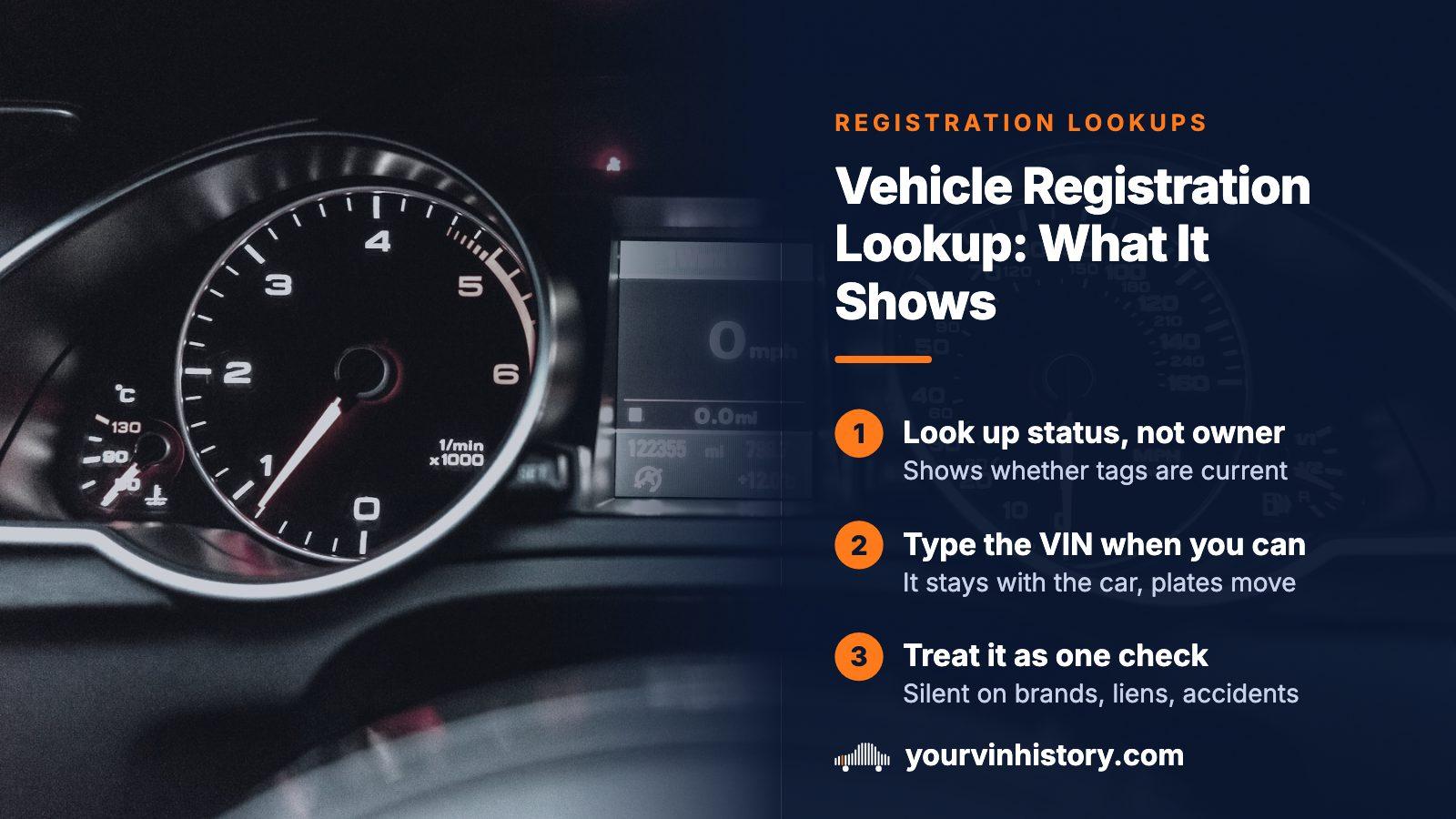
You can look up a vehicle's registration status, but not its owner. A handful of state motor vehicle agencies run public tools that show whether registration is current, using a plate, a VIN or a title number. The Driver's Privacy Protection Act shields names and addresses. Registration also says nothing about brands, liens or accident history, so treat it as one check among several.
- What it shows
- Whether registration is current, and when it expires
- What it never shows
- The owner's name or address
- Better key
- The VIN, which stays with the car
- Governing law
- The federal Driver's Privacy Protection Act
The one question a registration lookup answers
Registration is a state's permission for one vehicle to use public roads. It renews on a cycle, usually with fees, and in some states only after an emissions or safety inspection has been passed. A lookup checks a single thing: whether that permission is in force today and when it runs out.
That narrow scope explains most of the disappointment. People enter a plate expecting a life story and get back a date. The date still has value. Tags kept current for years suggest a seller who paid fees and passed tests on schedule, which says something modest but real about how the car was treated.
Five things a clean registration still hides
Registration is its own record, separate from the ones that hold the facts below, so a current tag can sit on a car with serious problems.
- Ownership. The registrant receives the renewal notice. That person may differ from the titled owner, as with a lease or a company fleet.
- Brands. Salvage, flood and rebuilt labels are written on the title, so a branded car gets registered just like a clean one.
- Liens. A lender's claim attaches to the title, so a car can be registered while a loan against it sits unpaid.
- Insurance today. Some states check coverage at renewal, but a policy can lapse the day after.
- Accidents and odometer history. Neither is part of a registration record.
Each fact lives somewhere else, which is why a registration check sits beside a title check instead of replacing it.
Which state portals answer a buyer's question
No national registration database is open to the public, so what you can do depends on where the car is registered. A handful of agencies publish real lookup tools. Most others offer renewal pages built for the owner.
| State | Tool | What a buyer can expect |
|---|---|---|
| Florida | Motor Vehicle Information Check (FLHSMV) | Accepts a VIN or title number and returns title and registration details |
| Wisconsin | License plate search (state DMV) | Needs the plate; shows expiration date, vehicle year, make and a renewal reference number, with no name or address |
| Georgia | DRIVES e-Services (Department of Revenue) | Lists registration and insurance status lookups; see what the screen asks you to enter |
| Connecticut | DMV online services | Has a registration status lookup; its insurance check asks individuals for a driver's license or ID number |
Portals get renamed and go offline for maintenance, so start from the agency's own website and not from an ad. When your state offers nothing public, the paper comparison further down works anywhere.
Plate or VIN: which to type
Where a tool offers the choice, use the VIN. A plate belongs to a registration, not to a car. It can move to another vehicle at a sale, be turned in, be reissued, or be typed with one wrong character, and the screen will describe whatever vehicle it finds. The VIN is stamped on the car and never changes.
Some tools take only plates, and Wisconsin's public search is one. In that case use the year and make it returns as a cross-check against the car in front of you. A mismatch means a typo or a plate that belongs to another vehicle, and either one needs sorting out before you go further. Copy the VIN from the car itself, not from the listing.
Reading what comes back
| Result | What it usually means | Your move |
|---|---|---|
| Current | Fees are paid and any required inspection was passed | Note the expiration date and keep going with the other checks |
| Expired | A renewal is overdue, possibly with late charges or a test the car has not passed | Ask why, then price the catch-up cost |
| Suspended | In some states, an insurance lapse that the state caught | Ask what the car did during the gap and request the reinstatement paperwork |
| No match | A typo, a plate from another car, or a VIN that disagrees with its paperwork | Re-enter the data from the car; if it still fails, stop |
Treat any result as a snapshot. A registration that reads current today can lapse next month, and the screen only knows what the state has on file.
The check that works in every state
Request the registration card and the title before you visit, then compare them in this order.
- Match the VIN on the dashboard plate and door jamb to the VIN printed on both documents. A difference ends the deal until someone explains it.
- Match the name on the title to the ID of the person selling. If they differ, ask for the paperwork behind it, such as a power of attorney, since the seller cannot otherwise sign the car over.
- Compare the registration name with the title name. Leases, company cars and family arrangements create innocent differences, so aim to hear which one applies.
- Hold the expiration date up against the seller's story. A tag that lapsed months ago on a supposed daily driver needs an answer.
None of this needs a portal, and it catches problems a database cannot, because it tests the documents against each other and against the car.
What federal law protects, and what it leaves out
Every state publishes status and withholds names because of the Driver's Privacy Protection Act, found at 18 U.S.C. § 2721 and the sections around it. The Act covers motor vehicle records, which it defines as DMV records about driver permits, titles, registrations and identification cards.
Its definition of personal information, in section 2725, covers a person's name, address, telephone number, photograph, Social Security number, driver identification number, and medical or disability details. The 5-digit zip code is carved out. So are information about accidents, driving violations and driver status. That last carve-out is why status lookups are lawful: the Act never classed status as personal in the first place.
Photographs, Social Security numbers and medical details also form a stricter tier, called highly restricted personal information.
Why a consumer site cannot sell you the owner
Personal data does leave motor vehicle agencies, but only for uses listed in section 2721(b). Examples: government agencies and courts doing their work under (b)(1), insurers handling claims, fraud checks and underwriting under (b)(6), and any requester who can show the individual's written consent under (b)(13). Curiosity about a stranger's car appears nowhere on the list.
Then comes the resale rule in section 2721(c). A lawful recipient may pass records on only for another permitted use, and must keep records for five years of who received the data and for which purpose, ready for the agency to inspect.
Hold a consumer site up against that. A business that sells owner names and addresses to anyone holding a credit card either lacks authorized access, so it has nothing to sell, or it keeps a five-year ledger naming each anonymous buyer and the lawful purpose each one claimed. Neither fits the ad. Buyers tend to receive something technically real and practically useless, such as an old address or a name from several owners ago.
Paid registration reports: when to skip them
Searches for registration terms turn up many sites selling instant registration reports. They tend to promise owner details, which the law rules out, and to charge for status information a state may publish itself. Check your state's portal first. It is the original, and the copies can be out of date.
Paying makes sense for a different question: what the title and odometer records say. A paid history report, such as the one yourvinhistory.com offers after a free preview, draws on NMVTIS title records and adds odometer readings, accident and salvage records, liens and open recalls.
Where registration fits in the whole check
Registration is an early step, not the verdict, and it never stands in for the title record. For a car you are serious about, a workable order is below.
- Copy the VIN from the car and decode it to confirm make, model and year match the listing.
- Run NHTSA's recall lookup and NICB's VINCheck, both free, for open recalls and theft or salvage flags.
- Check status through the state portal, or do the paper comparison.
- Pull the national title record for brands, odometer readings and liens.
- Inspect the car, then negotiate with any lapsed-registration cost in hand, and only then hand over money.
Where this information comes from
- FLHSMV: Motor Vehicle Information Check — Florida's agency, home of the public vehicle check that accepts a VIN or title number.
- Wisconsin DMV: vehicle inquiry and plate search — Source for what Wisconsin's plate search displays: expiration date, year, make and a renewal reference number, without personal data.
- Driver's Privacy Protection Act, 18 U.S.C. § 2721 — The federal text on permitted uses, consent and resale records; the definitions sit in section 2725 of the same chapter.
- NMVTIS: national title record — The Justice Department system behind title-side checks that complement a registration lookup.
Sources and photos: Facts checked against the sources above in October 2026. Photo by Viktor Theo on Unsplash; diagrams by YourVINHistory.
Keep reading
- License plate lookupThe legal limits on a plate search, if the owner's name is what you were after.
- DMV VIN checkHow far a state motor vehicle agency goes with a VIN, and where the free option is found.
- Car title vs registrationWhy brands appear on the title and never on the registration.
- Title status checkThe title-side lookup that pairs with a registration status check.
Frequently asked questions
Can I look up a car's registration status for free?
Often, where the state runs a public tool; Florida and Wisconsin do. Other states offer pages meant for owners, which may ask for details only the owner has. Reach any of them through the agency's own .gov address. A page that asks for a card number before it shows status is a reseller, probably repackaging what the state shows directly.
Can I find out who a car is registered to from its plate?
Not as a private person. Names and addresses are released only for listed uses such as government work, insurance claims and written consent. After a collision, give the plate to the police or your insurer, who may be able to request the information under a permitted use. Websites claiming otherwise are selling something else.
Does a registration lookup show liens or accident history?
A plain status check does not. Liens attach to the title, so a registered car can still carry an unpaid loan, and accident facts come from insurance, police and salvage records. Before paying a private seller, confirm the title is free of liens, and if a loan exists, arrange payoff with the lender so the lien is released when you pay.
Can I safely buy a car with expired registration?
It can work if you know why it lapsed and what renewal will cost. Get the figure from the agency, since a test or inspection may stand between the car and a new tag. Driving it home on the old tags may be illegal in your state, so ask the DMV what temporary permit applies instead of guessing.
What is the difference between a VIN check and a registration lookup?
A registration lookup answers one paperwork question: whether the state currently permits the vehicle on the road. A VIN check reads records about the vehicle itself, including specifications, recalls, theft flags and title history. One describes how the registrant handled the paperwork and the other describes the car, so a careful buyer runs both.
Now check the car itself
The guide explains what to look for. The report shows what this VIN has on record.