THE SHORT ANSWER
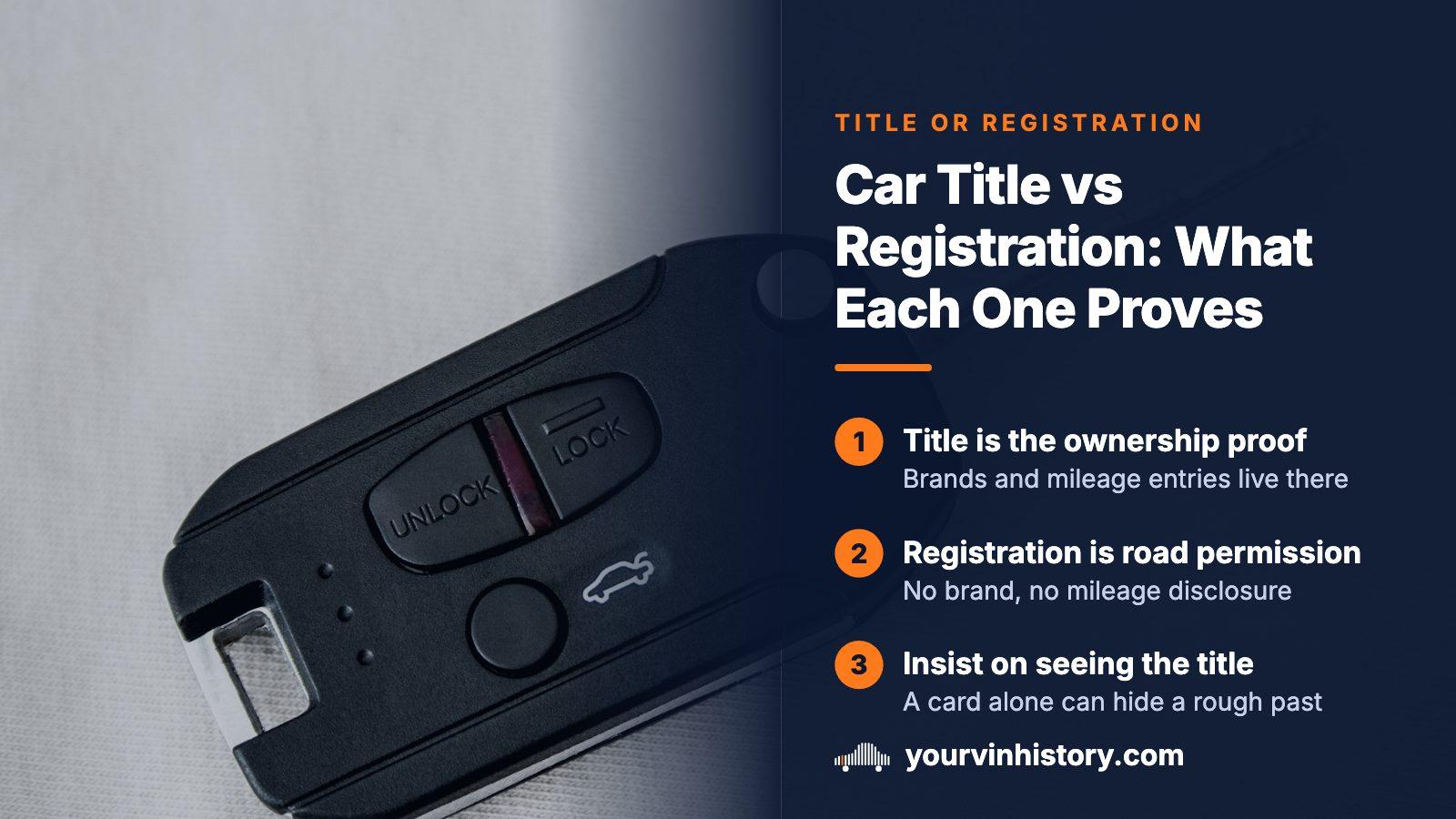
The title is the ownership document. It holds any brand, like salvage or flood damage, plus the odometer statement signed at each sale, and states report that data to the national title system daily. The registration is time-limited permission to drive on public roads. It holds no brand and no mileage disclosure, so a car with a troubled past can carry an ordinary registration card. When you buy, inspect the title and check the VIN.
- Ownership document
- The title, as defined in 28 CFR 25.52
- Where brands are recorded
- On the title, then reported to NMVTIS every 24 hours
- Where the mileage statement goes
- On the title, signed at each transfer
- Registration in the national title rules
- Never defined, and not part of the title data feed
Two papers that answer different questions
The same agency usually issues both, and they often arrive together, so they get treated as one document in two formats. A title answers who owns the vehicle and what has been recorded against it. A registration answers a narrower question, which is whether the vehicle is cleared for public roads for a set period with the state's fees paid.
The gap stays invisible while one person owns a car and renews it each year. It matters at a sale and at a move to another state, and both are title events. A buyer holding a fresh registration card has seen proof that the seller paid a fee. A license plate is a third item again: it points to a registration record and carries no history of its own.
Side by side: what each paper can and cannot tell you
Each row rests on a federal rule, named in the last column.
| Question | Title | Registration | Federal rule |
|---|---|---|---|
| Does it establish who owns the vehicle? | Yes, that is its defined purpose | Not its job | 28 CFR 25.52 |
| Is a salvage or flood brand recorded here? | Yes, as a reported field | No | 28 CFR 25.54 |
| Does it hold the mileage given at sale? | Yes | No | 49 CFR 580.5 |
| Must it be produced by a secure process? | Yes, for physical titles | Not covered by that rule | 49 CFR 580.4 |
| Is it part of the national data feed? | Yes, titling data goes in daily | No | 28 CFR 25.54 |
Expiry shows the contrast well. A registration lapses on a printed date unless renewed. A title has no calendar date, and it stops being current only when the record changes, through a sale, a lien added or released, a new brand, or another state issuing its own title.
How a brand reaches the title
A brand starts with a reporting duty, not a clerk's hunch. Under 28 CFR 25.55, any insurer operating in the United States reports every month on cars it has taken possession of and judged to be junk or salvage, covering the current model year and the four before it. Vehicles the carrier writes off as a total loss under its own policies are included.
The definition of salvage is arithmetic. A car qualifies when its salvage value plus the cost of repairs needed to make it legal to drive would exceed what it was worth just before the damage, whether the cause was collision, fire, flood or another event. The state then writes the brand on the title and reports the title data nationally. No step in that sequence touches the registration.
What the states send to the national system each day
Under 28 CFR 25.54, each state sends titling information for its automobiles to the national system once every 24 hours. Five kinds of data are required:
- The VIN.
- Any description of the vehicle that appears on the title, with every brand attached to it.
- The name of the person or business to whom the title was issued.
- Details from salvage yards, junk yards and insurers about vehicles they acquired, where the state collects them.
- The mileage disclosed when the title was issued, plus later readings the state has noted.
A seller who says the car has a clean title is describing something reported nationally on a daily cycle. A seller who says the registration is current is describing a payment.
The mileage statement is written on the title
The second permanent fact on a title is the odometer reading. Under 49 CFR 580.5, a title must show the mileage the previous owner disclosed at the last transfer and leave room for the next one. When the seller is the person named on the title, the statement goes on the title itself rather than a separate reassignment form, with a signature and printed name. It must also carry:
- The odometer reading at the time of transfer, in whole miles
- The date of transfer
- The printed names and current addresses of seller and buyer
- The vehicle's make, model, year, body type and VIN
The seller certifies that the reading is accurate to the best of their knowledge, or flags that it exceeds the odometer's mechanical limit or is not the actual mileage. Section 580.5(h) bars one person from signing as both seller and buyer in the same deal, outside the power-of-attorney cases the rules allow. Renewing a registration does not change hands, so it never triggers this disclosure.
A title is built to resist tampering
49 CFR 580.4 says a physical title has to be made using secure printing or an equivalent secure method, and it extends that to the forms used to reassign a title. Electronic titles must sit in a protected environment, and the system must log when each record was created, when each odometer disclosure was signed and every access, failed alteration attempts included.
The rule says nothing about registration cards. That is not a criticism, since a registration documents a fee paid and a permission granted. It does mean a card deserves less weight as evidence, because nothing in this rule asks that one be hard to copy.
The national record is organized around titles
NMVTIS, the national title database overseen by the Department of Justice, is defined by what it must let a user check under 28 CFR 25.53(b):
- Whether a paper offered as a title is genuine, and what its status is
- Whether a given VIN is titled in a certain state
- Whether a car titled in some state has ever been junk or salvage
- The odometer disclosure recorded when the title was issued, and any later reading the state added
- Whether an insurer or yard has reported the VIN as junk or salvage
Four of the five concern a title, and the fifth concerns reports filed against a VIN. None concerns a registration. The same section bars the operator from giving an individual buyer personal details such as an owner's name or address, so a search describes the car and not its owners. Access runs through approved data providers listed by the Justice Department.
The check a state runs before it issues a new title
The clearest sign of which paper is the record sits in 28 CFR 25.54(c). Before issuing a title to someone who says they bought the vehicle from a seller in another state, or is handling a title transfer, a state is expected to run a verification check through NMVTIS. The check has two steps.
- The state sends the system the VIN of the vehicle the applicant wants titled.
- The system reports back, and the state uses the results to judge whether the presented document is a valid title, whether the vehicle is or has been reported as junk or salvage, whether the stated mileage matches the system, and whether claims such as lienholder status hold up.
Put plainly, a state tests your paperwork against a national record before it issues the title, so a contradictory mileage figure is likelier to surface then than years later. The rule ties the check to issuing a title, not to renewing a registration.
When the seller offers the registration instead of the title
Sometimes a seller says the title is elsewhere and offers the registration as proof of ownership. An honest seller can say this and so can a dishonest one. The card cannot show a brand, cannot show an odometer disclosure, and cannot show who owns the vehicle.
Some reasons for a missing title are legitimate. Under 49 CFR 580.13, a seller may give the buyer a power of attorney for the mileage disclosure, if state law permits, in four situations: a lienholder holds the physical title, the physical title is lost, a lienholder holds or controls the electronic title, or the electronic title cannot be accessed.
A working rule
A seller who cannot produce a title may not be hiding anything, but cannot yet sell you the car cleanly. Ask which situation applies, ask when the title will arrive, and get any lien release in writing before paying.
A short routine for reconciling the paper with the car
Start from the VIN and judge every piece of paper against it.
- Copy the VIN from the car, at the dash plate and the door jamb, and confirm it matches the seller's papers.
- Decode it and compare make, model, year and body type with what the title says.
- Run the NHTSA recall lookup on the VIN. It is a free lookup based on manufacturer records, and it depends on neither document.
- Set the mileage written on the title next to the dashboard reading and next to any earlier disclosure you can find.
- Pull the national title record through an approved NMVTIS provider before you pay.
A yourvinhistory report is one route to that record. Its title entries come from ClearVin LLC, an approved NMVTIS data provider, and it adds accident, odometer, salvage and lien records. A preview comes first; the full report is a one-time purchase.
Where this information comes from
- eCFR: 28 CFR 25.52, NMVTIS definitions — Where the federal definitions of a title, a salvage automobile and a total loss come from. Registration does not appear among them.
- eCFR: 28 CFR 25.53, duties of the NMVTIS operator — Backs the five things the system must let users check, and the limit on giving owner names to individual buyers.
- eCFR: 28 CFR 25.54, duties of the states — Source for the daily titling reports that include brands and for the verification check before a new title is issued.
- eCFR: 49 CFR 580.4, security of titles — Covers secure production of physical titles and the protections and logging required for electronic titles.
- eCFR: 49 CFR 580.5, odometer disclosure — Sets out where the mileage statement goes at a transfer, what it must contain, and the ban on signing for both sides.
- Department of Justice: Research Vehicle History — The government list of approved NMVTIS data providers that consumers can use to reach the national title record.
Sources and photos: Facts checked against the sources above in October 2026. Photo by Shadow Photography on Unsplash; diagrams by YourVINHistory.
Keep reading
- Car title checkLearn which features a genuine paper title should show before you accept one.
- What is a branded title?See what each brand on a title means for value, insurance and resale.
- Register a car without a titleFind out how states handle a car whose title is missing.
- NMVTIS reportRead how the federal title record is packaged for consumers.
Frequently asked questions
Does the registration prove that I own the car?
Not by itself. A registration shows the state has approved the vehicle for road use for a period, usually with fees and insurance in order, but federal rules define ownership through the certificate of title instead. If you are buying, ask to see the title and make sure the name printed on it matches the person selling to you.
Can I buy a car if the seller only has the registration?
It is risky. The sale is a title transaction, and the federal mileage statement is meant to be signed on the title at the transfer. If the title is lost, ask the seller to obtain a replacement before you pay, or to follow whatever no-title process your state offers. A registration card alone gives you nothing to sign.
Will a registration show that a car was totaled or flooded?
No. Brands such as salvage or flood are recorded on the title, and insurers separately report vehicles they judge to be junk or salvage to the national system. A registration card is not where either one is kept. A car with a serious past can carry the same ordinary card as one that was never damaged, so look at the VIN-based title record.
Do I need a new title when I move to another state?
Usually, yes. A move normally means the new state issues its own title and its own registration. When a state is asked to title a vehicle bought from someone in another state, or to handle a title transfer, federal rules expect a verification check through the national system first. Deadlines and fees are set by each state.
Can a car have a valid title and an expired registration?
Yes, because the two follow different logic. A registration has an end date and lapses unless renewed. A title does not lapse on a calendar. It stops being current when something changes, such as a sale, a recorded lien or release, a new brand, or a title from another state. A car parked for years can hold a valid title and a lapsed registration.
Now check the car itself
The guide explains what to look for. The report shows what this VIN has on record.