THE SHORT ANSWER
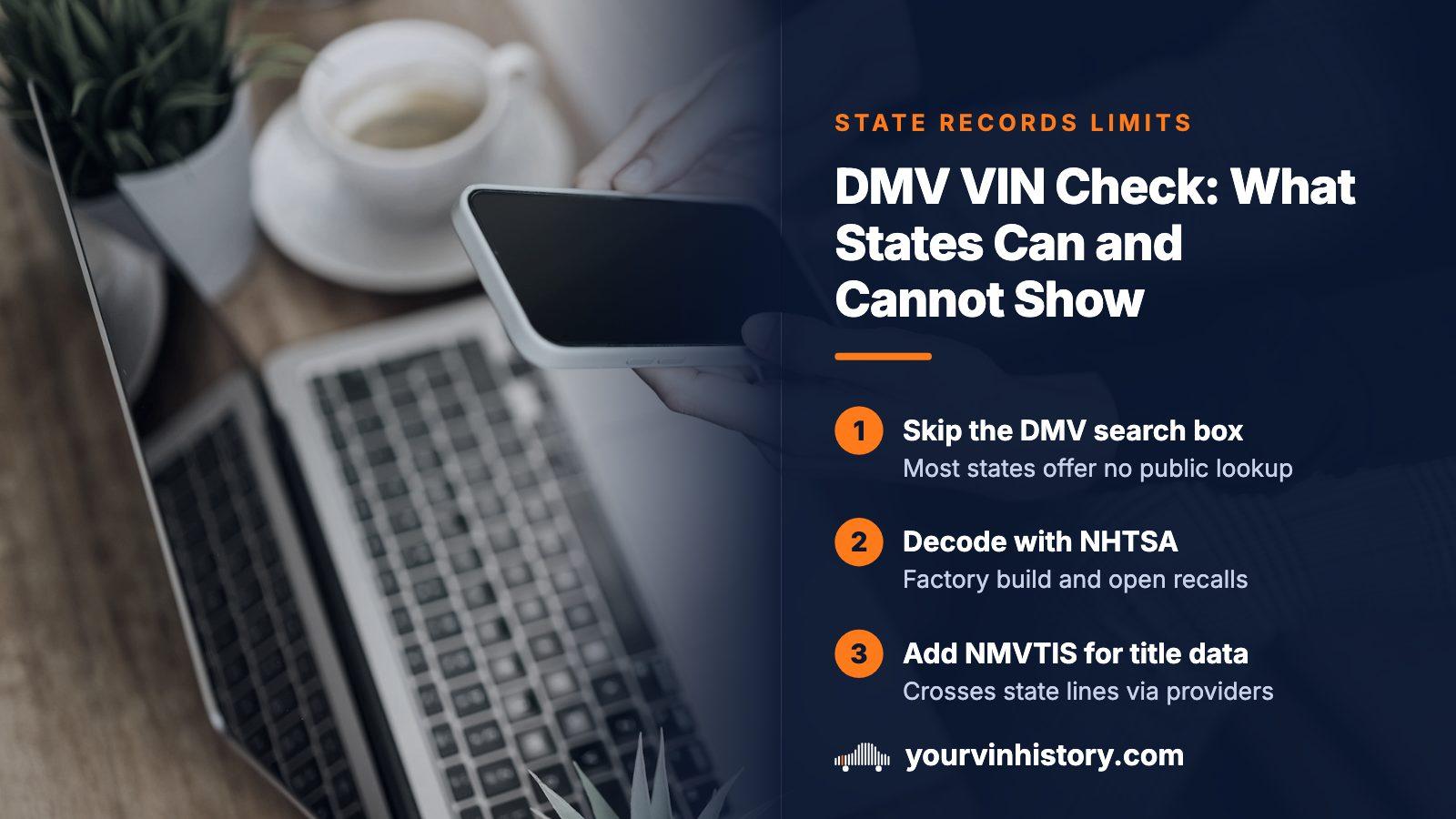
Most state agencies do not offer a public VIN lookup. They process records requests under a federal privacy statute, publish at most a narrow title or registration status page, and hold nothing on collisions unless damage ended in a title brand. The free check is federal: NHTSA decodes the factory build and lists open recalls at no charge. Title history across states comes from NMVTIS, sold through approved providers.
- Public VIN search at states
- Rare; most use records requests
- Federal decode and recalls
- No charge, no account
- Collisions in a state file
- None, unless a brand resulted
- Cross-state title data
- NMVTIS, via approved providers
Three requests hiding behind one search phrase
Searchers who type DMV VIN check are usually after one of three things, and each runs through a different process. A lookup would be a web form that takes a VIN and returns something. A records request asks the agency to release a copy of what it holds on the vehicle. A VIN verification is physical: a person inspects the number on the car itself.
| What people mean | What usually happens |
|---|---|
| A lookup | Rare; at best a narrow status check on that state's own file |
| A records request | A form, a permitted reason and a fee set by the state |
| A VIN verification | An in-person inspection that ends with a signed form |
There is also no single DMV to ask. Titling and registration are state jobs, the office may be called a DMV, a BMV or something else, and each one keeps its own files and publishes its own tools. A page promising one nationwide procedure is generalizing from a single state.
Why the state website has no search box
The barrier is legal, not technical. Section 2721 of Title 18 of the U.S. Code bars a state motor vehicle department, its employees and its contractors from knowingly releasing personal information taken from a motor vehicle record. Releases are allowed only for purposes the statute lists, which include:
- Government agencies, including courts and police, carrying out their functions
- Matters of vehicle and driver safety and theft, along with recalls and related monitoring by manufacturers
- A legitimate business confirming that personal details a customer gave it are accurate
- Legal proceedings, research, insurance, towing notices, licensed investigators and toll facilities
A buyer sizing up a stranger's car fits none of those categories unless the person named in the record has consented. That explains the forms and fees, and also why a state can still publish a narrow vehicle tool: a title or lien indicator can be shown without revealing anything about a person.
What a title and registration file actually contains
A state vehicle file is paperwork. It exists to settle who may lawfully operate the car and who has a claim on it, so its contents follow from that job:
- Title data for cars the state itself has titled
- Registration data and its current status
- Lien entries tied to the title
- Brands the state placed on the title
On a few questions this file is the final word. A lien, once recorded, stays with the vehicle even when the seller changes, and the recording state is the place that knows. The blind spots are what catch buyers off guard. Nothing predating the car's arrival in that state appears, and brands applied elsewhere but never forwarded are missing too. Repairs never show, because no government body collects them, and the public cannot see the current owner's identity.
Where a state's knowledge ends at the border
A state file begins on the day the vehicle enters that state's system. Asking your home state about a car titled elsewhere is therefore not a weak check; it is no check at all. Asking the state that titles the car today reveals only what it was told on arrival, which can be thin when a brand never traveled with the vehicle.
| Your question | Where the answer lives |
|---|---|
| Is a title issued where the car is now? | That state's own tool or records request |
| Does a lender hold a lien on it? | The state where the lien was filed |
| Was it branded in another state earlier? | The federal title record, not any one state's file |
| How many states has it been titled in? | The federal title record |
The last two rows are the case for a federal record, and the gap they describe is the one title washing exploits.
Status tools: the narrow things a state does publish
Some states offer a public page, and these are narrow on purpose. Typical examples report whether a title has been issued, whether a registration is current, or whether a lien is on file. Each answers an administrative question about that state's own file and says nothing about where the vehicle has been or what happened to it.
Start at the state's official site, not a third-party aggregator, and search for terms like record request or title status. Names, fees and availability differ widely, and some states publish nothing public.
A quick sanity test
The narrower the question a tool answers, the likelier it is genuine. A site that promises an owner's name from a VIN search is either not delivering or is not the state, since the privacy statute keeps that data out of public tools.
The free check lives at the federal level
The government's VIN decoder, NHTSA's vPIC, turns a 17-character VIN into a list of the vehicle's attributes. Its data comes from submissions by manufacturers, so a decode reflects what the maker filed, not an examination of the car in front of you. It costs nothing and needs no account or card. NHTSA's recall lookup works from the same VIN and is free to use as well.
Read the recall result before you drive out to see the car. An open recall means safety work is outstanding. Manufacturers generally cover the repair on vehicles inside the federal free-repair rule, but that rule has an age cutoff, so a very old vehicle can fall outside it. Confirm eligibility with a franchised dealer for the brand before counting on a no-cost fix.
Neither tool tells you a history. People arrive expecting a government accident report, meet a decoder and write it off, yet it answers a different question well: what was built, and what safety work is still owed.
The federal title record that crosses state lines
NMVTIS is the Justice Department's system for following a vehicle from state to state. Its consumer report is deliberately short. The official site describes five indicators:
- Current title information, including any brand history such as junk, salvage or flood
- The latest odometer reading reported
- Any salvage or total loss determination made by an insurer or self-insuring organization
- Reports of transfer to an auto recycler, junk yard or salvage yard
- Historical theft data, in some cases
Buyers get the report from an approved data provider, listed on the official page, which also notes that some well-known names sell only to dealerships. Each provider sets its own price, and for consumers it typically runs a few dollars. Two limits apply. Not every state reports into the system, so a clean result can be a false negative, and brand wording differs by state, so a car handled as salvage may not carry that label.
A yourvinhistory report includes NMVTIS title records supplied by ClearVin LLC, an approved NMVTIS data provider, after a free preview.
When the DMV wants to look at the car itself
When a seller or clerk says the DMV needs to check the VIN, the likely meaning is an inspection. A person with authority reads the number on the vehicle, checks it against the vehicle's documents, then signs a form certifying a match. States ask for this in specific circumstances, such as an out-of-state arrival, a rebuilt vehicle going back on the road, or a title with an unusual past.
Treat it as a registration step. It shows the car matches its documents, not that the car is worth buying, so it cannot replace the history research above. Fees, appointments and who may sign vary by state.
What no government office will hand you
- Repair and service history. Neither state nor federal government gathers it, so a service pitching an official maintenance record is selling something different.
- Ordinary collisions. Nobody reports a fender-bender to a motor vehicle agency, so an accident appears in a state file only if it ends in a title brand, a far higher bar than a repair.
- The current owner's identity, for the reasons the privacy statute sets out.
To fill those gaps, a mechanic's pre-purchase inspection speaks to condition, and a multi-source report speaks to reported damage, auction and salvage records. Neither comes from the DMV.
The order that spends the least
- Decode the VIN and read the recall list before you travel. It costs nothing and exposes any mismatch between the listing and the factory build.
- Read the title the seller holds. Match the VIN to the car, the seller's name to their photo ID, and note any lienholder.
- Buy the federal title history from an approved provider before money moves, especially when the car came from another state.
- Ask the titling state for its own record only when you need that state's paperwork, such as proof of a recorded lien.
- Book a verification only if the state requires one to register the car.
Each step in this sequence answers a question the earlier ones could not, and none repeats what a no-cost check already told you.
Where this information comes from
- NHTSA: vPIC VIN decoding API — Documents the decode service and states that its data is built from manufacturer submissions.
- 18 U.S.C. 2721: Prohibition on release of personal information — Source for the general bar on releasing personal information from motor vehicle records and for the list of permitted uses.
- Department of Justice: NMVTIS — Describes the national title information system, the indicators in a consumer report and how to buy one.
- NHTSA: Recalls — The federal lookup for open safety recalls by VIN.
Sources and photos: Facts checked against the sources above in October 2026. Photo by Jakub Żerdzicki on Unsplash; diagrams by YourVINHistory.
Keep reading
- NHTSA VIN decoderWhat the federal decoder returns and how far to trust each result.
- Motor vehicle recordsWho may lawfully obtain a record from a state, and how to request your own.
- NMVTIS reportA closer look at the federal title history that crosses state lines.
- VIN verificationThe in-person inspection that shares the name, and who performs it.
Frequently asked questions
Can I find out who owns a car with a DMV VIN check?
Generally no. Federal law lets a state release personal information from a motor vehicle record only for listed purposes, such as government functions, safety and theft matters, or confirming details a person gave a business. A request for any use needs the individual's consent. A better test of a private seller is whether the name on the title matches their photo ID and the VIN on the car.
Is there a free DMV VIN check online?
Not for history. Some states publish a status page limited to one question, and the federal decoder and recall lookup cost nothing, but no government office offers a full vehicle history at no charge. Be wary of any site claiming official DMV records.
If a DMV record is clean, does the car have no accident history?
No. A state file records titles, registrations, liens and the brands that state applied. Ordinary collisions are not reported to it, so a clean file only says no brand was recorded there. A repaired crash that never reached total loss stays invisible, and so does anything that happened before the car was titled in that state.
Who can do a VIN verification, and do I need one before buying?
A buyer does not need one to decide on a purchase, because it is a registration step. The inspection is carried out by a person your state authorizes, who compares the VIN on the vehicle with the paperwork and signs a form. Your state's rules decide who qualifies and whether your situation requires one, which is common for cars arriving from out of state.
How do I check whether a car has a lien?
A recorded lien is held by the state that recorded it, so that state's title status tool or record request is the direct source. The title the seller holds may also name a lienholder. The federal report's published indicators cover brands, odometer readings, total loss and salvage transfers rather than loan payoff, so ask the seller for a written release from the lender.
Now check the car itself
The guide explains what to look for. The report shows what this VIN has on record.