THE SHORT ANSWER
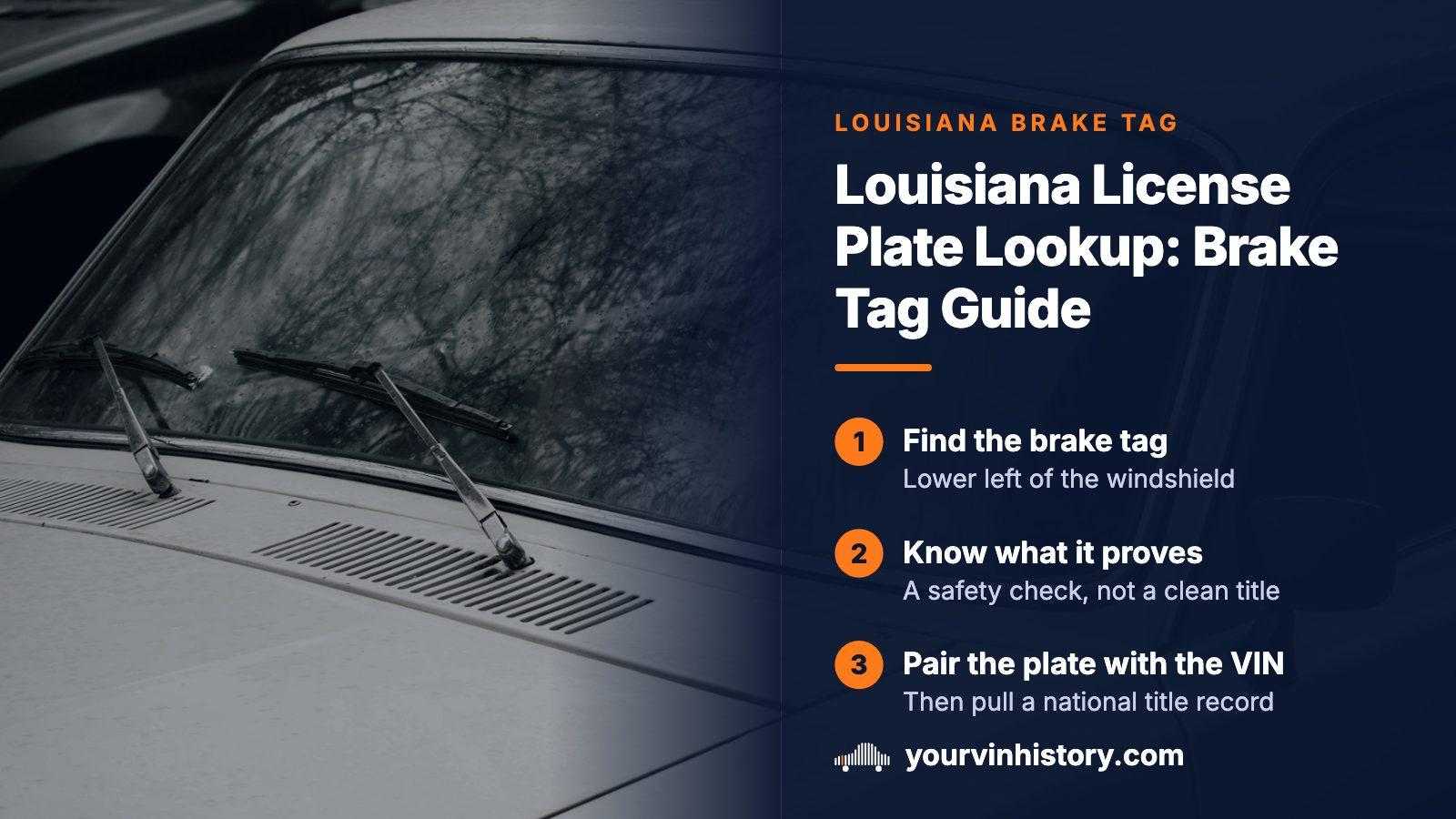
The public cannot trace a Louisiana plate to an owner. The federal Driver's Privacy Protection Act releases those records only for listed purposes such as insurance claims, court cases and licensed investigation. The brake tag is Louisiana's inspection certificate, displayed in the lower left corner of the windshield. It confirms a safety inspection, not a clean title or a dry history, so pair it with the 17-character VIN and a national title record.
- Brake tag
- Louisiana's everyday name for the inspection certificate
- Where it goes
- Lower left corner of the windshield
- Cycle
- At least once every other year, never more than twice a year
- Owner lookups
- Closed to curiosity by the federal privacy law
What a plate number can and cannot get you
Sites that promise a Louisiana owner's name for a plate number run into the Driver's Privacy Protection Act. The federal law bars a state motor vehicle agency from releasing personal information from its records except for a list of permitted purposes. Insurers working a claim qualify, as do parties to a lawsuit, licensed investigators acting within those purposes, employers verifying a commercial driver's license, and government agencies and courts.
Curiosity is not on the list. Neither is wanting to know who owns a car you are thinking of buying, or who cut you off on the interstate. If a driver clipped your parked car and left, give the plate number to the police and to your insurer, who can use the records for a permitted reason. No lawful public service will return a name from a plate in Louisiana or anywhere else, so a site that claims otherwise deserves suspicion.
The brake tag sits in one place on purpose
In Louisiana the inspection certificate goes by the name brake tag, though the statute uses the plainer term certificate of inspection. The law fixes the location: the lower left corner of the windshield, put there by the authorized inspection station that did the work. A set position lets an officer, or you, check the date in a second, and it makes anything out of place easy to spot.
| On the windshield | What it suggests | Your move |
|---|---|---|
| Current tag, lower left | An authorized station inspected the car within the cycle | Read the date and ask the seller when the inspection happened |
| Expired tag | The next inspection and any repairs it demands will be yours | Price it in, or ask for a fresh inspection before the sale |
| No tag | A required display is missing | Ask why before you talk about price |
| Tag in the wrong spot, or stuck on by hand | Possibly not applied by a station | Ask which station issued it, and weigh the seller's other claims more carefully |
| Paperwork from a station in another parish | A question wherever the parish rule applies | Compare it with the parish on the registration |
What the inspection covers and where it stops
By statute the inspection looks at a vehicle's mechanism, brakes and equipment. Everyday talk shrinks that to brakes, but the list reaches further, to lights, glass, tires and the other gear a vehicle needs to be roadworthy. The requirement is wide: motor vehicles, low-speed vehicles, trailers, semitrailers and pole trailers registered in the state all fall under it.
What the inspector checks is the machine in front of them. The inspection does not review the title, count previous owners or ask whether the car spent time under water. A sound-looking car can carry a title brand or an unpaid loan and still earn its sticker.
A current tag is not a clean history
Dry a flooded car, clean it, fix whatever stopped working, and it can still pass. On a Louisiana vehicle in particular, the tag is where your checking starts, not where it ends.
How often the tag comes due, and what a lapse costs you
The statute sets a floor and a ceiling. A registered vehicle needs an inspection in every second year at the least, and the law allows no more than two in a single year. Within that range, the date printed on the sticker is the fact that matters at a viewing, so read it instead of counting years in your head.
An expired tag has a plain money effect. Whoever owns the car at the next inspection pays for it, plus any repair the station requires before it will pass the car, so a seller who hands over a lapsed tag is handing you the bill. Use that when you talk price. Ask, too, whether the car has ever failed an inspection and what was fixed afterward.
Inspected where it is registered: the parish rule
This is the provision that sets Louisiana apart. In parishes that have adopted the relevant fee, a vehicle registered there has to be inspected there, not at a station one parish over that happens to be quicker or closer. Parishes that have not adopted it fall outside the rule.
The effect is to anchor the inspection to the registration rather than to the owner's convenience. For a buyer, that is a small gift: inspection paperwork says something about where a car is registered, which can differ from where it is parked today or where the seller says it lives. When a vehicle turns up with paperwork from a distant parish, ask where it is registered and read the registration document itself instead of taking an answer on faith.
Do not overread it. The rule depends on each parish's own decision, so a different parish on the paperwork is a question to ask, not proof of wrongdoing.
Parishes stand where counties stand elsewhere
No other state uses the word parish for its main local divisions, a holdover from French and Spanish colonial administration. The state has sixty-four, and they take on the roles counties hold elsewhere, vehicle matters included. Readers coming from outside should translate as they go: where a Texas or Mississippi form says county, a Louisiana form says parish.
The parish matters on a car purchase for more than one reason. Registration names one, and the inspection rule above follows it. The Office of Motor Vehicles title and registration page also links to a parish tax table, a sign that the parish does real work in vehicle paperwork.
Louisiana plate types and what each one hints at
A plate is mostly a category label. These are the kinds a buyer meets most often:
- Standard passenger: the everyday issue, renewed on the schedule the state sets.
- Personalized: characters picked by the owner and approved by the state.
- Specialty and cause: designs for universities, the military and organizations, each carrying separate fees.
- Antique: reserved for qualifying older vehicles, with restrictions on how the car is used.
- Commercial and trailer: classes tied to weight, each with separate registration requirements.
A personalized or specialty plate reveals the owner's tastes and nothing about the car's condition. An antique plate deserves a closer read of the use restrictions before you buy a car expecting to commute in it.
Flood history needs your own eyes
Louisiana's flood exposure, especially near the coast, makes a hands-on check worthwhile on almost any vehicle from the state. A flooded car can carry a title that reads clean, and the brake tag will never mention water. Spend time inside the car with the doors open and a flashlight, and look at:
- Carpet backing and the padding under it: dampness, silt or a stain line where the carpet meets a panel
- Seat rails and their bolts: rust in places a dry car would not show it
- Seatbelt webbing: pull the belt all the way out and look for stains or a mildew smell near the end
- Wiring under the dash: green or white corrosion, stiff insulation, fresh tape on an old harness
Any one of these may have an innocent explanation. Several together, on a car with a spotless title, are the cue to walk away or bring in a mechanic before you pay.
From the plate to the VIN: the checks that return answers
Everything useful about a used car is keyed to its 17-character VIN, which sits on the car and is printed on the title. Compare the two, then work down this list:
- Decode the VIN to confirm the year, model and build match the listing.
- Run NHTSA's recall lookup, a free tool that shows open recalls for that VIN.
- Run NICB's VINCheck, a free search of theft and salvage reports.
- Pull the national title record, since a brand applied in another state follows the VIN into Louisiana.
The last step matters most for a vehicle that has lived in more than one state, because a Louisiana tag cannot reveal a brand written elsewhere. A yourvinhistory report adds accident records with a damage map, odometer readings and auction photos to the title data, and it starts with a preview before any purchase.
After the sale: title, insurance, registration and a current tag
Once the price is settled, the paperwork runs in this order:
- Collect the signed title. The seller's signature and the odometer disclosure should be complete, and the seller's name should match their identification.
- Arrange liability insurance. Louisiana wants coverage that meets the limits written into statute for any registered vehicle, and it enforces the rule with civil and criminal penalties.
- Register through the Office of Motor Vehicles. Registration sets your parish of registration, and the inspection rule follows it. The agency's site has separate pages for used title and registration and for the Notice of Vehicle Transfer.
- Bring the brake tag current. If the sticker is near its date, the next inspection, and whatever it finds, falls to you.
Insurance compliance is something the state handles on its own side. A plate search will not show whether a car is covered, so ask the seller for current proof before you hand over money.
Where this information comes from
- Louisiana State Legislature: motor vehicle inspection law — The statute behind the inspection cycle, the parish-of-registration rule and the windshield position of the certificate.
- Louisiana Office of Motor Vehicles: title and registration — The state portal that links used-vehicle title and registration, plates, the Notice of Vehicle Transfer and the parish tax table.
- Driver's Privacy Protection Act, 18 U.S.C. 2721 — The federal rule that limits release of personal information from motor vehicle records and lists the permitted uses.
- NMVTIS: National Motor Vehicle Title Information System — The federal title record that collects brands from reporting states, which an inspection cannot check.
Sources and photos: Facts checked against the sources above in October 2026. Photo by Tigran Shishmanyan on Unsplash; diagrams by YourVINHistory.
Keep reading
- License plate lookupThe national rules, and where a plate search stops under the privacy law.
- LouisianaThe notarized sale and lien promise that come with a Louisiana purchase.
- Flood-damaged carsWhy a flooded car's title often reads clean and where to look instead.
- Texas platesThe western neighbor, where the windshield also says more than the plate.
Frequently asked questions
What is a brake tag, and does a car I just bought need one?
It is the everyday name for the state inspection certificate, which an authorized station applies to the lower left corner of the windshield. A registered vehicle must be inspected on a regular cycle, so a car bought with a lapsed tag needs an inspection soon after you take it, and the cost and any repairs are yours.
Can I find the owner of a Louisiana plate from its number?
Not as a member of the public acting from curiosity. The Driver's Privacy Protection Act limits release of owner data to defined purposes, and none of them covers a private person who wants a name. Police and insurers can request records for permitted reasons, which is why a hit and run belongs with them rather than with a paid website.
Can a Louisiana car be inspected in a different parish?
It depends on the parish. Where a parish has adopted the fee covered by the statute, a car registered there may be inspected only inside that parish. Ask the seller where the car is registered, then check the station named on the paperwork. The Office of Motor Vehicles or a local station can confirm how your parish applies the rule.
Does a Louisiana car need insurance, and will a plate search show it?
Registered vehicles must carry liability coverage meeting the limits set by statute, and the state enforces that with civil and criminal penalties. Enforcement happens inside the state's own systems, so a plate search will not report whether a given car is covered. Ask the seller for current proof of coverage and check that the name matches the title.
Besides the plate, what deserves a look on a used Louisiana car?
Start with the VIN. Decode it, search NHTSA's recall tool and NICB's database for theft and salvage entries, then pull the national title record. After that, inspect for water damage in person, because a clean record does not rule out a flooded history. Match the seller's name to the title before any money moves.
Now check the car itself
The guide explains what to look for. The report shows what this VIN has on record.