THE SHORT ANSWER
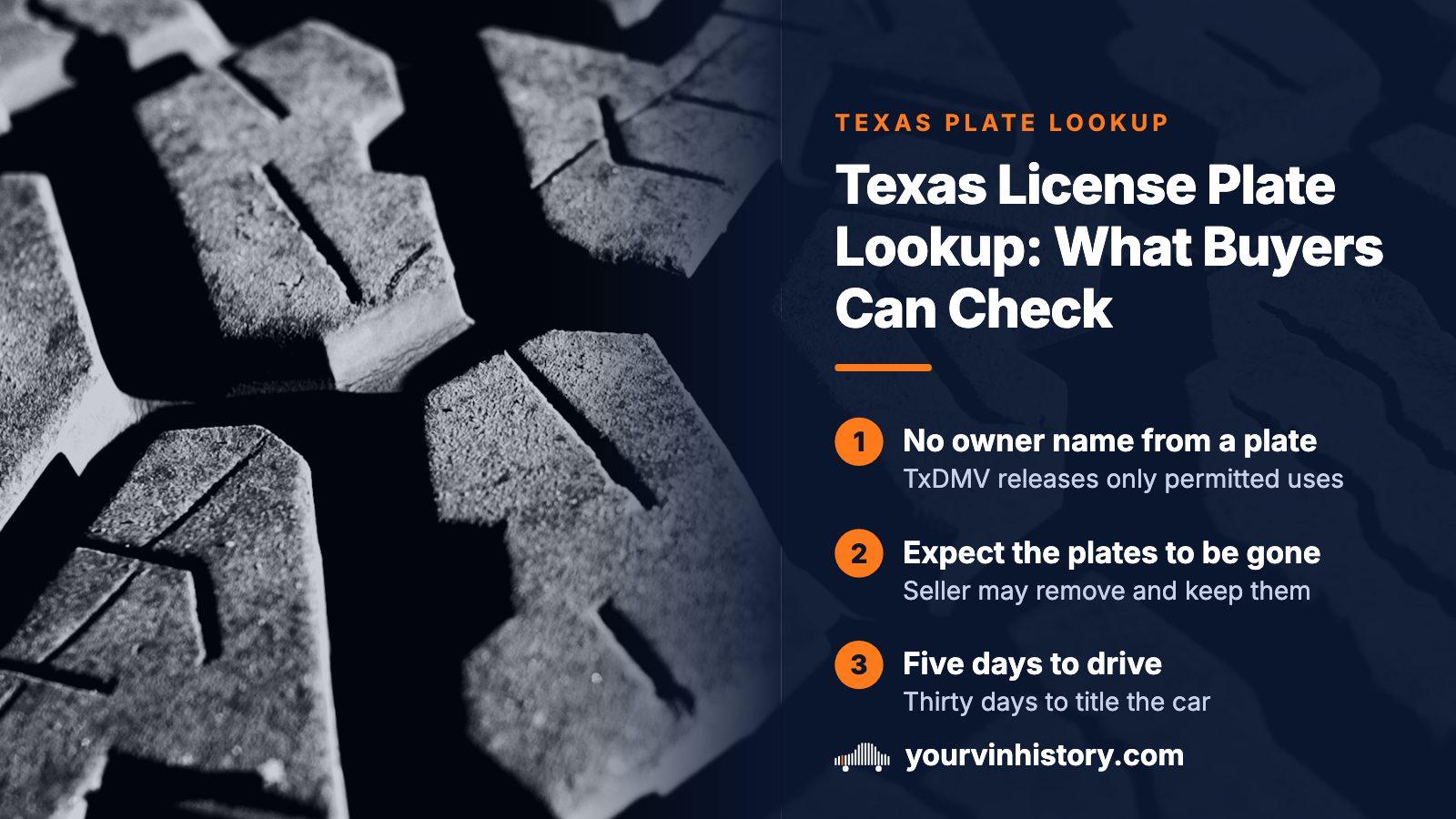
No public service turns a Texas plate into an owner's name or address, because TxDMV releases those records only for purposes the Driver's Privacy Protection Act allows. For a buyer the plate matters less than the paperwork around it. Plates stay with the seller, registration status shows on the windshield sticker, and the VIN is the number that opens recalls, title history and brands.
- Owner details
- Released only for federal permitted uses
- Plates at sale
- The seller may remove and keep them
- Drive-home permit
- No fee; valid for one trip within five calendar days
- Title deadline
- 30 days from the date of sale
What a Texas plate search can and cannot return
Owner names and addresses sit behind the Driver's Privacy Protection Act, codified at 18 U.S.C. § 2721. It bars a state motor vehicle agency from knowingly releasing personal information from its files, then carves out specific exceptions. TxDMV can hand over a record only when the request fits one of them. The permitted purposes include:
- government agencies, courts and law enforcement doing official work
- insurers investigating claims or fraud
- civil, criminal and administrative proceedings, including serving legal papers
- notifying the owner of a towed or impounded vehicle
- employers verifying a commercial driver's license
- licensed private investigators, but only for one of the listed purposes
Curiosity about a seller, or about a car parked on a street, is not on that list. A website that advertises an owner's name for any Texas plate is not drawing on a public feed from the state. What a buyer can lawfully get is narrower and more useful: facts about the vehicle itself, tied to its VIN.
Why the plates are gone when you take delivery
In Texas, plates attach to the owner more than to the car. TxDMV tells sellers they may remove the plates and the registration sticker at the time of sale, then move the plates to another vehicle, keep them for later or dispose of them. Moving plates costs nothing, so a seller has little reason to leave them behind. The sticker is the exception: it does not travel with the plates.
A seller who does not want the plates should deface the front with permanent black ink or similar, so a usable plate does not end up with a stranger. For you, the result is simple: expect a car with no plates and possibly no sticker, and plan a legal way home. Texas provides one, described below.
What the windshield sticker tells you instead
A Texas plate carries no registration dates, so status is read from the sticker in the lower left of the windshield, where the month and year are printed. County tax offices mail these stickers once payment clears. If the car still wears its sticker, compare the printed date with what the seller claims.
An expired sticker usually means unpaid registration, and the buyer inherits the job of catching up. TxDMV gives a grace period of five working days after the expiration date, during which driving carries no penalty; beyond it, a citation is possible. In a county that requires emissions testing, a lapsed sticker can also be a sign the car struggled to pass, so ask to see the last test result.
Safety inspections ended in 2025, so no one checked the brakes
House Bill 3297 stopped requiring annual safety inspections for private cars starting January 1, 2025. Registration now carries a $7.50 inspection program replacement fee instead. Emissions tests still apply in the participating metro counties, and commercial vehicles are still inspected.
For a used-car buyer, the effect is quiet but real. A Texas car last put through a safety inspection in 2024 or earlier has gone without a mechanic's look since, and nothing on the windshield says whether the tires, brake lights or wipers are in shape. That judgment now falls to you.
Budget for an independent look
A current registration shows that fees were paid, not that the car is sound. Have a mechanic you chose, not the seller's friend, check tires, brakes, lights and steering before money changes hands.
Five temporary permits, and only one suits a private sale
TxDMV issues several temporary permits, and they differ in length, cost and paperwork. People who search for a "temporary tag" often picture the 30-day plate, which asks the most of an applicant.
| Permit | Length | What it involves |
|---|---|---|
| Vehicle Transit Permit | Five calendar days counted from printing, one trip | No fee. Meant for a buyer whose seller kept the plates. Needs liability insurance and is not issued for salvage or nonrepairable vehicles. |
| One-Trip Permit | 15 calendar days, one trip | Origin or destination must be in Texas. Bought at a county tax office or regional service center for a fee. |
| 30-Day Permit | 30 calendar days, purchasable up to sixty days ahead | Application on Form VTR-66, proof of liability insurance and a photo ID, plus a fee. |
| 72-Hour and 144-Hour Permits | Commercial use only | For laden trucks, truck-tractors, trailers, semitrailers and buses; a valid USDOT number is required. |
For an ordinary purchase from a private seller, the first row is the match: no fee, no inspection step and a single printable document. TxDMV issues only one per vehicle sale, so settle the route before you print it.
Five days to drive, thirty days to title
A Texas purchase starts two timers, and they are easy to mix up. The permit limits how long you may drive the car on its one trip. The title deadline limits how long the state's record can keep showing the seller as the owner.
Texas wants the car titled in your name no more than 30 days after the sale date. Miss that and delinquent transfer penalties can follow. The count begins at the handshake, not on the day you finally reach the county tax office, and holding a valid permit does nothing to pause it.
Only one of the two charges you
An expired permit leaves the car unable to travel legally. A late title adds penalties and leaves the seller's name on the record. Mark the title deadline on your calendar the day you buy.
The seller's Vehicle Transfer Notification
A seller can tell TxDMV the car is gone by filing a Vehicle Transfer Notification. According to the agency, a seller who files within 30 days of the sale cannot be held responsible for the buyer's parking tickets and toll violations. Without it, those notices follow the registration record, which keeps showing the seller until you title the car.
The filing also tells a buyer something. Sellers who file promptly have usually sold a car before. A seller who would rather the sale not be recorded anywhere is sending a different signal, so suggest filing before you part and watch the reaction. Skipping the record is how title jumping works, and a car bought that way can be hard to register.
Faded plates, borrowed plates and records that disagree
A weathered Texas plate is not a warning sign. Since November 1, 2016, the state no longer replaces plates automatically after seven years, so a plate a decade old can be entirely legal. Owners can ask the county tax office for new ones when the old plates look bad or are hard to read. Compare these before you pay:
- the plate number against the registration and the title, if the seller still has the plates
- the sticker date against what the seller says about registration
- the VIN on the dashboard, the door-jamb label and the title
- a plate on the front as well as the rear, since Texas expects both
A plate that belongs to a different vehicle is a classic sign of cloning. If the seller offers the old plates to use until yours arrive, decline. The transit permit exists to make that unnecessary, and driving on plates registered to someone else attaches that person's name to every toll and camera notice you trigger.
Where the useful answers live: the VIN and the title
A plate identifies a registration. A VIN identifies the vehicle, and title records, recall campaigns and salvage files all hang on it. TxDMV offers a Title Check service of its own, which it describes as a way to see whether a title has issues affecting the vehicle's value. Treat it as a first screen.
NHTSA's recall search takes the VIN and lists open safety recalls. A vehicle history report from yourvinhistory.com goes further, with title brands from the NMVTIS records that ClearVin LLC supplies, reported accidents, odometer readings, and salvage or auction entries with photos where they exist. None of these tools needs the plate, and none replaces a mechanic's inspection.
A buying sequence that matches Texas's rules
Because the state's rules put the plate, the permit and the title on different schedules, the order of steps matters more here than in many states.
- Before paying, copy the VIN from the dashboard and the door label, confirm both match the title, and run recall and title checks on it.
- At the sale, collect a title signed by the seller with the date of sale and the odometer reading filled in.
- Before driving off, print the Vehicle Transit Permit and make sure you carry liability insurance.
- On sale day, have the seller file the Vehicle Transfer Notification.
- Within 30 days of the sale, bring the signed title, the title and registration application the seller also signs, proof of insurance and payment to the county tax office. Add an emissions result if your county requires one.
- After registration, mount your plates and put the new sticker on the windshield.
Missing a day on most of these costs nothing. Missing the county tax office deadline does.
Where this information comes from
- TxDMV: temporary permits — Lengths, costs and requirements for the transit, one-trip, 30-day and commercial permits.
- TxDMV: buying or selling a vehicle — The 30-day titling rule, delinquent transfer penalties, the seller's Vehicle Transfer Notification and Title Check.
- TxDMV: license plates — Plate transfers, the end of automatic replacement in 2016 and how to dispose of plates you keep off the road.
- Texas DPS: 2025 inspection program changes — How House Bill 3297 ended safety inspections for non-commercial vehicles.
- Driver's Privacy Protection Act, 18 U.S.C. § 2721 — The federal limit on releasing personal information from motor vehicle records, and its permitted uses.
Sources and photos: Facts checked against the sources above in October 2026. Photo by Joan on Unsplash; diagrams by YourVINHistory.
Keep reading
- License plate lookupThe national rules on what any plate search can return and which sites to avoid.
- Temporary tagHow temporary tag lengths vary by state and what deadline follows.
- Texas title checkWhat the Texas title record shows and how its brands work.
- Title jumpingWhy an unrecorded seller leaves a buyer unable to register the car.
Frequently asked questions
Can I find out who owns a Texas license plate?
Not as a private citizen acting on curiosity. Federal law limits owner details to listed purposes such as insurance claims, court proceedings and law enforcement work. If you are sizing up a seller, ask to see the title and a photo ID, then check that the name on the title matches the person selling. That match tells you more than any plate search would.
Do I need a safety inspection to register a car in Texas?
No, not for non-commercial vehicles, because House Bill 3297 removed that requirement on January 1, 2025. Counties in the emissions program still require a passing emissions test, and commercial vehicles are still inspected. If you are buying in one of those counties, ask the seller for a recent emissions result so registration is not held up.
Can I drive a newly bought car home in Texas if the seller keeps the plates?
Yes, with a Vehicle Transit Permit that you download and print. It is valid for five calendar days, covers one trip, and only one is issued per vehicle sale. You need liability insurance, and the permit is not available for salvage or nonrepairable vehicles. Settle your route first, because there is no second permit if the trip goes wrong.
How long do I have to put a bought car in my name in Texas?
Thirty days from the date of sale, not from the day you pick up the paperwork. Late titling can bring delinquent transfer penalties. Expect the sales tax and registration to be handled at the same county tax office visit, so bring the signed title, proof of insurance and a way to pay. Titling quickly also helps the seller, whose liability clock is the same length.
How long can I drive on an expired Texas registration sticker?
Texas gives a grace period of five working days once the registration lapses, and driving in that window carries no penalty. After it, you can be cited. Count working days, not calendar days. Since the plate carries no date, the sticker is the only place the expiry shows, so read it on any car you test-drive and again on delivery.
Now check the car itself
The guide explains what to look for. The report shows what this VIN has on record.